
Wrestling results leak before shows air for one basic reason: most episodes are recorded days or weeks before they broadcast, so a small group of people already knows how every match ends. That information travels outward through results reports, social posts and paperwork, and it usually moves faster than the network can schedule the show.
What you see is rarely one dramatic betrayal. Most leaks look like a chain of small, ordinary handoffs: someone finishes a segment, a report gets filed, an aggregator republishes it, and by the time the episode premieres the outcome has been public for hours. The pattern repeats every 2026 season across WWE, AEW, NXT and dozens of independent promotions.
This guide covers where the information comes from, how the tape-delay window shapes it, and how to tell a report worth trusting from a fan guessing loudly.
Table of Contents
- Why Wrestling Results Leak Before Shows Air
- How the Leak Usually Happens
- Planned Results, Test Matches, and Script Changes
- How Wrestling Results Leak Before Shows Air: Early Signals
- Sources Wrestlers Use to Confirm Results
- A Typical Timeline From Rumor to Air
- How to Separate Reliable Reports From Fake Results
- Why Promotions Sometimes Protect or Reveal Results
- Frequently Asked Questions
- How do wrestling results usually leak before a show airs?
- Are rumored match winners ever changed before the broadcast?
- Why do wrestlers post match spoilers on social media?
- What is the most reliable sign that a reported wrestling result is genuine?
- Can a finished match at a live event still be edited for television?
- What Readers Should Do First
Why Wrestling Results Leak Before Shows Air
Wrestling results leak before shows air because the shows are pre-recorded, the finishes were decided in advance, and people who were physically in the building talk, post or file copy about them before anyone at home has seen a single bell ring. The recording window creates the opportunity, and predetermined outcomes create the motive.
Both parts matter. If a show aired live from a venue, nothing could be known early because nothing had been decided yet in front of an audience. Scripting alone would not spoil anything, because the outcome would still be an open question until the match happened.
Four terms explain most of what you will read about this topic:
- Taping — the session where an episode is recorded, usually days or weeks before its broadcast date.
- Production notes — the internal document that lays out segments, finishes, angle calls and timing for that episode.
- Shoot interview — a recorded backstage comment shot during the same session, which is why some promos also surface early.
- Kayfabe — the agreement between a promotion and its audience that the story is being presented as real. Spoilers break kayfabe; an official reveal does not.
Predetermined finishes are the part that draws the most argument, and it is worth being precise about. Major televised wrestling operates on written storylines where winners are decided before the match, largely because a business needs to sell tickets for the next show and guarantee that a planned payoff arrives. Independent promotions vary far more, and some matches are genuinely worked out in front of a live crowd.
How the Leak Usually Happens

Leaks cluster into a handful of channels, and they differ mostly in speed and in how badly a promotion can respond to them.
- The results report. A reporter who is trusted by the promotion attends the taping and files the card match by match the same night. Outlets like Fightful Select and the news side of Wrestling Inc. republish those reports within minutes, often with the winner named in the headline.
- Aggregators and republishers. A site with no relationship to the promotion simply copies the report and adds a timestamp. By the time search engines index it, the information has been recycled through half a dozen sites.
- Backstage and crew talk. Wrestlers, production assistants, camera operators, photographers, venue staff and drivers all know the card. Some post a photo of a lanyard, a schedule or a locker room detail; some just describe the night to a friend.
- Talents and families on social media. A checked-in hotel photo, a location tag, a story posted at 2am from the venue, or a partner joking about a result has buried a result more than once.
- The promotion itself. Official accounts have spoiled their own episodes, including a big return announced moments before the wrestler walked out. That is a deliberate story reveal, not a leak.
- Search and AI answers. Even a fan who mutes everything can get a match result handed to them by a search result snippet, a thumbnail or a generated summary.
Not every early disclosure counts as a leak. Pre-show official listings, announced main events and rehearsed promotional photos are planned releases. A leak is an outcome that escapes before the promotion decides to publish it.
Planned Results, Test Matches, and Script Changes
A reported card is a snapshot of a plan, not a contract. The plans exist in degrees of certainty, and understanding that degree is the difference between a useful report and a ruined surprise.
Writers lock the broad strokes first: who appears, which championship sits in the main event, which returns are being sold. Finishes inside that structure stay loose for days, and the actual finish of a match often gets settled during the week through test matches. Two wrestlers run a match in front of the production team on one day, adjust the spots on the next, and the agreed finish can change between those two sessions.
Main event and championship outcomes sit at the far end of that spectrum. They are decided before anyone flies in, but a story beat during the taping can still force a rewrite on the day. Talent injury, a botched segment, a delayed flight or an unexpected crowd reaction all trigger those changes, usually within hours of the taping starting.
That is why a spoiler published on Tuesday and a spoiler published on show night are not equally trustworthy. The earlier one describes intent; the later one describes outcome.
How Wrestling Results Leak Before Shows Air: Early Signals
If you want to know how wrestling results leak before shows air without getting burned, watch these observable signals rather than the volume of the claim. Each one is something you can check yourself.
- Careful wording from the promotion. Phrases like “as aired” or “the advertised card” tell you the reported result has not been locked.
- Card confirmations that match the venue. When the announced lineup lines up with a publicly listed date and building, the basic scaffolding is more likely real.
- Dating of the original post. A report published the night of a taping is describing something that happened. One published a week earlier is describing a plan.
- Availability listings. Travel schedules and roster availability pages tell you who is expected on the card, not who wins.
- Agreement across independent outlets. Two unrelated sources reporting the same match-by-match card is worth paying attention to. One anonymous account is not.
Subreddits such as r/SquaredCircle and r/ROH handle this with a convention that professional outlets copied: spoiler results go in their own tagged post, with the show and date in the title, rather than being scattered through the discussion feed.
Sources Wrestlers Use to Confirm Results
Once an episode has been recorded, several kinds of confirmation appear in order, and telling them apart tells you how much time has passed since the taping.
The earliest is the pre-show official listing: a match card announced days ahead, which gives you the matches but not the finishes. Next comes the same-day card change, when a promotion swaps a participant and a reporter’s list updates accordingly. That change is a sign the plan moved, not that a result moved.
Then there is reaction footage and on-camera reactions. A wrestler reacting to their own result in a recorded segment tells you the recorded version exists. Photographs taken backstage or from the crowd the same night tend to be the first hard visual proof that a segment happened as reported.
Statements made after an event are the last category, and the most misused. A wrestler confirming their own loss after the show has aired tells you nothing about leaks. A wrestler confirming a result hours before the episode premieres is a genuine early disclosure, whether they intended it as one.
One thing to keep in mind: a spoiler surfacing early is not automatically a deliberate leak. Sometimes a scheduled segment runs long, a rehearsal gets filmed out of order, or a promotional image is published with a caption that gives the ending away.
A Typical Timeline From Rumor to Air
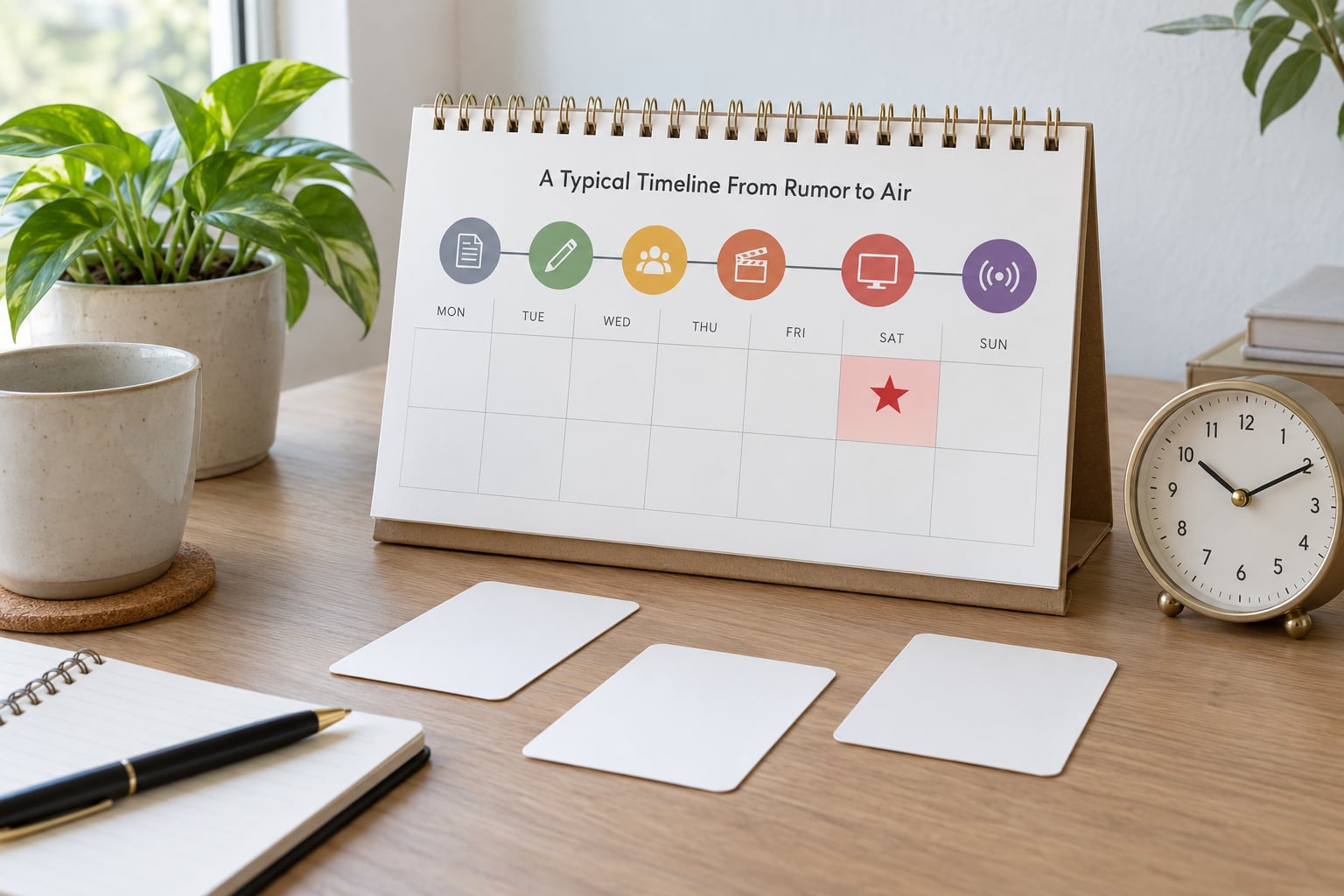
Here is the shape of a normal week for a taped episode, which is the clearest answer to how wrestling results leak before shows air.
| When | What is public | What is not |
|---|---|---|
| 10 days out | Announced main event, championship matches, headlining debuts | Finishes, exact segments, surprise returns |
| 5 days out | Reported card structure from a results report | Which announced match wins |
| 2 days out | Travel and availability confirmations | Any outcome |
| Taping night | Live results within hours; reposts and reactions | The polished episode itself |
| Next day | Full results, photo galleries, recap articles | Nothing new, except corrections |
| Air night | The episode | Surprise, for fans who avoided all of the above |
Live shows compress that table to almost nothing, which is why a Saturday night main event stays a surprise for people who simply do not open a spoiler thread that afternoon.
How to Separate Reliable Reports From Fake Results
Most bad spoilers are not deliberate hoaxes. They are confident people repeating a plausible guess, presented with the grammar of a report. A quick checklist separates the two.
- Find the original. Not the account that posted it, the one that posted the screenshot. Trace it to the outlet or person with a history of correct cards.
- Check the sourcing language. “Reportedly” and “sources say” mean a claim. A named reporter with a byline means something else.
- Look for specificity. Real reports name segments, order them chronologically and include unglamorous details. Fake ones usually deliver one enormous headline.
- Require corroboration. Two independent outlets matching card for card is a strong signal. Five accounts quoting one tweet is not.
- Look for a conflict of interest. Betting markets, fantasy wrestling rewards and prediction games all create reasons to fabricate results.
- Compare against the official promotion page. The promotion’s own listing settles whether a match is on the card. It never settles the winner.
Dramatic screenshots deserve particular suspicion. Cropped production documents with no date, no episode number and no source are cheap to produce, and they circulate because they travel better than a careful paragraph.
If you want to cut off the whole category instead of vetting it, the routine is short: mute or unfollow the reporting accounts before the taping window opens, keep search results and video autoplay off for a set of keywords, and decide in advance when you will read the results. Most people ruin a surprise by scrolling, not by seeking.
Why Promotions Sometimes Protect or Reveal Results
Suppressing leaks is real work. Promotions limit credentials, delay uploads to their own network, keep production notes off shared drives and brief talent on embargoes. Those measures work reasonably well for events and poorly for weekly television, where dozens of people leave the building every few hours.
There are legitimate reasons to release a result early. Blind or low-vision viewers have asked for accessible ways to follow a show, and reading a results summary ahead of time helps them. TV networks occasionally need an outcome early for a news package. Press obligations sometimes require a quote about a finish. And a promotion will sometimes spoil its own story on purpose, treating the reveal as a headline, as happened when WWE’s official account posted Brock Lesnar’s return moments before his music hit.
Then there is the motive that is purely commercial: testing whether a return generates conversation, keeping a reported story alive while the current episode sits in the can, or keeping a new signee’s name in the feed. Whether that is good faith or a bargain with the audience depends on who you ask.
Frequently Asked Questions
How do wrestling results usually leak before a show airs?
Because episodes are recorded days or weeks before broadcast, the performers and production staff already know every finish. A trusted reporter attends the taping and files the card match by match, outlets republish that report within minutes, and talent or crew post details on social media. The recording window creates the chance, and predetermined outcomes create the reason.
Are rumored match winners ever changed before the broadcast?
Yes, sometimes. A card report describes a plan, and plans move. Match finishes are often settled during the week through test matches, and a story beat on taping night can force a rewrite. A spoiler published a week out tells you what someone intended. A spoiler published hours before the premiere tells you what is actually happening.
Why do wrestlers post match spoilers on social media?
Most of the time it is not a calculated reveal. Someone posts a photo from the venue at two in the morning, a partner reacts to a result, or a wrestler jokes about a win without thinking about the show still being unaired. A few posts are deliberate, promoted by the company itself to sell a return or a debut. Both reach you in the same feed.
What is the most reliable sign that a reported wrestling result is genuine?
Trace the claim back to the outlet or reporter who originally broke it, then look for a second independent source that matches match by match. Real reports carry unglamorous detail and chronological order. They name the show and episode. Check whether the official promotion page agrees that the match is even on the card, and treat any screenshot with no date and no source as worthless.
Can a finished match at a live event still be edited for television?
A live show airs mostly as it happens, but segments can be held back, cut for time, or aired in a different order from the running order in the arena. That is why arena reports and television reports sometimes disagree about what came first. A taped show can be re-cut far more heavily, which is one reason broadcast results are the ones that matter.
What Readers Should Do First
If you want one habit, make it this: find the original source before you believe anything. Results leak before shows air through an ordinary chain of reporting, reposting and casual posts, and only the first link in that chain tells you how solid it is.
Then check the official promotion card for what is actually booked, look for a second independent report before you accept a winner, and treat any unverified result report as provisional until the episode airs. If you would rather not vet anything at all, mute the accounts and clear your search history before the taping window opens, then come back Sunday night.