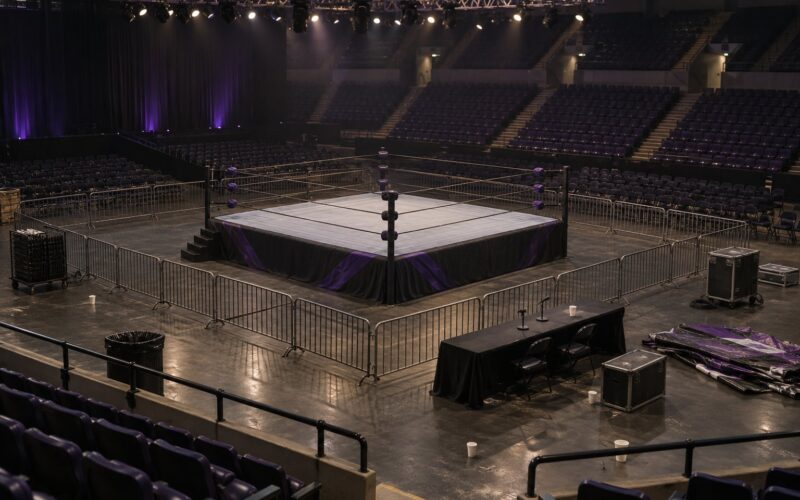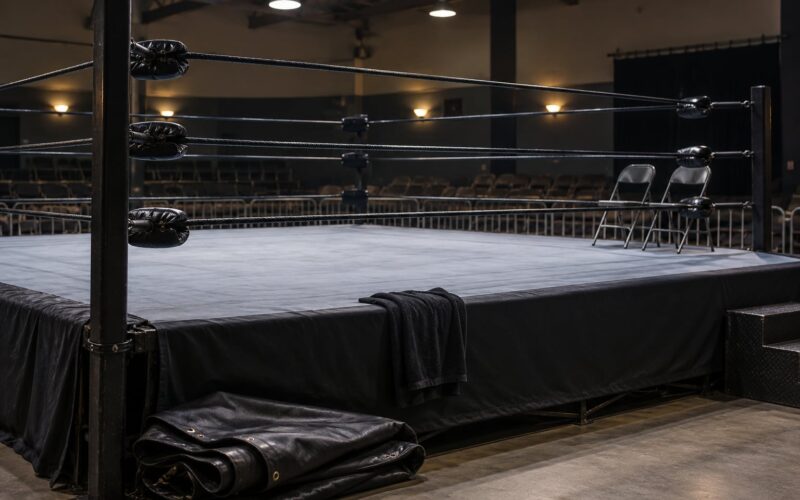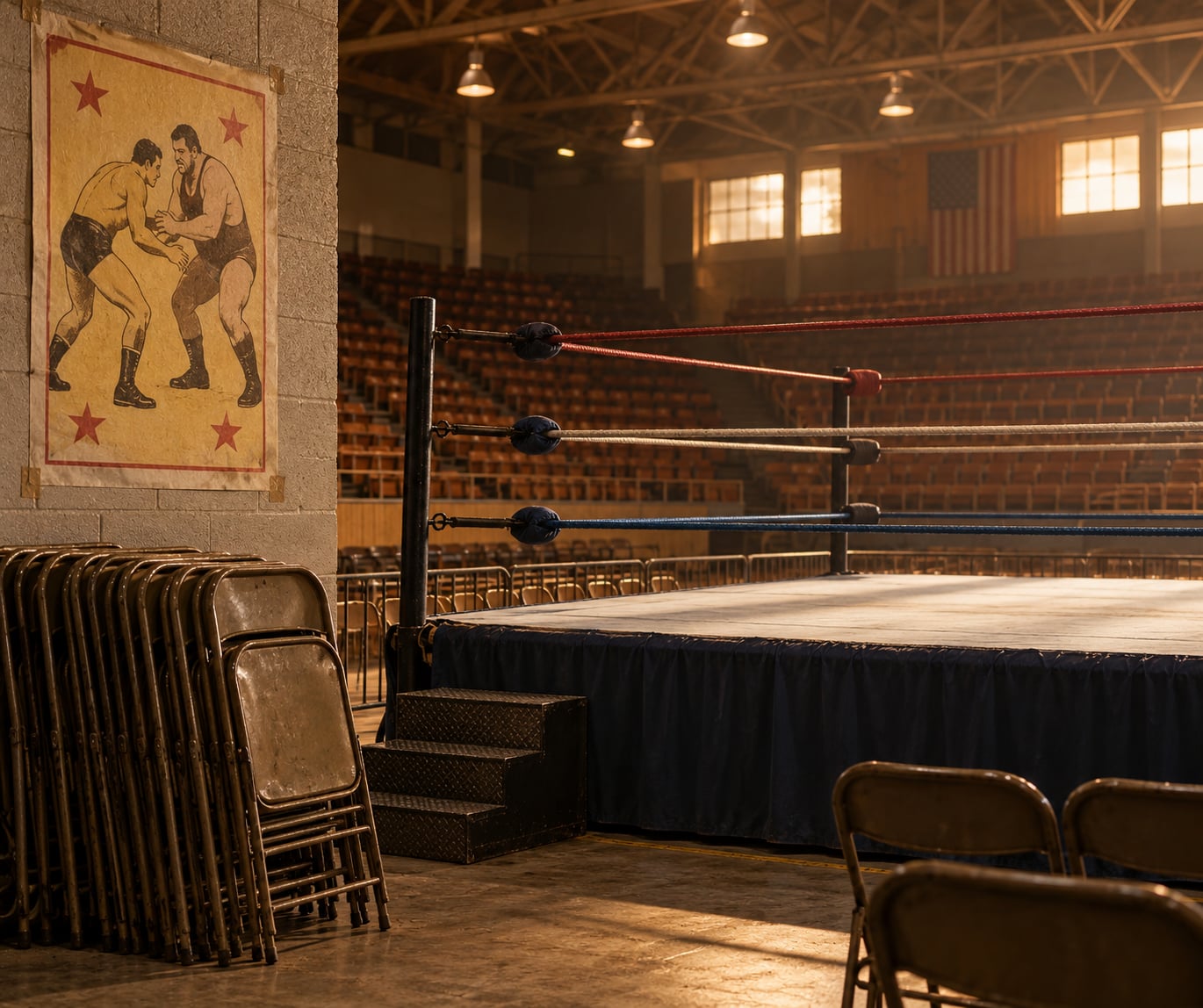
Before national television, professional wrestling in America ran the way professional sports leagues do now: a fixed map, a rule against poaching, and a traveling champion. From 1948 until the mid-1980s, regional promotions held exclusive ground under a loose governing body called the National Wrestling Alliance, which mapped the United States, shared talent, and kept a single world title circulating from arena to arena.
That is the short answer to how wrestling territories operated before national TV. Everything else — the weekly card, the local television show, the handshake contract, the promoter booking his own family on top — was a consequence of that arrangement.
Wrestling itself was already old business by 1948. What changed in that decade is the structure: promoters stopped chasing the same towns and started dividing them up, because a promoter who owned a market could sell sponsorships and airtime to local businesses instead of scrambling for a Saturday-night gate in a town someone else already owned.
Table of Contents
- What Was a Wrestling Territory?
- How Did Promoters Build a Weekly Wrestling Show?
- How wrestling territories operated before national TV, week by week
- How Did the Territory Business Model Work?
- How Did Promoters Find and Develop Talent?
- Why Were Feuds and Championships Central?
- How Did Wrestling Territories Operate on the Road?
- How Did National TV Change the Territorial Model?
- Why Did Wrestling Territories Fade Away?
- What Legacy Did the Territory Era Leave Behind?
- Frequently Asked Questions
- When did wrestling territories operate in the United States?
- Did territory wrestlers get real contracts?
- Who decided which promotions wrestlers worked for?
- How were local championships treated in the territory system?
- Are there still wrestling territories today?
- Conclusion
What Was a Wrestling Territory?
A wrestling territory was a geographic market — usually a state or a cluster of states — where one promotion held the practical monopoly on professional wrestling. It controlled the local wrestlers, the local championships, the venues it rented, and usually the local television slot, and it answered to nobody outside its own office except the NWA.
The system worked because of a rule almost nobody wrote down. Promoters agreed not to run in each other’s territory without permission, and in exchange they got to work their own territory free of interference. Sam Muchnick, who ran the St. Louis territory and served as NWA president, described his own territory as one he considered his property; other members accepted that framing.
It is worth being precise about what a territory was not. It was not an independent promotion in today’s sense. Indies operate in whoever’s city they want and sell streaming access to anyone. It was not a national company either, because no territory was large enough to fill arenas across the country on its own. And it was not a loose group of wrestlers working the same circuit for different paymasters. A territory had an owner, an office, a booker, a roster on salary or guarantee, a title lineage, and a specific place on the map.
Overlapping claims happened more often than the clean map suggests. A city like Louisville or Memphis could sit near a border where two promotions both felt entitled, which produced arguments in NWA board meetings and occasional illegal runs. The map held well most of the time, though, because everyone understood that the moment one promoter invaded another, the invaded promoter would simply leave the NWA.
How Did Promoters Build a Weekly Wrestling Show?
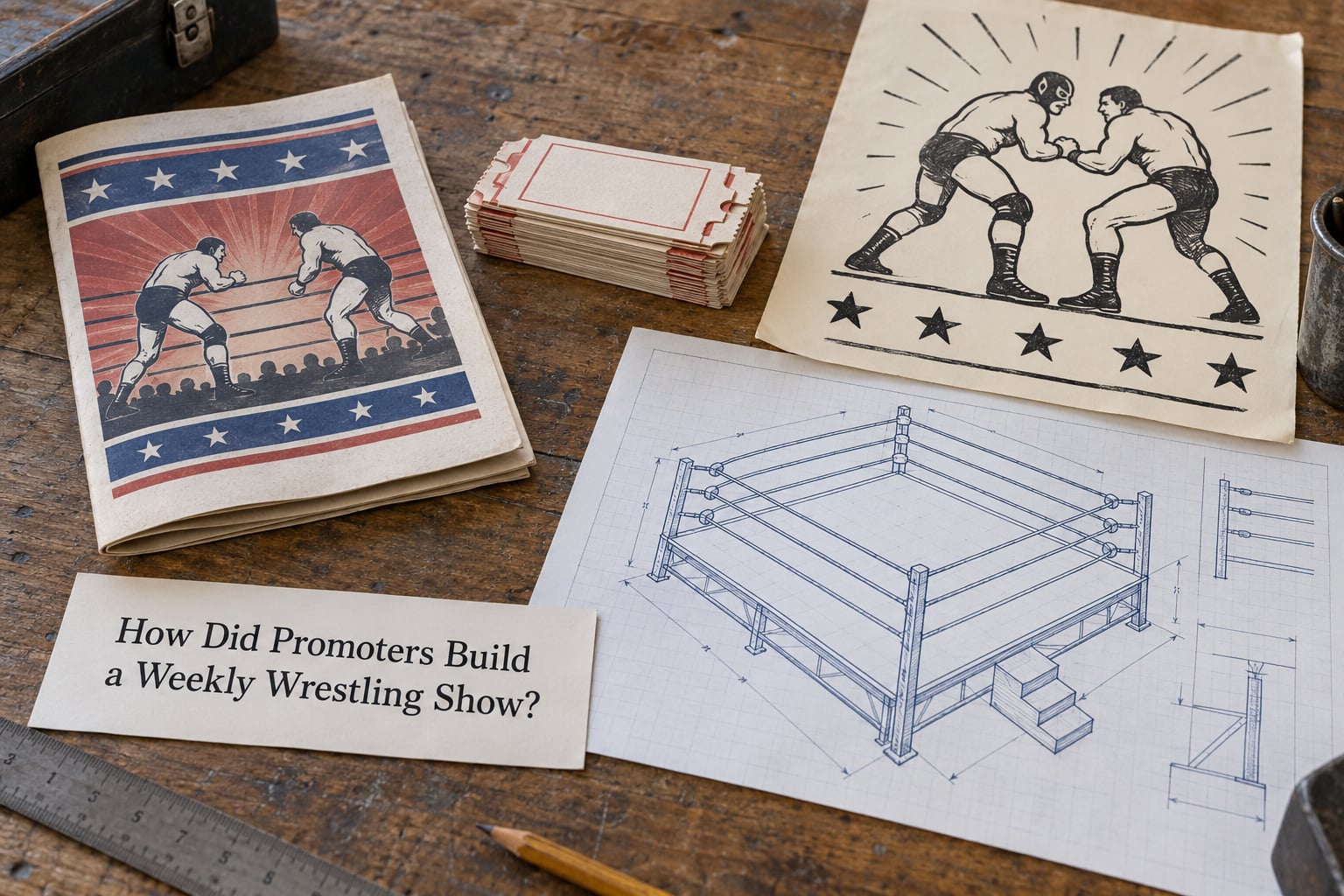
The weekly show was the product, and building it was a craft with a fixed order of operations. Promoters booked first on paper, then filled gaps, then adjusted to the house they had. Nothing was improvised on the night of a show except usually the finish.
The first decision was the venue. Armories, civic halls, gymnasiums and high school field houses got used because they were cheap and available on a Friday or Saturday. Fritz Von Erich’s territory ran out of the Dallas Sportatorium, and the Fort Worth Armory filled the same role nearby. Smaller towns got the armory or the municipal auditorium, where the promoter could control the building, the concession stand, and the parking situation as one deal.
Card construction followed a template that changed very little across thirty years. A headliner, usually the world champion or a top draw, closed the show. A singles match between two working heels or two babyfaces sat in the middle. A tag team match, a women’s match, and a program-ending feud finish filled the rest. Two-out-of-three-falls matches appeared when the crowd was hot enough, mostly in the South and in St. Louis.
Promotion started weeks ahead. A one-sheet went to local businesses to print, a program went to the printer, radio spots ran on local stations the week of the show, and tickets sold at the box office and from a promoter-owned table in a shopping mall. Many territory cards were listed as free admission with paid television, which sounds odd now but was standard practice for decades — the model was built for television, not the gate.
Rehearsals were short and practical. A promoter would book three weeks out, hold a ring rehearsal, and tell the finish as late as he could. Shows themselves ran two to three hours, with a ring crew of maybe four people, an announcer, and a promoter working the door. Weekly was the ideal, and many territories ran it. A few ran biweekly. Some, in thin markets, ran monthly or held a quarterly big show in a major arena and filled the rest of the year with small cards elsewhere.
How wrestling territories operated before national TV, week by week
Here is the rhythm a touring roster actually kept. Monday, travel and selling tickets for the coming show. Tuesday and Wednesday, house shows in smaller towns within driving distance of the main arena. Thursday, the weekly TV taping. Friday, the main show in the home city. Saturday, a big show or a rest, and Sunday, the drive to wherever the next week starts.
Working through that loop is what the term territory meant. The wrestlers lived inside a radius, and the promoter decided who moved and who stayed.
How Did the Territory Business Model Work?
The economics came from broadcasting, which is the part almost every account of the territory era leaves out. A local TV show let a promoter sell ad time to regional businesses — car dealerships, furniture stores, beer distributors — and that ad revenue, not the door, paid for the operation. The house show and the TV taping were two different businesses feeding the same card.
| Income or cost center | What it covered |
|---|---|
| Gate receipts | Often secondary; many cards were free-admission with paid television |
| Concessions | Venue deal, usually split or supplied by the promoter |
| Local TV ad revenue | The main engine; regional advertisers bought 30-second spots |
| Sponsorships | Direct deals with businesses, sometimes cash, sometimes car and gear |
| Merchandise | Programs, T-shirts, and later replicas of the local championship |
| World title talent | Guaranteed payouts for a traveling champion’s date, paid by the host promotion |
| Talent and staff | Weekly salaries for regulars, a booker, a crew, an announcer |
| Travel and hotels | Truck, fuel, driver, and lodging for a touring roster |
| Venue rental | Armory, civic hall, or arena rental, sometimes seasonal |
| Office and production | Film crew, editing, tapes shipped to other markets |
Guarantee money is where the traveling champions earned their reputation, and also where fights over money started. A big name drew a crowd large enough to justify real numbers, and a promotion that couldn’t pay the guarantee risked losing the draw it depended on. Wrestlers distrusted promoters over payoffs, and promoters distrusted each other over market encroachment — that tension sat underneath the whole arrangement.
One more cost worth naming: the promoter booking himself into his own main events. It reads like ego, and some of it was, but it also functioned as security under a handshake deal. A promoter who put his own family on top had a reason not to sign a rival’s headliner down the road.
How Did Promoters Find and Develop Talent?
Territories were talent factories disguised as local businesses. The main pipeline was long and unglamorous: a local wrestler works weekly for a small draw, improves in front of a live crowd, and gets noticed.
Tryouts were common and cheap. A promoter would hold an open tryout in a civic hall or armory, watch sixty people work, and hire two. Some promotions ran formal tryout camps. The Fritz Von Erich school in Texas is the most famous, and it operated as a standing invitation — bring your footage, get a ring, find out.
Imports filled the top of the card. A territory that could not book a visiting star in its own headline slot would buy or borrow one from a sister territory, which is why the NWA’s talent exchange mattered so much. Venues and dates were traded; the wrestler got paid by the promotion he worked that night.
Women’s wrestling ran as a program with its own bookings, sometimes as the headline, and in some territories it was the segment that reliably drew the biggest crowd. Specialty acts — high-wire and aerial performers, comedy units, the old-timer battles the old-timers insisted were real — filled out the card and gave the booking room to experiment.
Regular cards did the evaluating. A promoter could watch the same six or eight wrestlers every week and see who could work a crowd, who could take a loss and build from it, and who had gone off-script. There was no other evaluation process, which meant the booking office was the development system.
Why Were Feuds and Championships Central?
Feuds and titles existed to make a weekly show feel like a continuation. A fan who watched one card and came back for the next needed a reason, and a championship storyline was the easiest reason to build.
The formula is standard but the execution varied by territory. A babyface — the hero the crowd cheered — needed a heel to work against, and the heel needed heat. Once the pair sold tickets, the promoter could stretch it for months: wins and losses, cheating, outside interference, a masked match or a steel cage on the big anniversary show. Jim Crockett Promotions built a large part of its Mid-Atlantic identity on long programs that played out over months of Saturday nights in North Carolina and South Carolina.
Title lineages were the continuity device. The NWA World Heavyweight Championship traveled from market to market, and defending it in a host territory was how a local champion got established. Lou Thesz held it for long stretches during the system’s middle years, which gave the belt the stability that made it mean something.
Territorial championships were separate but parallel. Each promotion had its own state or regional belt, and those titles are still tracked today, which is one reason the era stays legible to modern fans. A title run also gave a wrestler a reason to stay in one place, and staying in one place was how you learn a crowd’s taste.
How Did Wrestling Territories Operate on the Road?
Touring was the part of the business that looked least glamorous and cost the most. A promotion’s crew loaded a truck in the morning, drove to a town, worked the gym or the civic hall, packed up, and moved to the next one. Promoters controlled the routing because a route that wasted gas wasted money.
Distances set the boundaries. A wrestler who could drive from the home city to a nearby town and back was booked there repeatedly. A town three hours away was a weekend trip with a hotel, and only a main event justified it. That geography is why territory maps looked the way they did — the lines followed drive times as much as population.
Bookings adjusted constantly on the road. A heel who got over in one town got repushed in another. A babyface who ran out of steam mid-tour got a storyline beat and a loss to reset. Promoters ran their towns differently on purpose, and a wrestler on a loan was expected to read the room fast, because a card in a town that hated heels needed a different main event than a card in a town that wanted to cheer.
Older wrestlers remember the practical details more than the glamour: the truck, the diners, the pay phone, a motel room shared with two other guys. A wrestler could be a household name in one city and completely unknown three states over. That was the trade, and the crowd next door never saw it.
How Did National TV Change the Territorial Model?
National television broke the territory system by making the map irrelevant. A promotion that could reach a million households at once did not need a hundred local markets, and a national promotion could take a town’s best date without asking anyone.
The sequence matters. Cable grew through the late 1970s and early 1980s. Georgia Championship Wrestling went national on cable in 1979 under Ted Turner, which exposed regional wrestling to an audience that compared it to everything else on the channel. The WWF, run by Vince McMahon Jr., bought syndicated time station by station in 1983 and 1984 and stopped pretending to be regional. WCW split off in 1991, closed in 2001, and the last major territories stopped trying to compete nationwide.
Television stations held the real leverage in the transition. Local bookers have said plainly that stations picked whichever promotion looked better on screen and could sell more advertising around, and that was the mechanism, not a national ratings war. A territory that looked cheap on tape simply lost the slot.
Independent promotions were not the first casualty. The casualty was the promoter, who owned a market he could no longer protect. Once a viewer in Boise could watch a Monday night program out of Connecticut, the argument that a Memphis card was the only wrestling worth watching stopped holding.
Why Did Wrestling Territories Fade Away?
Territories died of rising costs and falling leverage, and the two fed each other. Producing a weekly television show locally got expensive as equipment, travel, and salaries climbed. A national show spread those costs across a much larger audience, so a promotion had to be national to afford to be seen.
Scattered audiences did the rest of the work. A territory’s reach was one city’s worth of signal, and a national show reached a hundred. National schedules collided with local dates constantly, forcing promoters to choose which crowd mattered, and the crowd that mattered stopped coming to the armory.
Talent migration came next. Once a wrestler could be famous everywhere by working one promotion, the reason to accept a small regional draw evaporated. Top names refused to work towns, territories could not afford to replace them, and cards thinned out until local shows lost their reason to exist.
Consolidation finished the job. Major brands bought or absorbed the surviving promotion structures, and by 2001 the last national brand from the territory lineage had closed. A few territories held on as independents or in other countries — Mexico and Japan built parallel systems on the same logic — but the American model that started in 1948 was over.
What Legacy Did the Territory Era Leave Behind?
The business structures survive more than the promotions do. The promoter as owner, booker, talent scout, and local political operator is still the model most independent wrestling runs on, and a lot of its logic came straight from the territory system.
Title lineage is the clearest legacy. Promotions still track title history, still treat a lineage as an asset, and still build cards around protecting a belt. That instinct came from a time when a belt’s value was the crowd’s memory of the last eight men who held it.
Match psychology got its template in front of live weekly crowds. The heel turn, the losing babyface, the beat that resets a worker — all of it was designed for people who had seen you last week and would remember what you did. Modern wrestling still runs on that rhythm even with a much bigger audience.
Regional wrestling styles left fingerprints too. Promoters like Jim Crockett, the Von Erichs, Verne Gagne in the American Wrestling Association, and Frank Tunney in Toronto each built a distinct in-ring identity that later names picked up. The development pathway survived too: work weekly, get noticed, get a rub, move up. Independent wrestling is full of wrestlers who learned it in a territory loop before they ever made a national appearance.
And the fans who grew up in one market never forgot who made it. A promotion could be gone for thirty years and its audience would still argue about its matches.
Frequently Asked Questions
When did wrestling territories operate in the United States?
The territory system is usually dated from 1948, when the National Wrestling Alliance formed, to the mid-1980s, when the WWF went national. It did not end cleanly. The decline ran from the mid-1970s, when network television pulled back from local sports, through 1984, and effectively finished in 2001 when WCW closed.
Did territory wrestlers get real contracts?
Mostly not. Many were on handshake agreements or weekly guarantees rather than written contracts, which is part of why wrestlers distrusted promoters over payoffs. Top traveling champions and long-time regulars sometimes did have paper deals, and later-era independents moved toward real contracts as the business became more formal.
Who decided which promotions wrestlers worked for?
Promoters decided within their own territories, using a combination of booking judgment and gate drawing. Moving to a different territory required permission, arranged through the NWA board or the promoter whose market you wanted. The exceptions were outlaw promotions, which ignored the board and were blacklisted in return.
How were local championships treated in the territory system?
Each promotion ran its own regional and state titles, and those were recognized inside that territory and largely meaningless outside it. The NWA World Heavyweight Championship was the exception: it was recognized across the whole map, and defending it in a host territory was how a local babyface got made.
Are there still wrestling territories today?
Not in the 1948 sense. Promotions now share dates freely, and streaming has removed the need to protect a geographic market. But the structure survives in Mexico and Japan, where promotions still work fixed regions with long-running local titles, and in the United States regional independents often function like small territories when they book a local crowd and build a local champion.
Conclusion
Wrestling territories operated on a simple bargain: everyone kept to their own ground, everybody shared talent, and one belt traveled so that every local crowd had a reason to believe its own wrestler mattered. The weekly card, the local television deal, and the traveling champion were the three parts that held it together.
If you want to research the territory you grew up with, start with four things: which cities the promotion claimed, what its weekly card looked like, how it built a roster out of local hopefuls, and when it first started losing airtime to a national show. The last one is usually the moment the whole thing came apart.