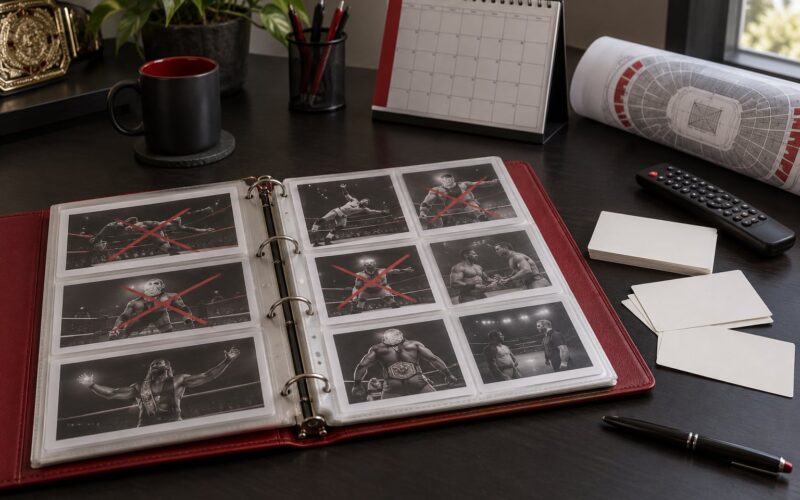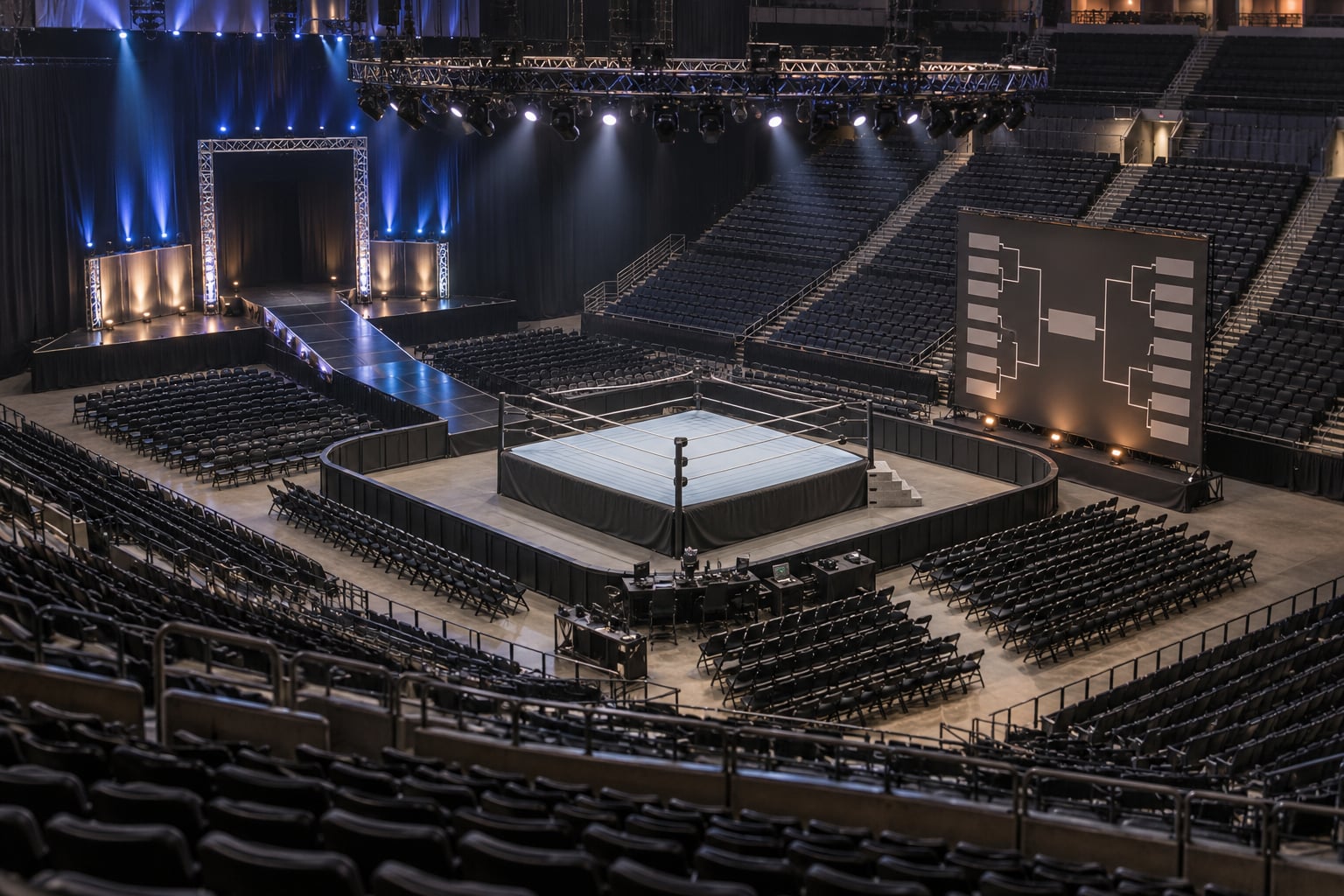
Wrestling companies run tournaments to give a card one clear goal: fill a vacated championship, force a whole division into a visible ranking, generate weeks of story, and give fans a reason to buy a ticket or a pay-per-view. A bracket concentrates competition that would otherwise be spread thin across unrelated matches.
A wrestling tournament is a planned, multi-match bracket or round-robin used to settle a championship, name a number one contender, or push a group of performers toward a common finish line. Promotions announce entries weeks ahead, run the matches across several broadcasts or inside one night, and let the outcome feed the next few months of story.
One thing worth saying up front: nothing about a tournament is unscripted. Promotions know who is winning before the bracket is announced. That does not make the format pointless — it just means the value comes from structure, stakes and match quality rather than from genuine competition. Fans who understand that tend to enjoy tournaments more, and the ones who do not tend to be the first to complain.
Table of Contents
- Why wrestling companies run tournaments
- The seven reasons wrestling companies run tournaments
- How tournaments create must-watch wrestling events
- The business reasons behind wrestling tournaments
- How tournaments help promotions build new stars
- Why tournaments create memorable matchups
- Tournament formats used by wrestling companies
- What makes a wrestling tournament work
- How long should a wrestling tournament run?
- The strategic difference between WWE, AEW, and indie tournaments
- Frequently Asked Questions
- Do wrestling tournaments actually increase viewership or pay-per-view buys?
- Is the Royal Rumble a tournament?
- Why do promotions hold tournaments when the winner is decided in advance?
- What is a number one contender’s tournament?
- What is the difference between a tournament and a triple threat match?
- How do independent promotions make a tournament worth attending?
- Conclusion: Start With the Tournament’s Purpose
Why wrestling companies run tournaments
The seven reasons wrestling companies run tournaments
- They fill a vacant championship. When a champion leaves or cannot wrestle, a tournament gives the company a public, rule-bound way to crown a replacement instead of handing the belt to one person by fiat.
- They sell tickets and pay-per-views. A named tournament is a headline an audience can anticipate, which is worth more to a promoter than another stack of singles matches with no through-line.
- They turn a regular show into a destination. A bracket makes an event feel like an occasion, so fans book travel and hotels around it instead of treating it as a stop on a weekly schedule.
- They repair a division with no hierarchy. When nobody in a division has a clear rank, a standings table fixes it in a few weeks without requiring the champion to lose on television.
- They launch or rebuild a brand. A new title, a new roster or a post-split roster can be introduced with a tournament that defines who matters in that brand from day one.
- They introduce and test new talent. A bracket gives a rookie a visible win to point to, and gives bookers several weeks of matches to judge how a newcomer handles a bigger spot.
- They are the easiest thing on a card to market. Names can enter, names can be eliminated, and every week produces a reason to post something.
Those reasons stack. A tournament for a new title also fills a division, launches a brand and sells an event, which is why promotions lean on them so heavily when they are rebuilding something.
It also helps to define one term properly, because fans often mix it up with a different booking device. A number one contender’s tournament does not award a championship. It decides who gets the next shot at one. The champion is not part of the bracket, the matches establish an order, and the winner lines up for a title match down the road. That distinction is what separates a tournament from a rubber match, a triple threat or a four-way.
How tournaments create must-watch wrestling events
The power of a bracket comes from constraint. A normal card is a list of matches with no relationship to each other, so the crowd has no reason to care about match four. A bracket gives every match a job: eliminate somebody, advance somebody, or set up the next pairing.
Three things happen when that structure is in place. First, the finish line becomes visible. Fans are not waiting to find out who the main event is, they are counting eliminations. Second, stakes rise for everyone involved, because a loss now ends something rather than just closing a segment. Third, and this is the part people forget, tournaments protect surprise: the outcome is decided in advance, but the path to it is not, so an injury, an unexpected showing or a sudden conclusion still creates a moment.
That is exactly why forum posters tend to praise tournaments when they are booked well. A public bracket forces a promotion to be honest about its own rankings, and fans respect that more than a change of champion that comes out of nowhere. Wrestling writers have made the same point about the format for years: a good tournament adds a layer of credibility to the promotion and to the craft, and a badly booked one takes all of it away.
A tournament can also create the one thing a weekly card cannot: a reason to stay until the end. Elimination matches are structurally tense. Nobody is watching to see whether the booking is good, they are watching to see whether their favorite is still in it.
The business reasons behind wrestling tournaments
The clearest money argument is the one most fan conversations skip. WWE’s parent, TKO Group Holdings, reports its revenue in four segments: live events, media rights, sponsorship, and merchandise. A tournament touches all four in the same week.
Live events benefit because a bracket is an easy reason to buy a ticket. If a promotion has four names it wants in one arena, a tournament is the cheapest way to guarantee all four are advertised together, and to give local promoters a story they can sell without a star appearing in person. Media rights benefit because a bracket generates a run of episode-level stakes, which tends to hold casual viewers through a broadcast. Sponsorship benefits because a named tournament is easy to attach to a partner’s branding for the length of the arc. Merchandise benefits because shirts and entrance gear can be sold on a promise before anyone has won.
The honest caveat is data. WWE does not release buys for individual events, so any article claiming a specific tournament moved a specific number of buyers is guessing. What you can watch instead is ratings trend lines for the weeks the tournament runs, announced attendance for the events, and TKO’s segment results in its annual filings. Those tell you the direction. They do not tell you the cause.
For independent promotions the arithmetic is different but the logic is the same. An indie show has no media rights revenue and often no sponsorship desk, so a tournament is a way to fill a building. Put four or five credible names on one card who normally work separate promotions, sell it as a mini-event, and suddenly the room is worth more than the sum of three separate shows would have been.
How tournaments help promotions build new stars
A rookie’s problem in pro wrestling is not talent, it is proof. Nobody can see how good someone is until they are put in front of an audience with something at stake. A tournament supplies that proof cheaply.
Four things happen for a newcomer inside a bracket. They get matches they would not normally be given, because the format requires them. They get a result that matters, so the crowd reacts to them rather than talking over them. They get a story to carry into the next round, which is usually better material than the same two people feuding. And bookers get a longer read, because a tournament is a trial run spread over weeks rather than a single impression.
That trial-run function gets used for returning talent too. A wrestler coming back after years away can be tested in early rounds against lower-stakes opponents and given a meaningful win at the right moment, without the promotion betting its main event on them immediately. NXT has long been the developmental showcase in WWE’s structure, and tournaments are one of the cleanest ways a promotion introduces fresh names into that pipeline in front of the main audience.
The risk is the opposite of the reward. If the crowd can tell from the first round that a debut was written to lose, the exposure can set a wrestler back instead of ahead. The bracket is only a launchpad if the booking inside it earns something.
Why tournaments create memorable matchups
Matchmaking is the daily tax of wrestling. The same performers meet too often, rematches pile up, and a card drifts toward the same handful of pairings that everyone has already seen five times. A bracket forces variety, because each round eliminates options.
That variety does real work. It pairs opponents from different factions who would rarely be scheduled. It produces first-time matches in a division that has been stuck on the same four names for a year. And it gives bookers a natural place to stage a rivalry, because a tournament final between two people who spent weeks knocking each other out of contention carries history that a random match does not.
Fans call repeat matches inside a short span “rubbers,” and they are right to grumble. Rubbers are what happens when a promotion has fewer names than it has dates. A tournament is the opposite of a rubber: it is a structure built on the assumption that somebody is about to be left without a match, which forces the creative team to look wider. Independent promotions feel this most acutely, since a name-heavy tournament is often the only practical way to justify booking six credible wrestlers on one small show.
Not every match inside a bracket is a classic, of course. Formats stretch a roster thin, and a promotion with a thin roster will produce a rubber inside the tournament too. But the default effect of a bracket is more variety, not less.
Tournament formats used by wrestling companies
Format choice is really a choice about how many matches a promotion is willing to spend and how long it wants the arc to run. Here are the formats you will actually see on television.
| Format | How it works | Where you see it | Advantage | Drawback |
|---|---|---|---|---|
| Single-elimination bracket | Losers are out after one defeat | Money in the Bank, King of the Ring | Fast, obvious stakes, easy to follow | Runs out of opponents quickly |
| Battle royal | Entrants arrive in waves and are thrown over the top rope | Royal Rumble | Instant spectacle, one match covers many names | Little ring time per performer |
| Round-robin block | Everyone wrestles everyone, points awarded on results | New Japan Pro-Wrestling’s G1 Climax and related tournaments | Merit decides the ranking, so a loss stings | Needs a big roster and weeks of dates |
| Gauntlet | One wrestler faces a line of opponents in a single match | Traditional championship matches, classic event finales | Distributes punishment and tells a story | Losers get almost no time |
| Fatal four-way | Four wrestlers, one fall to decide it | Occasional championship and no-disqualification specials | Maximum star power in one match | Three wrestlers usually come away shortchanged |
| Interbrand bracket | Performers from separate brands compete for one prize | Post-brand-split tournaments | Gives a reason for brands to share a card | Can dilute the identity of each brand |
The distinction fans ask about most is single-elimination versus round-robin. A single-elimination bracket says the winner of the final is the best performer that day, full stop. A round-robin block points the table after everyone has wrestled each other, and the wrestler with the best record at the top wins the tournament. That is why Japanese promotions use it: it produces a title shot on merit rather than on a single lucky or unlucky night.
The Royal Rumble is technically a battle royal rather than a bracket, which trips people up, but the strategic reason is the same. The Money in the Bank briefcase is the most portable tool in WWE’s toolkit: any champion can cash it in at a convenient moment, which lets the company control when a title changes hands without running a bracket.
What makes a wrestling tournament work
There are five ingredients, and a tournament missing one of them usually feels like homework.
A clear prize. Fans should know within one sentence what the winner gets. A title, a briefcase, a contendership at a specific date, a fixed cash prize for an indie show.
Visible stakes. Elimination has to cost something. If a loss changes nothing, the matches are warm-ups.
Fair qualification. The entries should look chosen on merit or on story reason, not thrown together to hit a number. Fans forgive a predetermined outcome; they do not forgive an unexplained one.
Varied matchups. If round one already pairs the same two people the promotion featured last month, the bracket has told the audience it ran out of ideas.
Consequences in the final. The winner’s tournament should change the shape of the next few months. A new champion, a new rival, a new set of challengers. Without that, the whole thing was a detour.
What breaks a tournament is the mirror image of that list. Long arcs with no payoff, winners whose victory opens no new story, brackets announced too late for fans to invest, and multi-bracket sprawl where every match starts to feel equally unimportant. The audience disengages the moment the outcome is obvious, because a tournament with a known finish is just a very long handshake.
How long should a wrestling tournament run?
Length is a trade between attention and wrestler availability, and the three common arcs each solve a different problem.
One night. A bracket run inside a single show compresses everything into a few hours. It is punchy and easy to sell, but nobody gets a story, and there is no built-in reason to come back for the second week. Promotions use it for special events where the whole card already justifies the trip.
Multi-week. The most common structure. A round or two of television, then a final at a bigger show. This is the sweet spot because it creates a reason to watch each week and still pays off somewhere fans have already planned to attend.
Season-long. A round-robin block spread across a summer of dates, the way New Japan Pro-Wrestling runs the G1 Climax and the related block tournaments. It is the format that most rewards sustained work, and it demands a deep roster and a wrestler willing to wrestle often. Impact Wrestling’s X-Cup is the smaller-scale version of the same idea.
Runs that exceed a season tend to lose momentum, mostly because injuries pile up and finishes get delayed. Fans also disengage when the same bracket drags past the point where the payoff still feels affordable to book. When a promotion keeps announcing tournament rounds a year after the bracket started, that is usually a symptom of a booking problem the tournament cannot fix.
The strategic difference between WWE, AEW, and indie tournaments
Different companies use the same tool for different goals, and the difference comes down to how much roster depth and how much television time each one controls.
WWE treats tournaments as annual occasions. The Royal Rumble, King of the Ring and Money in the Bank are recurring fixtures that fans mark their calendars for, which is the most valuable kind of tournament there is. They get announced far in advance and are sold as tradition. When WWE needs to crown a belt quickly, it reaches for a tournament too, usually to legitimize a change it has already decided.
AEW builds events around the bracket itself. The Continental Classic, Double or Nothing and All-American shows treat the tournament as the event rather than as a segment inside an event, which concentrates fan travel and gives a card one obvious purpose. Fan discussion has repeatedly asked for more of this approach, including Rumble-style and Money in the Bank-style events built to headline a top star, so the appetite for it is clearly there.
New Japan Pro-Wrestling treats tournaments as work. Round-robin blocks reward volume and condition, and a bad day in the standings matters as much as the final. That is a completely different strategic bet from a one-night bracket, and it explains why the same promotion can sell a summer tournament with no championship on the line at all.
Independent promotions use tournaments as showcases. A small show has no deep roster, so the bracket is borrowed depth: names invited from other promotions compete, the winner gets a visible win, and the room gets a draw worth the ticket. The prize is usually a title or a cash purse, and the tournament is announced weeks ahead because the community needs time to get interested.
The broad lesson is that the format matters less than the goal. A promotion with a thin roster wants volume and a showcase. A promotion with a mature roster wants a ranking it can defend for six months. Choosing the wrong tool is why some tournaments feel like an event and others feel like paperwork.
Frequently Asked Questions
Do wrestling tournaments actually increase viewership or pay-per-view buys?
Nobody can prove it, because WWE’s parent company does not publish buys for individual events. Promotions will tell you a tournament lifted interest, and the surrounding ratings trend usually supports that claim. But correlation is not proof, since a hot storyline can drive both. The signals worth watching are week-over-week ratings during the bracket, announced attendance for the events, and the live events and media rights segments in TKO’s annual filings.
Is the Royal Rumble a tournament?
It is usually called a tournament, but it is technically a battle royal: wrestlers enter in numbered waves and are eliminated by being thrown over the top rope. There is no bracket and no seeding, so the structure is looser than a single-elimination event such as Money in the Bank. Strategically it does the same job, though, giving a promotion a way to feature a large number of performers in a single match.
Why do promotions hold tournaments when the winner is decided in advance?
Because predetermined outcomes are true of every match, not just tournaments. The format is not sold as a sporting competition, it is sold as structure and stakes. A bracket gives the audience a clear goal, a visible elimination risk and a reason to keep watching week to week. Done well, it also makes a change of champion feel earned rather than arbitrary, which is a bigger deal to fans than any surprise result.
What is a number one contender’s tournament?
It is a tournament that does not award a championship. The current champion stays out of the bracket while the rest of the division wrestles each other over several weeks, and the winner is named the official number one contender. The title match usually happens at a set date, which lets a promotion announce a main event months ahead. It is the standard fix when a division has no clear ordering.
What is the difference between a tournament and a triple threat match?
A triple threat is a single match with three wrestlers competing for one decision, usually the championship. A tournament is a multi-match structure that produces a result through elimination or standings over several bouts. The distinction matters because a tournament can involve many wrestlers, can run across weeks, and creates consequences beyond the one result, while a triple threat is one match with a winner and two losers.
How do independent promotions make a tournament worth attending?
Borrow depth. Invite credible names from other promotions so the card looks bigger than the promotion’s own roster, announce entries early enough for fans to plan, and give the winner something concrete such as a title or a purse. Keep the bracket short, usually one night or two weeks, and make sure at least one pairing is a first-time match. A small show wins on variety of opponents, not on length.
Conclusion: Start With the Tournament’s Purpose
Wrestling companies run tournaments to fill a vacancy, create a destination worth buying, repair a division without a hierarchy, and give talent something to prove. Every one of those goals is served by the same structure, which is why the format keeps coming back.
So decide what you are actually evaluating before you judge a bracket. If the promotion needed audience excitement, ask whether the eliminations and the final felt consequential. If it needed star development, ask whether the newcomer had matches worth watching and a win that changed something. If it needed ticket sales, ask whether the announced field justified the travel. If it needed a decisive match, ask whether the winner’s tournament altered the division afterward. Tournaments that answer their own purpose rarely disappoint, and the ones that do usually were booked to solve a problem the format could not fix.