How G1 Climax scoring works in one line: a win is worth two points, a time limit draw is worth one point to each wrestler, and a loss is worth nothing. New Japan Pro Wrestling splits twenty wrestlers into two blocks of ten, and the top two in each block by points go through to a four-man single-elimination bracket.
That is genuinely all the arithmetic there is. The confusion almost everyone hits comes later, usually when a wrestler with more points than someone else does not advance and the numbers stop being the whole story.
A first-timer on r/njpw put it plainly: the point system was the thing that made the tournament hard to follow at first. So here is the whole system, the tiebreakers nobody writes down, and how to read a standings table without getting lost.
Table of Contents
- What Is G1 Climax Scoring?
- How Do G1 Climax Match Points Work?
- What is the highest possible score in a G1 Climax block?
- How Are G1 Climax Standings Calculated?
- What Happens If Wrestlers Tie in the Standings?
- How Does Scoring Differ Between Round-Robin and Knockout Formats?
- Why Do Time-Limit Decisions Matter?
- Frequently Asked Questions
- What does G1 Climax mean?
- How does the G1 Climax tournament work?
- Can a wrestling match end in a tie?
- What are the tie-breaker criteria in wrestling tournaments like the G1?
- How long does the G1 Climax last?
- Is a takedown 2 or 3 points? Does amateur scoring apply to the G1?
What Is G1 Climax Scoring?
G1 Climax scoring is the system New Japan Pro Wrestling uses to rank wrestlers inside each block of its annual round-robin tournament. Its only job is to compress nine results into a single sortable number so the standings can be published after every show.
The tournament has run every summer since 1990. Twenty wrestlers are split into two blocks, ten in each. Every wrestler faces the other nine in their block once, so each person competes nine times over roughly three weeks of shows.
Points decide qualification, not the champion. The top two finishers from A Block and the top two from B Block advance to the semifinals, and the winner of that bracket gets the right to challenge for the IWGP World Heavyweight Championship at Wrestle Kingdom. Nothing else about the format is a mystery once you know that framing.
One useful piece of context for older fans: earlier eras used six-man blocks worth a single point per win. That is why old results pages look nothing like today’s ones, and why a 10-point season from the 2000s is not the same achievement as 10 points now.
How Do G1 Climax Match Points Work?
There are only three outcomes to price, and the table below is the complete scale:
| Result | Points | What it means |
|---|---|---|
| Win | 2 | A pin, submission or count-out. The only way to build a lead. |
| Draw | 1 | Reaches the 30-minute time limit. One point each. |
| Loss | 0 | No points, but it still counts against your record. |
There is no points differential in this system. Nobody gets extra credit for a decisive win over a strong opponent, and nobody loses points for a narrow defeat. Total points, then record, then the tiebreakers below.
What is the highest possible score in a G1 Climax block?
Eighteen. Nine wins multiplied by two points each, and that only arrives if someone finishes the block undefeated. In practice you will almost never see it, because a wrestler leading a block is guaranteed to keep facing wrestlers who need that win as much as they do.
The opposite end is zero, which is mathematically possible and practically meaningless. Nobody with a single win in hand is still in a trophy race by the final week.
Rare results do happen. Double count-outs and matches ruled no contest come up a handful of times across the tournament’s history, and the authoritative call on any points adjustment is always the official tournament page NJPW publishes, not a recap written the same night.
How Are G1 Climax Standings Calculated?
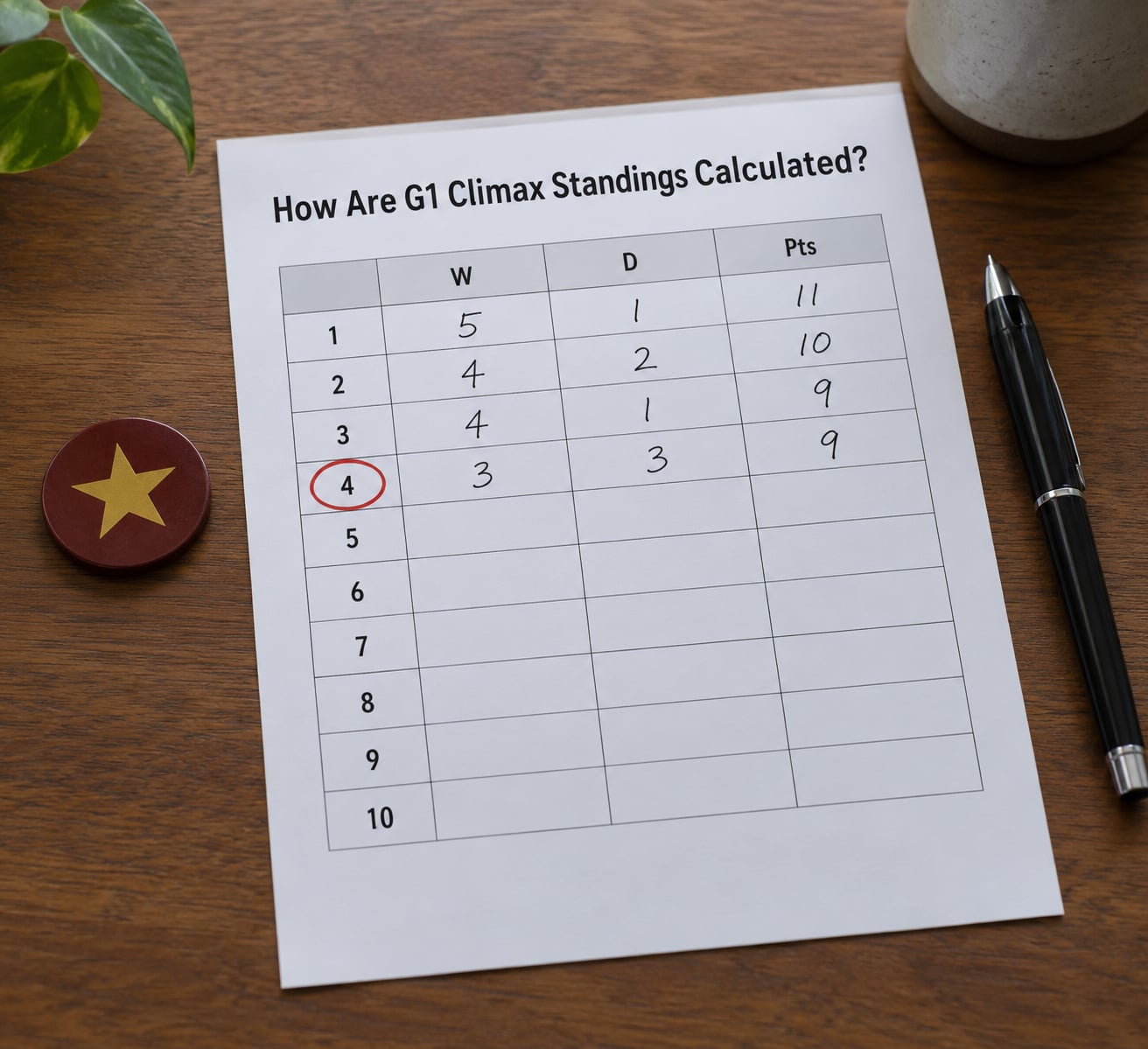
Your total is wins multiplied by two, plus draws. Losses are worth nothing, so a 6-3 record and a 6-2-1 record both land on 12 points, which is exactly why the record column sits next to the points column on every standings table.
Here is a made-up block, but a realistic one, showing how ten results turn into a table:
| Wrestler | Record | Wins | Draws | Points |
|---|---|---|---|---|
| First | 7-2 | 7 | 0 | 14 |
| Second | 6-3 | 6 | 0 | 12 |
| Third | 6-3 | 6 | 0 | 12 |
| Fourth | 5-4 | 5 | 0 | 10 |
| Fifth | 4-3-2 | 4 | 2 | 10 |
| Sixth | 3-6 | 3 | 0 | 6 |
Second and Third above are the case that drives people mad, and it is handled in the next section. Note also Fifth: four wins and two draws is ten points, identical to Fourth, and the record breaks that one before any tiebreaker is even considered.
Reading live coverage gets easier once you know the convention. Match reports list running totals in brackets beside each name, so a header reading one wrestler at four points against another at two is telling you their totals going into the match, not a match score.
On elimination: a wrestler sitting on six points has won three of nine and is usually gone with a week to go, even though more matches remain and the maths technically keeps them alive. Twelve points is usually enough to stay in genuine contention, and sixteen or more is close to unassailable. Those are working thresholds rather than official cut-offs, because the real bar shifts with how the rest of the block is distributed.
What Happens If Wrestlers Tie in the Standings?
Head-to-head record breaks the tie. The wrestler who beat the other one takes the higher position, and that is the whole rule in most cases. This is the single most misunderstood part of the format.
In the worked table above, Second beat Third during the block. Both finished on 12 points, so Second advances and Third does not, even though the two records on paper are identical.
When head-to-head cannot separate them, which happens when two tied wrestlers drew each other, the order generally moves to the wider record first, then the total number of wins, and then draws. Where a tie reaches that far, NJPW has previously used additional criteria and, in some years, a run-off match between the wrestlers involved.
The reasoning is that the tiebreakers are not a secret judgement call. They follow the rules the promotion publishes, applied in order. Fans get frustrated when they see only the final table because the chain between the tied total and the final order never gets shown.
Discussion threads from G1 Climax 30 in r/njpw and r/SquaredCircle asked exactly this: four wrestlers, one points total, one wrestler through. It turned on the same head-to-head rule described above.
How Does Scoring Differ Between Round-Robin and Knockout Formats?
Points exist only in the round-robin phase. The nine block matches are the only place points are awarded, and the only thing points decide is who reaches the semifinals.
From the semifinals onward, the tournament is single elimination. A loss in the semifinals does not cost points, does not alter a block record, and cannot be recovered from. The final settles the tournament outright, usually on a standalone show rather than as part of a regular card.
That is why a wrestler can finish the block on a brilliant 14 points and still go home. Qualification is decided by points and tiebreakers. Everything after that is decided by whoever is left standing.
Why Do Time-Limit Decisions Matter?
Most NJPW tournament matches have a 30-minute time limit. When it expires, the result is a draw and one point goes to each wrestler, so a draw equals exactly half a win.
That single relationship changes how the last night of a block feels. Two draws are worth the same as one win, so a wrestler protecting a one-point lead is still in a race, while a wrestler two points clear can afford to be cautious. With draws this valuable, matches that look even often end with someone going for the win late rather than playing safely for a draw.
It also means a wrestler can finish a block on fewer wins than a rival and still be level on points. Four wins and two draws, as in the table above, is the standard example.
Frequently Asked Questions
What does G1 Climax mean?
The G1 Climax is New Japan Pro Wrestling’s annual tournament, run every summer since 1990. Twenty wrestlers are split into two blocks of ten, and each wrestler faces the other nine in their block once. The top two from each block advance to a single-elimination semifinal and final. The winner earns a shot at the IWGP World Heavyweight Championship at Wrestle Kingdom.
How does the G1 Climax tournament work?
A win is worth two points, a time limit draw is worth one point each, and a loss is worth nothing. After nine matches the top two wrestlers in each block by points advance to the semifinals. Points are never awarded after that stage, where the bracket is single elimination and the final decides the tournament outright.
Can a wrestling match end in a tie?
Yes. Tournament matches have a 30-minute time limit, and if the bell rings with neither wrestler decisively ahead the result is a draw. Both competitors receive one point. Because a draw equals half a win, draws matter far more in a G1 block than the word suggests, and two draws are worth the same total as a single victory.
What are the tie-breaker criteria in wrestling tournaments like the G1?
The first criterion is head-to-head record: if two wrestlers finish a block on the same points, whoever beat the other one ranks higher. If they drew their mutual match, the tie moves to the wider record, then total wins, then draws. In some years NJPW has gone further and used a run-off match to settle a tie that survived every criterion.
How long does the G1 Climax last?
Roughly three weeks of shows. With twenty wrestlers competing nine matches each in two blocks, the tournament runs from its opening show through to the block finals, followed by the semifinals and the tournament final. In recent editions the opening show has been held outside Japan before the rest of the schedule is staged in Japan.
Is a takedown 2 or 3 points? Does amateur scoring apply to the G1?
No. Takedown scoring of two or three points belongs to amateur freestyle wrestling, where points are awarded live for control and takedowns. Nothing like that exists in the G1 Climax. There, only the final result counts: two points for a win, one for a draw, nothing for a loss, with no points for how the match is won.
Start with the record column, not the points column. Points tell you roughly where a wrestler stands, the record explains why two equal totals are not really equal, and the head-to-head result between any tied pair tells you who actually moves on. Once those three are in your head, the standings stop being a puzzle.