Wrestling storylines get dropped suddenly for ordinary business reasons far more often than for storytelling ones. A performer gets hurt or released, a new booker takes over, a brand gets split or merged, or an episode simply runs out of minutes. Then the angle is never mentioned on television again, with no explanation and no payoff.
That gap between what was promised and what aired is the single most common complaint about modern pro wrestling, and fans on r/Wreddit and r/Wrasslin have argued about it for years without getting a satisfying answer. Here is how it actually works.
Table of Contents
- What Does It Mean When a Wrestling Storyline Gets Dropped?
- Dropped storyline
- Delayed storyline
- Retconned storyline
- Why Does Wrestling Creative Change Plans?
- How Ratings and Audience Reaction Influence Storyline Decisions
- Why Wrestling Storylines Get Dropped Suddenly
- How Roster Moves and Injuries Create Abandoned Feuds
- Why Storyline Continuity Is Not Always Possible in Wrestling
- What Are the Signs a Storyline Has Really Been Dropped?
- Why Wrestling Storylines Get Dropped Suddenly: What Fans Can Do
- Frequently Asked Questions
- Are WWE injuries scripted?
- Why does WWE drop storylines with no explanation?
- Why do AEW storylines get dropped too?
- Does a delayed payoff mean the storyline was cancelled?
- Is wrestling storytelling getting worse?
- Conclusion
What Does It Mean When a Wrestling Storyline Gets Dropped?
A dropped storyline is a feud, mystery or character arc that a promotion builds across several episodes and then stops advancing, with no payoff and often no on-screen acknowledgement that it ever happened.
Not every abandoned thread is the same thing, and telling them apart is most of the skill in following wrestling week to week.
Dropped storyline
The angle is finished and cancelled. The mystery attacker is never named, the heel turn never lands, the redemption arc never completes. Sometimes a wrestler leaves the company, which makes a drop obvious. Often there is no explanation at all.
Delayed storyline
The plan still exists but the payoff is pushed back. Feuds get paused for a pay-per-view, a draft, a brand move or a wrestler’s schedule. The difference is that a delayed angle tends to be referenced again later, sometimes months later.
Retconned storyline
The story did not vanish, it was rewritten. A reveal is changed, a betrayal is reversed, or a feud quietly becomes a friendly storyline instead. The audience is told it was part of the plan all along.
The Daniel Bryan retirement announcement from 2016 is the clearest example of the first category: months of vignettes, a ring announcement, and then nothing, with the reason never stated on television. Compare that with storylines that were delayed and eventually paid off years later, which fans on r/SquaredCircle frequently recall when they discuss unfinished arcs.
Why Does Wrestling Creative Change Plans?
Booking is a live production. A main event on Raw or SmackDown is written in the afternoon and aired that night, while a pay-per-view is planned weeks ahead with far more certainty. Anything can change in between.
The most common causes of a mid-course change are a new head of creative arriving with their own direction, a wrestler leaving the roster, a sponsor or network request for a specific segment, and a bigger match or angle being written to fill a bigger slot. When a priority angle gets more airtime, the one underneath it loses its week and often never gets it back.
None of that is malicious. It is a scheduling consequence, and the reason an abandoned angle almost never gets an on-screen explanation is simple: explaining it would take minutes away from the thing being pushed instead.
How Ratings and Audience Reaction Influence Storyline Decisions
Ratings do not decide a storyline on their own, but the reaction to it feeds straight back into the room. If a push is met with visible disengagement, creative usually keeps the wrestler on television but pulls the story, because keeping the performer is cheaper than admitting the angle failed.
That is what a heat that will not convert looks like from the outside. The wrestler keeps appearing, wins or loses matches that mean nothing, and the story that was supposed to explain any of it never arrives.
The opposite happens too. When audience reaction is strongly positive, the payoff often gets accelerated rather than cut, which can feel equally strange: three weeks of setup compressed into one segment, with the consequences never explained afterward.
Social media has made this loop faster. A widely criticised segment now produces feedback within hours rather than over a season, so a creative team can see a reaction before the angle has finished airing.
Why Wrestling Storylines Get Dropped Suddenly
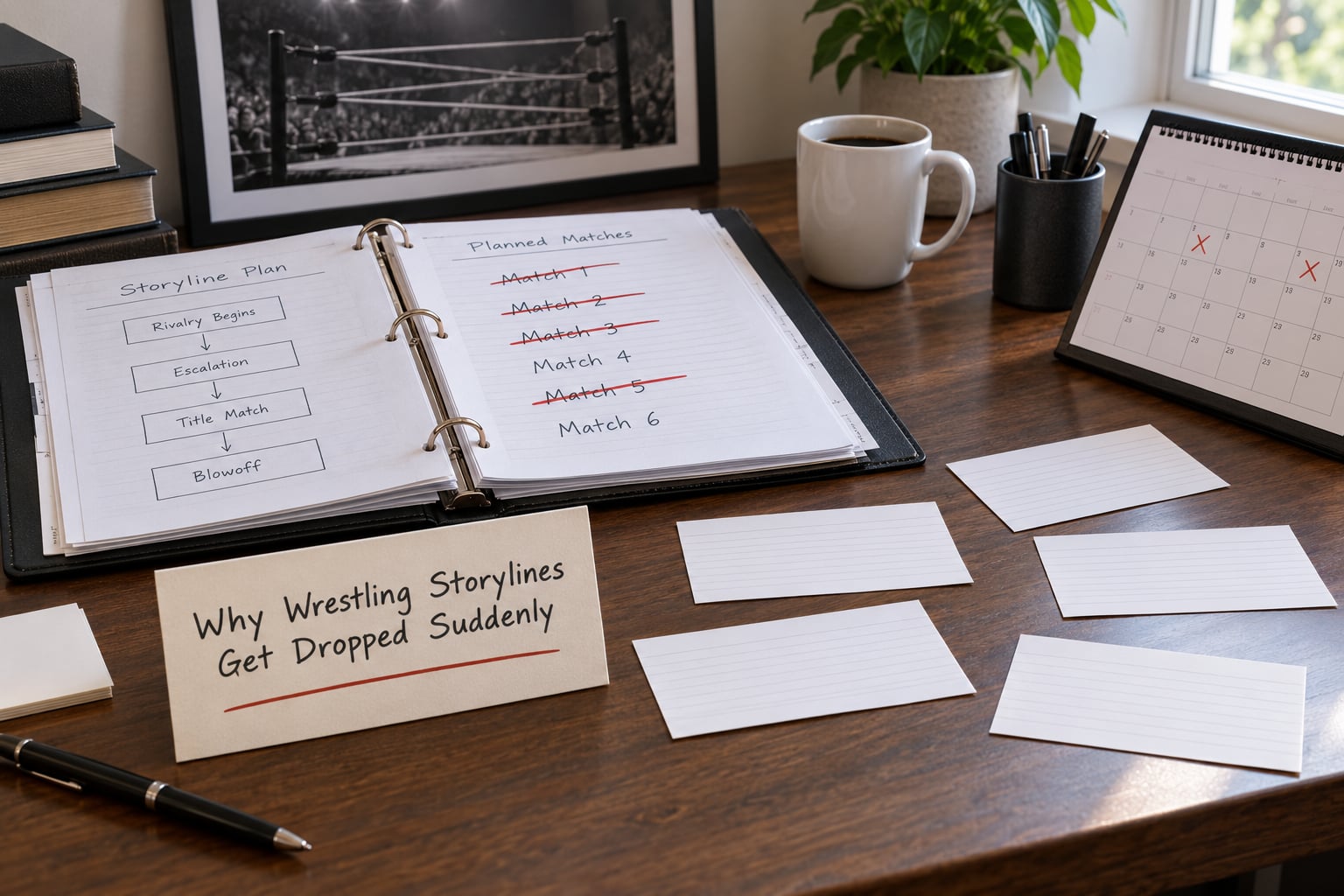
These are the seven causes that come up again and again, from WWE, AEW and TNA alike.
- An injury, real or exaggerated. When a performer cannot work, every angle built around them is suspended immediately. Because safety decisions are made the same day, there is no time to write a graceful exit, so the storyline simply freezes.
- A release or contract non-renewal. Contract expiries land on fixed dates, often at the start of a new season. Feuds in progress end without a match, without a defeat and sometimes without the other wrestlers acknowledging it ever happened.
- A change in creative leadership. New bookers routinely inherit open angles they did not create. Keeping them costs airtime that could go to the new direction, so unfinished work is quietly closed off.
- A roster shuffle or brand change. Drafts, brand splits and roster reshuffles move wrestlers between shows mid-story. If two halves of a feud end up on different brands, the angle has nowhere to go.
- A network or sponsor decision. Raw Underground is the well-known case: a shoot-style weekly show launched in 2020 and folded into Raw roughly a year later, taking its feud continuations with it.
- Ratings decline. When a show’s numbers fall, writers shorten arcs and move on to whatever tested well. Longer setups with delayed payoffs are the first thing cut in that squeeze.
- A better angle replaced it. The simplest reason. An idea gets shelved not because it was bad, but because something else worked better and needed the space.
Each cause leaves a different trace on screen, which is why fans often assume the worst when the truth is more mundane.
| Cause | What fans see | Example |
|---|---|---|
| Injury | Wrestler vanishes, no replacement story offered | Damien Priest injury covered in a 2020 r/Wreddit thread on storytelling |
| Release | Attacker shown on TV one week, gone the next | Aleister Black shown attacking Big E in 2021, then released days later |
| Creative change | Two wrestlers stop being mentioned together | Alexa Bliss and The Fiend separated without closure in 2021 |
| Brand or roster shuffle | One half moves to another show | Champions absent from their own brand’s episodes in 2020 |
| Format change | A whole segment vanishes with no tribute | Raw Underground ended and folded into Raw in 2021 |
| Mystery element | Video package plays, reveal never airs | Hideo Itami’s masked attacker in 2019, never revealed on television |
| Creative shelved | Vignette or stipulation is simply never referenced | McMahon family briefcase mystery from 2019 |
How Roster Moves and Injuries Create Abandoned Feuds
Contract mechanics kill more angles than writers do. Deals expire on set dates rather than whenever a story is finished, so a wrestler can be let go in the middle of the exact week a payoff was supposed to air. The other half of the feud is left holding an unfinished argument.
Retirements and health decisions work the same way. When someone leaves, everything they were carrying goes with them, and nobody is going to re-cast a mystery attacker two years later just to resolve a video package.
It also happens without anyone leaving. r/SquaredCircle members point to performers who were moved up from a developmental brand before the payoff landed, including wrestlers who built title arcs across dozens of episodes without ever cashing in. The talent was not released; the story was simply left behind when they changed brands.
One caution worth repeating: a legitimate injury and a storyline injury are different things. A real injury is a safety matter handled by medical staff and announced as such. A kayfabe injury is a scripted device that can be dropped on a whim, and no promotion is obliged to explain it when it stops being convenient.
Why Storyline Continuity Is Not Always Possible in Wrestling
Weekly television is a format built for deadlines, not for novels. Each episode has a fixed runtime, and every main event, rematch and segment is fighting for the same minutes. A feud that needs six weeks of build cannot have an unlimited number of company.
Touring makes it harder. Performers split their weeks across live shows and television, and a wrestler booked in three cities on one weekend cannot appear in a long cutscene on the following Monday. Writers build around availability, so an angle dies quietly whenever somebody is not where the story needs them.
Safety has the same effect from the other direction. A segment involving a real injury, a weapon or an unscripted risk may be pulled in rehearsal or on the night, and the payoff goes with it.
None of this means inconsistency is always forced. Plenty of abandoned angles had every condition in their favour and were still shelved. It does explain why continuity is fragile enough that a single change in circumstances can undo months of build.
What Are the Signs a Storyline Has Really Been Dropped?
There is a pattern, and once you have seen it a few times you can tell within two or three episodes whether something is paused or gone.
- The name is never mentioned on television again, by either wrestler or by a commentator.
- Video packages are quietly re-edited or removed from the show’s playlist.
- A wrestler involved in the angle is moved to another show, another brand, or off television entirely.
- Other characters begin referencing the feud’s events as though they ended differently.
- A title or prize introduced for the payoff is never shown again.
- Announced matchups for the feud are replaced without explanation between tapings.
- The wrestlers involved appear on the same card but never acknowledge the storyline at all.
If one of those happens and is explained the following week, it was a delay. If two or three happen in a row and nothing is said, assume it was dropped.
Why Wrestling Storylines Get Dropped Suddenly: What Fans Can Do
Check the promotion’s own channels before the rumour thread. Official announcements, roster pages and post-show interviews tell you about releases and contract changes; social posts and insider speculation do not.
Then compare the storyline’s last appearance with the two episodes that follow. One missed week means very little in a weekly format. A silent three-week run with the names scrubbed from the show means the angle is gone.
Finally, keep a note of when an unresolved thread does come back. Several feuds fans assumed were dead were quietly paid off years later, and recognising that pattern stops you writing off a story that was only ever parked.
One last habit worth dropping: assuming every unexplained change is a punishment or a mistake. Some of these angles were never meant to finish. Others were finished internally and simply never made air.
Frequently Asked Questions
Are WWE injuries scripted?
Some are and some are not. Real injuries are genuine safety matters handled by medical staff, and they frequently end a storyline because a performer cannot be risked. Storyline injuries are scripted devices used for drama, and those can be dropped whenever the angle stops being useful. No promotion is required to explain which category a given absence falls into.
Why does WWE drop storylines with no explanation?
Because an explanation needs television time that is already spoken for. When an angle is cancelled because a performer was released, a brand moved, or creative changed direction, the remaining episodes are already committed to whatever replaced it. The result is a silence fans read as indifference, even though the cause is usually scheduling or a contract.
Why do AEW storylines get dropped too?
The same structural reasons apply, because AEW runs weekly television with fixed episode lengths and a travelling roster. A 2020 r/Wreddit discussion thread catalogued abandoned feuds on both Raw and AEW simultaneously, including talent who were called up, given a major moment, and then dropped into battle royals with no follow-up feud.
Does a delayed payoff mean the storyline was cancelled?
Not necessarily. A delayed angle is paused and then referenced again, sometimes months later, often after a pay-per-view, a draft or a brand change. A cancelled angle is simply never mentioned again. The useful test is whether either wrestler’s name still appears in the show’s vocabulary weeks after the segment stopped airing.
Is wrestling storytelling getting worse?
There is no single answer, but the complaint is consistent across promotions and formats. Abandoned angles are blamed for audience drop-off because they teach viewers that nothing they invest in matters. Whether that reflects worse writing or simply tighter weekly deadlines is the argument every promotion is having with its audience.
Conclusion
Most dropped storylines are not mysterious. A wrestler was hurt, released or moved, the episode ran out of minutes, or somebody’s plan changed on the afternoon of taping.
So do this first: check when the storyline last appeared, watch the two episodes after it, and see whether either name is still spoken. Then check the promotion’s official announcements rather than the rumour thread. If the names are gone and nothing was announced, the angle was dropped, and no amount of speculation will bring it back.