Wrestling ratings dropped for a bundle of reasons, not one. The audience aged and stopped converting younger viewers, the writing leaned on recycled angles, the weekly schedule bloated to the point where a live episode felt optional, and the cord-cutting wave removed millions of homes from cable altogether. Add stronger competition for the same evening hours, and a chunk of the reported decline turns out to be a Nielsen methodology change rather than people actually leaving.
The honest version is messier than that. Ratings and the business have pulled in opposite directions for years now, and a big event like WrestleMania can spike while the weekly baseline erodes underneath it. Numbers and measurement notes here were checked as of October 2026; where a figure varies by source I have given a range instead of a false-precision number.
Here is what the different measurement types mean, what the decade looked like, and where fans who walked away say the show lost them.
Table of Contents
- What Do Pro Wrestling Ratings Actually Measure?
- What Changed in Wrestling and TV Viewing Over the Last 10 Years?
- Why Wrestling Ratings Dropped Over the Past Decade: The 7 Main Causes
- How Did Cord-Cutting and Streaming Change the Audience?
- How Did WWE Programming Affect Weekly Viewership?
- What Do the Ratings Numbers Show Across the Decade?
- Why Media Rights Fees Rise While Ratings Fall
- Did AEW and Other Competitors Take Viewers From WWE?
- How Much Did Changing Storylines and the Roster Matter?
- Can Professional Wrestling Ratings Recover?
- Frequently Asked Questions
- Why is it difficult to compare wrestling ratings from different years?
- Does a lower live rating always mean fewer people watch wrestling?
- How much do three-hour WWE broadcasts affect audience retention?
- Can streaming growth offset a decline in television ratings?
- What is the first sign that a wrestling promotion is improving audience retention?
What Do Pro Wrestling Ratings Actually Measure?
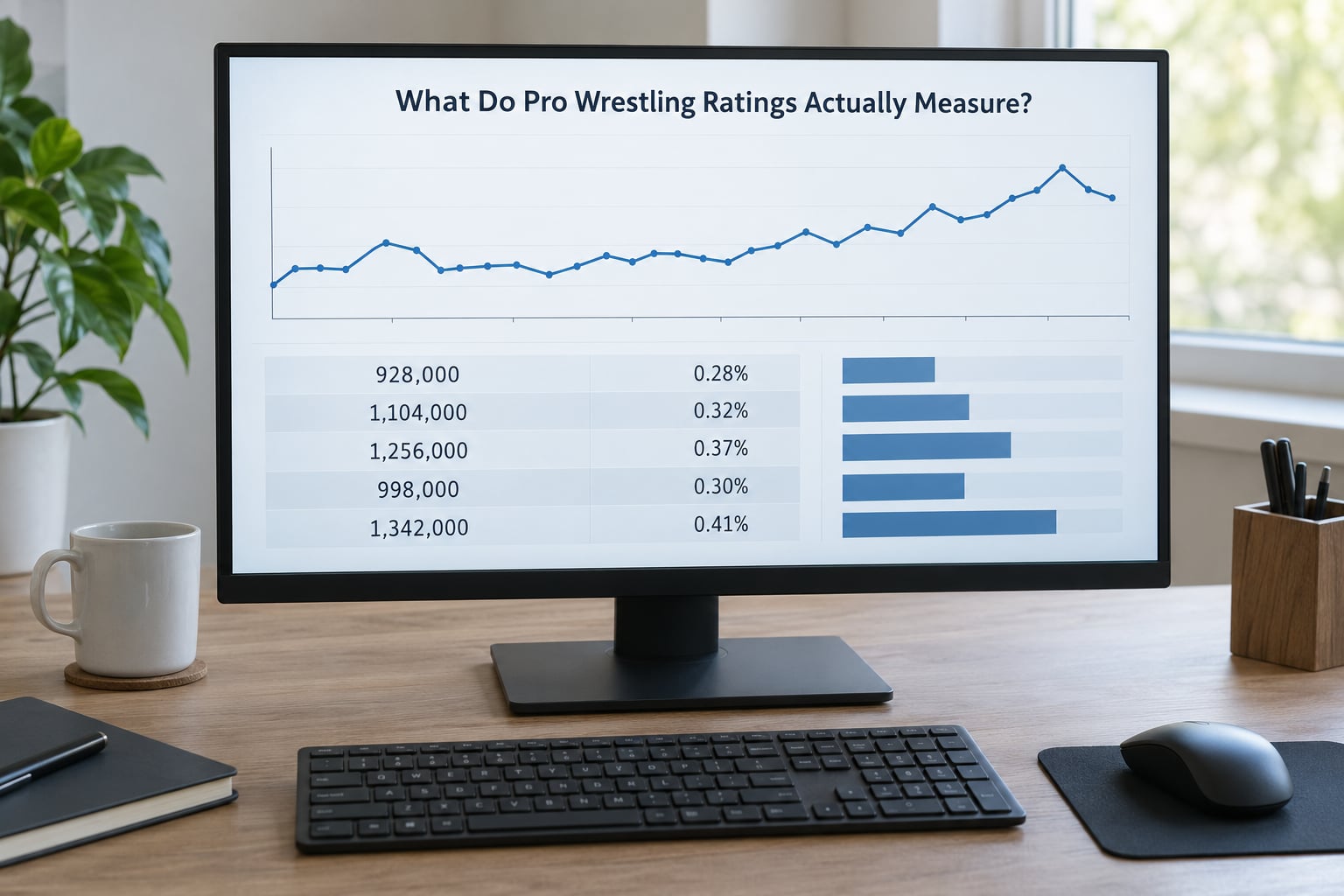
Most wrestling ratings come from Nielsen, which measures television audiences using a panel of roughly one million households across the country. Earlier in the 2010s, much of the trade-press data came from BAR and TVDS instead, which is one reason decade-long comparisons get messy.
Three numbers get thrown around constantly, and they are not interchangeable. A rating point is a share of all television households watching, a viewers figure is a raw count of people, and a demo rating (usually adults 18-49, written P18-49) is the slice networks actually sell advertising against.
| Measurement type | What it counts | What it misses |
|---|---|---|
| Live or same-day rating | Viewing during the broadcast plus viewing later that night, from the panel plus set-top-box data | Anyone who watched on a delay of a day or more, or on a streaming platform outside the measurement window |
| Delayed viewing rating | Catch-up viewing days or weeks after air, added to the live figure | On-demand viewing that never registers in any Nielsen window at all |
| Demo rating (P18-49, P25-54, M18-49) | The advertiser-facing slice used for network renewal talks | The core older fan who makes up a large share of wrestling’s actual audience |
| Streaming minutes viewed | Hours streamed on a platform’s own service | Anything watched on a smart TV app, social clip, or a friend’s screen |
| Live attendance and social reach | Doors sold and short-form clip engagement | Nothing about the linear television audience networks care about |
Four conclusions readers should refuse to accept. That a falling live rating equals a shrinking fan base, because delayed and on-demand viewing sit mostly outside the measurement. That a strong demo means strong revenue, because the demo and the audience are not the same people. That a single week proves a trend, because weekly wrestling numbers swing hard around segments. And that a number from 2016 is directly comparable to a number from last year, because the panel and the software behind it both changed.
What Changed in Wrestling and TV Viewing Over the Last 10 Years?
Two shifts ran at once: the way people watch television changed for every genre, and wrestling-specific creative and scheduling problems compounded. Separating them matters, because the industry-wide headwind would have hit any show in that slot, while the promotion-specific problems were avoidable.
The industry-wide side is the one that cannot be negotiated away. Linear television as a habit thinned out, pay-tv bundles became a line item households cut first, and viewing moved to on-demand schedules. A network no longer knows in advance whether the people who watched a show at 8pm are still in front of a screen three hours later.
The wrestling side is about supply. When a viewer has access to more wrestling than at any point in history, each individual episode carries less weight, and the habit of watching live erodes. The rest of this section covers each cause in turn.
Why Wrestling Ratings Dropped Over the Past Decade: The 7 Main Causes
1. The audience aged and stopped converting younger viewers. This is the single most-cited structural problem in the business. A 2012 estimate put roughly 30 percent of the audience at 50 or older, and by 2014 about 66 percent of weekly viewers were over 35. A 2019 Reddit thread in r/SquaredCircle put WWE’s average viewer age at over 40, against even older averages for smaller promotions. Nobody is replacing those viewers at the same rate.
2. Storylines leaned on recycled angles and callbacks. A 2016 MEL Magazine analysis made the case that the writing kept referencing its own history: new characters built as deliberate echoes of older ones, the same betrayals and the same finishes re-run with different names. Fans notice when a heel turn is a rerun, and the audience that grew up on the Attitude Era reads repetition faster than almost anyone.
3. Content over-saturation made live viewing optional. Two weekly brand shows, a third on the developmental brand, a pay-per-view nearly every month, and a deep back catalog meant a fan could miss weeks and still feel current. The same MEL piece called too much content the core problem for reaching new viewers. When catching up is free and waiting is possible, tune-in loses its value.
4. The product lost its edge after 2008. The shift toward a PG, family-safe tone aimed at a broader audience arrived alongside the brand split, when the edgy product split into two brands that both had to work for sponsors. Adults who wanted edginess found less of it, and children who wanted edginess were not really the target. Critics still call the current product corny, and that word traces straight back to this change.
5. Linear television declined, and cord-cutting took wrestling with it. This is the biggest factor nobody in wrestling controls. See the next section for the detail.
6. The audience fragmented across WWE, AEW, NJPW, indies, and social clips. More options split a fixed pool of hours, and short-form clips became the default way a casual viewer encounters the product. Several lapsed fans in r/WWE and WrestleZone threads said they now watch highlights rather than full episodes, which deflates linear ratings without meaning the interest disappeared.
7. Competition for the same evening hours got fiercer. Streaming series, live sports, the UFC, sports betting, and gaming all compete for the same block of a viewer’s night. A show that starts at 8pm now competes with a heavily promoted live card, not just other cable channels.
Survey data makes causes two through four concrete. A YouGov/VIP poll of 417 adults asked people who had stopped watching which factors drove them away:
| Reason given for stopping | Share of surveyed defectors |
|---|---|
| Too cartoonish / not believable | 30% |
| Storylines not interesting | 29% |
| Did not like the characters | 28% |
| Poor match quality | 26% |
| Too kid-focused | 14% |
Commentary and announcing quality, and the sense that fan feedback goes nowhere, came up repeatedly in the same responses. A wider poll of about 1,200 adults found 43 percent had never watched, 43 percent had watched and stopped, and 12 percent watched regularly. That third figure is the one worth holding onto: regular viewers are a small slice of everyone who ever cared, and shrinking a small slice still looks like a decline.
How Did Cord-Cutting and Streaming Change the Audience?
Leaving cable did not turn those households into streaming wrestling viewers. A household that drops a pay-tv bundle is very often a household that watches whatever is already on a service it pays for, and most of those services are not carrying weekly wrestling. The viewer was lost to the habit, not necessarily to the interest.
Delayed viewing makes this worse for the headline number. A fan who watches Monday’s episode on Thursday, or watches three episodes on a Saturday, may never appear in any live or same-day window. Streaming consumption of wrestling is largely invisible to the ratings system, and the platforms report their own streaming minutes viewed rather than a Nielsen audience figure.
The panel itself changed too, which is the reason year-to-year comparisons across the last few years are the shakiest in the industry. If the sample or the method behind a number changes, the direction of travel can shift on paper without a single viewer changing their habits.
| Viewing change | Size | Main cause |
|---|---|---|
| Live and same-day weekly audiences | Large, sustained decline across the decade | Cord-cutting, time-shifting, and creative fatigue combined |
| Delayed viewing share | Grew steadily as a share of total weekly viewing | DVR and on-demand catch-up became the default way to follow a show |
| Streaming minutes viewed | Rose as content moved to subscription platforms | Back catalog and tentpole events moved behind a login |
| Short-form social clips | Became a primary entry point for casual viewers | Platform algorithms and highlight culture |
| Reported ratings after the methodology change | Wrestling telecasts reported 14-20% lower | Nielsen’s Big Data + Panel method replacing the older panel-only approach |
That last row is the one that trips people up. Analysis from Wrestlenomics in November 2025 found Dynamite, SmackDown, NXT, and Collision all measuring between roughly 14 and 20 percent lower under Big Data + Panel than under the old method. WrestlingIn covered Dave Meltzer’s reporting on promotions and networks complaining about the change in private. A chunk of the recent step-down is the ruler being swapped, not the audience walking out.
How Did WWE Programming Affect Weekly Viewership?
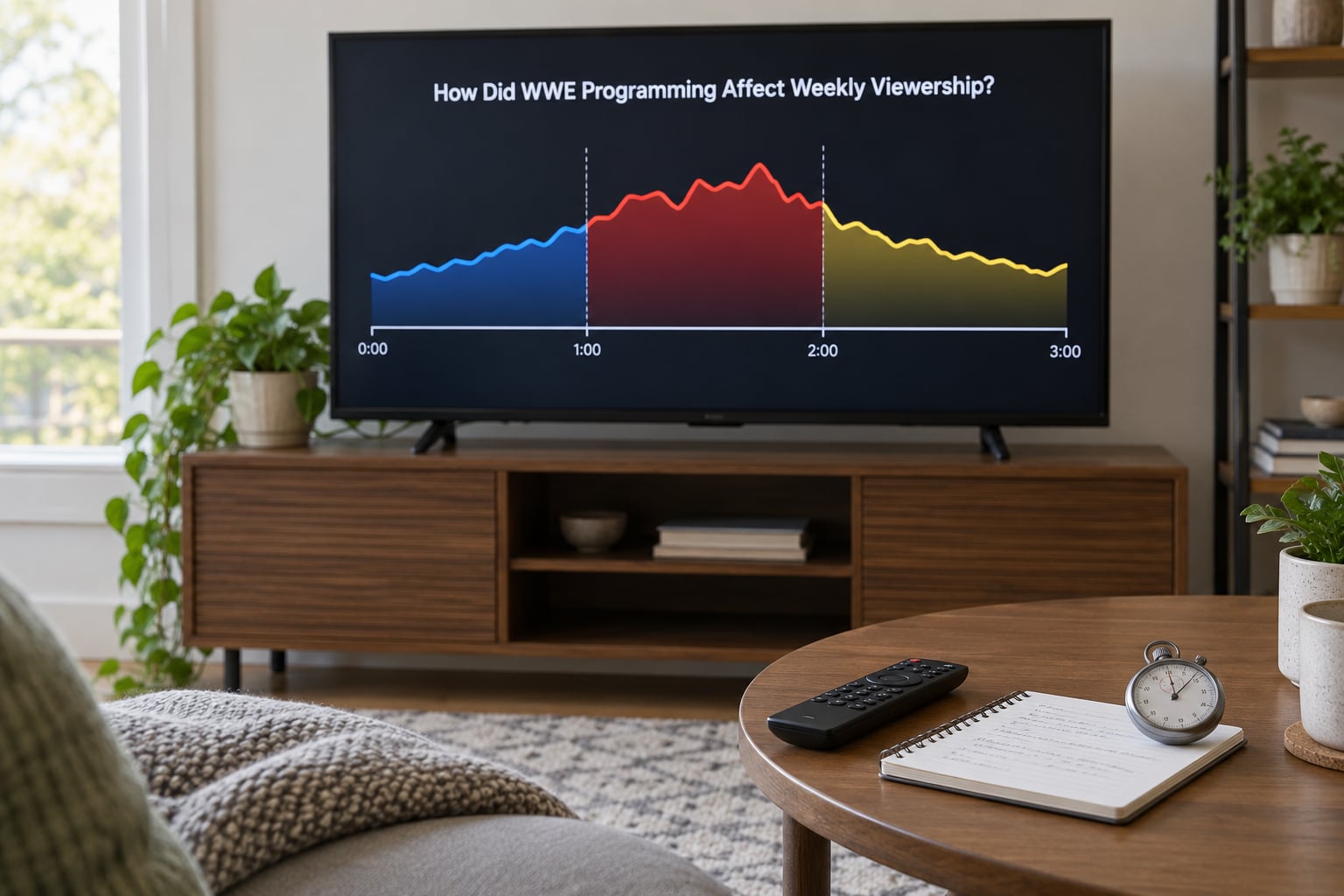
Runtime is the first thing to look at, and it is the easiest number to check. Monday Night Raw expanded to three hours, which is a longer weekly commitment than most cable dramas ever asked for. SmackDown moved to a Friday night slot later in the decade, putting a weekly show up against whatever else a viewer had planned for a Friday evening.
Longer broadcasts create more places to lose someone. Commercial breaks fragment the show, a long segment with a backstage angle interrupts momentum, and a match card that strings together six contests instead of four gives casual viewers more chances to stop watching midway.
The other structural problem is finish predictability. Fans on WrestleZone and GameFAQs threads repeatedly describe the same patterns as stale: forced finishes where the outcome is decided by outside interference, referees becoming story characters, and title changes that feel arranged rather than earned. When a viewer can predict the finish, the reason to stay for it thins out.
Here is where I would push back on the standard take. Nobody has ever run the experiment. You cannot hold a schedule constant and change the writing, then compare audience numbers, across ten years of a live show. A three-hour runtime is not automatically bad; a poorly built three hours is bad. And plenty of shows with tighter runtimes have still drifted downward.
What you can say is that the correlation runs the right way. Weeks with stacked main-event cards and strong finishes hold better than weeks of filler, and the trend over the decade is downward for both the quality of the product and the size of the audience. Correlation, not proof of cause.
What Do the Ratings Numbers Show Across the Decade?
The broad direction is not in dispute. The fine detail depends heavily on which measurement service and which methodology you are reading, so treat the table below as shape, not precision. Anyone publishing exact year-by-year figures for wrestling should verify them against primary ratings releases or a reputable measurement archive first; complete comparable series for every year are not readily available, and this article does not invent the gaps.
| Era | Direction of weekly audiences | Inflection point |
|---|---|---|
| Early 2000s peak | Ratings around 8.4 with roughly 8 million viewers for the flagship weekly show | Monday Night Wars-era attention at its widest |
| 2008-2010 | Step-down after the brand split and the shift to a sports-entertainment presentation | Two brands diluted one audience; edginess traded for sponsor-friendly tone |
| 2010-2014 | Gradual erosion with tentpole spikes holding the top | Pay-per-view volume and the weekly back catalog pulled viewing off the live telecast |
| 2014-2016 | Network move to a larger channel; weekly numbers in the low-to-mid two millions | Audience aging becomes the dominant published concern |
| 2016-2020 | Continued decline; Friday-night SmackDown move reshaped the schedule | Creative direction widely criticised as vanilla; tentpole spikes widen the gap versus the weekly baseline |
| 2020s | Weekly WWE audiences commonly cited in the 1.5-3 million range; tentpoles still spike | Streaming era, plus Nielsen Big Data + Panel reporting telecasts 14-20% lower |
Two things that table hides. First, big events still outperform the weekly baseline by a wide margin every year, so an annual average flatters the trend unless you look at the split. Second, smaller promotions are a useful control: Impact Wrestling on AXS TV averaged 174,000 viewers in the first quarter of 2020 and fell to 147,000 in the second, a pattern that predates the pandemic and tracks the same industry headwind rather than any one promotion’s creative choices.
Why Media Rights Fees Rise While Ratings Fall
This is the part that confuses newcomers most. Networks keep paying more for wrestling rights while the audience shrinks, and the Wrestlenomics analysis lays out the reason plainly: wrestling is cheap to produce and hard to replace on a schedule. A scripted, promotable, live event with a known start time gives a network an hour that requires no writing staff, no expensive set build, and no risk of a blowout in the ratings that damages other programs on the schedule.
So the rights fee tracks value to the network, not the size of the audience. Which means a falling rating is bad news for advertising revenue and talent budgets, but not an existential threat to the promotion’s income. It also means a promotion can be losing viewers and still be profitable.
Did AEW and Other Competitors Take Viewers From WWE?
Both things happened, and separating them requires looking at timing. AEW’s 2019 launch initially expanded the category, bringing in viewers who had stepped away from wrestling entirely and drawing casual curiosity from a younger, online-first crowd. That is the good version of competition.
The other version is division. A GameFAQs thread from 2019 lays out the argument fans keep returning to: a dominant number one compresses the space available for a number two in any industry, and WWE held that position for two decades. When AEW started, some of that audience split rather than growing.
Timing is the tell. WWE’s larger step-downs cluster around internal decisions: the brand split, the move to USA Network, then SmackDown to Friday nights. AEW’s own slide, from its launch peak through the early 2020s, gets attributed by its own viewers to inconsistency, roster churn, and fewer matches worth the name, not to WWE taking its viewers. Those are two different problems, and treating them as one story hides the useful information.
Streaming-only competition deserves a separate line. International promotions such as NJPW built large audiences on YouTube and Twitch, and much of that consumption never touches a US television panel. Some of it, though not the largest share, competes for the same hours as the weekly show.
How Much Did Changing Storylines and the Roster Matter?
A great deal, but it works on the audience rather than the chart. Characters viewers have never seen, unearned title wins, and matches booked months in advance with no narrative justification for the rematch all reduce the reason to stay tuned. Fans describe this precisely in forums: a babyface or heel turn that makes no sense, a rivalry that needs a Wikipedia page to explain, or a champion whose reign is treated as a placeholder.
Promotion outside wrestling plays a role too. When a performer is on a mainstream talk show or a sports show more often than they wrestle, the show stops feeling like the main event in their own life. It also confuses the audience about what the product is.
The honest position on era comparison is that no single star, title, or storyline explains ten years of decline. A generation of viewers left for reasons that accumulated: a few bad stretches, a schedule that grew tiring, a product that stopped surprising them, and cable packages that got more expensive. Naming one wrestler as the cause is a fan argument, not an analysis.
One counter-trend is worth naming. Women’s wrestling has drawn a growing, younger, more engaged audience and has been the most consistently praised part of the product in recent years. It has not been large enough to reverse the weekly numbers, but it is the clearest example of new material pulling in people who were not watching.
Can Professional Wrestling Ratings Recover?
Partially, and not to the levels of the early 2000s, because the cord-cutting headwind does not reverse. What could plausibly improve is retention of the audience that remains.
A shorter and more consistent weekly show would help most. Three hours has to justify itself every week, and trimming to a tight two would remove the low-stakes segments that give casual viewers an exit. Clearer development for new characters, where new wrestlers are introduced with actual story rather than a run-in, addresses the unfamiliarity problem directly.
Stronger event storytelling is the other lever. Tentpole shows consistently outperform the weekly baseline, which says the audience still wants to be surprised and they want it to matter. A promotion that spends its best material on four weeks a year and reserves the rest for filler is spending its credibility backwards.
Better schedule competition and broader distribution follow. Fighting for a slot against nothing interesting, or launching into a crowded night, costs audience before the show is even judged. And distribution has to span television and streaming rather than treating one platform as legacy and the other as the future, because the audience splits its week across both.
Finally, the measurement has to get honest about what it misses. Until streaming minutes, delayed viewing, and social consumption are reported alongside the panel numbers, every decline looks slightly larger than it is.
Frequently Asked Questions
Why is it difficult to compare wrestling ratings from different years?
Because the measuring tools changed underneath the numbers. For much of the 2010s the industry used BAR and TVDS data, later Nielsen panel figures, and since late 2025 Nielsen’s Big Data + Panel method, which reports wrestling telecasts roughly 14-20 percent lower than the older approach. Each shift resets the baseline, so a year-to-year drop can partly reflect a new ruler rather than viewers leaving.
Does a lower live rating always mean fewer people watch wrestling?
No. Live and same-day windows miss most delayed viewing, on-demand catch-up, streaming minutes, and social clips. Casual fans who watch three episodes on a Saturday may never register in a live figure, which is why weekly ratings can fall while tentpole spikes and back-catalog consumption stay strong. The ratings show what happened on one night, not how many people care.
How much do three-hour WWE broadcasts affect audience retention?
There is no clean experiment, so treat it as one factor among several. A three-hour weekly commitment gives casual viewers more chances to stop watching, adds commercial breaks and backstage segments that break momentum, and makes catching up on a delay feel more reasonable than sitting through it live. Promotions with tighter runtimes have still declined, so runtime matters more alongside show quality than on its own.
Can streaming growth offset a decline in television ratings?
Partly, and it already does for the business. Rights fees have risen while live audiences fell, because networks value cheap, promotable, reliable live programming that is hard to replace on a schedule. Subscription platforms report their own streaming minutes rather than a Nielsen audience, so streaming growth shows up in revenue and subscribers more clearly than it shows up in ratings.
What is the first sign that a wrestling promotion is improving audience retention?
Look at week-to-week consistency on the weekly show rather than a single spike. A promotion on the way up holds its baseline between big events instead of bleeding viewers between them, and the quarterly demographic trends on the flagship show improve before the raw totals do. A strong WrestleMania number on its own tells you very little about the rest of the year.
If you take one thing from this, compare like with like: check whether two years of wrestling ratings were measured the same way before treating the gap as audience loss, then decide how much of what remains is cord-cutting versus creative decisions. The measurement changed, the schedule changed, and the writing changed, and only one of those three is a creative problem the promotion controls.