British wrestling style is different from American wrestling in one sentence: British wrestling is won by outwrestling an opponent with holds, counter holds and submissions under a rulebook of timed rounds and two-out-of-three falls, while American wrestling is won by finishing an opponent inside a single continuous match with strikes, power moves and aerial spots. That design choice changes the pacing, the characters, the length of the promos and the job the crowd does in the building. Understanding how British wrestling style is different is mostly a matter of learning to read a match where the drama lives inside a wrist lock instead of inside a leap off the top rope.
One warning before we start. British wrestling is not one style, and “British” covers everything from the joint promotion circuit that fed World of Sport to PROGRESS wrestling in 2026. Some UK shows work technical rules, some work hard-hitting strong style borrowed from Japan, and a few work the American television model almost unchanged.
The explanation below describes the older, classic tradition and then explains where it survives now.
Table of Contents
- How British Wrestling Style Is Different from American Wrestling
- British and American Wrestling at a Glance
- Long-Match Psychology and Storytelling
- Why Promos and Verbal Skills Matter More
- Character Work, Mentality, and Perceived Skill
- Pacing, Movesets, and Match Structure
- Crowd Interaction and the Relationship With the Audience
- Presentation, Venues, and Weekly Television
- How British Promotions Vary from One Another
- Frequently Asked Questions
- What is the main difference between British and American wrestling?
- Are all British wrestling promotions focused on long matches?
- Which British wrestling promotions are best for beginners?
- How is British wrestling different from WWE?
- Who are some important wrestlers from the British wrestling tradition?
- Can an American fan understand British wrestling without watching the entire history?
- Conclusion
How British Wrestling Style Is Different from American Wrestling
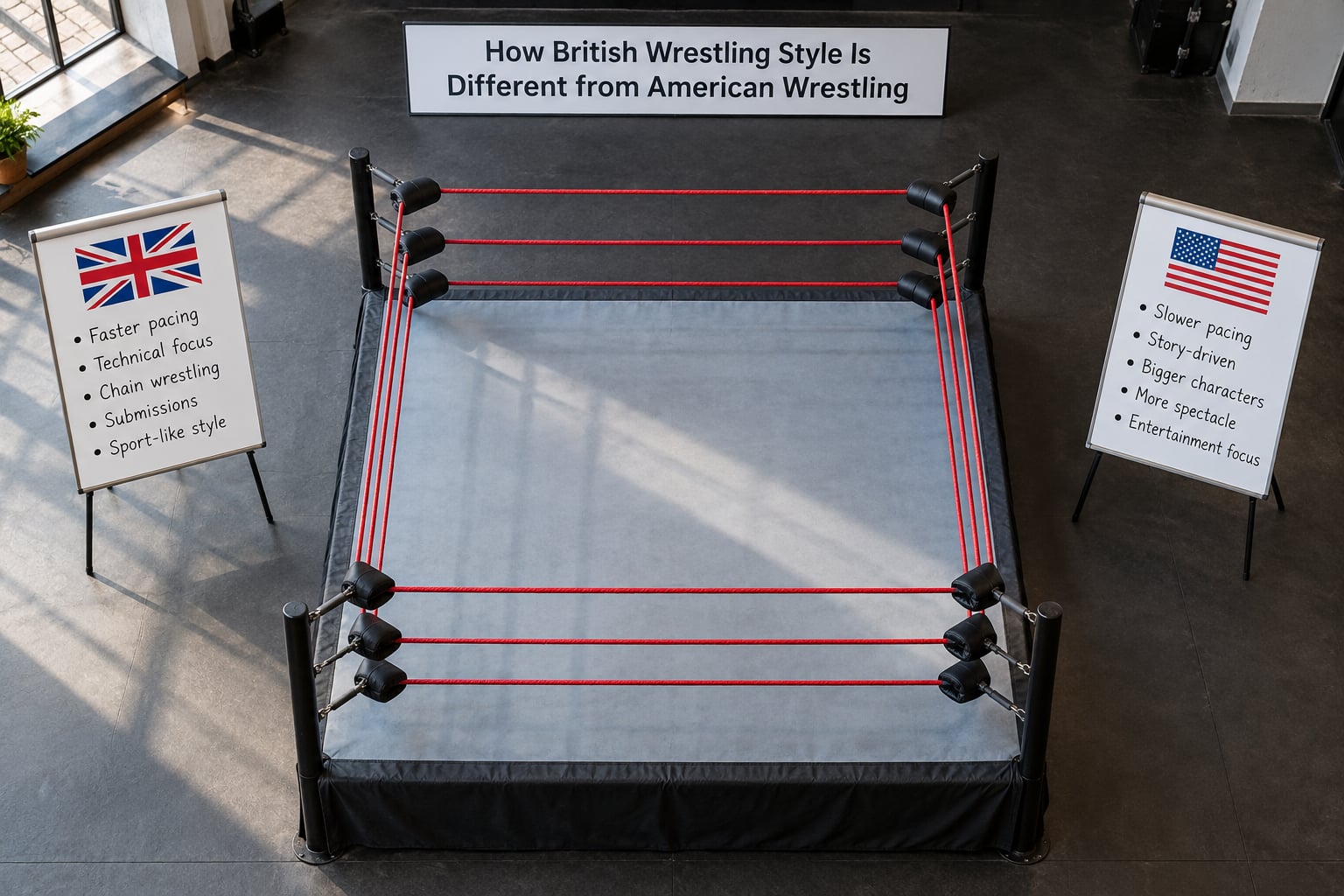
Here is the short version of how British wrestling style is different. British wrestling grew out of catch-as-catch-can, a legitimate combat sport whose aim was to take an opponent down, control a limb and force a submission. Professional wrestling kept the holds and threw away the legitimacy. What survived is a match built from applied holds, applied counters and the ability to make each exchange look like a small argument that the other wrestler has to win back.
American wrestling runs on the same basic physics but spends them differently. A power move or a kick in front of thousands of viewers needs three seconds of clarity, so matches are built around short spikes of intensity separated by story segments. British matches are built around sequences, and a sequence that takes ninety seconds to complete is normal.
Eight differences account for most of what a newcomer notices:
- Rounds instead of one continuous stretch. Classic British matches are divided into timed rounds, usually five minutes, with three minutes for title bouts. The bell ends a round, wrestlers go back to their corners, and the drama carries into the break.
- Two falls out of three. Win the first fall and you reset. Win two falls and the match is over. A single decisive pin is rarer than the one-and-done finish that ends most American main events.
- Holds over strikes. Limping, Boston crabs, full nelsons, headscissors and wrist locks do the work that forearms and chops do in a WWE ring. Dynamite Kid made a career out of showing the difference, then exported the high-energy end of it to Canada and Japan.
- Weight divisions. Traditional rules recognise seven weight classes, from flyweight upward. Matches were booked around men of similar size, so size was not the story.
- Clean wrestling. No weapons, no chair shots, no outside interference as a habit. The Greater London Council spent years trying to ban the sport, and promoters answered by presenting it as respectable sport, which is where the sportsmanly character tradition came from.
- Fewer outright heels. Villains were rare and looked out of place. When one turned up, the crowd knew, and the character usually paid for it later.
- Speaking is part of the wrestling. Promos were long, argumentative and frequently the best part of the card. A wrestler could be established as clever or dangerous before a single hold was applied.
- The crowd is a participant. Venues were smaller, the ringside was close, and the audience reaction between rounds carried information about who the fans had decided to back.
Stampede wrestling is the useful exception to the “no strikes” line. The loose-limbed, kick-heavy branch associated with Stampede Wrestling in Canada and Michinoku-Pro in Japan grew directly out of the British tradition, and Dynamite Kid and Billy Robinson carried it across the Atlantic.
British and American Wrestling at a Glance
| Criterion | British tradition | American mainstream |
|---|---|---|
| Rules system | Mountevans rules: timed rounds, weight divisions, two public warnings before disqualification | One continuous match, one fall, single disqualification warning |
| How a match is won | Two falls out of three, a submission, a count-out or a disqualification | Pinfall or submission, usually inside one fall |
| Typical match length | Long, built from sequences with callbacks | Five to fifteen minutes, built from story beats and spots |
| Core technique | Holds, counter holds, chain wrestling, limb control | Strikes, power moves, throws, aerial work, run-ins |
| Standing wrist locks | Central, since a hold can be applied from a standing tie-up | Rare, treated as comedy or a transition |
| Typical finish | Limping, a Boston crab variation, a submission applied clean | Finisher move followed by an immediate pin |
| Character morality | Heroes outnumbered villains, sportsmanship over heat | The full range from babyfaces to monsters and icons |
| Promos | Long, verbal, character-defining, occasionally philosophical | Short, angle-driven, sold to a television audience |
| Crowd role | Close and reactive, audibly deciding the match between rounds | Large, choreographed reactions for broadcast |
| Venues | Clubs, sports halls and later television studios, often a few hundred seats | Arenas and stadiums, plus television studios built for crowd noise |
| Strongest tradition | Match psychology, technical credibility, character voice | Story clarity, spectacle, roster and global reach |
Two rows deserve emphasis. Weight divisions and round structure are not cosmetic details, they are the reason the style works: dividing men by size and stopping the clock every few minutes forces wrestlers to prove control rather than stamina, and forces the crowd to decide who is winning while the wrestlers are standing still.
Long-Match Psychology and Storytelling
Here is the mechanic that makes a hold escape legible. A wrestler trapped in a hold has three options: break out cleanly, counter into a hold of their own, or reach the corner during the round break and get some help. All three cost something.
Breaking out looks hard. Counters look like the opponent’s plan is working. Getting saved at the bell is the most interesting of the three, because the crowd treats it as cheating. The wrestler who escaped looks relieved and the crowd starts booing, which is exactly the heat the character needs going into the next round.
That is why a round break is not a pause. It is a scheduled argument between the wrestlers and the audience, and it is why British crowds in old footage go loud at moments that look random to a newcomer. Watch a classic World of Sport match with the bell breaks in mind and the noise pattern suddenly makes sense.
Sequences also get referenced later. The hold applied in round one reappears in round three, usually turned into the finish. A wrestler who sold a leg badly in the first fall is made to favour that leg for the rest of the match. Nothing in a British main event is wasted, because the match is long enough for the payoff to land.
Why Promos and Verbal Skills Matter More
British wrestling treated a microphone as part of the craft. A promo was not an advertisement for a match, it was the match’s first act, and a wrestler who could speak well could headline a card without being the best technical wrestler in the building.
The classic British promo was conversational and long. Wrestlers argued about the sport, about each other’s character, about who deserved credit for what. Interviews could run long enough that the crowd started treating them like a debate programme, and some regulars became famous for heckling a wrestler who tried to sound too clever.
Three kinds of speaking mattered most:
- The character introduction. A new wrestler would explain who they were and why, and the crowd would decide whether to accept it. The decision was final for months.
- The challenge. Issuing a challenge in front of the crowd created a reason for the match beyond a promoter needing a booking, and it gave the winner or loser a storyline to answer later.
- The comedy and the personality. Humour was a legitimate way to be memorable, and British crowds appreciated a wrestler who could take a joke about themselves.
William Regal is the clearest modern example. He arrived with the holds and the accent, but the reason he survived in American wrestling was that he could talk, and that he argued rather than recited. Zack Sabre Jr took a different route, staying almost silent and letting the ring work speak, which is its own kind of discipline.
The contrast with the American model is structural rather than cultural preference. American television promos have to advertise a match to people who came for the brand, they are cut for ad breaks, and they deliver an angle in a sentence. British promos could assume the audience already cared.
Character Work, Mentality, and Perceived Skill
British wrestlers were usually written as competent, ambitious and slightly resentful. Not good guys exactly, and not villains, but men who believed they deserved their position and were frustrated when the world disagreed.
That produced a very different moral range from American television, where turnbuckle-friendly babyfaces have coexisted with monsters, masked legends and comedic heel pops for decades. In the British joint promotion era the honest answer was that villains were rare, and when one appeared he was often presented as a man who had been driven to cheating by bad luck.
Skill is sold differently too. A British wrestler being called skilled usually means he can hold a position under pressure and control an opponent without cheating. In American wrestling, being called skilled more often means a high-impact move was hit cleanly, or that the match was booked well.
Both versions reward different things. British viewers tend to follow the wrestler who makes a hold look inevitable. American viewers tend to follow the wrestler who makes a big move look inevitable. Both are forms of credibility, and both are real skills, but the audience cannot reward one while watching a match built on the other.
Gender is part of this history too, and it is not a flattering part. Women’s wrestling was banned by the Greater London Council until the late 1980s, which meant two decades of British television without it while the sport made its money in front of men. The modern scene has corrected that imbalance, and a current UK card will often put a women’s match on the bill for the same reason a men’s match is there.
Pacing, Movesets, and Match Structure
In a British match the action slows down rather than stopping, because the next hold is always being prepared. Two wrestlers working a standing wrist lock are not paused, they are negotiating, and the audience is watching for who blinks.
Concrete differences in the body of the match:
- Strike exchanges are shorter and sharper. The traditional style discourages long striking exchanges in favour of a committed forearm, chop or kick that changes a hold.
- Ground control is restricted. Mountevans rules stop a wrestler applying follow-up moves to an opponent who is already down, which forces matches back to standing control.
- Transitions are the skill. Moving from a wrist lock to a headscissor to a full nelson without breaking contact is where the crowd reacts, not where the wrestling is judged most harshly.
- Near falls are rare. Because a fall is only half a win, holding somebody down for a long count matters less than in a single-fall match.
- Limping is a signature. The repeated drop-to-one-knee kick exchange reads as punishment in a way that a big move does not, which is why so many British finishers are variations on it.
- Signatures matter more than finishers. A wrestler with one hold and one kick often has a clearer identity than a wrestler with six throws.
The wider comparison matters here too, because “British strong style” is a term used loosely online. It is not the same thing as the strong style associated with Antonio Inoki and New Japan Pro-Wrestling, which is a hard-kicking combat-sport style. British strong style usually means British wrestling that has absorbed strong style influence.
| Criterion | British | Lucha Libre | Strong Style | King’s Road |
|---|---|---|---|---|
| Base of the style | Catch-as-catch-can holds | Mexican lucha tradition | Martial arts influence, notably Antonio Inoki | Puroresu spectacle, notably All Japan |
| Match structure | Rounds, two of three falls | Best of three falls, sometimes timed | Mostly single fall | Mostly single fall |
| Core exchange | Holds and counters | Mask match, hair, pride | Strikes and kicks | Stakes and drama |
| Submissions | Central and legitimate | Less central than holds | Rare, often an insult | Rare |
| Aerial work | Uncommon traditionally | Central, especially high flyers | Rare by design | Very common |
| Signature identity | A hold or a kicking exchange | A mask and a family name | A hard kick | A dream match storyline |
| Typical audience expectation | Watch the psychology | Watch the sacrifice | Watch the combat | Watch the story |
| Skill is measured by | Control of an opponent | Trust and commitment | Striking and endurance | Storytelling and heat |
None of these styles is harder than another, and arguments on that score usually come down to what a viewer already understands. What is fair to say is that British wrestling asks for the most patience, because its payoff is delayed furthest.
Crowd Interaction and the Relationship With the Audience
The crowd is part of the match rather than a witness to it. That relationship is structural: smaller venues put spectators close enough to hear every exchange, so reactions guide what happens next.
Newcomers are usually confused by the volume. A crowd that has been quiet for ninety seconds erupts when a hold is escaped at the bell, then goes quiet again while the next round starts. The pattern is not random once you know the round system.
Three forms of interaction repeat constantly:
- Choosing a hero. Fans decide who they are supporting during the first round and stay with it. In a two-fall match, that decision often decides the finish, because the crowd will not cheer a second fall for a wrestler they have not accepted.
- Punishing cheating. A wrestler saved at the bell or using the ropes to escape a hold draws boos that carry into the following round.
- Building callbacks. Promos earlier in the card set up matches later, and a wrestler who was insulted on the microphone gets booed before the bell, which the opponent uses.
Royal Albert Hall crowds were the extreme version of this, thousands of people in a building designed for concerts, close enough to see a face being worked. Modern UK venues are smaller still, often a few hundred seats, and the audibility is comparable.
Forum watchers tend to describe this as the thing that gets them. British Wrestling Remembered and long-running beginner threads on Pro Wrestling Only are full of people saying they started watching the old footage for the holds and stayed for the crowd.
Presentation, Venues, and Weekly Television
British wrestling was presented as sport with theatre attached. Competitions ran to order, results were announced, and the presentation borrowed from boxing and athletics. The Joint Promotions cartel that organised most major British wrestling in the middle of the century worked like the American territory systems, with recognised promotions sharing talent and titles.
The compressed history explains why the style looks the way it does:
- Victorian era. Catch-as-catch-can develops as a legitimate sport. George Hackenschmidt and figures like Atholl Oakeley dominate it.
- 1930s. All-in wrestling offers a livelier product. The London ban arrives, and promoters lean harder on the respectable-sport framing.
- 1940s. A committee sets Mountevans rules, fixing rounds, weight divisions and the two-out-of-three-falls format.
- 1950s. Television arrives and a Saturday afternoon slot puts wrestling in front of a mass audience, with audiences reported in the tens of millions at peak.
- 1970s and 1980s. Max Crabtree and Big Daddy define the era’s personalities, with Giant Haystacks, Kendo Nagasaki, Dynamite Kid and Johnny Kidd as the names carried into the tape libraries.
- 1985. The loss of the ITV slot ends the mass audience. Attendance falls and the joint promotion circuit shrinks.
- 1990s onward. Old school and new school promoters divide the scene. A proper weekly television presence returns through the World of Sport YouTube archive and, later, NXT UK.
Commentary and production followed suit. British television commentary explains the hold while it is happening, which helps newcomers far more than American commentary, where the announcer sells a story rather than a technique. Graphics were functional and entrances were short, because venues were small and the crowd was close.
Modern independent shows use the same instincts in bigger buildings. Progress Wrestling sells season tickets and long-form storylines, and its matches often borrow round structure and callbacks from the older style while adding modern booking.
How British Promotions Vary from One Another
Treating British wrestling as a single style is the biggest mistake a newcomer can make. The classic division is between old school promotions, which keep Mountevans rules and clean wrestling, and new school promotions, which dropped those rules and adopted the American single-fall model.
- World of Sport was the television era, and the name still refers to its style: rounds, weight divisions and two falls. Most modern promotions have dropped those rules, and say so openly.
- PROGRESS runs long-form storylines and season-long arcs, with a small venue and a hard-working crowd. Its match work borrows from both worlds, often with strong-style influences in the roster.
- RevPro built a modern British promotion on technical credibility and an open-book style, and it has become a route for wrestlers with catch-based backgrounds to work in front of a paying UK audience.
- OTT (One True Promotion) went further toward an American-style single-fall, high-impact product while keeping the UK independent scene’s habit of putting on shows people travel to.
- All Star Wrestling keeps the traditional match focus and the older presentation, and its crowds are known for reacting to technical work rather than to pops.
- NXT UK is a WWE television show filmed in Britain with an American booking model, which confused plenty of viewers who expected the local style.
The same point applies to wrestlers. Doug Williams and Nigel McGuinness are routinely named by fans as the modern masters of the hold style, while Will Ospreay and Zack Sabre Jr represent a generation that studied catch in Britain and works a hybrid everywhere. Pete Dunne, Tomohiro Ishii and others came the other way, learning the style from Britain and importing it.
One term to be careful with is British strong style. It shows up in databases and forum posts as if it were a national style. It is better read as a description of UK promotions that lean on stiff kicks and strong-style psychology, not as a separate rules tradition.
Frequently Asked Questions
What is the main difference between British and American wrestling?
British wrestling is won by outwrestling: applying holds, counters and submissions under timed rounds and two-out-of-three-falls rules. American wrestling is won by finishing an opponent in one continuous match, usually with a power move, kick or aerial spot followed by a pin. That is why British matches run longer, contain fewer strikes and put the crowd to work between rounds.
Are all British wrestling promotions focused on long matches?
No. The traditional length came from round structure and a two-fall finish, and most modern UK promotions have dropped both in favour of American single-fall rules. Progress Wrestling, RevPro and OTT all run matches in the ten to twenty minute range. Long, sequence-heavy matches still happen, but they are a stylistic choice now rather than a rule requirement.
Which British wrestling promotions are best for beginners?
Progress Wrestling is the easiest entry point because it runs a clear storyline season and a small, loud room. RevPro is better if you want technical match work and a mixture of British and Japanese-influenced styles. All Star Wrestling is closer to the traditional presentation. For history, the World of Sport YouTube archive covers the classic era at no cost.
How is British wrestling different from WWE?
WWE is a television-first product: short promos built for ad breaks, story angles delivered in a sentence, single-fall matches and a roster designed for spectacle across a global audience. The classic British model was sport-shaped, with results announced, longer competitive promos and matches that took ten to twenty minutes across multiple rounds. NXT UK brought the WWE model to Britain, which is why the two now overlap.
Who are some important wrestlers from the British wrestling tradition?
From the classic era, look at Dynamite Kid, Johnny Kidd, Big Daddy, Max Crabtree, Giant Haystacks and Kendo Nagasaki. From the modern hold tradition, Doug Williams, Nigel McGuinness and Zack Sabre Jr are the names fans point to most often. Will Ospreay and Pete Dunne represent the hybrid generation, and William Regal shows how the verbal side carried into American wrestling.
Can an American fan understand British wrestling without watching the entire history?
Yes. Watch two or three modern technical matches first so your eye is used to holds, then go back to classic footage with the round system in mind. You do not need the history to enjoy it, but knowing that a round ends at the bell, that two falls win a match and that a saved escape draws heat makes old footage far easier to follow.
Conclusion
The central difference is where the drama is stored. American wrestling puts it in the storyline, the spot and the pop; British wrestling puts it in the hold, the round and the crowd’s reaction to how a sequence was won. Once you know that a bell ends a round, that two falls decide a match and that a corner save is a legitimate cheat rather than a missed move, the slow pacing reads as deliberate rather than dull.
Start with Progress Wrestling if you want the modern scene with a clear storyline and a small room, then dip into the World of Sport archive for the classic version. If holds are what fascinate you, search out Doug Williams and Nigel McGuinness first.