A wrestling character connects when one stated motivation reliably explains what the wrestler does in the ring, how they talk, and how they look. Get that motivation right and the name, gear, entrance theme and story beats all fall into place on their own. Get it wrong and you are stuck retrofitting reasons onto a costume.
This is about developing a wrestling persona for performance on an independent show, at a wrestling school, or in front of a booking committee. It is not about building a Create-A-Wrestler in a video game, which is a different craft with a different menu.
The most common mistake is starting with the name and the look. Those are the cheapest parts to invent and the fastest to get excited about, which is exactly why they come first and exactly why so many characters stall. Spend a few hours on motivation before you spend a dollar on gear and you will not have to rebuild anything later.
Here is the order that works: desire, identity, style, stakes, presentation, story, testing.
Table of Contents
- What You Need
- Step-by-Step: How to Build a Wrestling Character That Connects
- 1. Define the character’s central desire
- 2. Create a recognizable identity
- 3. Match the personality to the wrestling style
- 4. Build a clear reason to enter the ring
- 5. Design promos, entrances, and signature moments
- 6. Give the character a believable story progression
- 7. Test the character with fans and refine it
- Common Mistakes
- Frequently Asked Questions
- What makes a wrestling character connect with fans?
- How do I make a wrestling character feel believable?
- How can I develop a wrestling character without copying someone else?
- What is the best way to get fans emotionally invested in a wrestler?
- How do I keep a wrestling character consistent while still developing the story?
- How do I turn a wrestling gimmick into a believable character?
- Conclusion
What You Need
Before you start designing, get these seven things into writing. The whole build takes a couple of hours on paper, and it is much cheaper than a failed debut.
- A central motivation. One want or one fear, in a single sentence. Not a backstory.
- A recognizable identity. A ring name, a visual direction, and one physical habit the crowd can spot from the cheap seats.
- A style decision. A wrestling archetype matched to your body and your attitude, plus a finisher name you can say out loud.
- A short and long-term outline. What the first appearance establishes, what the first three months escalate, and what a turn would cost.
- A feedback source. A trainer, a promoter, or two or three people who will be honest rather than kind.
- A performance plan. Promo voice, entrance behavior, and the three signature actions you will repeat so often they become expectation.
- An entrance and support plan. Theme music direction, gear budget, and whether you need a manager, valet, or faction around you.
None of that requires a finished costume. It requires decisions, and decisions can be changed for free right up until the day you get booked.
Step-by-Step: How to Build a Wrestling Character That Connects
1. Define the character’s central desire
One sentence, one want or one fear, is the load-bearing wall of the whole character. Everything else is decoration, and decoration is easy to swap. If you cannot write the sentence, stop and keep writing until you can.
Internal motivation looks like “he is terrified of being found out” or “she needs people to need her.” External motivation looks like “he wants the title his father never won.” External motives generate clean conflicts and rivalries; internal motives generate promos and callbacks. Plenty of good characters run on one, plenty of great characters run on both, with the internal one driving the promos and the external one driving the matches.
The test is simple: if you removed the gimmick, would the character still do something interesting? If the answer is no, you have built a costume with a wrestler inside it somewhere.
One thing people ask constantly on wrestling forums is whether you bring your own character or get assigned one. The honest answer is that most promotions have a vision, and it is not personal, but almost none of them hand a new performer a finished package with no input. A useful approach: arrive with two versions, one of which you could give up without losing anything. You demonstrate that you can build, and you show you are a professional about being told no. The characters that get assigned are usually assigned because nobody brought anything worth defending.
2. Create a recognizable identity
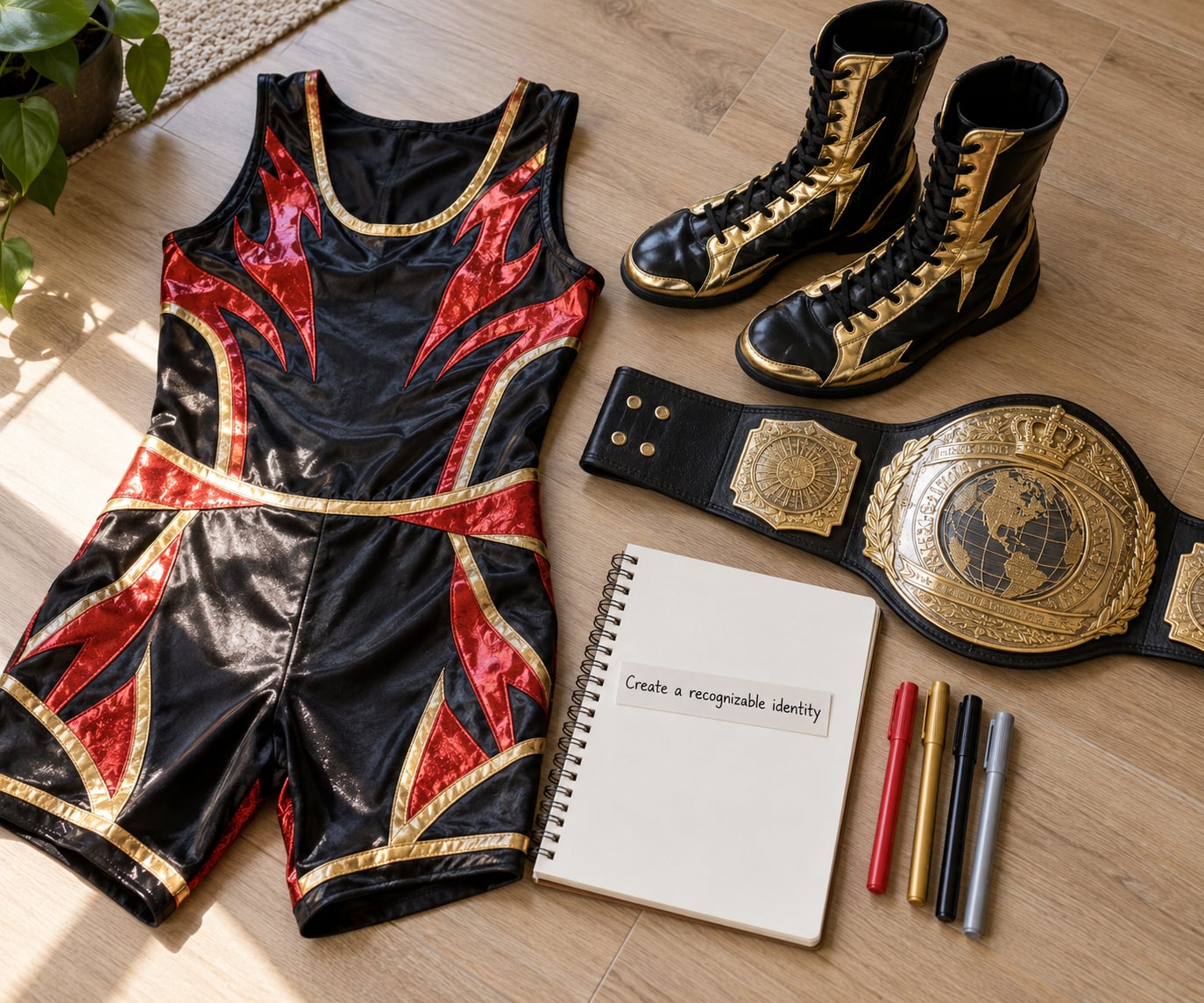
A recognizable identity is not the same as a memorable one. Recognition is speed: can a stranger point you out from a still photo in half a second. Speed comes from one dominant shape or color and one repeated gesture.
Build it in this order. Name first, because the name sets the syllable count your entrance music has to hit. Then color, limited to two so people can name it later. Then silhouette, which is the part a crowd sees from the back row. Then voice, which is the most forgotten element and the one that does the most work on the microphone. Then one signature habit, something small enough that you can do it every single night without tiring: adjusting a glove, stepping over the rope instead of through it, tapping two fingers against the sternum before a promo.
Derive each choice from Step 1. If the desire is proving worth after being dismissed, the colors should be sharp and the entrance should be fast and slightly too eager. If the character hides something, the silhouette should be conservative and the voice should be the most colorful element in the package.
Originality is easier to state than to do. Take the structural lesson from a wrestler you like, never the surface. Learn that Kevin Owens works because his motivation is a plain, ordinary want that anyone in the crowd has had, then build your own version of that plainness. Do not adopt the look, the catchphrase, or the moveset. Fans notice a lookalike instantly and the comparison flattens whatever you were trying to do.
3. Match the personality to the wrestling style
Your attitude should pick the style, not the other way around. A wrestler who builds everything on anticipation and control should not be selling forearm smashes. A wrestler who builds on rage should not be working a submission-grinding pace for twenty minutes.
Match the archetype to your actual body first, because a mismatched style reads as trying too hard no matter how good the concept is. High-flyers need to move; powerhouses need mass; brawlers need to look like they enjoy it; technicians need mat time and a reason to want it. Then check the temperament against the archetype, because the interesting choices live where they disagree slightly.
Personality should also decide your in-ring decisions, not just your strikes. A cautious character will stall, bail out, and run. A reckless one takes the drop from the top because taking the drop proves the point. A vain character will show off after a big move and miss the cover. Once your character makes one of those choices in a match, the crowd learns something about them for free.
Chris Jericho is a useful example because he has rebuilt the same core character through a dozen styles. The motivation stayed legible, so each reinvention read as a new chapter rather than a different person.
4. Build a clear reason to enter the ring
Every character needs a starting condition the crowd can grasp in the first thirty seconds. Proving worth after a public humiliation, seeking revenge for a specific named wrong, protecting a group, chasing one specific title, or correcting something the audience has already been told is broken. Pick one and make it specific.
Specific is the operative word. “I want to be a champion” is a wish. “I am going to win the title my coach threw away the night he got fired” is a hook. The second version gives a promoter a feud, gives you a promo topic, and gives the crowd something to argue about in the parking lot.
This is where relatable motivation earns its keep. The extravagant look gets noticed once. The ordinary want, delivered with conviction, gets people emotionally invested enough to follow the character from show to show. Fandango built a career-adjacent package on self-obsession and willingness to look foolish, which is a very human engine. Mick Foley built on failure and scrappy persistence rather than visual flash. Neither depends on spectacle to hold attention.
Counterargument worth taking seriously: gimmicks do not have to be relatable to work. A character built on theatrical strangeness can connect through craft and commitment alone. Relatability is the cheaper and more durable route, not the only route.
5. Design promos, entrances, and signature moments
The entrance is where the crowd decides whether to look up from their phone, so it needs a clear job. Pick one: intimidate, mourn, distract, or invite. Whichever you pick, the entrance behavior, the gear movement, and the first thirty seconds of the match should all point the same direction.
For promos, write down three things: your vocabulary, your rhythm, and your tell. Vocabulary is the word set you return to. Rhythm is how fast you speak and where you pause. The tell is the physical gesture that replaces a gesture you cannot perform well. Becky Lynch built a package on voice and attitude long before the rest of the presentation existed, which is why the voice carried it.
Then decide what repeats. Two or three signature actions, used in a specific order, do more for a character than anything new. A finisher you use only when you must, a promo catchphrase that lands differently depending on who is in front of you, a gesture the crowd eventually starts doing back at you. Repetition is how a crowd learns to expect you.
Support structure counts too. A manager, a valet, or a faction gives your character someone to talk to, someone to lose to, and someone to protect. It also makes you easier to book, because a booker can give you three minutes instead of ten.
For women wrestlers specifically, build the inner life first and the presentation second. Advice written entirely around men’s archetypes tends to skip past what actually holds a women’s character: voice, frustration, ambition, and a specific target for the heat.
6. Give the character a believable story progression
A character with no arc is a series of unrelated appearances. Decide what escalates. If the motivation is proving worth, the escalation ladder runs through being dismissed, getting one small win, being dismissed again, and finally getting the win that changes the terms.
Bring in an ally, a rival, and one complication early. The ally humanizes, the rival externalizes, and the complication forces a choice. Choices are what make a character feel alive, because a wrestler who never chooses anything is only being moved.
Callbacks do the heavy lifting. Reference something from three appearances ago in a promo or a match, and the crowd realizes the character has a memory. That realization is close to what connection actually feels like from the cheap seats.
Keep the motivation stable through any turn. A babyface turn should change what the character is willing to do, not what the character wants. If the want flips, the crowd has to re-learn you from scratch, and most of them will not bother.
7. Test the character with fans and refine it
Testing is where most self-taught wrestlers stall, usually because they are afraid of reading as a gimmick spammer. The fix is to ask for a reaction rather than for approval. Nobody wants to tell you your character is bad. Everybody has an opinion about whether a character feels cool, boring, sad, or exciting.
Before a debut, show the concept to one trainer and one wrestler who works a different style, and ask two questions: what do you think this character wants, and what would you expect them to do in a match. If their answers do not match yours, the motivation is not clear enough yet. Fix that before anybody sees you.
After a debut, watch the room instead of listening to it. Which entrance moments got phones up. Which promo lines got a reaction. Which match decisions got audible noise. One show is noise; three shows is a pattern.
When a character fizzles, change one thing at a time. Most fizzles are a communication failure in the first sixty seconds of the first match, not a failure of the concept. Shave the entrance, simplify the promo, or move the signature earlier, then test again.
Common Mistakes
Starting with the name and the look. Fix: write the motivation sentence first and only allow yourself to name the character once that sentence exists.
Copying a wrestler you admire. Fix: write down what structural choice makes them connect, then build a character with a different motivation and a different silhouette. Inspiration is fine, resemblance is not.
Choosing traits with no motivation underneath. Fix: list every trait, then cross out any that the central desire does not explain. Whatever survives is your character.
Playing the same match every time. Fix: give each opponent a different question, and let your character’s motivation answer it differently each night.
Leaning on appearance alone. Fix: cut all gear from the description and ask whether the character still works. If it does not, the concept is not finished.
Overpromising. Fix: promise one thing per appearance and pay it off before announcing the next. Credibility on the independent scene is the scarce resource.
Changing direction with no explanation. Fix: any turn should be traceable to a moment on screen. Give the crowd a reason inside the story, not a reason in a social media post.
A few habits help more than the rest: write one page a month, keep a notebook of crowd reactions after every match, and never change two things at the same time.
Frequently Asked Questions
What makes a wrestling character connect with fans?
Fans connect when a character’s motivation explains their choices consistently. The crowd builds a mental model after one or two appearances, and every later match that confirms the model deepens their investment. Consistency matters more than originality: a simple, well-committed character outperforms a clever one that changes every month. Watch for the tells of connection, such as the crowd reacting to your entrance rather than ignoring it.
How do I make a wrestling character feel believable?
Believability comes from consistent cause and effect. If your character is proud, they should refuse help. If they are desperate, they should take the risky option. Write down your motivation in one sentence, then test whether each in-ring decision could be explained by that sentence. Believable characters also react to losses badly, which is the detail most newcomers skip.
How can I develop a wrestling character without copying someone else?
Separate the lesson from the surface. Identify what makes a wrestler you admire work, such as a clear motivation or a repeatable presentation habit, and build your character from that principle with different content. Copying looks, catchphrases, and move sets is what audiences notice. A lookalike gets compared from the first entrance, and the comparison flattens whatever you were trying to do.
What is the best way to get fans emotionally invested in a wrestler?
Give them a specific want and a specific obstacle. Broad wishes do not generate attachment, while named goals and named enemies do. Then pay off small promises consistently, because fans invest in reliability more than in spectacle. A character who loses the same way every time gets sympathy; a character who wins differently every time gets a shrug. Reliability is what turns viewers into return viewers.
How do I keep a wrestling character consistent while still developing the story?
Keep the motivation fixed and change the circumstances around it. The want stays the same while rivals, stakes, and methods shift. That way a turn reads as growth rather than as a replacement, and returning viewers stay with you. If you want to change what the character wants, treat it as a deliberate turn with a clear on-screen reason, and give the crowd a few appearances to adjust.
How do I turn a wrestling gimmick into a believable character?
Keep the visual element and attach a motivation to it that the audience can see. Ask why the character does the strange thing, who taught it to them, and what it gets them. Then let that motivation drive decisions in matches and promos, so the gimmick becomes evidence of character rather than a costume choice. Anything with a motive can grow into a character with an arc.
Conclusion
Learning how to build a wrestling character that connects comes down to ordering. Motivation, then identity, then everything else. Characters fail most often because the cheap parts got designed first and the expensive part, the reason, got patched in afterwards.
Start with three things today: write the central desire in one sentence, state what the crowd should feel in the first thirty seconds of an appearance, and pick one behavior you will repeat in every promo and every match. Get those three on paper and the rest of the build writes itself.