There is no national regulator for professional wrestling in the United States. Deathmatch wrestling is governed, where anything governs it at all, by state athletic commissions, county and municipal venue rules, the promoting company’s own medical policies, and the terms of the promoter’s insurance policy. Is deathmatch wrestling illegal? No. It is legal in every state as a form of professional entertainment, and in most states nobody outside the promotion has a legal say over what happens in the ring.
This guide covers professional deathmatch and hardcore wrestling only. High school and amateur wrestling run under a completely separate set of rules through associations like the National Federation of State High School Associations, and mixing the two is the single most common source of confusion on this topic.
Table of Contents
- How Deathmatch Wrestling Is Regulated in the United States
- Why wrestling regulation is thinner than boxing or MMA regulation
- Which Government Authorities Oversee Deathmatches?
- What Rules Cover Weapons and Potentially Dangerous Moves?
- How Blood, Injuries, and Medical Policies Are Handled
- What Must Promoters Provide Before an Event?
- How Do State Rules Differ for Deathmatch Wrestling?
- Why Do Promoters and Venues Carry Liability Risk?
- How Wrestlers and Promoters Can Stay Compliant
- Frequently Asked Questions
- Is deathmatch wrestling illegal?
- What is considered illegal in wrestling?
- What gets you disqualified in wrestling?
- Which states require a wrestling license?
- What are the rules to a Texas Death Match?
- Are professional wrestling matches pre-determined?
- Conclusion
How Deathmatch Wrestling Is Regulated in the United States
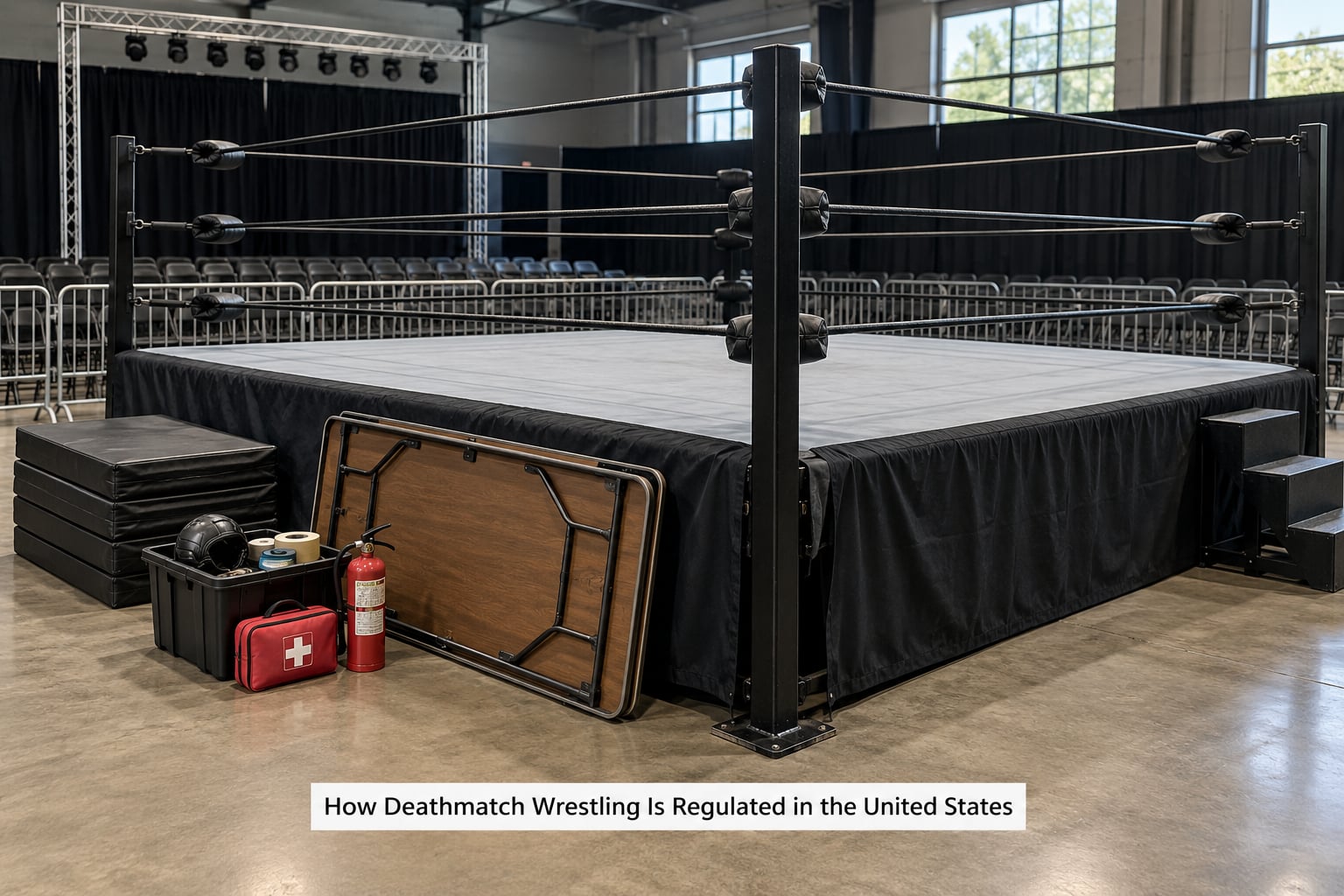
Regulation happens in four layers, and in a given event one or two of them may be doing all the work while the rest are simply absent.
The first layer is the state athletic commission. Roughly two dozen states still license professional wrestling promoters and referees, and those commissions can impose match rules, assign officials, require a ringside physician, and revoke a promoter’s licence. The second layer is local government: county health or fire marshals, and city or county licensing for the building itself.
The third layer is the promoter’s own rulebook, which in the independent scene often functions as the only real regulation in the building. The fourth layer is the insurance market, where underwriters routinely restrict or exclude weapons, blood, and off-site injuries from coverage.
Why wrestling regulation is thinner than boxing or MMA regulation
The short answer is the word “professional.” Boxing and MMA licensing statutes generally grant commissions authority over combat sports where injury arises from athletic competition. Wrestling statutes have historically been written for a different product, and the modern industry is presented as scripted entertainment rather than as a sport.
Long-time fans make this point on r/SquaredCircle, where the loss of commission oversight is remembered specifically as the loss of the no-blood rule. Veteran fans in those threads tend to look back on the licensed era as the period when the sport had a legal floor under it, and treat today’s scene as operating without one.
The practical result: an injury in a deathmatch is handled as a civil liability question after the fact, not as a regulated medical-safety question during the event.
Which Government Authorities Oversee Deathmatches?
State athletic commissions are the only bodies with authority over the conduct of the match itself, and only in the states that still license wrestling.
A commission’s authority typically extends to licensing the promoter, licensing or registering referees, setting rules for sanctioned events, requiring licensed medical personnel at ringside, and holding hearings on complaints. Where a commission supervises an event, its rules outrank the promoter’s preferences. That is the arrangement described in a 1983 Philadelphia Spectrum card announcement, where matches were promoted as “sanctioned and supervised” by the Pennsylvania State Athletic Commission, which supplied a ringside physician and a timekeeper.
County and municipal authorities regulate the building rather than the match. Health departments can inspect the venue, fire marshals can cap occupancy, and local licensing boards can require a permit for the event type. School districts and National Guard armories set their own stricter rules, and those bans are administrative decisions rather than regulatory findings.
There is no federal wrestling regulator. The federal government touches the sport only indirectly, through workplace injury law, federal drug scheduling, and state-level insurance requirements.
What Rules Cover Weapons and Potentially Dangerous Moves?
Weapons rules are the part of regulation that varies most, because the promoter usually publishes the list and the commission, if there is one, either approves it or does not exist to approve it.
A compliant weapons list names every permitted object in advance. Typical entries include a folding steel chair, a wooden kendo stick, a fishing net, a table, a ladder, a folding tray, a garbage can, and a glass bottle. Prohibited items are the ones that turn a promotion into a criminal proceeding: razor blades and thumbtacks deliberately given to a wrestler, barbed wire, broken glass, light bulbs, weapons with exposed metal, and anything improvised on the spot.
Blading means deliberately cutting a wrestler with a blade to produce blood. Where a commission still regulates the sport, blading is frequently the clearest line in the code, and in Pennsylvania it is addressed directly in 5 Pa.C.S. Section 2107(b), which makes it a misdemeanor of the third degree. Blood that arrives on its own is a different matter from blood a wrestler engineered.
Match stipulations then change what the referee is permitted to do, and this is where a No DQ match sits awkwardly inside any regulatory scheme.
| Match type | Weapons | Blood | Referee authority |
|---|---|---|---|
| Standard match | Prohibited | Usually stopped and cleaned | Full authority to stop at any time |
| No DQ | Per written list | Per promoter policy | Can stop for safety, rarely for weapons |
| Texas Death Match | Chairs, barbed wire, ring floor or apron | Common and expected | Stops for unconsciousness and blood pooling, not for weapons |
| Cage of Death | Full cage, weapons on the roof | Common | Same as No DQ, with escape rules |
| Barbed Wire Deathmatch | Barbed wire on the ring or in the ring | Common | Limited; wire injuries often force a stop |
| Ironman | Per written list | Per promoter policy | Timekeeper manages falls, referee manages safety |
| I Quit | Per written list | Per promoter policy | Referee ends match the moment a wrestler says the phrase |
The important thing to notice is that a No DQ stipulation changes the referee’s job, not the law. A wrestler in a No DQ match is not thereby permitted to commit assault, and a promoter cannot license a criminal act by writing it into a match rule. On r/prowrestling, the recurring fan question is whether No DQ gives a wrestler blanket permission, and the answer is that it removes the in-match penalty while leaving criminal and civil liability fully intact.
How Blood, Injuries, and Medical Policies Are Handled
The blood rule is the most widely recognized safety rule in wrestling regulation, and its practical form is simple: the match stops, the surface is cleaned, and the match continues or ends.
Where a commission supervises, the requirement is written into commission regulations rather than left to the promotion’s discretion. Pennsylvania’s model is the most direct example of a statutory approach, treating blading as an offence rather than a stipulation. Most other commissions that still license wrestling handle it administratively instead, through a rule that any match involving a bleeding wrestler is stopped until the surface is disinfected and the wrestler is checked.
Ringside medical staff carry real decision-making power. A commission-assigned physician can end a match for reasons that have nothing to do with the script, including a wrestler who is unresponsive, showing signs of concussion, or unable to continue. A wrestler returning after being cut is normally checked before the bell rings again, and that decision belongs to the physician or medical professional, not to the booker.
The timekeeper runs the match clock and the count. In an Ironman match, the timekeeper’s falls count can end the contest, which is a different kind of authority from a referee’s, and a wrestler who refuses to answer the bell can be given a disqualifying count.
Fan and wrestler testimony concentrates on the limit of all of this. On r/prowrestling, wrestlers who have worked the style describe it as a genuinely dangerous spectacle rather than as wrestling, and the recurring note is that the regret is rarely about doing the matches. The regret is about how far a career was pushed. Forum discussion also raises pay: regular deathmatch work pays poorly relative to accumulated injury, and wrestlers in unlicensed promotions may have no health coverage of any kind.
What Must Promoters Provide Before an Event?
Getting licensed is the administrative part, and promoters describe the paperwork as the least difficult hurdle compared with finding medical staff.
Applications generally ask who owns the promotion, who will referee, which building will host the event, and what stipulations are planned. A promoter in a licensing state typically files a licence application, pays the applicable fee, submits a copy of the event insurance certificate naming the commission as an additional insured, provides the names and credentials of the referee and timekeeper, and lists the weapons by category.
Medical requirements are the part that catches new promoters out. Common conditions include a licensed ringside physician, a certified emergency medical technician on the floor, an ambulance or on-site emergency service commitment, a written emergency action plan with a hospital route, and a stretcher positioned within a set distance of the ring.
After the event, the promoter files a report if there was a stoppage, an injury, or a blood rule violation, and keeps the incident record. In states with no commission, every item on that list becomes a self-imposed policy, which is the central weakness of the unlicensed model.
How Do State Rules Differ for Deathmatch Wrestling?
State rules differ so much that there is no meaningful national standard to compare against, only a set of regulatory postures.
| Regulatory posture | Weapons | Medical cover | Local permits |
|---|---|---|---|
| Commission licenses wrestling | List submitted and approved | Physician required, sometimes assigned | Ordinary venue and fire approval |
| Commission exists but does not license wrestling | Promoter sets the list | Promoter decides | Ordinary venue approval |
| Commission handles other combat sports only | Promoter sets the list, local law still applies | Promoter decides | Varies by county and city |
| No commission at all | Promoter sets the list | Promoter decides | Building-specific rules dominate |
| School or armory venue | Typically prohibited outright | Usually not required for non-athletic use | District or Guard policy, stricter than law |
Two examples show how quickly an enforcement action spreads. When a state revoked IWA Mid-South’s licence over repeated use of broken glass, thumbtacks and mousetraps, the promoter lost the ability to hold sanctioned events in that state, and school systems and National Guard armories in the region moved to ban wrestling events entirely. The administrative bans were not part of the licensing penalty, which is exactly how a single regulatory action turns into a whole market closing.
Legislators have periodically revisited the gap. Connecticut lawmakers have asked why professional wrestling is not overseen the way mixed martial arts is, and similar proposals have been raised elsewhere. None produced a national standard, which is why anyone involved should check the rules for the specific event location rather than assume the rules of a neighbouring state.
Why Do Promoters and Venues Carry Liability Risk?
Liability exposure climbs sharply when the paperwork is thin, and the same facts look very different in a state with a commission than in one without.
Informed consent and waivers are the first layer, and their value depends on how specific they are. A general liability release tells a court very little about a wrestler who was handed a razor blade. A written rules sheet that the wrestler signed, listing the weapons in use, is far stronger evidence that the risk was disclosed and accepted.
Defective equipment and unsafe venues are the second layer. A loose ring rope, a ring apron that has rotted, a floor covered in broken glass that nobody cleared between matches, each of these is a straightforward premises liability problem that exists independently of anything the promotion did or did not do to a wrestler’s body.
Undisclosed weapons and missed injuries make up the third layer. A promoter who tells an insurer a show is standard wrestling and then books a barbed wire match has created a coverage problem. A promotion that lets a wrestler continue after a head knock, or after a wrestler tells a referee the match is off, has a different kind of problem. Workers’ compensation filings add a further wrinkle, because wrestlers are frequently treated as independent contractors who are not covered by the promotion’s policy.
Nothing here is legal advice, and liability questions turn on the specific facts, the venue contract and the wording of the insurance policy.
How Wrestlers and Promoters Can Stay Compliant
A workable compliance routine is mostly about writing things down before the doors open.
- Identify which regulator actually covers the event, then confirm whether that commission licenses professional wrestling at all. A commission that regulates boxing and MMA may have nothing to say about a wrestling show.
- Check the county and city requirements for the specific building, including fire inspection, occupancy and any permit tied to the type of event.
- File the promoter licence application and pay the fee early, since processing times vary widely by state.
- Publish a written weapons list and have every wrestler sign it. No item appears in the ring that is not on that sheet.
- Procure event insurance that explicitly covers weapons and blood, and confirm that the venue’s own policy does not exclude them. Insurers restrict these risks more often than promoters expect.
- Book licensed medical personnel, name a ringside physician, and give that physician written authority to stop any match without consulting the booker.
- Brief referees, wrestlers and the timekeeper on the blood rule, the concussion protocol, and who has final authority to end a bout.
- Inspect the ring, apron, floor, lighting and entry ramp before the first match, and re-check the floor between matches once weapons come into play.
- Document consent for every participant, including venue waivers, medical disclosures, and the signed rules sheet.
- Hold a short emergency review before the doors open: ambulance access, hospital route, emergency contact, and the stretcher position.
Keep the incident log after the show. Records of stoppages, blood-rule violations and medical interventions are what a commission, an insurer or a court will ask for first.
Frequently Asked Questions
Is deathmatch wrestling illegal?
No. Deathmatch wrestling is legal in every U.S. state as professional entertainment. What varies is the oversight: in states that still license professional wrestling, a state athletic commission may set weapons rules, require a ringside physician and restrict blading. In states with no wrestling commission, the promoter’s own rulebook and the venue’s policy are the only rules, and criminal law still applies to deliberate weapons.
What is considered illegal in wrestling?
Illegal conduct in professional wrestling centres on deliberate weapons and on blading. Improvised weapons, razor blades, thumbtacks, barbed wire and broken glass are treated as criminal assault or wanton injury rather than as part of a match. Pennsylvania makes this explicit in 5 Pa.C.S. Section 2107(b), which treats blading as a misdemeanor of the third degree. A No DQ stipulation removes the in-match penalty; it does not legalise the act.
What gets you disqualified in wrestling?
In a standard match, disqualification usually comes from a prohibited act such as a low blow, an eye poke, a foreign object or leaving the ring during a count. In a No DQ match those penalties are removed by stipulation, so a weapon strike does not disqualify anyone. A No DQ wrestler can still be disqualified for refusing to answer the bell, for leaving the ring, or for a stoppage the referee or ringside physician calls for safety.
Which states require a wrestling license?
There is no single list, because rules differ by event location. A number of states still license professional wrestling promoters through a state athletic commission, which is why you will see sanctioned shows there. Other states have a commission that handles boxing and MMA but not wrestling. In those states a promotion needs no wrestling licence and simply follows local venue rules and its own policy. Always check the commission for the state where the event happens.
What are the rules to a Texas Death Match?
A Texas Death Match is a no-disqualification match where the ropes are removed, falls count anywhere in or out of the ring, and chairs, barbed wire or the ring apron are used as weapons. The match usually ends by pinfall, submission, count-out, or a time-limit draw. The referee still stops the bout for a wrestler who is unresponsive, bleeding heavily, or unable to continue, so the stipulation changes the fall rules rather than removing safety stoppages.
Are professional wrestling matches pre-determined?
Modern matches are worked, which is central to why regulation works differently than for boxing or MMA. Commissioners and legislators in states that have considered new laws argue the other way, citing cumulative injury, and some have questioned why a scripted performance should not be treated as a sport for safety purposes. Until a state passes a law covering it, the practical answer is that promotions operate under entertainment rules with almost no state sports body policing the match.
Conclusion
Deathmatch wrestling is regulated mainly by state athletic commissions where they still exist, by county and city rules over the building, and by the promoter’s own policy everywhere else. The single most useful thing anyone involved can do is find out which of those layers actually applies to the event location, then write the weapons list, the medical plan and the consent forms down before the first ticket is sold.