High flying wrestlers protect their knees in four layers: protective gear, landing mechanics that roll impact from heel to hip, strength and prehab work that controls a single leg, and workload management across a heavy match schedule. No gear or technique removes the risk, but the wrestlers who fly for two decades are almost always the ones who work all four.
This guide breaks down what each move actually asks of a knee, which injuries show up most, and what a wrestler, a coach or a worried parent can realistically do about it in 2026.
Table of Contents
- How High Flying Wrestlers Protect Their Knees
- The four layers of knee protection
- Why High Flying Moves Put Stress on the Knees
- Common wrestling knee injuries and what they feel like
- What Strength and Conditioning Work Helps?
- Quadriceps, especially eccentric work
- Single-leg strength and stability
- Hamstrings and glutes
- Ankle and hip mobility
- Trunk control and aerobic base
- How Do Wrestlers Practice High Flying Moves Safely?
- How Can a Wrestler Land With Less Knee Stress?
- How High Flying Wrestlers Protect Their Knees During Matches
- How high flying wrestlers protect their knees once fatigue sets in
- What Recovery Habits Support Knee Health?
- When Should a Wrestler Stop Training or Competing?
- Frequently Asked Questions
- What is the most common type of knee injury in wrestling?
- Is wrestling hard on your knees?
- Do professional wrestlers wear knee pads?
- What is the best knee sleeve for wrestling?
- What are the three C’s of knee injuries?
- Is wrestling safer than boxing?
- Conclusion
How High Flying Wrestlers Protect Their Knees
Ask a trainer what protects a high flyer’s knees and you will usually get four answers in the same order. Gear covers the joint surface, technique controls how force travels, strength work controls how much force arrives in the first place, and workload control decides how much of it the knee can take in one week.
A high-flying style means a move set built on aerials: frog kicks, dropkicks, senton splashes, springboard attacks, moonsaults, 450 splashes and top-rope dives. The common thread is takeoff and landing, both of which route a wrestler’s body weight straight through two knees that are bent, twisted or extending at the moment of impact.
The four layers of knee protection
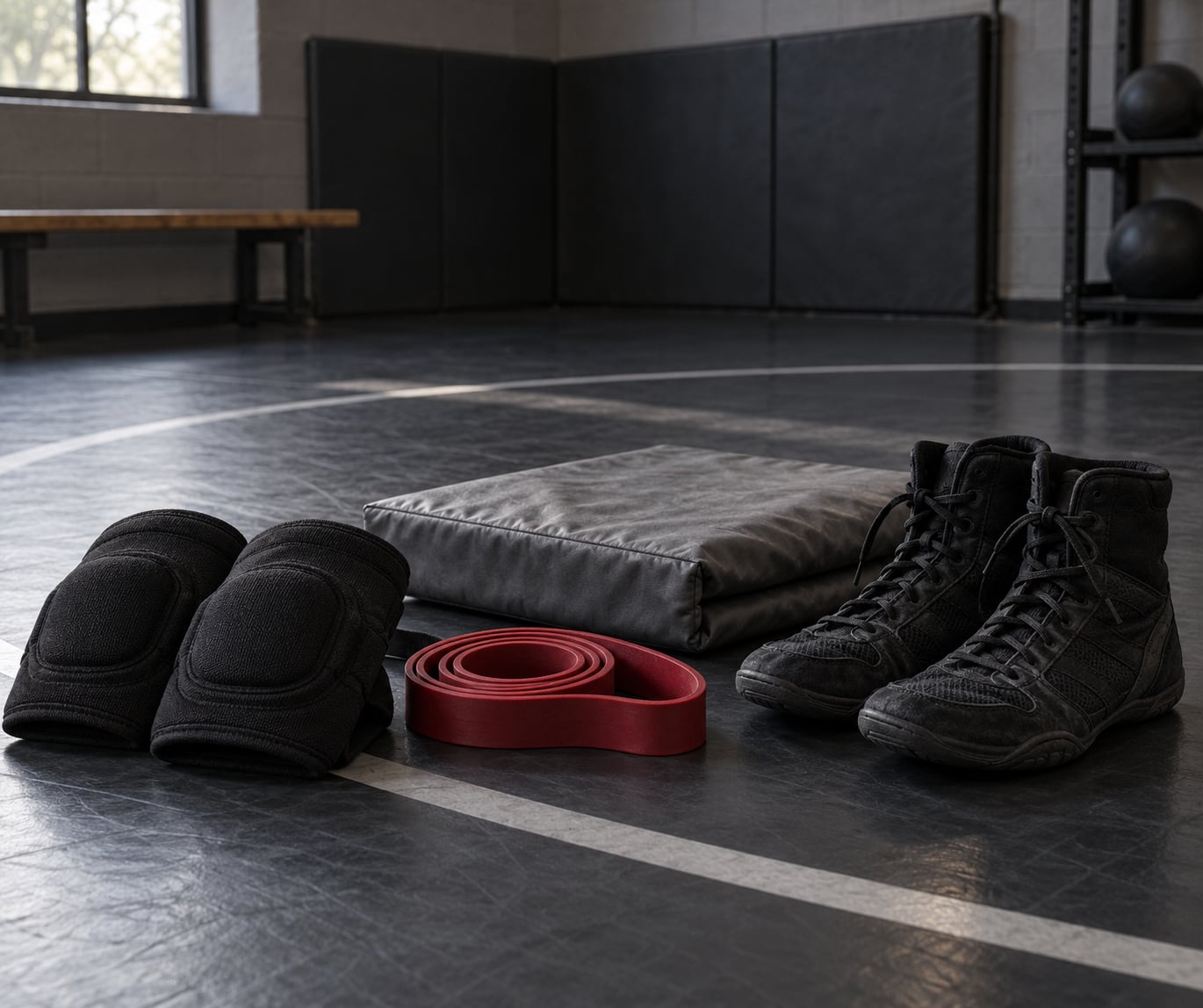
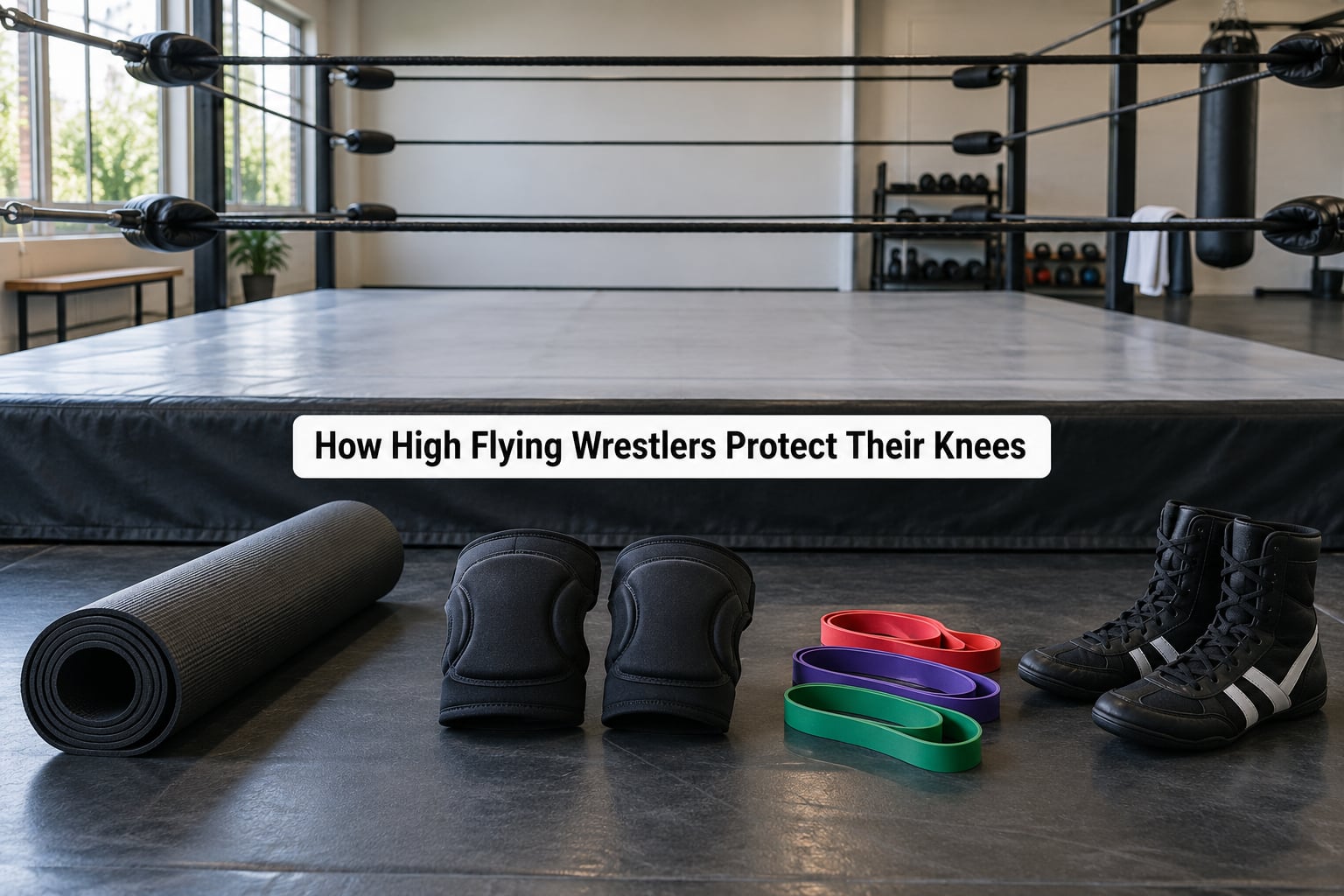
- Equipment. Knee pads, compression sleeves or hinged braces, chosen for the specific move and the specific wrestler.
- Mechanics. Landing technique that spreads impact over a longer time and a wider surface instead of dumping it into the joint.
- Strength and prehab. Quad and glute capacity, hamstring strength, single-leg control, ankle mobility and trunk stability, all built outside the wrestling room.
- Load management. Pacing a match-heavy schedule, scheduling rest days, and backing off when pain appears instead of pushing through it.
Each layer covers the gaps in the others. Pads do nothing for landing mechanics, and perfect mechanics do nothing about a wrestler taking fifteen hard matches in eleven days.
It is worth saying plainly that no knee sleeve prevents injury. What gear does is spread surface pressure, add a small amount of warmth and proprioceptive feedback, and take the edge off a direct blow. The protection comes from technique and preparation around the gear.
Why High Flying Moves Put Stress on the Knees
Wrestling asks the knee to handle three things badly: absorbing weight it did not choose to receive, rotating while loaded, and extending past where it should. High flying intensifies all three because the takeoff is usually fast, the flight is unstructured, and the landing is often on a hard canvas over a frame or a ring floor.
Absorption is the big one. A knee that lands straight and stiff takes the whole load in one instant. The same knee landing with flexion lets the muscles and the joint take several hundredths of a second longer, which lowers peak force sharply. Take the landing away from a senton splash and a hard stop on the feet, and you have a very different joint.
Rotation is the second. A diving crossbody or a mid-air turn means the foot is planted while the hips and shoulders keep rotating. That combination loads the medial and lateral ligaments, and it is why so many wrestling knee problems show up on the inside or outside of the joint rather than in the kneecap.
Hyperextension is the third, and it is the least expected. A heel hook or a badly timed landing can push the knee backward past its normal range. The knee was built to bend forward. Asking it to do the opposite, under load, with no muscle prepared for it, is how careers quietly change.
Common wrestling knee injuries and what they feel like
- Patellar tendinitis. Dull ache under or just below the kneecap that builds through a session and settles overnight. Common with heavy jump and dive volume.
- MCL strain. Pain and swelling on the inside of the joint, often after a twisting landing or a side impact. Swelling can arrive hours later.
- Meniscus tear. A catching, clicking or locking sensation, sometimes with a pop, usually with joint-line pain and some swelling.
- ACL tear. A sharp pivot, a sudden pop, rapid swelling within minutes, and a knee that feels unstable or gives way when turning.
- Contusion. The wrestler’s own knee striking the canvas on a bad landing. Bruising and pain on the kneecap, painful to kneel on.
- Hyperextension injury. Pain at the back of the joint after the knee is driven past its normal bend, often with rapid swelling.
In a 2011 r/SquaredCircle thread about Cody Rhodes wearing kneepads, the consensus was that kneepad use was a negotiation rather than a blanket rule, permitted as long as the wrestler wore them for high-flying acrobatics specifically. That is still a fair picture of how the conversation goes in most locker rooms today.
What Strength and Conditioning Work Helps?
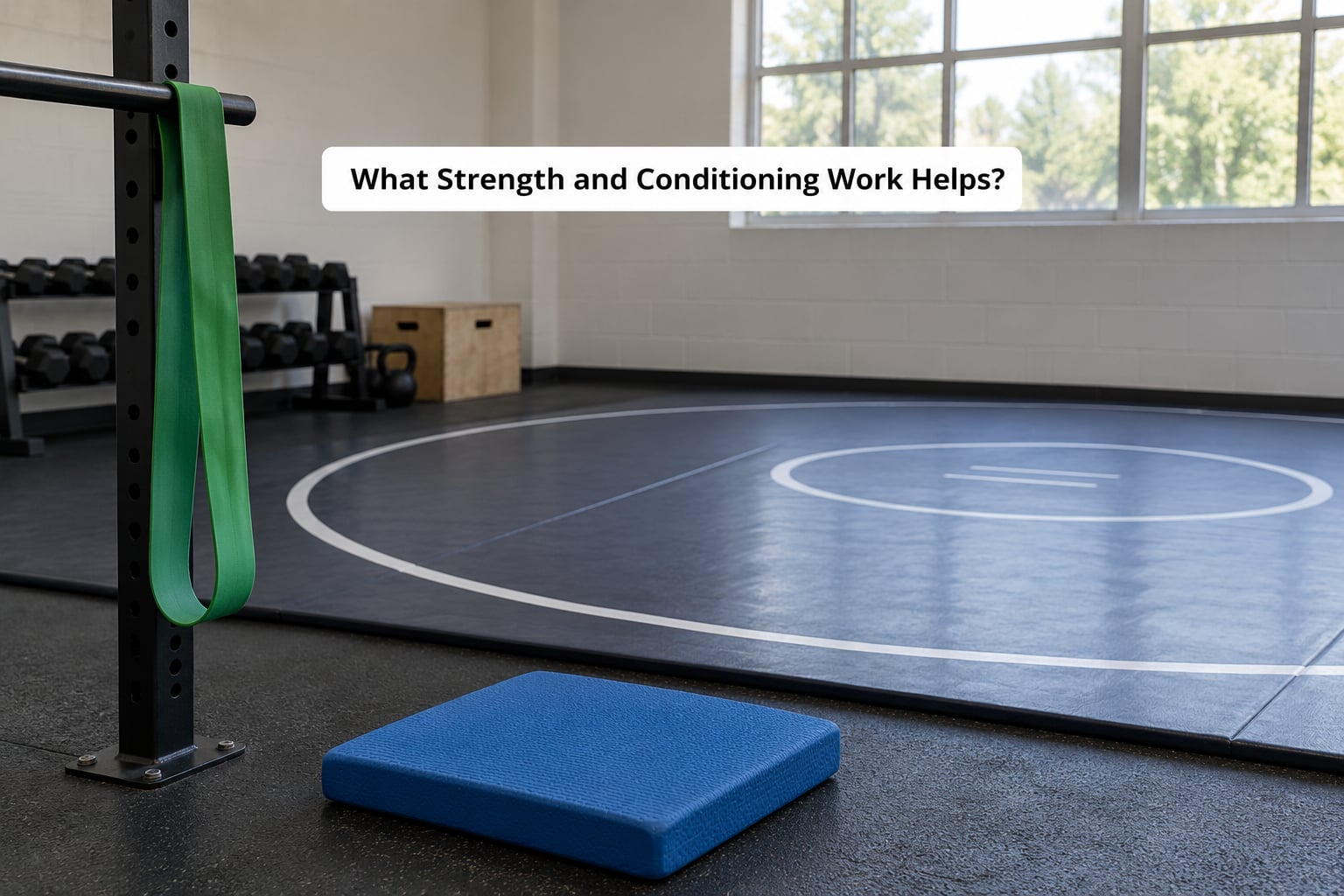
Strength work does not make a landing softer. It makes the muscles around the knee better at controlling the wrestler before the knee has to, which is what turns a stiff arrival into a controlled one.
Quadriceps, especially eccentric work
The quads are the main brake on a landing. Eccentric exercises, where the muscle lengthens under load, train that braking ability more directly than pressing movements do. Slow squats, step-downs from a box, and controlled lowering out of a squat are the staples. Depth matters more than load here.
Single-leg strength and stability
Almost no wrestling move lands on two feet. Single-leg work, split squats, step-ups and single-leg balance on an unstable surface, builds the hip and knee control needed when only one leg has to absorb the landing. It also mirrors the position a wrestler is in during a kick exchange.
Hamstrings and glutes
The hamstrings and glutes sit behind the knee and do a lot of the work of controlling forward momentum. Weak glutes push the knee inward on landing, which is one of the most common ways an otherwise clean landing goes wrong. Romanian deadlifts, hip hinges and banded work in all three planes cover this.
Ankle and hip mobility
An ankle that cannot dorsiflex turns every landing into a knee-first arrival. Simple calf and ankle mobility drills, plus hip work, often fix landing problems that look like knee problems. This is the cheapest fix on the list and the most overlooked.
Trunk control and aerobic base
A tight trunk turns a rotational landing into a rotational knee problem. Planks, carries, anti-rotation work and controlled rotation keep the middle from deciding where the knees end up. The aerobic base matters too, because a wrestler who gasses out at minute eight lands badly from then on.
How Do Wrestlers Practice High Flying Moves Safely?
Rehearsal is the protection. Moves are drilled on the floor long before they are attempted from the ropes, built up in stages, and coached rather than self-taught.
A wrestler learning a senton will first rehearse the jump and the tuck on a padded floor. Then they will catch the tuck and roll it out onto a crash mat. Only after the coach is happy with shape and landing do they go to height, and only then to a live partner. Each step adds one variable at a time.
Progression matters more than volume here. Fifty sloppy repetitions of a new landing are worse than five good ones, because the body is learning whatever pattern is happening in front of it.
Surfaces change everything. Landing on a folded ring apron or a thin gym mat puts the knee through a range it was not meant to handle. Full crash mats, wrestling mats and spring floors are for learning new aerial moves. Ring canvas over steel frame is for performing them.
Coaching feedback should be constant and specific. One thing at a time, told before the attempt rather than after, makes progress faster than twenty reps of general encouragement.
Equipment checks belong in this list too. Worn or ill-fitting kneepads shift during a match. So do boots with a broken sole or a lace that has come loose. Neither belongs on a jump.
And the honest part: practice protects the body only when it is managed. Repeating a hard aerial session on three consecutive days turns a good progression into a bad week.
How Can a Wrestler Land With Less Knee Stress?
A wrestler absorbs a landing by touching down on the ball of the foot, letting the heel lower after, and bending the knee to bring the hips down and through rather than stopping dead. The hips and trunk take the rest of the load, and the movement keeps going instead of ending on a locked knee.
The heel-to-toe rollover is the first thing to get right. Landing flat-footed and rigid sends the full force up through the shin and out through the joint. Touching down on the ball of the foot lengthens the time available to absorb and spreads the load along a larger surface of the shoe.
The second is knee flexion. A wrestler who lands with a small, controlled bend travels maybe 30 to 45 centimetres down and through, letting the muscles take the momentum over more distance. The wrestler who lands with almost no bend has nowhere to put it.
The third is position. Knees tracking over the feet in roughly the same direction as the toes keeps the load centered. A leg crossing under the body on an off-balance landing pushes the joint sideways, which is where ligament problems come from.
The fourth is the follow-through. Real dropkicks and frog kicks land on the feet and then transfer into a roll or a hop. Landing and sticking in place, which is what happens when a move is off-balance, is far harsher on the knee.
None of this should be learned from a video. A qualified coach watching a wrestler land from the outside will spot things the wrestler cannot feel. Individual technique is a coaching conversation, not a checklist.
How High Flying Wrestlers Protect Their Knees During Matches
Inside a match, protecting knees is a decision-making problem as much as a physical one.
Move selection is the first filter. Not every finisher has to be hit every time. A wrestler who takes a dive to the outside on every show and drops the senton on every finish is spending the same joint reserve repeatedly in a short window. Spreading the impact across a match, or dropping a high-impact finisher to a shoulder block or a rope-assisted version, is normal work.
Pacing protects the landing more than most people expect. A wrestler landing a dive from the top rope at minute two and the same dive at minute eighteen has two very different landings, and only the first one was planned.
How high flying wrestlers protect their knees once fatigue sets in
Once the legs are heavy, the mechanics that were drilled stop holding on their own. That is when a wrestler substitutes a caught move, holds a pose rather than adding height, or hands a spot to a partner instead of hitting it at speed. Choosing a safer version of a move is a skill, not an admission.
Communication is what makes that possible. The exchange has to be agreed before the bell, because nobody can negotiate a catch in mid-air.
Gear during a match has one more job than protection. Kneepads cut surface friction and give opponents a visible landing surface, which changes timing for both people. Promotions differ on when they are allowed for acrobatic moves, and a wrestler who does not ask in advance gets told no in front of an audience.
One more practical habit: a match should not be the first time a move is tried. Anything debuted on live television without rehearsal is a coin flip on the knee.
What Recovery Habits Support Knee Health?
Recovery is where the accumulated load is either paid down or carried forward. The basics are unglamorous and they work.
Sleep is the first one. Most tissue repair and hormonal recovery happen at night, and a wrestler running a tour schedule on short sleep is asking a knee to rebuild under an overdraft. Seven to nine hours is the usual adult range, and consistency matters as much as the total.
Hydration and fuel follow. A knee that is landing a dive on empty is landing it badly. Protein, carbohydrates and fluids around training days matter because the landings are what create the damage those nutrients repair.
Rest days are the underrated piece. Wrestling schedules compress hard, and most wrestlers plan training days without planning the day after. Treating a knee as sore the morning after an aerial-heavy session as a signal to train something else is simple and effective.
Mobility work between sessions keeps ankles and hips moving through range. It does not replace load, but it means the next session starts from a better position.
Gradual return after time off matters more than anything for a returning wrestler. Coming back to full-intensity aerials after a break has the same effect on a knee as spiking the training volume. Walk it back.
And the line that is not negotiable: persistent pain, swelling that has not settled, a knee that gives way, catches or locks gets assessed by a sports medicine professional or a doctor. Nobody at a training facility can read a ligament from the outside, and nobody can tell whether a torn meniscus needs rest or a scope.
When Should a Wrestler Stop Training or Competing?
Normal fatigue feels dull, symmetrical, and gone after a day or two of rest. Warning signs feel sharp, one-sided, and specific to a movement.
Stop training that day and get it checked if pain is sharp rather than aching, if it wakes you at night, if the knee is visibly swollen, if it gives way during a movement, if it catches or locks, if there was a pop with rapid swelling, or if the same spot has hurt for more than a week without improving.
Swelling is the most reliable signal most people have. A knee that is measurably bigger in the morning than the night before needs a professional assessment, not another session.
Toughing it out is the worst available strategy here. Wrestling culture rewards working through pain, and a knee is a poor place to apply that lesson because the thing being protected is the joint that carries every subsequent move. A wrestler who rests for a week often returns in a month; a wrestler who loads a torn ligament returns in a season or not at all.
Some injuries do end careers, and it helps to hear that honestly. A fully torn ligament with an unstable knee can rule out high flying entirely, since the moveset is built on stable landings. A doctor, not a trainer and not a fan forum, is the only person who can say which category a knee falls into.
For parents of young wrestlers, the community advice on r/SquaredCircle is the standard caution: taking frequent bumps before eighteen is a lot to ask of joints that are still developing. Start young athletes on fundamentals and mat-based work, and hold acrobatic moves until the body has the strength base to land them.
Frequently Asked Questions
What is the most common type of knee injury in wrestling?
Contusions from the knee hitting the canvas are the most frequent injury in wrestling, because they happen on almost every bad landing. Among deeper injuries, patellar tendinitis and MCL strains are common, since repeated impact and twisting both irritate those structures. ACL tears are less common but more likely to end a high-flying career, because the moveset depends on stable landings. Any swelling that has not settled by the next morning deserves a professional assessment.
Is wrestling hard on your knees?
Yes, compared with most sports. Wrestling combines repeated impact landings, twisting under load and hyperextension in a single session, and high-flying styles add jump height and hard surfaces on top of that. Amateur wrestlers who never leave the mat usually finish with fewer knee problems than high-flyers, so the style matters more than the sport does. Strength work, correct landing technique and workload control are what separate a career from a run of injuries.
Do professional wrestlers wear knee pads?
Many do, and in most locker rooms the pads are tied to a specific deal: a wrestler may skip them in general, then wears them for high-flying acrobatics. A 2011 r/SquaredCircle thread on Cody Rhodes described exactly that arrangement. Pads spread surface pressure and soften the blow when a knee meets the canvas or a boot. They do not prevent ligament injuries, and a wrestler who thinks they do will happily land worse.
What is the best knee sleeve for wrestling?
A compression sleeve is the most practical choice for most wrestlers because it adds warmth, mild support and a small amount of proprioceptive feedback without restricting the joint. A hinged brace is heavier and better suited to someone returning from injury under medical guidance, at the cost of bulk and heat. Pads are for impact, sleeves are for warmth and feel. Most wrestlers end up wearing both, and none of them replaces good landing technique.
What are the three C’s of knee injuries?
The three C’s are contusion, cartilage injury and cruciate ligament injury. Contusions are the everyday bruising from a knee hitting the canvas. Cartilage and meniscus problems show up as catching, clicking or locking inside the joint. Cruciate injuries are the serious structural ones, marked by instability and rapid swelling. The reason trainers care about the C’s is that each one behaves very differently over the following weeks.
Is wrestling safer than boxing?
It depends on the style and the rules, and neither sport is gentle. Professional boxing concentrates damage on the head with repeated blows, where wrestling concentrates damage on joints, the neck and the skin with repeated falls and impacts. The injury profile of a high-flying wrestling career is dominated by knees and shoulders, while a boxing career is dominated by neurological concerns. Ask a doctor for an individual assessment rather than relying on either reputation.
Conclusion
Start with the foundation. Build quad, hamstring and glute strength, get the ankle and hip range of motion, and learn what a proper heel-to-toe rollover feels like with a coach watching, not a video.
Then progress the moves slowly, rehearse on padded surfaces before height, and rehearse landings before you rehearse aerials. Match to match, keep an eye on how many hard landings a week you are absorbing, and swap a finisher for a safer version when the legs get heavy.
Most important of all, respond early. A dull ache that settles after a rest day is normal. Sharp pain, a knee that gives way, or swelling that has not gone by morning is not, and that is a doctor conversation rather than a toughness test. Nobody on the roster talks about the knee protection that happened off camera, but that is where a long career is actually built.