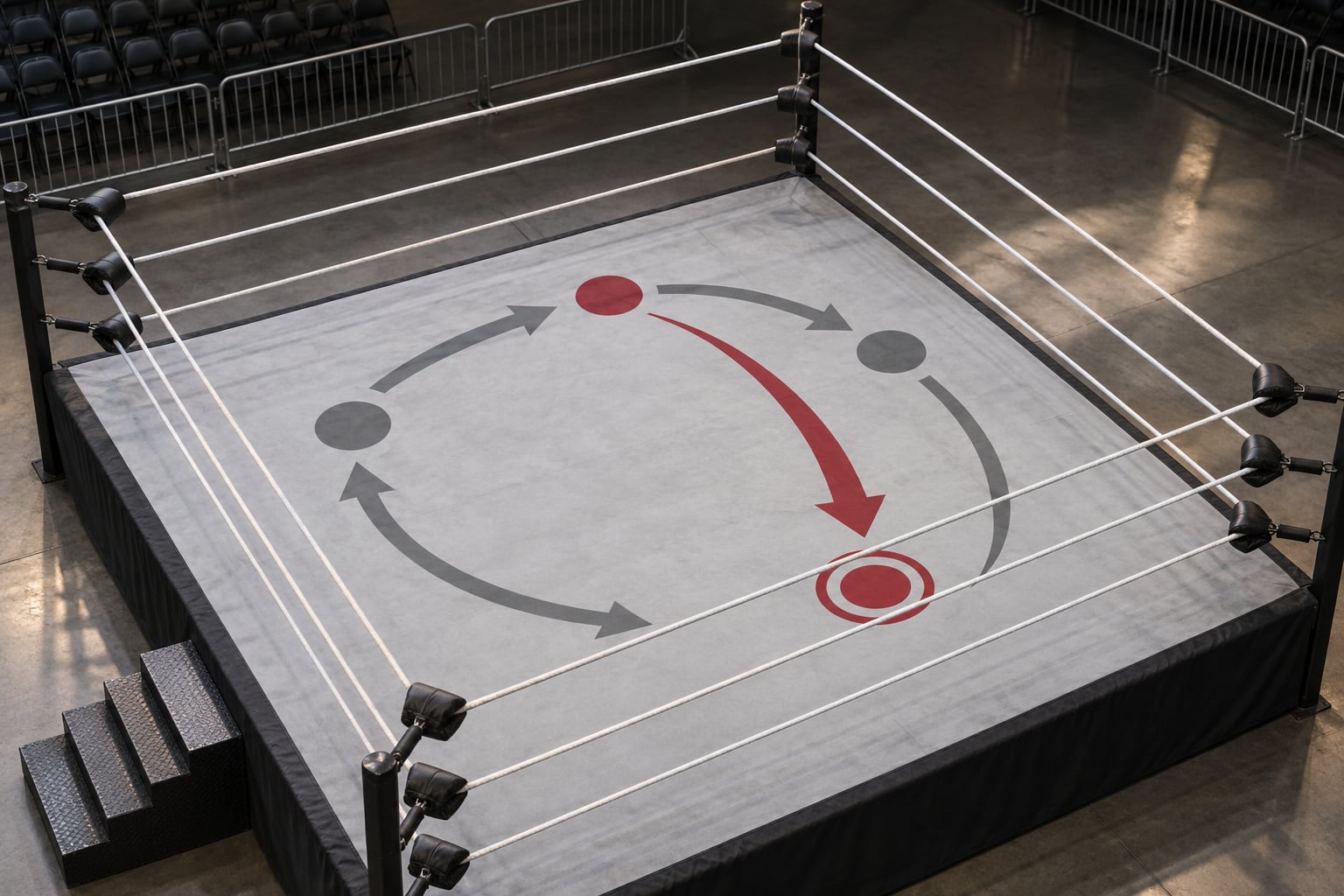
Finishers stop getting clean wins because a match that runs long needs somewhere else to go. Once a booking has spent twenty minutes on kick-outs, counters and near-falls, the finish stops being the payoff and turns into one more thing that happens. The reason is never a single cause. It is a stack of them: match length, near-fall inflation, protecting the next payoff, deliberate kick-out scripting, move variety and plain audience fatigue.
Here, “finisher” means the signature finishing move of a professional wrestler — not the wrestling video game ability, not the drywall tool, not the marathon event branding. This is about matches on television, not about a finishing move in WWE 2K or a paint product.
Table of Contents
- What Does a Clean Win Mean for a Finisher?
- What Changed in Modern Wrestling?
- Why Finishers Stop Getting Clean Wins in Modern Matches
- How Match Length and Near-Falls Change the Impact
- Why Wrestlers Protect Their Signatures
- How Booking Creates and Loses Finisher Moments
- Does Move Variety Make Finishers Feel Less Special?
- Do Crowds Stop Believing in Clean Wins?
- How to Tell a Planned Kickout from a Botched Finish
- Frequently Asked Questions
- Why does a wrestler kick out of their own finisher?
- Is every finisher kickout planned by the booking team?
- Why do wrestlers suddenly use a different finisher?
- Does protecting a finisher make it better or weaker?
- How can you tell a botched finish from a scripted kickout?
- Why do finishers still win cleanly in some matches?
- Conclusion: Start with the Finish, Not the Kickout
What Does a Clean Win Mean for a Finisher?
A clean win is a match that ends on the three-count with no kick-out, no referee break, no outside interference and no escape. The finisher converts the first time it lands.
That matters because a finisher is a wrestler’s payoff currency. When Cody Rhodes hits the Cross Rhodes for the three-count, the crowd reads a statement: that move ends matches. If the same move gets kicked out of four times in a row, the crowd reads the opposite — that move is a transition, not a conclusion.
Three terms do most of the work here. A signed finisher is the move booked to end the match. A signature move is a popular move that does not have to finish anybody. A transitional move is a big, spectacular move used to bridge to the next sequence. Somewhere along the way a lot of finishers quietly become signature moves, and then transitional ones.
One rule surprise worth knowing: nothing in wrestling rules requires a pause after a kick-out. The losing wrestler does not have to rest, and the referee does not have to reset them. Fans have asked this on r/prowrestling repeatedly, and the answer is that the pause is convention and crowd expectation, not a rule. When a wrestler springs straight back up and the covering wrestler simply walks away, that one beat tells you more about the match’s structure than anything said on commentary.
What Changed in Modern Wrestling?
Main events got longer, cards got bigger, and television got more time to fill. A twenty-five minute New Japan Pro-Wrestling main event and a six minute television sprint are both legitimate structures, but they produce completely different finisher economics.
Why Finishers Stop Getting Clean Wins in Modern Matches
Six reasons come up again and again when this topic gets argued, and most matches that disappoint on the finish hit at least three of them.
- Match length. A twenty-five minute match has already spent its drama. The finish gets whatever is left over, and often that is a scramble rather than a payoff.
- Near-fall inflation. Every kick-out is dramatic the first time. By the fifth, the crowd knows what it means, so it stops meaning it.
- Protecting the next payoff. A booker who knows a finisher lands clean in December will refuse to spend it in October.
- Star conservation. Headlining wrestlers carry a heavy schedule. A finish that ends the match early is sometimes treated as a scheduling tool rather than a lost main event.
- Scripted kick-outs. Some kick-outs are decided weeks out so the loser still gets a moment. The move is sacrificed on purpose to build someone.
- Move variety. When a wrestler has four finishes, each one gets used in transitional spots and none of them gets to be rare.
The uncomfortable part is that one fan complaint about 2026-era booking captures the whole thing: “finisher tier moves are used as transitional and finishers aren’t protected.” That poster was describing a structural failure, not a taste disagreement.
How Match Length and Near-Falls Change the Impact
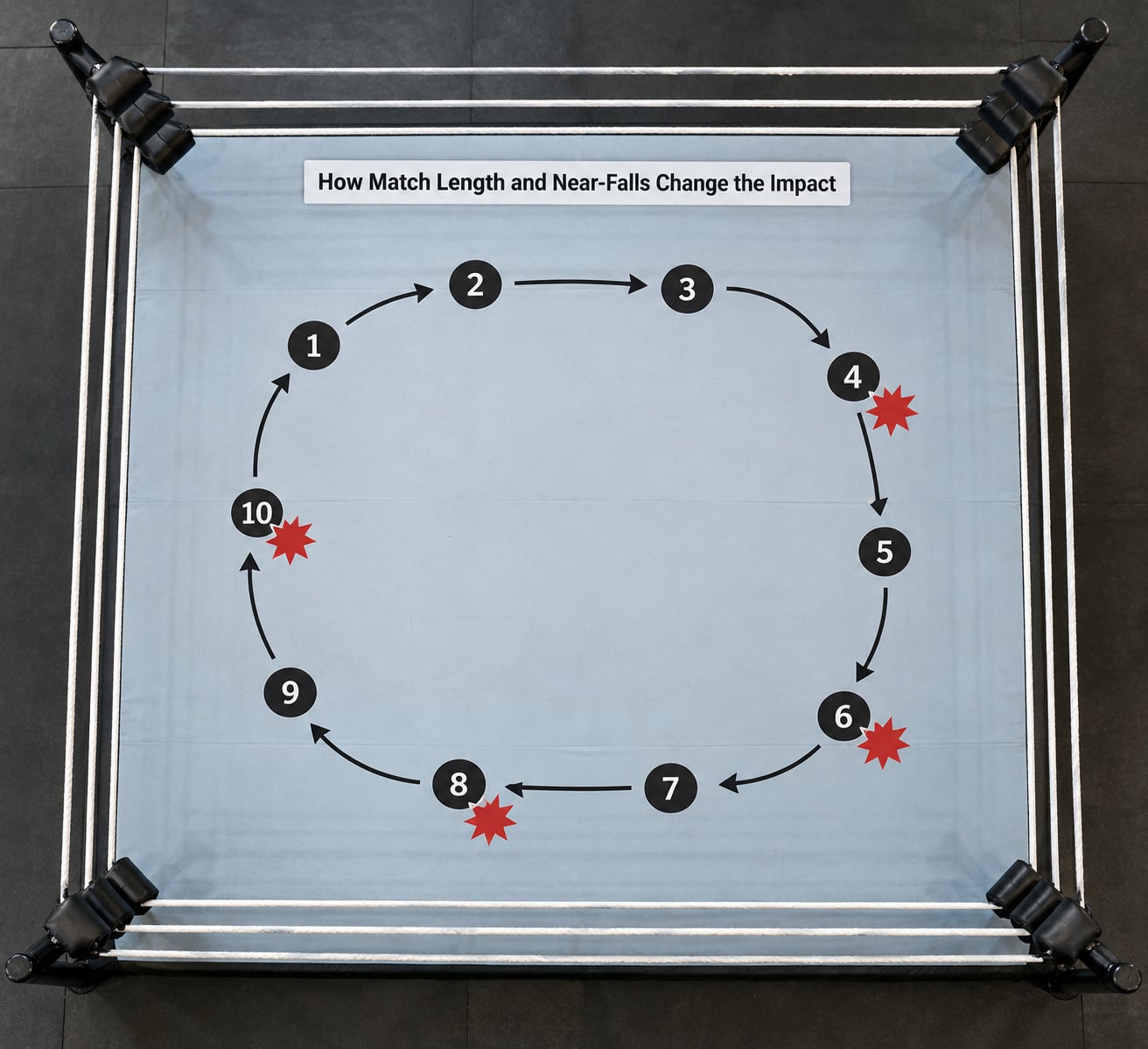
Watch the clock, not the moves. Once a match passes about fifteen minutes and the first finisher has already been kicked out of, the odds of a clean finish fall for structural reasons rather than talent reasons. That, more than anything else, is why finishers stop getting clean wins in modern wrestling.
The community has a good model for this, borrowed from video game players who deal with a mechanic called a pin escape rating: kicking out has its own energy bar that you need to drain. The first two pins are almost never the win. The third might be. The fifth is a joke, because the crowd has spent the drama already.
That is what makes the Ospreay versus PAC match at All Out 2024 the example fans still bring up. Poison Ranas landed repeatedly and were barely sold. Counters came back immediately. The Hidden Blade took more than one attempt. By the time someone was actually pinned, nobody had the emotional credit left to feel it.
The counter is real, though. Forcing your opponent to burn energy to kick out is legitimate psychology, and repeating pin attempts is exactly how you sell a near fall. The problem is quantity, not principle. One kick-out makes the second win bigger. Four make the finisher look decorative.
| Finish type | What it signals | When bookers use it | How the crowd reads it |
|---|---|---|---|
| Clean win off the finisher | The move is rare and decisive | Title matches, debuts, feuds that need a statement | Big pop, belief in the wrestler |
| Kick-out of a finisher | Extra drama, or a match that must go longer | Once or twice, in the middle third | Exciting the first few times, flat after |
| Flash pin or roll-up | Underdog heart, quick steal | Babyface upsets, opening match heat | Cheer for the person taking a chance |
| Finisher after a long sequence | Maximum effort and payoff | End of an epic, main events | Great when it lands, ruined if it gets kicked out |
| Time-limit draw | Nobody could commit | When a finish is not ready to be written | Unfinished business, frustration |
Why Wrestlers Protect Their Signatures
From a kayfabe standpoint, the argument is simple: if you are the strongest person in the ring, being kicked out of the thing that makes you strong looks bad. The Cagematch comment that gets quoted on this topic makes a sharper version of the point. AJ Styles kicked out of John Cena’s specials during their matches because those moves belonged to specialists and Cena is not a specialist.
That “your finisher versus their finisher” distinction is the one smart viewers already make. Kicking out of someone else’s finisher sells that person’s power. Kicking out of your own costs you.
Wrestlers also protect signatures for boring physical reasons. A finisher lands on the same shoulder, neck or lower back every time it is hit, and independent wrestlers working eighty shows a year feel it. Unpredictability matters too: a finisher that never gets kicked out of stops being a threat, and a threat is the only reason opponents take it seriously.
Selling a kick-out properly can also raise the value of the eventual clean win. The WrestleMania 42 weekend diary from Social Suplex describes Senka Akatsuki refusing two-counts in a five minute exhibition, refusing to be pinned, and the crowd popping harder for every non-kick-out. She lost in overtime to a Chris Hero piledriver, and the loss felt earned rather than wasted.
How Booking Creates and Loses Finisher Moments
Booking destroys good finishes in a handful of predictable ways. A distraction at the ropes. A manager stepping through the ropes. A double fall where both men hit the mat and nobody knows who covers first. A last-second scramble out of the ring that ends the match entirely outside it.
Sometimes the damage is self-inflicted. Jobitis is the reason some wrestlers will not eat a pin at all, because a kick-out is a smaller ego hit than a loss. The same wrestler can refuse every pin for eight minutes and then get pinned by a move they have never seen.
What makes it worse is when a match runs past the point where a finish could land well. The WrestleMania 42 weekend also produced the other outcome. Miko Alana versus Ai Houzan ended in a blown finish where nobody in the crowd could tell what had just happened. That is not a kick-out problem, but it lands in the same category of a finish that gives the audience nothing.
The same newsletter made a structural argument in passing: a twelve minute independent sprint was booked better than a NJPW-style epic. Length is a choice, and the choice has a cost at the finish.
Does Move Variety Make Finishers Feel Less Special?
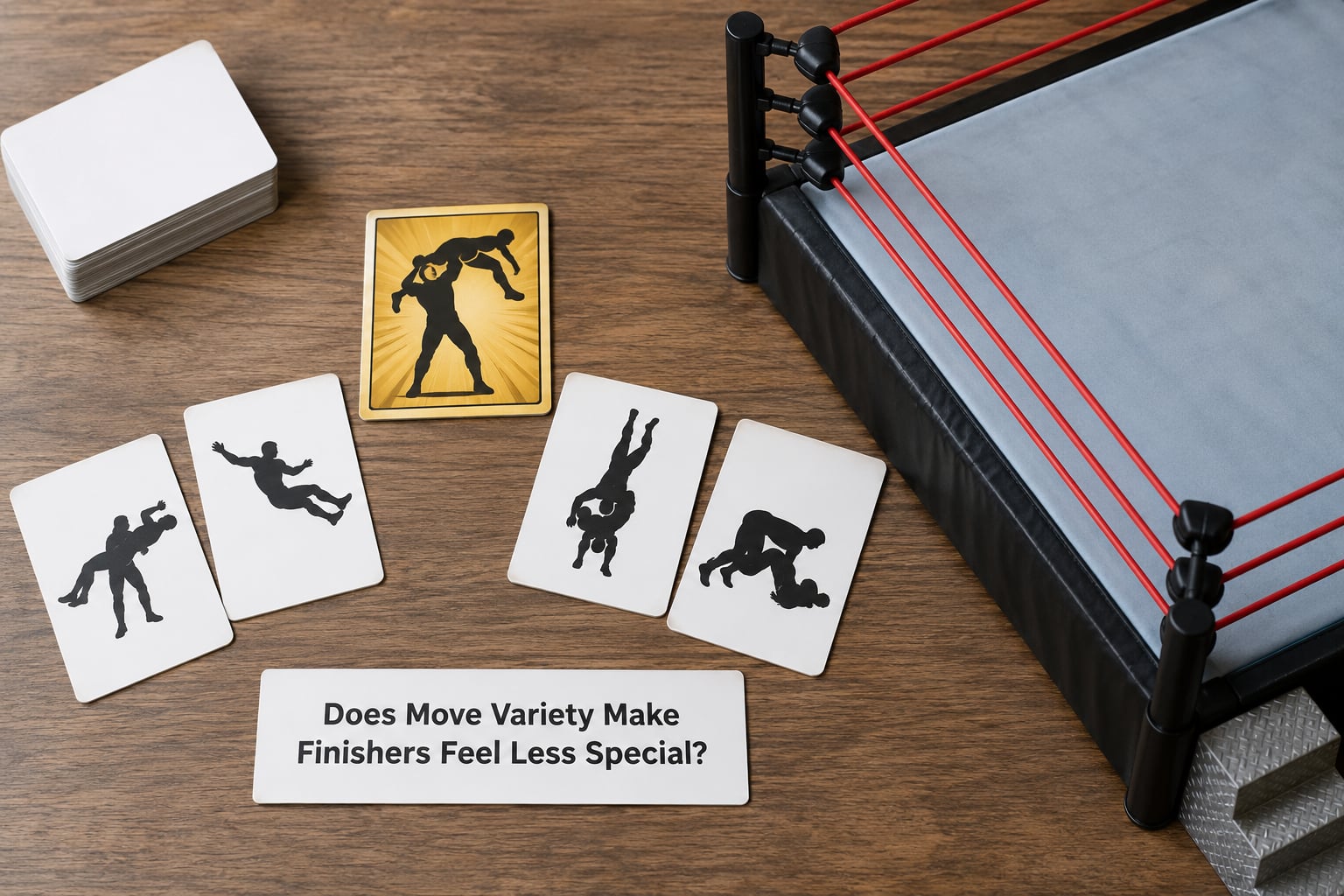
A wrestler with four finishing moves can still be booked well, but only if the booker decides in advance which one is the real finisher. Without that decision, all four drift toward transitional use and the crowd stops tracking any of them.
This is how moves become transitional. Fans collect finishers that never beat anybody, and the usual names come up: The 619 on its own, the worm, Go to Sleep. The Canadian Destroyer is the one most people argue about, since it was once among the most feared finishes in the sport and now gets kicked out of regularly.
Variety is not the enemy. A wrestler who throws the same move in every match gets figured out, and the crowd stops reacting because it can see the ending coming. The problem is variety used as filler, where a big move appears in the middle of a sequence because nobody planned what the finish should be.
Do Crowds Stop Believing in Clean Wins?
Crowds do not stop believing in clean wins. They stop believing that the match in front of them is going to produce one, and that is a reasonable conclusion.
The best example of this is the try-three structure. The Something Awful thread about wins and losses uses two matches with identical structure to show the split: Okada winning the third attempt reads as earned, while Naito winning the third attempt reads as a bigger loss, because the crowd had fully invested in him being the one to finally get there. Same match shape, opposite meaning.
The same thread argues the position most experienced fans eventually land on. Wins and losses only matter in the context of the story being told. A wrestler who never wins clean when it matters picks up what that thread calls loser aura, regardless of the official record.
Once a match has used up its drama on kick-outs, no amount of selling brings the finish back. That is why the matches people complain about are rarely the ones with the most kick-outs but the ones where the kick-outs stopped meaning anything.
How to Tell a Planned Kickout from a Botched Finish
You do not need production access to read a match. Five signals will tell you whether the kick-out was written or whether something went wrong in front of you.
Timing. A planned kick-out happens after the ref has started the count, usually at one or two, and it comes with a shoulder blade or a roll that lands on the mat properly.
Reaction. The covering wrestler pops and argues, then resets. A botched finish usually gets a long pause and people looking at each other.
Camera. A planned kick-out gets a close-up on the kicker’s face. A botch often gets a wide shot because nobody wants to show what happened.
Referee position. When the kick-out is planned, the referee ends up somewhere sensible and the match resumes on schedule. A mess at the ropes usually means the referee lost the spot too.
Follow-up. After a planned kick-out the covering wrestler usually goes straight back to the same move, because the sequence was built around it. After a botch, everyone resets and starts something different.
One more signal fans ask about: a wrestler can no-sell a pin on purpose and still lose by three-count, so tapping the mat early is not proof of anything. If they do not move at all, the count still ends the match.
Frequently Asked Questions
Why does a wrestler kick out of their own finisher?
Usually because the match is booked to go longer, or because the kick-out is building someone. Selling the biggest move without ending the story buys crowd investment, protects a later payoff and keeps the finish from feeling inevitable. It also lets a losing wrestler keep a moment in a match they are not winning. Done once it works well. Done four times, it drains the drama before the real finish arrives.
Is every finisher kickout planned by the booking team?
Most of them are. Wrestling is written, and a kick-out in a planned sequence is often decided in advance so the loser still gets a moment and the finish lands harder later. Botched finishes do happen, usually from a mistimed spot, a mistimed camera cut or two wrestlers improvising the same idea at once. A blown finish is recognisable because nobody in the arena seems to know what just occurred.
Why do wrestlers suddenly use a different finisher?
Often because a booker wants to protect the primary finisher for a bigger match later, so a secondary move does the work in a match that has to end. It can also happen when a wrestler changes their character or a move stops connecting reliably. The result is a finisher losing its identity: the same wrestler uses four finishing moves, none of them feels like a payoff, and the crowd stops knowing what ends a match.
Does protecting a finisher make it better or weaker?
Better, in most cases. A finisher that always works feels like a guarantee, and guarantees kill tension, so a booker has to protect it deliberately, saving it for the matches that matter. The argument on the other side is that constant protection can make a finish feel unearned or predictable. The workable version is a finisher that mostly works, loses the occasional time for story, and lands when it counts.
How can you tell a botched finish from a scripted kickout?
Watch the timing and the follow-up. A scripted kick-out lands after the referee starts the count, with a shoulder blade on the mat, and the covering wrestler immediately argues and resets. A botch usually comes with a long pause, a wide camera shot and confused looks. If the covering wrestler then goes straight back to the same move, the sequence was planned. If everyone changes direction, something went wrong.
Why do finishers still win cleanly in some matches?
Because a clean finish is the clearest way to tell an audience that a match ended the way the booking wanted it to. Squash matches, debuts, title changes and short independent sprints rely on it because there is no time to sell anything else. Wrestlers who rarely win when it matters build what fans call loser aura, which is why bookers hand the clean pin to the person who needs it most that night.
Conclusion: Start with the Finish, Not the Kickout
A finisher stops getting clean wins when the match has already spent everything it had. Length, near-fall count, star scheduling and a booker saving the payoff all push in the same direction.
Next time a main event feels like it drifts, check three things in order. Count the kick-outs before you count the moves. Notice whether the finish came off the primary finisher or a secondary one. And decide whether the match ever had a real endpoint, or just a long middle. The answers tell you more about the booking than any review of the work rate will.