WCW lost the Monday Night Wars in stages, not in a single catastrophic night. It led the weekly ratings battle for 83 consecutive weeks from June 1996 to April 1998, lost that lead for good in late 1998, slid through a brutal 1999, and stopped existing entirely on March 26, 2001. The cause was never one moment, one match, or one villain, even though a single comedy routine is usually blamed.
Here is how WCW lost the ratings war in order: roster stagnation, creative churn, backstage politics and a bloated cost base fed each other for two years, and the AOL-Time Warner merger finished the job. Get the sequence right, because the popular version of this story is wrong in ways that matter.
One warning before the numbers below. If you have ever compared a 1997 Nitro cable rating to a modern Raw demo number, you were comparing two different measurements. Cable households and total viewers are not the same thing as the adults 18-49 figures advertisers buy today.
Table of Contents
- How WCW Lost the Ratings War Over Time
- How WCW Lost the Ratings War: Key Turning Points
- Why WWF Built a Lead That WCW Could Not Recover
- How the Roster Exodus Damaged WCW
- Why Creative Instability Made Good Matches Hard to Maintain
- How WWF Outpaced WCW During the Monday Night Wars
- What Business Decisions Accelerated the Decline
- Did the End of Nitro Cause WCW’s Ratings Collapse?
- Could WCW Have Recovered From the Ratings Deficit?
- Frequently Asked Questions
- When did WCW collapse?
- Did Hulk Hogan joining WWF single-handedly make WCW lose the ratings war?
- Was the departure of Hulk Hogan, Randy Savage, and Lex Luger the main reason WCW fell behind?
- Why did WCW’s ratings decline after its mid-1990s peak?
- Did WWF win the Monday Night Wars because it had better wrestling matches?
- Could WCW have recovered its ratings before its sale in 2001?
- Conclusion: The First Cause to Look For
How WCW Lost the Ratings War Over Time
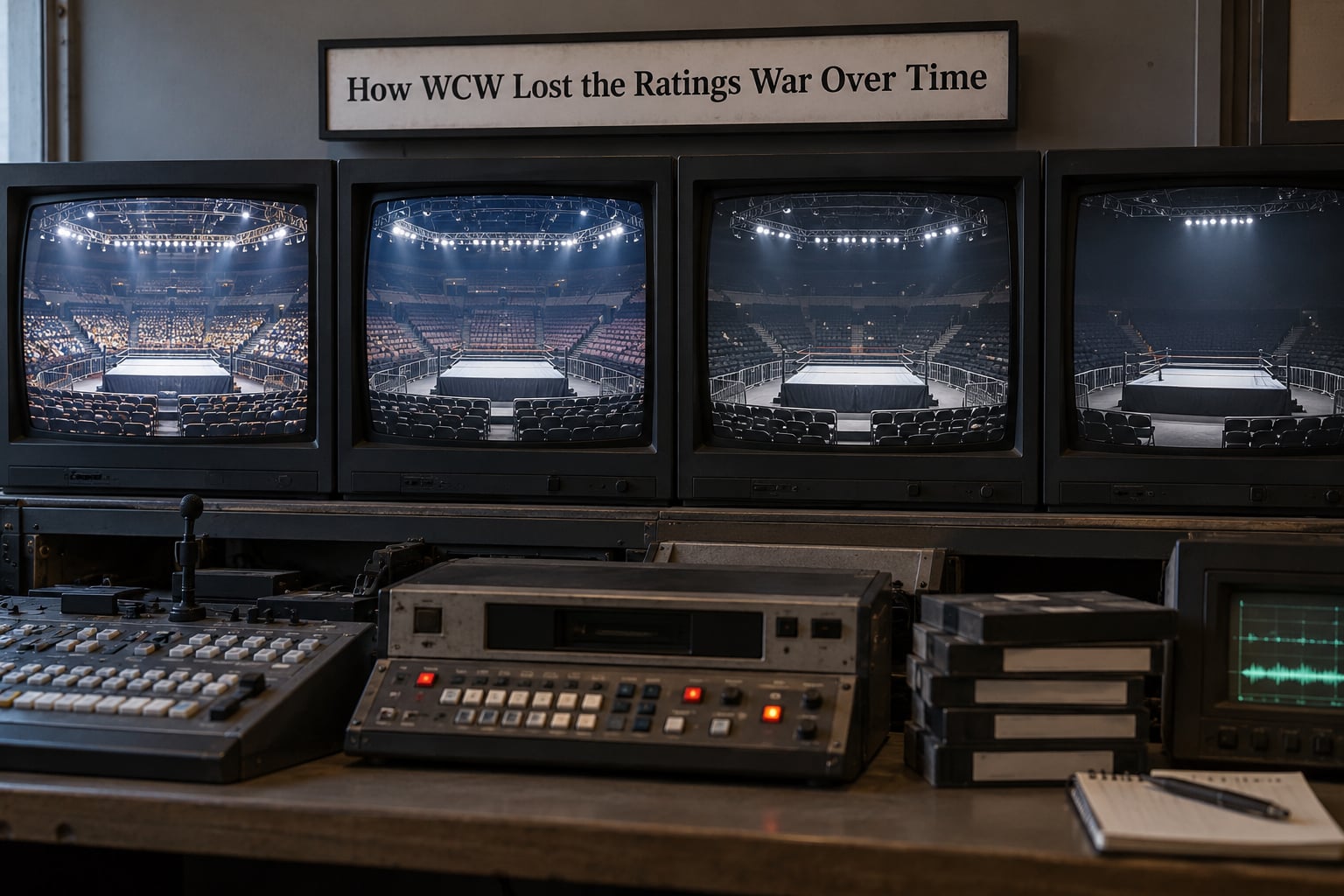
Understand WCW’s fall as a slope with three ledges on it. The company won the war, held it, lost it in a grind, and then discovered the ground was not there anymore.
| Period | What the numbers showed | What was driving it |
|---|---|---|
| June 1996 – April 1998 | Nitro won 83 consecutive weekly head-to-head weeks | The nWo arriving, crossover bookings with WWF, and a roster of genuine movie-money names |
| May – October 1998 | The lead narrowed month by month | Raw rebuilt around a fresher roster while WCW recycled the same feuds |
| November 1998 onward | Raw’s streak begins and is never answered | WWF had stars arriving weekly; WCW had none |
| January 4, 1999 | One widely remembered episode, a temporary dent | The Fingerpoke of Doom in front of a Georgia Dome crowd |
| February 1999 | WCW outsold WWF on pay-per-view | Proof that television and buyrate were already telling different stories |
| May 1999 onward | The real inflection point | Ric Flair’s heel turn, Diamond Dallas Page’s title win and immediate heel turn, and failed main events |
| March 2000 | A short ratings bounce | Vince Russo arrived and relaunched the show as nWo 2000 |
| March 26, 2001 | The last broadcast of Monday Nitro | A corporate decision, made after a decline that was already two years old |
Two caveats on that table. A widely circulated dataset of historical Monday Night Wars numbers matches Nielsen records only about 72% of the time, and a pay-per-view buy is a different animal from a weekly rating. Where the two disagree, pay-per-view usually told the truth first.
How WCW Lost the Ratings War: Key Turning Points
The first turning point was the one nobody remembers: May 1998. Through late 1998 WWF won back weeks one at a time while WCW stayed nominally ahead, and the audience learned that Nitro was no longer the show you switched to. By November 1998 Raw had started a streak that WCW never ended.
The second was January 4, 1999, when Hulk Hogan lost to Ric Flair in under two minutes and the new nWo members shook his hand. Half the people who blame that night for the whole decline confuse a famous moment with a causal one. WCW still outbought WWF on pay-per-view the following month.
The third was May 1999, and this is the one that actually mattered. The wrestling got worse in a way viewers could feel: a main event built around a wrestler who had just been turned heel, a championship image built on a heel turn that contradicted the crowd’s investment, and pay-per-view cards that recycled the same matchups without earning them.
Then came the market collapse in 2000, where WCW’s losses ran into nine figures. That is when the company stopped being a ratings story and became a balance-sheet story.
Why WWF Built a Lead That WCW Could Not Recover
WWF’s advantage was never that its matches were better. It was that Raw never went more than a few weeks without something new to watch, while Nitro kept asking viewers to re-invest in stories they had already seen.
That difference shows up in the structure of the two shows. Raw could replace a main event with a returning legend or a new star and still feel like a program that was going somewhere. Nitro’s best weeks in the 1990s came when it had something concrete to promote, and its worst weeks came when the pay-per-view was the only real event on the calendar.
Advertising made the gap worse. WCW’s audience skewed older, and older audiences are worth less per viewer in the adult 18-49 demo that cable advertising prices against. Nitro could hold a similar headline number and still lose the room on the metric that paid the bills.
Network scheduling did the rest. A WCW show that moved from TBS to TNT in 1999, plus the pre-emptions USA and TNT pulled on key head-to-head nights, meant some weeks were lost before a single wrestler stepped through the curtain.
How the Roster Exodus Damaged WCW
Hulk Hogan leaving for WWF in 1999 is the roster story everyone tells, and it is the most visible, not the deepest one. A top star departing costs a company a few bad weeks. It does not cost it two years.
The real damage came in layers. Lex Luger and Randy Savage had already moved on by 2000, taking name recognition with them. Then Chris Benoit and Eddie Guerrero left in 2000, and those were working professionals whose departures removed the most dependable in-ring talent from the roster at once. Hogan’s departure was loud; losing Benoit and Guerrero quietly removed the matches.
Each departure reset the balance between established talent and unproven talent in the wrong direction. The pattern repeats across wrestling history: when the recognised names leave, the remaining roster has to carry the weekly show, and the weekly show is where you lose the audience if it fails.
By late 2000 WCW was running a beloved veteran, a celebrity titleholder, and a lot of people making their television debut. In February 2001 the mainstream press was writing that the company had run out of wrestlers, which is a sign you have run out of options.
Why Creative Instability Made Good Matches Hard to Maintain
Creatives moved through WCW at a rate that made continuity impossible. Changes in bookers, changes in championship direction, and changes in who had final say meant that a story started on one Monday could be abandoned by the next. A wrestler could lose a main event slot for political reasons, and the audience worked that out quickly.
The clearest example is the summer of 1999. Ric Flair turned heel and was installed as the on-screen WCW President, and Diamond Dallas Page won the world title at Spring Stampede only to turn heel almost immediately. Both moves made logical wrestling sense and both felt like a punchline to viewers, because WCW kept asking its audience to be angry at characters they had chosen to love.
That is the mechanism behind the trust erosion. Events kept happening, pay-per-views kept running, and the arena crowds kept filling, so from the outside WCW looked busy. The audience had stopped believing the results would mean anything, and a viewer who does not believe the outcomes is a viewer who eventually changes the channel.
Eric Bischoff’s removal from power in early 1999 removed the one person who had a track record of fixing a bad quarter. Vince Russo arrived in March 2000 and delivered the bounce, but the bounce came with a reset that annoyed the same audience that had stayed loyal through the bad years.
How WWF Outpaced WCW During the Monday Night Wars
Raw ran on a weekly engine that WCW never matched. New or returning stars appeared constantly, which meant a viewer who tuned in for one reason stayed for another. Stone Cold, The Rock and Triple H were not just good wrestlers; they were reasons to watch a specific Monday, and WWF kept producing new ones.
Crossover bookings are the part of the Monday Night Wars most fans misremember. WCW’s nWo era worked because WWF was actively collaborating with it, sending Steve Austin in against Hogan and turning planned matches into events. Once WWF no longer needed WCW to make its own nights bigger, that collaboration stopped, and WCW was left competing against a show that had just absorbed its best angle.
Steve Austin’s well-documented refusals to work with several of the bookers who came through WCW in 1998 and 1999 sit somewhere in the middle of this. They hurt the product, and they also removed the single most reliable weekly draw from a company that needed reliable draws.
By the time the 1999 pay-per-view season arrived, WWF had a coherent title picture and WCW had a crowded card built on four names who had already wrestled each other repeatedly. Audiences do not stay for a rematch they have seen a dozen times.
What Business Decisions Accelerated the Decline
WCW’s television ratings were the visible problem, and its contract structure was the reason it could not recover. Guaranteed deals for established talent, creative control clauses, and per-show costs that did not shrink with the audience meant every ratings loss was funded from a fixed base. You cannot cut your way out of fixed costs by having a good quarter.
The pay-per-view calendar added to it. A high volume of events, some of them in a month, split the same audience and reduced each event. The buyrate data from 1999 and 2000 shows WCW falling behind on pay-per-view even in stretches when television was roughly even, which is the single clearest sign that the value was leaking faster than the ratings revealed.
Live attendance was the metric the company ignored longest. Nitro and other shows were drawing crowds in buildings while television audiences shrank, and the resulting revenue was never going to close the gap against a rival drawing six figures of advertising revenue per season.
Then the AOL-Time Warner merger arrived. Announced in early 2000 and closed in early 2001, it created exactly the kind of ownership situation where a mid-sized asset becomes a distraction. The merger is the cause people name, and it is the right one, but it is the last cause, not the first. WCW was already losing money before the new parent company took control, and a company that cannot cover its own costs is not saved by a merger.
Did the End of Nitro Cause WCW’s Ratings Collapse?
No. March 26, 2001 was a decision, not a cause. By the time the final Monday Nitro aired, the ratings collapse had been running for roughly two years, the company had been through bankruptcy, and the executive team being replaced had no path back to profitability. A show that is cancelled is not a show that was cancelled by ratings.
What the final weeks did change is the shape of the ending. A ratings-driven cancellation would have produced one story. Instead the final weeks of Nitro were covered as the sale of a brand to a competitor, with WWF acquiring the name, the library and a roster it could not fully absorb, and the Monday Night Wars being formally closed in the same week as WWF beat WCW in the ratings it had won.
The strangest fact of the ending is that the final Nitro outperformed expectations. Fans turned up for the closure, which is exactly the pattern that makes the business failure so hard to explain from the outside: the audience was still there on the night, and the money had already been gone for a year.
Could WCW Have Recovered From the Ratings Deficit?
Partly, and only with a different roster. The honest case for recovery starts in 2000: keep the workers, rebuild the weekly show around a clear identity, cut the guaranteed contracts, and reduce the pay-per-view calendar. That is a hard but survivable list, and a version of it worked in other promotions.
The case against recovery is just as concrete. The talent pipeline behind WCW was already thinning, the corporate parent was in no position to invest, and by late 2000 the company was negotiating a sale. A turnaround needs time, and WCW did not have a calendar year left.
Nostalgia reunions and a nostalgia main event would not have moved the number. A big one-off main event draws the fans who already watch, and the fans who had left were not gone because they missed a specific match. They were gone because the weekly show stopped earning their evening. Fixing a single crowd-pleasing night is a good weekend, not a business model.
Many WCW-only viewers did not follow WWF when the promotion ended. They simply stopped watching professional wrestling. That migration is the real cost of the decline, and it is the part of the story that no closing date captures.
Frequently Asked Questions
When did WCW collapse?
WCW collapsed in stages rather than on one date. Its weekly ratings reversal began in late 1998, the irreversible decline started in May 1999, and it filed for bankruptcy in 2000. The company stopped broadcasting after the final Monday Nitro on March 26, 2001, when WWF acquired the name and video library.
Did Hulk Hogan joining WWF single-handedly make WCW lose the ratings war?
No. WCW was already losing weekly ratings by the time Hogan left in 1999, and the bigger cause was structural: recycled storylines, booker turnover, a loss of dependable in-ring workers such as Chris Benoit and Eddie Guerrero, and contract costs that never scaled down with the audience. Hogan was the most visible departure, not the one that set the decline in motion.
Was the departure of Hulk Hogan, Randy Savage, and Lex Luger the main reason WCW fell behind?
Those departures mattered, but they explain a bad 1999 and 2000 rather than the whole fall. Losing a star costs a company some bad weeks. Losing several respected workers at once also removes the matches that keep a weekly show watchable, and that compounds. The ratings reversal was already visible before any of those departures were confirmed.
Why did WCW’s ratings decline after its mid-1990s peak?
Four things compounded. WWF rebuilt Raw with new and returning stars every few weeks, WCW kept re-running the same feuds, the 1999 title and heel-turn decisions made viewers stop caring about outcomes, and a bloated cost base turned each ratings loss into a bigger loss. The audience also skewed older, which hurt in the advertising demo that mattered most.
Did WWF win the Monday Night Wars because it had better wrestling matches?
Not mainly. WWF won on consistency and momentum. Raw reliably gave viewers a reason to tune in that week, whether through a new star, a returning legend, or a coherent championship picture. WCW’s in-ring work was frequently the better wrestling, which is exactly why the ratings decline is such a useful lesson: quality alone does not hold an audience when the surrounding product feels directionless.
Could WCW have recovered its ratings before its sale in 2001?
A partial recovery was possible in 2000 with a different roster, a trimmed pay-per-view calendar, and a weekly identity that did not change bookers every few months. Full recovery was not realistic, because the losses were structural, the parent company was in no position to invest, and the talent pipeline was already emptying out. The sale process was under way before any of those fixes could have landed.
Conclusion: The First Cause to Look For
How WCW lost the ratings war comes down to interacting failures, not one culprit. Roster departures removed the workers, creative churn removed the reason to care, and a fixed cost base turned every lost viewer into lost money. The AOL-Time Warner merger closed the door that was already swinging shut.
Start with the dated timeline above, then read the 1999 heel turns as the moment trust broke rather than the moment the war was lost. That sequence will hold up better than any single-culprit version, because the record does not support one.