Wrestling tape trading was a mail-order exchange of homemade VHS recordings between fans, and understanding how wrestling tape trading worked before streaming comes down to three habits: collectors advertised what they owned, dubbed a spare copy for each partner, and shipped it in exchange for something they wanted. Nothing about it was legal retail, and nothing about it was fast.
Below is the whole process as collectors themselves described it, from finding a partner to dubbing the tape to mailing an irreplaceable recording across the country. The specifics below come from the newsletters, forum threads and magazine classifieds that documented the practice, so treat the numbers and dates as the ranges collectors themselves used rather than fixed rules.
Table of Contents
- How Wrestling Tape Trading Worked Before Streaming, Step by Step
- Step 1: You catalog what you already had
- Step 2: You advertise availability
- Step 3: You send your want list
- Step 4: You agree on the exchange
- Step 5: You dub and package
- Step 6: You mail and confirm
- Why Wrestling Fans Traded Tapes
- How Collectors Found Tapes to Trade
- What Collectors Looked for in an Exchange
- Rarity and how many copies survive
- Completeness
- Runtime and speed
- Generation and source
- Edits and presentation
- How a Wrestling Tape Circulated
- What Labels and Packaging Looked Like
- How Dubbing and Copies Affected Value
- The generation hierarchy collectors used
- Speed changed the outcome too
- Clean versus edited versus extended
- How Trades Were Completed by Mail
- What Tape Trading Cost
- How Wrestling Tape Trading Worked Before Streaming in Practice
- Why Tape Trading Eventually Declined
- Frequently Asked Questions
- Did collectors give away their original wrestling tapes when trading?
- What made a wrestling tape rare before streaming?
- Is a first-generation wrestling VHS worth more than a later copy?
- How did collectors advertise the tapes they wanted before websites?
- Were homemade wrestling tapes legal to trade?
- Why did fans collect wrestling tapes when television became available online?
- Conclusion
How Wrestling Tape Trading Worked Before Streaming, Step by Step
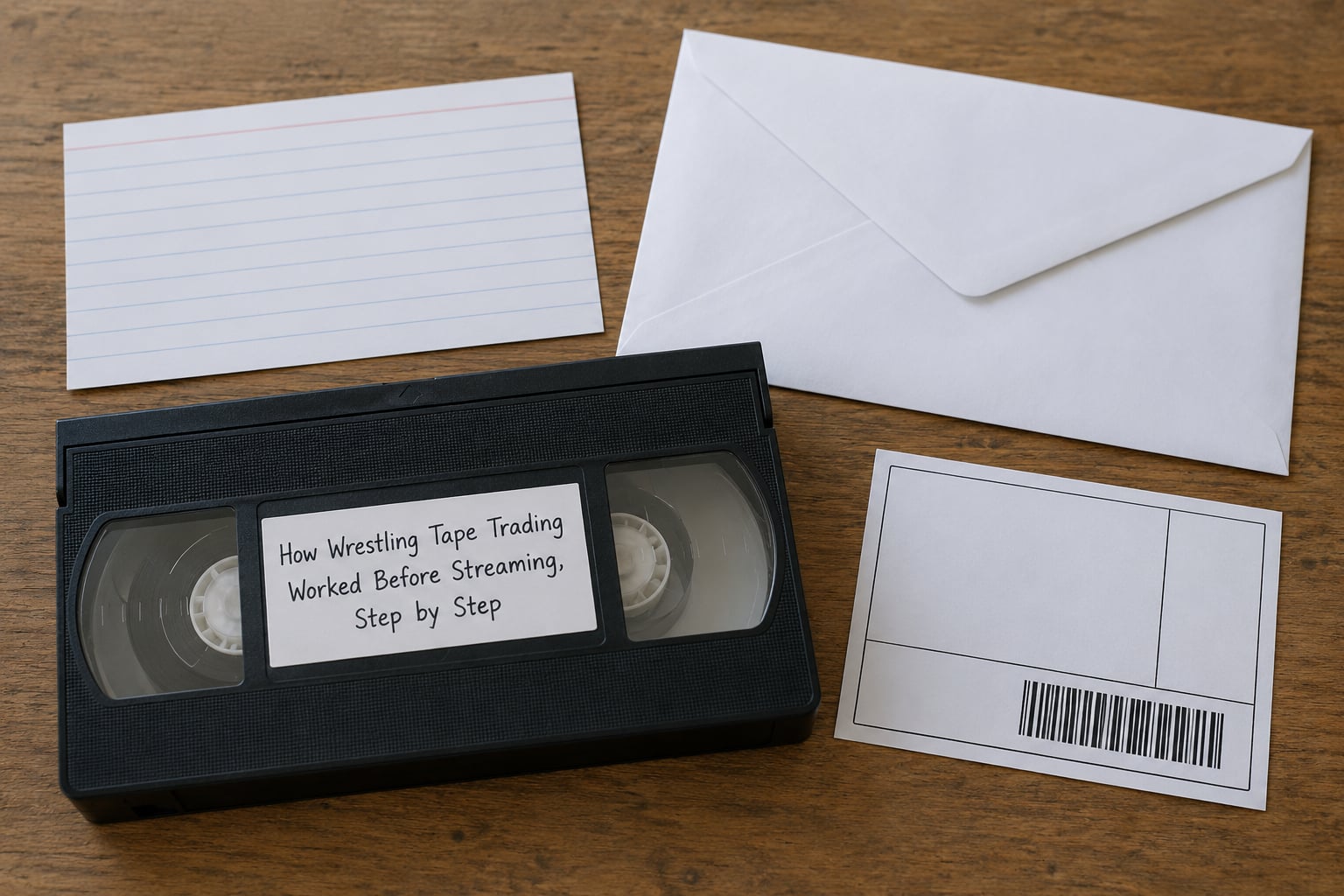
Here is the short version. A collector posted what they had and what they wanted, usually in a magazine classified or a newsletter. A second collector answered with an offer. Each side then recorded a fresh copy of the agreed event, wrote up the label, packaged the tape carefully, and mailed it to the other person. The original never traveled. Only the dub did.
That single rule is what made the hobby possible. If originals changed hands, collections would shrink with every trade, and within a few years everyone would be trading holes. Instead, the trading library was effectively doubled whenever a collector dubbed for a partner: one copy for the other side, one for the shelf.
The six steps below are the sequence nearly every veteran describes the same way.
Step 1: You catalog what you already had
You wrote an index card, a typed list, or a photocopied sheet. Promotions and dates went down one side, tape speed and source quality on the other. Serious collectors rated each title, usually with stars or a numbered scale, so a partner could tell a broadcast copy from a two-generation dub without playing the tape first.
Step 2: You advertise availability
Newsletters and magazines carried the listings. Later, message boards and early online forums took over. The format was usually spare: a name, a mailing address, and a list of events offered for trade.
Step 3: You send your want list
A want list was a request, not a demand. The more specific it was, the better the replies. Collectors routinely noted the promotion, the approximate date, whether they wanted a clean broadcast or an extended cut, and which country or league the event came from.
Step 4: You agree on the exchange
Most trades were tape for tape, meaning you recorded the event your partner wanted and they recorded the one you wanted. Other arrangements existed: cash plus postage for a rare item, a B&P trade, or a straight gift to a new collector. The terms were settled in letters and later in email threads before anyone touched a deck.
Step 5: You dub and package
You played your copy of the event and recorded a fresh copy for your partner, usually at standard speed with noise reduction on. Then you labeled the tape and packed it so it could survive the mail.
Step 6: You mail and confirm
Parcels went out with tracking once tracking became affordable and common. Collectors waited for a note confirming arrival. A trading relationship that started as a single dub often turned into years of regular contact, and that relationship was worth more than the tape.
Why Wrestling Fans Traded Tapes
Trading existed because television could not carry everything. Regional wrestling dominated the 1970s and much of the 1980s, so a fan in one city saw one promotion while a friend three states away watched a completely different card.
House shows made the gap worse. A promotion on the independent circuit might run fifty towns a year with a name change and a booking change in every market. Those stops were filmed by whoever owned a camcorder, and those copies existed nowhere else. If your local promotion did not film, or if the one copy lived three hundred miles away, trading was the only route to that footage.
Missed cards pushed people into the hobby too. Working shifts, illness and bad cable all meant an event you never saw. A trade partner with the same pain point could mail you a copy within a week, which felt miraculous.
Then there was international wrestling. Japanese puroresu, Mexican lucha libre and British heavyweight wrestling were barely televised in North America, and for a long stretch tape trading was the only route most American fans had to those styles. Fans built whole collections around closing that gap.
Finally, there was the collector’s own drive. Completing a promotion meant filling gaps, and the gaps were only visible once you started writing down what you had. Most traders describe the same turning point: the moment the list on the wall got longer than the shelf behind it.
How Collectors Found Tapes to Trade
Discovery ran through magazines, newsletters, conventions and word of mouth. There was no search box, so finding a partner with a copy of a specific 1985 house show meant knowing people who knew people.
Magazine classifieds were the main channel. Wrestling magazines of the era carried swap and trade notices in their back pages, and those notices were often the only place a fan in Ohio could discover that somebody in Wisconsin held a full set of a territory’s house shows. Period wrestling magazines came up again and again in recollections of this era as the hub for exactly that kind of trading community.
Specialist newsletters served the same function with more detail. Fan-driven newsletters listed want lists, reviewed incoming tapes and passed along trading contacts. Because newsletters were mailed to subscribers, a letter to a newsletter editor could put you in touch with a dozen collectors at once.
Conventions did the same job face to face. Tables at wrestling convention gatherings were informal trading desks, where collectors flipped through index cards and negotiated in hallways. A trade agreed at a convention table often had two people in the same room, which removed the trust problem entirely.
Local fan clubs handled the early stage. Before anyone advertised anywhere, a teenager with a camcorder and a VCR shared copies with the handful of friends who showed up at independent wrestling shows. Many large collections started that small, usually with someone’s parents’ house as the dubbing location.
Word of mouth closed the loop. A tape arrived with a note from a friend naming someone who had a want list. That letter produced three more contacts, and a network formed without anyone organizing it.
What Collectors Looked for in an Exchange
Traders graded offers the way other collectors grade anything, and the criteria were consistent enough to build a reputation on.
Rarity and how many copies survive
The core question was whether the event still existed anywhere. A card from a small territory with one known circulating copy could command a level of attention a network television special never did.
Completeness
A full show mattered, including the segments fans usually cut: the interviews, the in-ring promos taped before the bell, the dark match if it had one. Collectors learned to ask whether the tape was the whole event or a trimmed card, and they penalized trimmed copies accordingly.
Runtime and speed
Recorded at standard play, a three-hour event fills a single tape. Recorded at a slower speed, it stretches across two or three. Multi-tape sets were the norm for house shows, which meant more chances for a dub to be missing a part.
Generation and source
How many times the recording had been copied before it reached you, and whether the source was a broadcast or a handheld audience recording. Collectors traded these details in writing before agreeing to anything.
Edits and presentation
Some copies carried an announcer’s voice over picture, some were cut to remove commercials, and some included a compilation of several events rather than one. Collectors specified which they wanted, because a best-of tape was not a substitute for the full event.
How a Wrestling Tape Circulated
A trade moved through the same stages every time, whether it took a week or six months.
Availability was advertised first, usually as a line in a newsletter or a classified. Interested collectors replied with a want list. The two sides compared notes on quality, generation and format, and agreed on terms.
Then the dub happened. The person holding the event played their copy and recorded onto a blank at standard speed. Community advice repeated for years: go at normal speed, use noise reduction on both decks, and never try to save time with high-speed dubbing. The results of high-speed dubbing were poor enough that experienced collectors avoided it outright.
Labeling came next, then packing. The tape was written on, sealed, boxed, and wrapped. Some collectors mailed in padded envelopes. Others used boxes padded with paper, which is what seasoned traders tend to recommend because a jammed deck can be rebuilt but a crushed tape cannot.
The package went out with tracking where possible. The receiving side confirmed receipt in writing. Feedback followed, and if everything matched what was promised, both collectors updated their reliability notes. That note is the real currency of the hobby.
What Labels and Packaging Looked Like
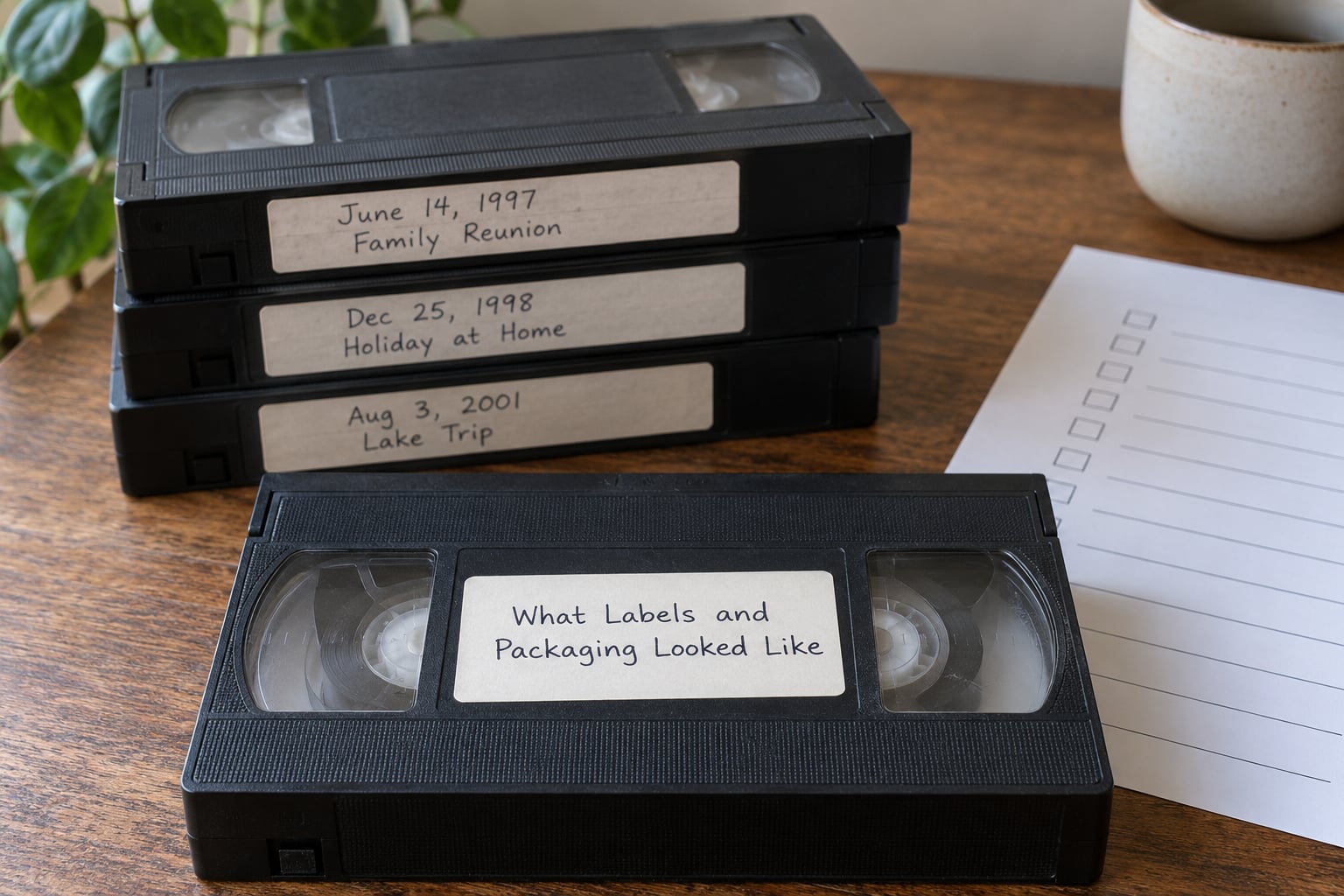
Labels were the only information a partner had before pressing play, so collectors developed conventions fast. Spine writing was usually white or gold marker on the narrow edge, sometimes a sticky label stuck on the flat side.
Typical writing gave the promotion, the event and the date, followed by the source and the speed. A spine might read as a promotion name, a date, and a notation such as a broadcast tape recorded at standard play, or a fan-camera copy. Collectors who kept notebooks also wrote the generation number, so a partner could see at a glance that a tape was already three copies removed from the original.
Date formats varied and caused constant confusion. American collectors were used to month-day-year, international partners often used day-month-year, and both formats appeared on spines with equal confidence. Mismatched dates were one of the most common complaints in old trade feedback threads.
Star ratings and letter grades showed up on index cards rather than on the tape itself. A letter grade from a small newsletter operation sometimes carried more weight than the copy quality, because it reflected that editor’s judgment of the event’s importance.
Catalog numbers came from two directions. A tape already carrying a printed number usually meant it came from a mail-order operation that numbered its inventory, which told a buyer something about the source. Separately, collectors invented their own numbering systems, usually a promotion code plus a sequential number, and those numbers traveled between partners as shorthand.
Paper inserts were a niche practice. A photocopied event sheet, a hand-drawn card with the card results, or a printed checklist of what the tape contained all showed up occasionally, and buyers paid a little more for a copy that arrived documented.
How Dubbing and Copies Affected Value
Every copy degrades the picture a little. That is generation loss, and the trade term of art for where a copy sits in the chain is its generation.
The generation hierarchy collectors used
| Generation | What it is | Typical demand |
|---|---|---|
| First generation | Recorded directly from the original source by the collector who owned or attended it | Highest; most prized |
| Second generation | Dubbed from a first generation copy | Very strong |
| Third generation | Dubbed from a second generation copy | Common, still usable |
| Fourth and beyond | Three or more copies removed from the source | Low; often traded only to fill gaps |
Community consensus held that image quality held up through the second and third generation, then degraded fast, particularly in detail, color and stable picture. Fourth generation copies were frequently described as unwatchable rather than merely poor.
Speed changed the outcome too
Standard speed produced the cleanest copy and used the most tape. Slower speeds stretched a long event across multiple cassettes, which meant more parts to go missing in a trade. High-speed dubbing halved the time but produced ghosting, audio drift and unstable lines, so collectors who wanted a copy worth keeping stayed at standard speed.
Clean versus edited versus extended
A clean copy ran without commentary over the picture. An edited copy removed commercials or cut commentary to save space. An extended copy kept everything, including the parts an editing friend had thrown away. Collectors valued the clean version most, the edited version next, and treated extended cuts as a bonus rather than a defect.
The practical rule traders settled on: describe your source honestly, because a partner who receives a weaker copy than promised will remember it, and that memory follows you through every trade after.
How Trades Were Completed by Mail
Mail was the weak point of the whole system. Both sides were sending irreplaceable recordings to a stranger, and neither could watch the other pack the box.
Want lists did most of the negotiating work. A well-kept want list, updated regularly, told a potential partner exactly how to be useful to you. Collectors also ran trade lists, which listed what they could offer instead of what they wanted.
The B&P arrangement, blanks and postage, solved the problem of traders with nothing worth offering. Instead of an event, one side sent blanks for the other side to dub onto plus the postage to do it. It kept new collectors in the hobby without requiring them to own anything rare, and seasoned collectors were generally willing to do it.
Tape trees pushed the idea further. One person with a master recording would dub for several people, and each of those people would dub for several more, so a rare event spread outward without anyone mailing an original. Forum veterans describe tape trees as the mechanism that put mid-1980s Japanese wrestling into the hands of American fans at a scale the classifieds alone could never have reached.
Packaging became its own craft. Tapes went into padded mailers or small boxes with corner protection, padded so nothing pressed on the cassette shell. Tracking numbers were used whenever the cost allowed. Collectors who shipped insurance for a trade got respect, and those who used a flimsy envelope with a bare bubble wrap got a reputation.
Trust was built slowly and lost permanently. When someone took a tape and stopped responding, the community response was fast: a note on a bad trader list, and the name spread from newsletter to forum to newsletter until it reached most serious collectors.
What Tape Trading Cost
Trade itself was free, which is exactly why collectors guarded it so tightly. The expenses came in around the trade, and they added up.
Blanks and shipping were the routine costs. A three-hour standard play event could take two or three cassettes, and postage for an oversized package was the single most predictable line item in the hobby.
Duplication gear was the big-ticket item. A consumer VCR handled the work, though quality varied by brand. Prosumer decks and high-end models cost more and produced visibly better dubs, and collectors described buying one as an investment that paid for itself in trading value. The same went for noise reduction on both decks, a stabilizer, and decent cabling.
Subscription and membership costs came from newsletters and organizations that ran trading boards or mail-order catalogs. Some operations also charged a fee to list an event they had sourced themselves.
Premiums were charged when a copy was scarce, original quality, or international. Japanese and Mexican wrestling carried an extra charge that reflected shipping, customs and scarcity rather than talent, and it was the part of the hobby most prone to gatekeeping. Veterans recall established collectors sitting on rare events and deciding who was ready to receive them.
How much any of this came to varied enormously by era, event, distance and copy quality, which is why you will see collectors describing the same event at wildly different figures. The honest summary is that the hobby was affordable for almost anyone with a recorder and a deck, and that the real currency was reputation.
How Wrestling Tape Trading Worked Before Streaming in Practice
Here is how the whole thing worked in a real scenario, using a trade of the kind described over and over in old threads.
A fan in Ohio has a first generation standard play copy of a regional promotion’s house show from a small market, recorded by a friend who shot the whole building from behind the crowd. It runs two hours and fifty minutes with interviews intact.
She has written it into her catalog as offered, dated, marked first generation, and rated with three stars. A collector in Pennsylvania replies with a want list that includes the same promotion from a different month, plus a specific event from a Japanese promotion he has been hunting for three years.
They agree on terms: Pennsylvania dubs the Ohio house show and sends it along with the Japanese event, Ohio dubs the second house show and mails it out. Both record at standard speed with noise reduction on. Ohio checks the recording for dropouts on the crowd footage, rewinds, and labels the spine with the promotion, date, standard play and first generation source.
She wraps the cassette in padding, boxes it, adds a handwritten note with her catalog number, and sends it with tracking. Eleven days later a note arrives confirming the tape played clean, and she updates her card with a feedback mark. On the next mailing she includes a printout of the second house show’s card results, which Pennsylvania had requested, because documented copies were always worth more.
Four weeks after that, both collectors send each other their updated want lists. This is how the hobby actually operated, one mailed package at a time.
Why Tape Trading Eventually Declined
The hobby did not collapse in a single year. It eroded across two decades, and each step removed one of its reasons for existing.
| Era | What changed | Effect on trading |
|---|---|---|
| VHS era | Magazine classifieds, newsletters, conventions, fan clubs | The core era; trades by mail at standard speed |
| Message board era | Forums, mailing lists, chat channels | Faster discovery, more bad traders, reputation lists |
| DVD-R era | Burned discs replacing cassettes in many collections | Cheaper and higher quality, but loss of the trading ritual |
| Marketplace era | Online listings where items are sold instead of swapped | Access improved, the barter economy faded |
| Streaming era | Official back catalogs available on demand | The reason to trade mostly disappeared |
Writable DVD media changed the practical side first. Burning took an hour instead of a three-hour dub, quality held up through far more generations, and a full event fit on one disc. Collectors moved over, sometimes overnight. What disappeared with it was the reason to own two decks and stay up until a three-hour house show finished copying.
Marketplaces changed the culture next. Once an event could be listed for sale, the incentive to trade for something you could not buy shifted. Some traders went that direction deliberately, since a hobby that always costs money is a different hobby from one that only costs postage.
Official releases and streaming finished it. When a promotion’s back catalog became available on demand, the scarcity that justified trading evaporated. Most of the rare house show tapes never appeared officially, and those are the copies collectors still argue about.
What has survived is preservation. Some trading communities moved to disc and file sharing, with material uploaded to public archives, and modern channels stream transferred tape collections to audiences who never knew the mail-order scene. The copies are degraded and the context is gone, but the hobby’s output is still turning up.
Frequently Asked Questions
Did collectors give away their original wrestling tapes when trading?
No. The standard rule was that only a dub ever moved. The collector who held an original recorded a fresh copy for their partner and kept the original on the shelf. If an original did change hands, it was usually a separate sale or gift, never part of a normal tape-for-tape trade. That rule is why collections grew instead of shrinking.
What made a wrestling tape rare before streaming?
Rarity came from limited surviving copies, not from hype. A house show filmed by one person with one camcorder, in a territory that never taped a regular series, was rare because almost nobody else owned it. Scarcity could also come from a widely traded copy existing only in a low generation, or from a promoted event whose original recording was never made.
Is a first-generation wrestling VHS worth more than a later copy?
Almost always, yes. A first generation copy was recorded straight from the original source, so it kept the most picture and sound detail. Collectors ranked generations carefully and treated first and second generation copies as the ones worth dubbing from. A later copy could still be worth having, but it was the fallback when the good copy was already spoken for.
How did collectors advertise the tapes they wanted before websites?
Magazine classifieds and specialist newsletters were the main routes. Collectors sent a want list to an editor or placed a trade notice in the back pages of a wrestling magazine, listing what they had and what they hoped to get. Conventions served the same purpose face to face, and later, message boards and mailing lists replaced print as the primary channel.
Were homemade wrestling tapes legal to trade?
It was a grey area. Recording a program for personal use was generally tolerated, but selling copies or trading them was different, and broadcast recordings made with intent to distribute carried obvious risk. Laws varied by country and era, and collectors were rarely advised by anyone. Most relied on informal community norms rather than on clear legal ground.
Why did fans collect wrestling tapes when television became available online?
Because official availability never matched what collectors wanted. Territorial wrestling, most house shows and nearly all foreign styles stayed unavailable, and streaming services offered selections rather than complete catalogs. Collectors also cared about generation and completeness, which an on-demand stream usually ignores. The physical tape represented an attempt at a specific event, not general access.
Conclusion
Wrestling tape trading worked because it solved a problem television created and could not fix. Fans in different cities watched different wrestling, foreign wrestling barely aired at all, and whole cards existed only on somebody’s camcorder. Trading moved those recordings between people who wanted them, at standard speed, by mail, based on written descriptions and years of reputation.
If you are starting a collection now, work out what you actually want before you trade anything. Write down the promotions, the eras and the specific events you are chasing, and separate the ones that matter from the ones that merely sound rare. Then decide honestly whether you want a finished collection or an active trading relationship, because the second one costs far more in decks, blanks and postage than most people expect. Either way, describe your sources accurately, ship like the tape matters, and treat a stranger’s recording with the care you would want your own to receive.