Booking an intergender wrestling match means a promoter builds a contest around one of a small number of narrative devices — a championship, a betrayal, a debt, or a public challenge — then shapes the offense, the size differential and the finish so the result holds together inside kayfabe. Most of the craft is in who is protected, why, and how the crowd is walked into accepting it.
That last part matters more than people expect. The same two performers, with the same moves, can read as completely different matches depending on the reason they are in the ring together and on how the last thirty seconds are handled. A match that reads as a stunt is usually not a match with bad moves; it is a match with no reason to exist.
One wording note before we start. Fans search for both “intergender” and “mixed gender,” and both appear in this guide. Promotions themselves increasingly use mixed gender in official announcements, while “intergender” remains the term most used in everyday conversation and in booking rooms. Nothing about the two words describes different matches.
What no performer’s gender determines is their ability, their style, or their role in a match. Every decision below turns on the character, the audience’s existing expectations, and what a wrestler can safely and credibly do at the level the booking needs.
Table of Contents
- What Does Booking an Intergender Wrestling Match Involve?
- How Do Wrestlers and Promotions Choose the Match Participants?
- How Is the Match’s Story and Stakes Established?
- How Intergender Wrestling Matches Are Booked From Start to Finish
- 1. Establish the objective before a single spot is written
- 2. Introduce the early offense and earn the first heat
- 3. Add the first major change, where the match is won or lost
- 4. Create the finish, then hide it behind a false finish
- 5. Extend the story only when the story needs it
- What Makes the Moves and Offense Feel Believable?
- How Can a Match Protect Credibility Without Overselling the Stakes?
- Example: How a Balanced Intergender Match Could Be Booked
- What Safety and Accessibility Checks Happen Behind the Scenes?
- Frequently Asked Questions
- What is the main goal when booking an intergender wrestling match?
- Should every intergender match be designed as a spectacle or stunt?
- How do bookers make a major finish look believable?
- Does a wrestler’s gender determine the style of offense they should use?
- What can change after a match is announced and rehearsed?
- Conclusion
What Does Booking an Intergender Wrestling Match Involve?
It involves six decisions in a fixed order: choose the participants, establish the in-story reason, decide who is protecting whom, design the offense and the selling, select a finish that does not insult either performer, and then check the match against safety, medical and regulatory constraints. Change the order and the match falls apart on television.
The in-story reason is not decoration. It is the load-bearing wall. Remove it and the audience is asked to accept two strangers beating each other for no discernible purpose, and the crowd has no emotional stake in the result — which means the finish has nothing to pay off.
Modern promotional use also narrows what these matches are usually for. The classic modern case is a special attraction: a one-off on a bigger card, a payoff after a long-running grievance, or a cross-division story that resolves cleanly and then closes. A recurring weekly series built around the format is rare, and the reasons for that rarity are mostly commercial rather than creative.
Wrestlers themselves are part of the booking conversation rather than a delivery mechanism for it. A performer who does not want to work a particular match, a particular opponent, or a particular finish can decline, and a booker who ignores that ends up negotiating the story around a refusal instead of in front of one. Promotions that book these matches well tend to have the discussion early, not on the day of the show.
How Do Wrestlers and Promotions Choose the Match Participants?
Booking starts with each wrestler’s established character, not with a demographic. A booker is matching a persona the audience already understands to a scenario that stresses it in an interesting way, and then checking that the two performers can physically deliver the picture being sold.
Six factors get weighed, and none of them is gender:
- The character as established. A calm, technical babyface thrown into a brawl is a different match from a reckless heel who finally gets the fight he has been demanding for months.
- Audience expectations. What does this crowd already believe about each person? A performer who has never been shown losing may be protected for the first time in a match like this.
- Ring style and pacing. A technician’s match and a power match are constructed with entirely different sequences, and mixing them badly is the most common booking error of any kind.
- Physical capability and workload. Who can absorb the offense being planned, and who has a full schedule already? A performer working a hard match on a light card and a performer working the same match on a grueling one are not in the same situation.
- Narrative value. What does the match add to both careers afterwards? A finish that helps one performer and flattens the other is a poor trade even when it draws heat.
- Availability and consent. Both performers have to want it, and logistics — travel, schedule, medical history — decide as much as creativity does.
The size factor needs care, because the numbers fans argue about are usually the wrong ones. Billed height and weight are kayfabe: inflated for both men and women, and often inflated more for the woman. A wrestler billed at far more weight than he actually carries can still work a match against a much larger opponent, because the audience reads the person, not the number. Real measurements matter for medical planning; billed measurements matter for how the match is sold.
A concrete pairing: a stocky, methodical heel who works by grinding an opponent down, against a quick, springy technician who has built her whole character on outworking bigger people. Their styles clash without either one being diminished, and the match has a natural shape — control versus momentum, patience versus pace. The two personas would be just as interesting opposite each other in any other combination, which is exactly the point.
How Is the Match’s Story and Stakes Established?
A booker establishes stakes by attaching the match to something the audience already cares about, then repeating that attachment at every opportunity before and during the contest. Without an existing attachment, the crowd has no reason to care who wins.
Four narrative devices do most of the work:
An existing rivalry. The cheapest and the strongest, because the audience already has an opinion. Nothing needs explaining in the ring.
A championship opportunity. A title creates a clean, legible stake and a natural reason for the challenger to be underestimated. It also gives the finish an outcome that matters afterwards.
A faction or stable conflict. A betrayal, a broken partnership, or a manager who has turned on a former ally. Personal grievance generates heat without requiring a size argument to justify the fight.
A character objective. The person with the most to prove — a returning performer, someone who has been humiliated, someone under a contractual clock. The objective itself becomes the through-line.
Watch how one objective shapes everything downstream. Suppose the challenger’s stated aim is to prove she was never the weak link her former allies claimed. The entrance can echo the faction she is rejecting, the first offense can be the specific move that faction used to humiliate her, the mid-match distraction can be an old associate appearing at ringside, and the finish can be a reversal of the original spot — the same maneuver, opposite outcome. One objective, and the entrances, the callbacks, the interference and the finish are all doing the same job.
The four devices are frequently combined. A championship match inside a faction betrayal usually carries more heat than either element alone, and it gives the booker more ways to sell the result before the bell rings.
How Intergender Wrestling Matches Are Booked From Start to Finish
How intergender wrestling matches are booked comes down to five phases, and each one has a crowd reaction attached to it that tells the booker whether the phase is working. If the reaction at any stage is wrong, the booker adjusts that stage rather than pushing harder on the finish.
1. Establish the objective before a single spot is written
The objective is written first, in one sentence, and everything downstream has to serve it. The check is simple: can you describe who wants what and why in a single line that a fan could repeat after the match? If not, the story is not ready, and no amount of good sequences will fix it.
2. Introduce the early offense and earn the first heat
The opening establishes the size question for the audience, usually by giving the larger or more established performer control of the first two to three minutes. The intent is not to humiliate anyone; it is to create a problem the audience wants solved. A first major spot that looks brutal for too long stops generating heat and starts generating discomfort, which is where most of the criticism of these matches comes from.
3. Add the first major change, where the match is won or lost
Every one of these matches needs a turn: the challenger survives something, counters something, or exploits something, and the momentum visibly flips. This is the moment that decides whether the crowd accepts the premise. If the turn does not get a pop, the problem is almost never the finish; it is that the turn was unclear, badly sold, or too small to read from the cheap seats.
4. Create the finish, then hide it behind a false finish
The finish is chosen before the match is written, not after, and it is then obscured with a false finish — a near fall, a rope break, a counted-out kickout — so the real ending arrives as a surprise rather than an expectation. Bookers reach for a small set of standard finish types, and each carries a different amount of risk.
| Finish type | When it is used | What it risks |
|---|---|---|
| Clean win | When the story pays off a long grievance and the audience is fully behind the winner | The highest risk of all, because there is no escape hatch if the crowd rejects it |
| Time limit draw | When neither side can win without damaging protected booking, or when the finish is genuinely ambiguous | Can read as a cop-out if the story did not earn a resolution |
| Disqualification | When a heel’s cheating is the entire character, or when a violent act needs consequences without a loss | Loses most of its punch if used repeatedly; fans start expecting it |
| Outside interference | When the winner has an established ally or manager, or when the story needs a faction payoff | Reflexively booing can flatten the moment if the interference was set up properly |
| Title belt excuse | When the outcome is about a championship being retained rather than a person winning | Feels like a workaround unless the belt is central to the announced stakes |
| Stipulation change | When the premise itself needs a test — a rubber match, a no-contact clause, a timed format | Adds rules that must then be enforced consistently for the rest of the card |
More than one of these is often used in a single match, layered rather than stacked, so the audience is processing a new turn rather than a new excuse.
5. Extend the story only when the story needs it
Most of these matches should not run long. Fifteen to twenty minutes is the usual range, and every minute past that has to be earning something beyond the fight itself. A short match with a clear objective outperforms a long one where the objective quietly disappeared at minute eight, and a draw or an inconclusive ending often serves a feud better than a decisive finish that closes the door.
What Makes the Moves and Offense Feel Believable?
Believability comes down to four physical variables: strength, speed, technical style, and positioning. Everything else — crowd familiarity, repetition, the eyetest, lighting and camera angles — affects whether the audience accepts the picture, but the four variables determine whether the match can be worked at all.
| Offense approach | What it requires | Best fit | Common mistake |
|---|---|---|---|
| Strike-based | Timing, choreography and a willingness to take head strikes carefully | Performers whose character is defined by toughness | Underexplained head contact that reads as reckless, or overexplained selling that reads as theatre |
| Power-based | Safe spots and clear communication on landings and lifts | Larger performers with established physical personas | Underestimating the smaller performer, who has to sell power she may not physically have |
| Technical | Ring psychology, pacing and submission credibility | Performers who have built a career on ring craft | Using a technical style to avoid committing to any story, which flattens the whole match |
| High-risk | Rehearsal, medical clearance and a hard ceiling on what gets attempted on the night | Special attraction matches where the danger is part of the advertised premise | Treating a spectacular move as automatically correct, regardless of whether it serves the story |
The key point is that a spectacular move is not automatically the right choice. It reads as impressive only if the audience understands why it happened at that moment and what it cost the person who did it. A dive onto a table means nothing if it appears in minute two for no reason, and a smaller performer landing a power move on a larger one means everything if the crowd knows exactly what it took to set it up.
Crowd familiarity does the quiet work. The audience has to have seen the wrestler being hit hard before, or they have no frame of reference for what the offense should look like, and a match built on an unestablished performer is inherently harder to sell than one built on a known quantity.
How Can a Match Protect Credibility Without Overselling the Stakes?
Credibility is protected by selling consequences rather than by escalating them. Show what the offense costs, let reactions carry the weight, and follow through on callbacks. This is where most of the craft in these matches actually lives, and it is also where a performer can be protected without the match looking protected.
Five things break credibility more often than any individual spot does:
Stealing heat. Going over deliberately and without a story reason reads as the booker having a point of view rather than telling a story, and the crowd notices immediately.
Comedy that outlasts the moment. A joke that lands once is fine. A match built on humiliation as a running gag takes heat off the performer being humiliated, not on the character causing it, and no amount of crowd reaction can fix that.
Unnecessary injury spots. Fans who broadly accept these matches still report hard head shots as hard to watch. That is a physical discomfort reaction, separate from any objection to the premise, and it is the criticism that shows up from the most unexpected places.
Unexplained finishers. A signature move used with no setup and no build reads as the finish being announced rather than earned.
Exaggeration in the promotion. Promising something the match cannot deliver sets the crowd up to reject the result before it happens.
The way through is consistency. The callbacks get acknowledged in commentary, the injuries are carried into the following weeks, and the winner’s later behaviour reflects what just happened. When the aftermath matches the offense, the finish stops feeling like an imposition and starts feeling like an event.
Historical case studies make the pattern concrete. Wrestling Forum threads and a long-running WrestlingSmacks discussion both single out Chyna’s 1999 run against Chris Jericho as the moment a clean win by a woman against a top male star drew serious backlash, and both note the accompanying pattern: her wins were concentrated against mid-card and lower-card opponents such as Val Venis and Jeff Jarrett rather than the very top of the card. Eddie Guerrero’s published account and Bob Holly’s later interview both point to a separate problem behind those bookings, with complaints about being hit too hard and about how a report over a broken nose was handled inside the company. The point for a booker is not the ethics; it is that a run can be structurally sound and still damage people behind it if the protection stops at the card.
The same threads point to Lucha Underground as the most-praised modern example, and the reason fans give is structural rather than athletic. Star versus Big Ryck is repeatedly described as the strongest of them, praised for the story rather than the wrestling, with Star presented as courageous, Ryck as sympathetic and the power behind him as the villain. Ivelisse versus Mil is described as well constructed and logically ended. Star’s win over Pentagon Jr is, by contrast, the most-cited example of the format failing outright. The difference fans keep drawing is whether the world of the match gave a reason for the two to be in the ring at all.
Example: How a Balanced Intergender Match Could Be Booked
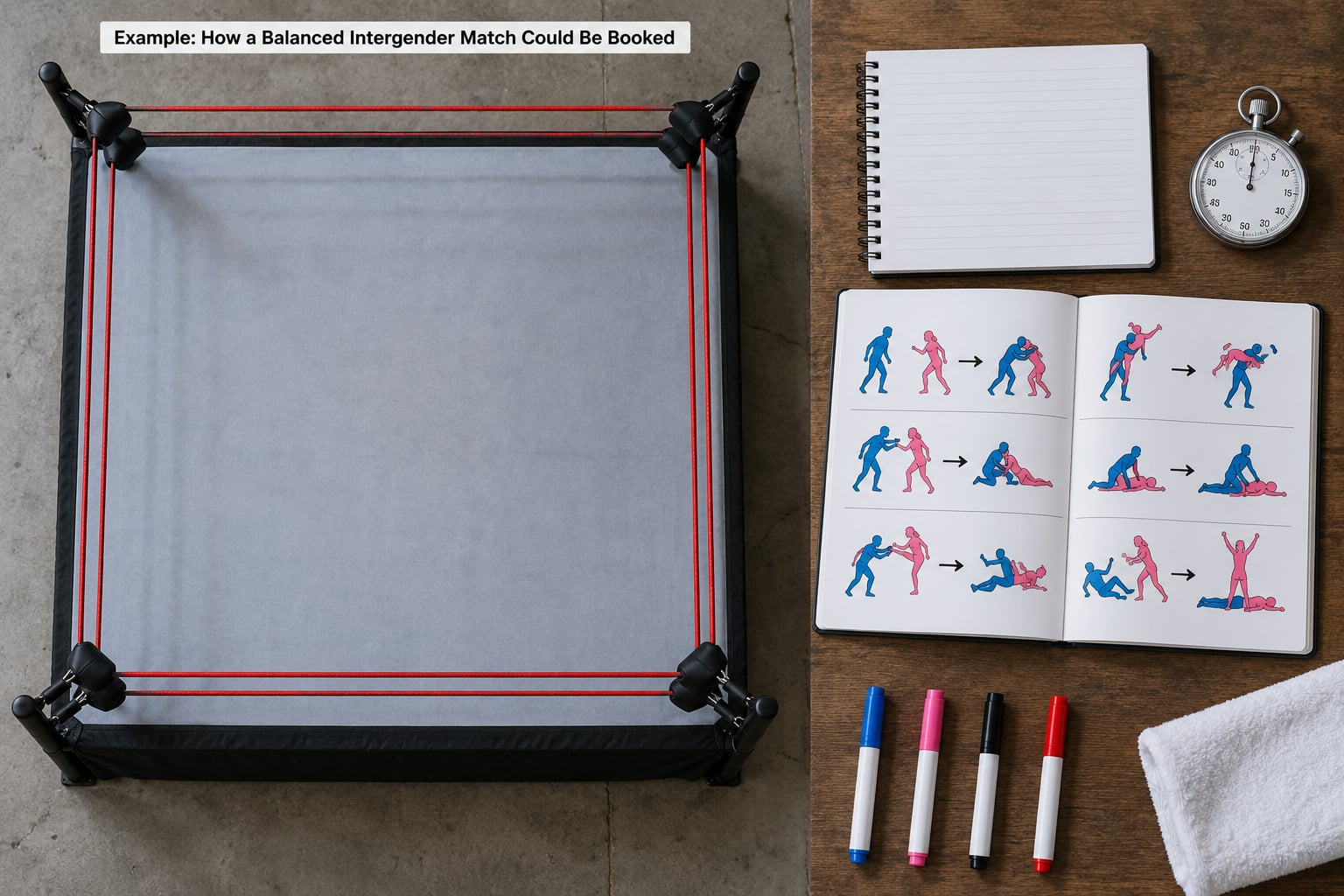
A worked outline, using generic character roles rather than any real promotion or performer. The premise: a former partner, a deliberate technician, has been publicly humiliated by a larger heel she once helped build up, and she has challenged him in front of the crowd he used to control.
Minute zero to one — entrances. The heel arrives first to a hero pop he has earned. The challenger’s entrance deliberately borrows his framing, and her stated objective in one line: to beat him with the move he used on her the first time he betrayed her. That single line drives the whole card.
Minute one to three — early offense. The heel controls the ring with a methodical grind. He targets one body part consistently rather than mixing offense, so the crowd can count the spots. The reaction to watch: boos rising, then silence when the challenger’s first kickout happens too early.
Minute three to six — the first change. The challenger survives the betrayal spot — the exact move from the objective — with a kickout. Crowd reaction should spike here. If it does not, the spot is not selling and the match needs a different turn, not a bigger one.
Minute six to eleven — the middle. The challenger’s counter comes from her technical style: limb targeting, working the leg he has been relying on, and a near fall from a reversal rather than from a power move she has not earned. Interference comes at minute eight from the heel’s ally, which is what the finish is built on.
Minute eleven to twelve — false finish. A rope break on a pin that the crowd fully believes. This is the point of the interference being set up early: the audience expects it to decide the match, and it does not.
Minute twelve to fourteen — finish. The challenger’s objective is paid off with the betrayal spot, this time reversed and completed. Clean win, because the story earned a resolution and the audience is behind her. The heel is out, the ally takes the fall outside, and the aftermath is a full beat of selling before either performer leaves the ring.
Runtime sits in the usual range, the turn lands at minute three, the finish is set up by an interference the crowd anticipated, and the winner’s offence all came from her established style. Nothing in it required a performer to do anything their character or body had not already established.
What Safety and Accessibility Checks Happen Behind the Scenes?
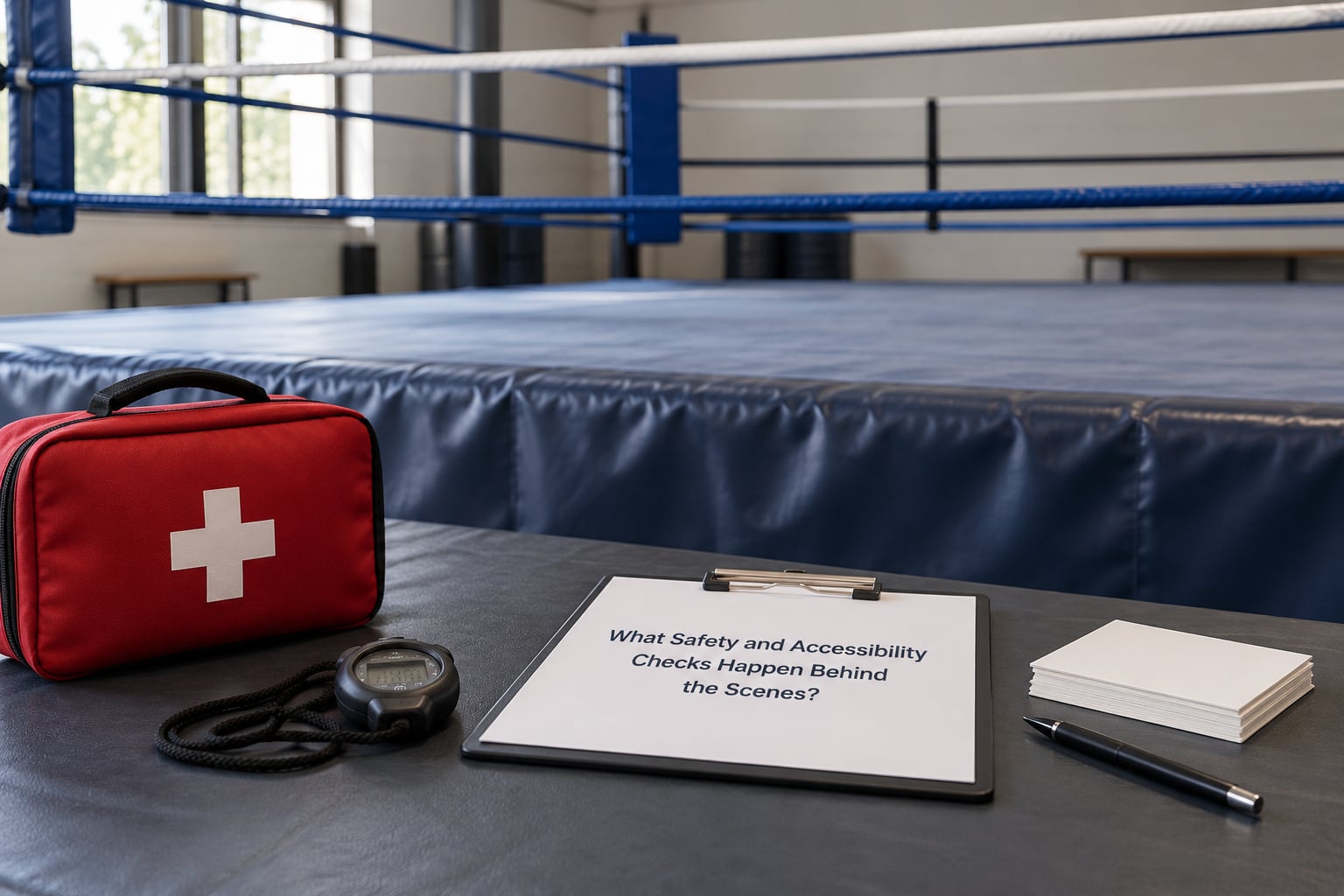
Behind every finished booking sits a safety process that fans never see, and it can change the advertised outcome after the match is announced. It runs across five areas: communication, rehearsal, medical input, adaptation, and contingency planning.
Communication happens before anything is written down. Both performers and the referee agree on what happens, what is improvised, what is never attempted, and the exact word — usually a pre-agreed sound — that means stop. Nothing in a match like this is improvised on the night that has not been agreed in advance.
Rehearsal covers sequences, transitions, and specifically the spots most likely to cause injury: lifts, catches, head impacts, and anything on or near the apron. The stopwatch matters here; sequences get longer under pressure and short time limits create rushed spots.
Medical input comes from the medical team, whose assessment outranks the booking. A performer’s health history, current condition and workload are part of the plan rather than a detail discovered later.
Adaptation is planned for, not improvised. If one performer is fatigued, if a spot is refused on the day, or if a section has to be shortened, the match has a shorter version that still resolves the story. Booking only a full-length version means the fallback gets decided under time pressure in front of a crowd.
Contingency planning covers the finish. If a planned finish is refused, a second and third option exist, and the story’s payoff is structured so it survives any of them.
Accessibility runs alongside this: matching ring and equipment to a performer’s needs, and treating adaptive requests as standard booking information rather than as a favour.
Two further constraints belong here. The first is regulatory, and it is a separate matter from the men’s-versus-women’s question: state athletic commissions license wrestling, and rule reviews do come up. The Oklahoma State Athletic Commission deferred an intergender wrestling rule change to a state legislature in October 2024, with Commissioner Michael Stopp publicly worried the issue could become too political, following earlier meetings connected to a transgender wrestler’s appearance at an AEW event. Whatever a booker’s preference, the licensing layer is outside a promotion’s control and shapes what can be advertised where.
The second is commercial. Sponsor and broadcaster reaction is real, and it is one reason the format stays occasional. That constraint explains a great deal of the booking pattern without any single promotion ever having issued a formal policy. Where a stated promotion policy is not on the record, it is better described as inferred from what has and has not been booked.
Frequently Asked Questions
What is the main goal when booking an intergender wrestling match?
The goal is to give the audience a reason to care, then let the physical match justify it. Booking starts with a narrative device — a championship, a betrayal, a debt or a public challenge — and every spot, turn and finish has to serve that one objective. If a fan cannot describe who wants what in a single sentence after the match, the story has not been booked, no matter how good the sequences were.
Should every intergender match be designed as a spectacle or stunt?
No. The high-risk approach is one of four options, and it is only correct when danger is part of the advertised premise and both performers are trained, cleared and rehearsed for it. Strike-based, power-based and technical approaches are used far more often because they are easier to sell and far safer to execute. A dramatic finish built on a clean reversal usually outperforms a stunt.
How do bookers make a major finish look believable?
By setting it up long before it happens. The finish is chosen before any spots are written, then hidden behind a false finish such as a near fall or a rope break so the real ending arrives as a surprise. Credibility comes from callbacks, from reactions in commentary and from the following weeks reflecting what happened, not from making the finish louder.
Does a wrestler’s gender determine the style of offense they should use?
No. Style follows the character, the crowd’s existing expectations, the ring work the performer is known for and the body they have to work with. A technician booked as a technician can absolutely be booked against a power performer; the styles simply have to be constructed so neither one is diminished. Choosing offense because of a performer’s gender is a booking shortcut that tends to read as artificial on screen.
What can change after a match is announced and rehearsed?
Quite a lot. A performer can decline the match, an opponent or a specific spot on the day, a spot can be ruled out by the medical team or the referee, and a planned finish can be swapped for one of several prepared alternatives. Announced matches are not final. Any promotion that treats an announcement as a commitment has skipped the stage where the plan is actually confirmed.
Conclusion
Booking an intergender wrestling match comes down to four things, in order: the two performers’ established roles, a single clear objective, a finish that earns itself through callbacks rather than volume, and an execution that survives the safety process. Get the objective right and most of the rest gets easier.
If you are studying this as a fan, watch where the first major turn falls and whether the crowd believes it. If you are booking one, start by writing the objective in one sentence, then choose a finish type you can defend afterwards. Either way, the match works or fails on the story, not on the moves.