TNA built an alternative to WWE by doing the things WWF never had to do. It launched in 2002 with no television deal and sold cheap weekly internet pay-per-views instead, invented a division that headlined small high-flyers rather than burying them, took funding from Dixie Carter’s Panda Energy when it was nearly broke, landed a Spike TV slot, and spent years protecting its young talent even while importing WWF-era headliners.
Six mechanisms did most of that work, and they are the same ones you’d point to if someone asked you how TNA built an alternative to WWE today:
- Starting television-independent. TNA held its first show on June 19, 2002 in Nashville and sold weekly internet pay-per-views direct to fans, so it never needed a network’s permission to exist.
- Inventing the X Division. Cruiserweights closed shows instead of opening them, which gave the promotion a match type WWF rarely headlined.
- Winning patient ownership. Dixie Carter’s Panda Energy provided the money that kept the company alive through its worst years.
- Securing a network without imitating one. A Fox Sports Net slot and then Spike TV put TNA on cable while its style stayed deliberately different from Monday Night Raw.
- Mixing recognizable names with homegrown ones. Kurt Angle, Sting, the Hardy Boyz and others brought viewers, while AJ Styles, Christopher Daniels, Samoa Joe and Eric Young were given the reps that made them.
- Booking long, self-contained stories. The Hardy era’s Final Deletion in 2016 was so distinct that WWE copied the structure years later.
The rest of this piece walks through how those pieces fit together, and just as importantly, where the experiment broke.
Table of Contents
- Why TNA Needed to Be More Than a WWF Runaway
- The Early Foundation: Crossroads and the No-Dispute Era
- How TNA Built an Alternative to WWE Through Its Television Style
- Why an alternative to WWE needed its own in-ring identity
- The Talent Strategy: Established Names and New Legacies
- The Knockouts as the underrated alternative
- The Creative Breakthrough: Turning the Alternative Into a Movement
- How the Major-Payview Strategy Changed the Perception of TNA
- What Made TNA a Credible Alternative—and Where the Comparison Broke Down
- Frequently Asked Questions
- What does TNA stand for, and when did it start?
- Was TNA really just a retirement home for WWE castoffs?
- Did TNA ever beat WWE in ratings?
- What was the downfall of TNA?
- How much of TNA does WWE own?
- Which is bigger, TNA or WWE?
- Conclusion: TNA’s Alternative Identity in Wrestling History
Why TNA Needed to Be More Than a WWF Runaway
Timing is the whole story here. When World Championship Wrestling folded into the WWF in 2001 and ECW shut down shortly after, a huge number of experienced wrestlers suddenly had nowhere to work. Almost overnight the industry had one dominant company and a pile of people without a television contract.
At the same time, the WWF was legally obliged to drop the F from its name in 2002, settling a dispute with another promotion that owned those initials. It rebranded as WWE, which made a fresh start sound like a new era rather than a monopoly declaration.
That left a gap that TNA walked into, but a gap is not an audience. TNA’s early broadcasts had real limits. There was no national television deal, venues were tiny, tapes were distributed on a delay, and the promotion was effectively unknown to casual viewers. Being a WWF runaway also meant being judged by WWF standards it had no intention of matching.
So the founding question was never “can we steal WWF’s audience.” It was “can we build something that people watch on purpose.”
The Early Foundation: Crossroads and the No-Dispute Era
Jeff Jarrett, back on the road after WCW, and longtime associate Bob Ryder are the credited founders, and the origin story longtime fans repeat starts with a fishing trip. The first Total Nonstop Action show landed on June 19, 2002 at the Nashville Fairgrounds Speedway.
The distribution idea mattered more than the venue. With no network deal, TNA sold weekly internet pay-per-views at a price engineered to be affordable, which put the product directly in front of fans instead of in front of advertisers. It also gave the promotion a real weekly schedule from day one, which most start-ups never had.
Retrospective accounts of that first year are full of scrappy detail: a crew small enough that several people taped the ring and handled lighting cables, and a room so tight that the in-ring crowd felt closer than a normal television audience allows. The Asylum, a converted building in downtown Nashville, became the identity for years, and its cramped, loud, blown-out atmosphere turned out to be a feature rather than a flaw.
Money was the constant emergency. Dixie Carter’s Panda Energy took a controlling stake and kept the operation solvent through the first half-decade, something the promotion has never fully shaken credit for. Carter understood the assignment, and wrestlers who worked for her have said so on the record, describing her as the reason there was a company to work for at all.
By the time the promotion moved out of the Asylum and onto a cable network, it had the thing WWF never needed: a distinct visual and verbal signature. TNA came to mean six sides, faster openings and a fan-first tone that felt like a counter-program rather than a copy.
How TNA Built an Alternative to WWE Through Its Television Style
This is where the question gets its sharpest answer. TNA’s broadcasts looked different from WWF television in about five specific ways, and every one of them was a deliberate choice rather than a budget limitation.
Why an alternative to WWE needed its own in-ring identity
The six-sided ring is the obvious marker, but it is not the important one. The important structural decision was the X Division. In most promotions of that era, cruiserweights were an opening-match attraction. TNA built main events and title histories around them, which meant a fan tuning in for the undercard was suddenly watching the most important match on the card.
Names like Christopher Daniels, AJ Styles, Low Ki, Elix Skipper and later Samoa Joe got length, spots and push momentum they could not have gotten anywhere else at that time. Eric Styles himself, now known as AJ Styles, used TNA as the launchpad before WWE signed him, which is the clearest evidence that the model worked.
Production choices followed the same logic. Hard-hitting match psychology, submission matches, six-man tags and open-fire spots, longer formed story arcs, and a commentary approach that talked about the wrestling instead of hyping it. Spike TV even branded the period as a no-disputes era, which was a direct thumb of the nose at WWF’s presentation.
The network path was equally deliberate. A Fox Sports Net slot in 2003 proved TNA could exist on broadcast television, and Spike TV in late 2003 gave it a permanent cable home with a much bigger audience. Then came the one genuinely reckless move: in 2006 TNA went head-to-head against Monday Night Raw on Mondays. It lasted a handful of weeks before Spike moved it back, and the lesson stuck, because the product was fine and the schedule was not.
The Talent Strategy: Established Names and New Legacies
Bringing in WWF and WCW names was the easy half of the strategy. Protecting young talent while doing it was the hard half, and it is where fan arguments about TNA still get heated.
The signings arrived in waves. Kurt Angle came in 2007 after leaving WWE, and his arrival gave the promotion immediate legitimacy with casual viewers. Sting’s appearance at Bound for Glory turned a long-running WCW storyline into a genuine main event, and the Hardy Boyz, Abyss, Matt Morgan, Booker T and others filled out the roster with recognizable faces.
The accusation that follows is the standard one, and it deserves a straight answer. Fan communities have called TNA a retirement home for WWF rejects since as early as 2009, and the criticism has never fully gone away. Some of it is fair. Several signings were veterans whose best years were behind them rather than wrestlers arriving at a creative peak.
But Angle in 2007 was not a novelty booking. He was a former world champion who could still work main events, and treating him as an insult misreads what the promotion was doing. The pattern was closer to mixing a well-known opening act with a breakout band than to collecting has-beens, and the test that matters is the roster behind the headline names. Daniels, Styles, Samoa Joe, Low Ki, Jerry Lynn, Raven, Austin Aries and Eric Young all got the reps there that made them valuable elsewhere later.
The Knockouts as the underrated alternative
The women’s division is the least appreciated part of this history. The Knockouts arrived as a named division with its own championships and a real card position, and the work of wrestlers like Gail Kim, Awesome Kong, Karen Qi, ODB and later Taya Valkyrie gave fans a genuine alternative to what WWE was offering on women’s wrestling at the time. It is the clearest example of TNA being different by design rather than by accident.
The Creative Breakthrough: Turning the Alternative Into a Movement
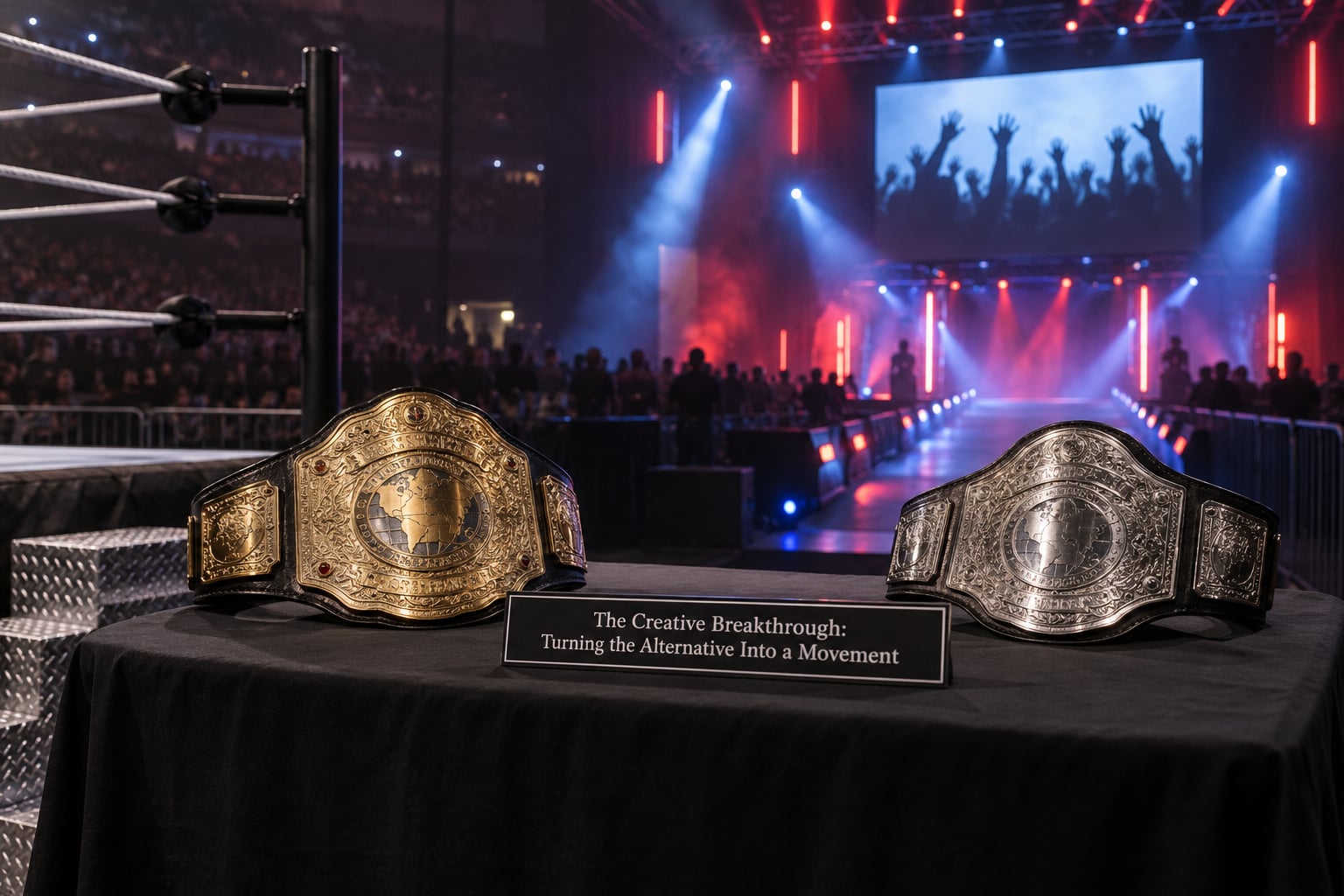
Creatively, the promotion had a stretch where it was not simply different from WWF but ahead of it, and the clearest evidence sits between roughly 2003 and 2009.
Championship storytelling got genuinely serial. Feuds ran for months with clean turns, and main events felt like conclusions rather than weekly resets. Tag team wrestling had real identity, with groups like America’s Most Wanted and Triple X earning an audience that later showed up in WWE tag titles. Factions gave the card shape, and freek-show and supernatural material found a home that WWF’s mainstream tone would not have carried.
Samoa Joe’s rise is the sharpest example. An undersized heavyweight with legitimate submission grappling and a finishing hold nobody had seen at that size turned into a legitimate main-event draw, and his match with Angle at Lockdown 2008 is still cited as proof the promotion could headline properly.
Then there is the Hardy era, which is the part WWE writers have never stopped referencing. Jeff Hardy as champion, Matt Hardy’s descending, increasingly strange breakdown, and The Decay turned a backstage mess into the most discussed wrestling story of 2016. The payoff, Final Deletion at Bound for Glory in October 2016, was framed as a fictional video game created inside the story, which is a piece of structure WWE later imitated with its own deleted-from-the-universe angles and never matched.
Industry reporting credited Final Deletion with delivering TNA’s highest Tuesday audience in months. Whatever the exact figure, the reaction told its own story, because viewers came to a promotion most of them had already written off.
How the Major-Payview Strategy Changed the Perception of TNA
Weekly television built habit. The major events built reputation, and the tactic was straightforward: put recognizable WWF or WCW names on the card so casual viewers had a reason to sample the promotion, then hope the in-ring product kept them.
Bound for Glory became the anchor once a year, joined later by Hard Justice, Lockdown and Victory Road. Angle against Jarrett, the Sting storyline, Hardy title runs and the Lockdown main events gave TNA the kind of one-night credibility that a weekly show could not.
It escalated further when TNA wrestled live on WWE television in 2007, with Angle’s debut effectively serving as an invasion. For a few minutes the alternative stopped being an option on a cable guide and became something that happened inside the company it was defined against. That is the high-water mark for the perception strategy, even though it was brief.
What Made TNA a Credible Alternative—and Where the Comparison Broke Down
The honest version has two halves, because the strongest case for TNA and the case against it are both real.
The strengths were a distinct style, a genuine talent pipeline, a passionate core audience and an ability to feel dangerous on a good night. Wrestling people who worked there routinely describe a place where a young wrestler could be put in matches instead of being parked on television, which explains why so many of them became valuable elsewhere afterward.
The weaknesses were structural. WWE had deeper pockets, far wider distribution, better-known executives and a much larger audience, and TNA never solved those problems. Nor did it ever hold a lead over Raw; the 2016 audience surge was a spike, not a takeover. Eric Young put the honest framing better than anyone when he described TNA as the Nashville Sounds to WWF’s Yankees, not the same team in a different stadium, and that distinction explains both the appeal and the ceiling.
The clearest self-inflicted wound came after Vince Russo, Hulk Hogan and Eric Bischoff arrived in 2006 and 2007. The booking started chasing WWF’s formula, and the six-sided ring, the X Division emphasis and the youth movement were quietly shelved. The crowd felt it, and the promotion spent years rebuilding a look it already had.
What followed was a long decline through network moves, an ownership change to Anthem Sports, the failed rebranding to Impact Wrestling in 2018, near-bankruptcy moments and constant roster turnover. Fans blame the timeslots and the rebranding fatigue as much as the creative, and both complaints have some merit.
What came back is the more useful lesson. The promotion returned to the TNA name in 2023, built on the modern independent model: regular talent-sharing with PRO Wrestling NOAH, CMLL, AAA and DDT, a WrestleCon-adjacent fan relationship, and working with WWE through crossover shows rather than pretending it does not exist. That is a sustainable version of building an alternative, because it borrows credibility without buying imitation.
Frequently Asked Questions
What does TNA stand for, and when did it start?
TNA stands for Total Nonstop Action Wrestling. It held its first show on June 19, 2002 in Nashville, Tennessee, founded by Jeff Jarrett and Bob Ryder with no television deal. The promotion sold weekly internet pay-per-views directly to fans, which is how it survived before landing a cable slot on Fox Sports Net and then Spike TV.
Was TNA really just a retirement home for WWE castoffs?
Partly, and fans said so as early as 2009. Signings like Hulk Hogan and some other older veterans were past their peak rather than arriving at a creative high. But Kurt Angle in 2007 was a former world champion working main events, and the young talent behind the headline names, including AJ Styles, Samoa Joe and Christopher Daniels, got the reps there that made them valuable later.
Did TNA ever beat WWE in ratings?
No. TNA never held a sustained ratings lead over Monday Night Raw, and the size gap was permanent. The closest it came was the Hardy and Final Deletion period in 2016, when industry reporting credited the October 2016 Bound for Glory main event with delivering the promotion’s strongest Tuesday audience in months. A spike is not a takeover.
What was the downfall of TNA?
The main causes were self-inflicted. The post-2006 booking shifted toward copying WWF and shelved the six-sided ring, the X Division emphasis and the youth movement. Financial instability followed, then a series of network moves that put the show in bad timeslots, the 2018 rebranding to Impact Wrestling, near-bankruptcy moments and heavy roster turnover that pushed talent out the door.
How much of TNA does WWE own?
WWE does not own TNA. The promotion is run by its own parent company, which was Anthem Sports and Entertainment before being renamed TNA Group after the 2023 return to the TNA name. WWE’s relationship is a working one instead, with crossovers and shared appearances on both brands since 2024 rather than an acquisition.
Which is bigger, TNA or WWE?
WWE, by a wide margin, across audience, budgets, distribution and global reach. TNA is a smaller promotion with a devoted core audience and a history of developing wrestlers who go on to bigger stages. The useful comparison is not size but role, since TNA has functioned as an alternative outlet rather than a genuine commercial rival.
Conclusion: TNA’s Alternative Identity in Wrestling History
TNA built an alternative to WWE by refusing to compete on WWF’s terms. It sold direct to fans before it had television, invented a division around the kind of wrestling WWF would not headline, took money from an owner who believed in it, kept its young talent working, and produced stories with their own shape rather than borrowed ones.
It also made the mistake of chasing the company it was meant to be different from, and the years after that choice cost it the identity fans had signed up for. What survived is the more durable lesson, one that the current independent era has picked up again through talent-sharing rather than imitation.
If you want to understand the promotion rather than just read about it, start with the 2002 to 2007 era. Watch the X Division title matches from the Asylum, the Raven and Jeff Jarrett feud, Samoa Joe’s rise, and Angle’s first year, then jump ahead to the Hardy compound era and Final Deletion. That sequence shows both the model that worked and the standard TNA was judged by.