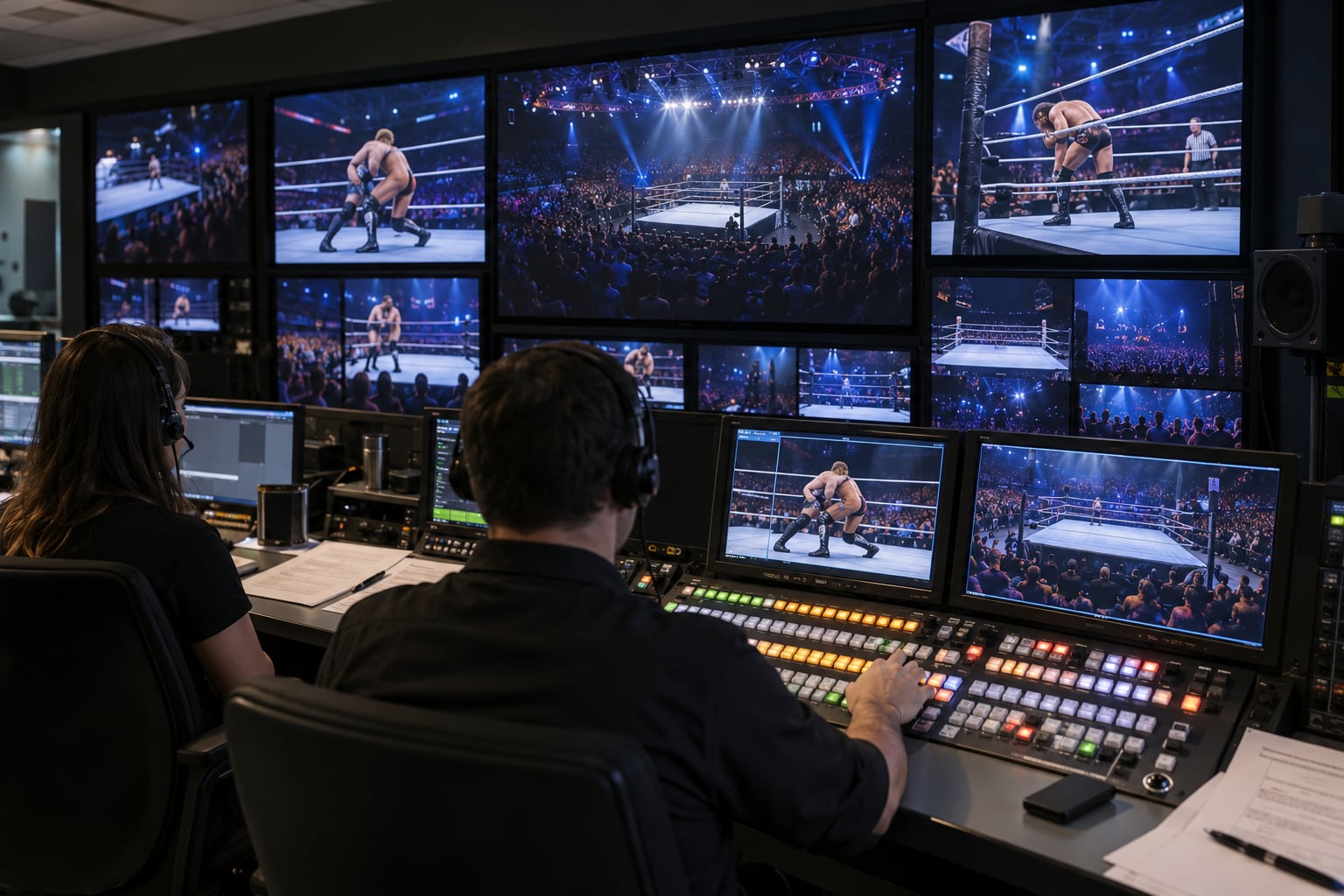
Live wrestling TV production is the crew-driven process of turning an in-ring performance into a timed television broadcast. Multiple camera operators feed a live switcher, a commentary team explains what is happening, and a producer follows a run-sheet that assigns every match a segment time and an out time, trimming or cutting segments when the show runs long.
Watching a wrestling show on television and watching the same show in the building are two different experiences, and almost all of that difference comes from decisions made by a dozen or so people in a production truck you never see. This guide walks through those decisions, from the morning the crew arrives at the arena to the second the broadcast fades to black.
Table of Contents
- How Live Wrestling TV Production Works From Start to Finish
- How live wrestling TV production works, step by step
- What Happens Before the Show Goes Live
- How the Production Team Is Organized
- How the Cameras Cover a Wrestling Match
- How Live Switching and Replays Are Controlled
- How Commentary, Audio, and Graphics Add Context
- What Happens During Entrances, Breaks, and Segments
- How Live Broadcast Problems Are Handled
- Frequently Asked Questions
- What is a run sheet in wrestling television?
- Why does a wrestling show cut away every few seconds?
- What does a hard camera do in wrestling?
- Is wrestling on TV scripted?
- Who decides what gets cut from a wrestling show?
- How long does a wrestling match take to produce on TV?
- Conclusion
How Live Wrestling TV Production Works From Start to Finish
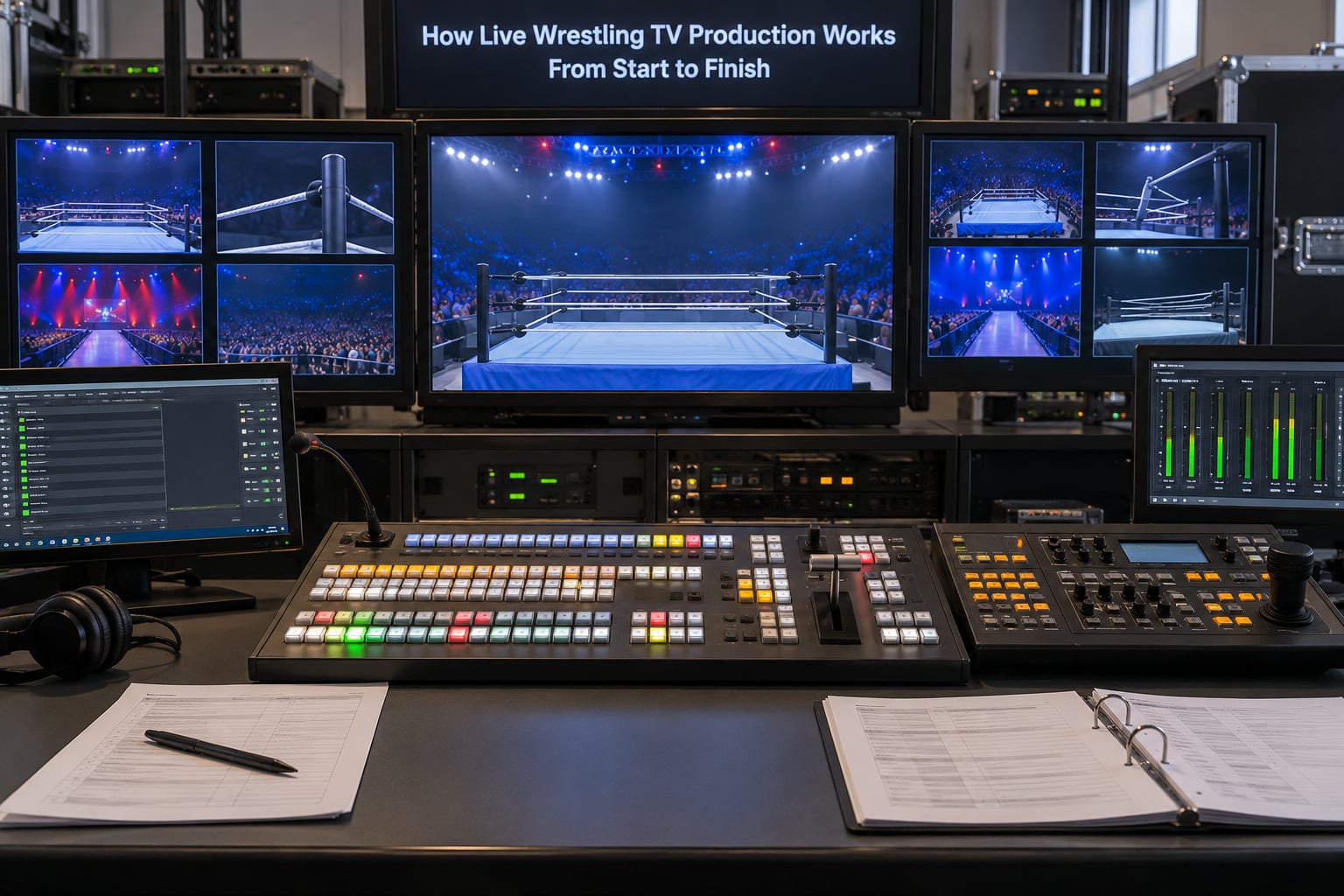
A live wrestling broadcast is not one continuous shot. It is a controlled sequence built around a hardwired schedule, cut together in real time by a switcher operator following a director’s calls, and padded with pre-produced video packages and entrances so that every match fits a fixed slot.
How live wrestling TV production works, step by step
- Load-in. The truck parks, cables run, and the video and audio paths get patched into a working state. Nothing on air is possible until this is finished.
- Camera positions are set and tested. Every camera has a marked spot on the floor. Operators frame shots against an empty ring and confirm clean video back to the truck.
- Talent check and rehearsal. Entrances, bell rings, spotlight cues, pyrotechnics and any scripted sequences are walked through with the crew and with production leadership.
- Pre-show runs. A separate show, often a few hours earlier, fills the runtime before the main broadcast begins. It exists partly to sell tickets to the main show.
- Doors open and the arena fills. Crew shifts to show mode. Levels, mics and comms are checked again against real crowd volume.
- The main show starts on the clock. The first non-match segment, often a cold open or in-ring introduction, is already in progress when the broadcast begins.
- Matches run inside their slots. A match allotted 14 minutes usually contains 10 or 11 minutes of bell-to-bell action. The rest is entrance, setup, and aftermath.
- Breaks and packages fill the gaps. Commercial breaks, video packages, recaps and crowd shots absorb the time the in-ring work did not use.
- Out time, then teardown. When the show reaches its hard out time it ends, regardless of where the story is. The next day the truck may already be pointed at another city.
What Happens Before the Show Goes Live
Most of the visible work is finished before the audience notices anything at all. Storylines are decided by the writing team, and a producer converts those decisions into a document assigning each match a segment time rather than a desired match time.
Venue preparation starts days earlier. The ring is built, lighting and LED boards are rigged, camera platforms and cable runs are marked, and the video wall position is chosen so it stays in frame from the hard camera without blocking the crowd’s sightline.
The day of the show is dominated by rehearsal blocks. Wrestlers run entrances while lighting and pyrotechnics cues are tested. A technical director with a long event history, such as Grant Sawyer, who has worked more than 600 events, treats those blocks as the only chance to fix problems cheaply.
Final meetings matter more than fans expect. Producers confirm talent availability, who is winning and how, whether a finish has changed, and what will be cut first if the show is running long. That conversation is short and it shapes the next three hours.
How the Production Team Is Organized
The people in the truck divide into three groups: people who decide what happens, people who capture and mix it, and people who move the physical pieces. Only some of them can change the show while it is on the air.
| Role | What they do | What they can change live |
|---|---|---|
| Executive producer | Owns the broadcast vision and network relationships | Very little, and not on a live segment |
| Producer | Owns the run-sheet and the clock | Cut, trim, reorder and extend segments |
| Director | Decides which camera you see and when | Every cut, replay and cutaway |
| Vision mixer | Executes the switch during the show | Transitions and which feed is live |
| Camera operators | Frame and hold shots on the action | Zoom, pan and framing within their shot |
| Replay operators | Run instant replay and slow motion | Which replay and how it is trimmed |
| Audio engineer | Balances crowd, commentary, music and effects | Levels and which microphone is open |
| Graphics and LED | Lower thirds, logos, statistics, match graphics | What is on screen and when |
| Talent and stage crew | Entrances, crowd, ring reset, timing of bell | Cue timing and crowd handling |
That table is the honest answer to who decides what gets cut. The producer owns the clock and the order, the director owns what you see, and the vision mixer is the pair of hands that makes it happen.
Coordination happens over an open intercom, and the language is deliberately terse. Producers wrote for years before they were allowed to call a live segment, a pattern veterans describe as the standard path from associate producer to full control of a broadcast.
How the Cameras Cover a Wrestling Match
The hard camera is the shot you see about 80 percent of the time. It sits at a fixed elevated position on one side of the ring, wide enough to hold two or three wrestlers, and it is the angle the in-ring work is choreographed for.
Hard camera footage rarely gets exciting on its own. If a promo is built around a camera angle, it is built around this one, which is why production teams tell wrestlers constantly where it is and what it can see. Wrestlers learn to work to that side of the ring so the signature spots land in frame.
Alongside it you will see handheld or roving cameras on the floor, a low angle camera at apron height for power moves, a crane or steadicam for entrances, and dedicated replay operators feeding back a slow-motion angle that the live cut could not have caught.
Entrances get treated as their own production. The roving camera leads the wrestler down the ramp, a wide camera establishes the arena, and the hard camera switches to the ring so the in-ring work stays consistent. On big cards, pyrotechnics are triggered from production, not from ringside.
Camera position list:
- Hard camera: elevated, fixed, main match coverage
- Handheld or roving: floor level, follows action, gets close
- Low or apron camera: dramatic angle for finishes and near-falls
- Crane or steadicam: entrances and arena establishing shots
- Replay cameras: isolated, angled for slow motion
- Wireless handheld: backstage segments and cutaway interviews
How Live Switching and Replays Are Controlled
The vision mixer sits in front of a wall of monitors, one per camera, plus preview and program feeds. The director calls a shot and the mixer throws it. Nothing is recorded in the ordinary sense during a live show, so a wrong cut is gone.
Replays are a controlled second look. Operators on isolated cameras capture the same action from a tighter angle, and the director decides when to interrupt the action with a replay. Sports-style wrestling uses them for near-falls and finishes; worked-style shows save them for spots that a live cut missed.
The cut rhythm is a deliberate craft choice. It hides the reset between sequences, keeps energy high during a rest hold, directs your eye to the important wrestler, and fills dead air when something slow happens. Fans in wrestling forums have complained for years that they can count from three and call every cut, which is exactly the response a tight cut rhythm produces.
When a show runs long, the producer starts cutting in a predetermined order. Padding goes first, then recaps and packages, then entrance length, then match length, and major story segments go last. The person in charge of each match is told backstage so talent are not surprised mid-ring.
How Commentary, Audio, and Graphics Add Context
Commentary does two jobs at once. The play-by-play calls the action and gives the crowd something to hold onto during rest holds, while the color commentator explains why the match matters and connects it to months of storyline.
The trap fans notice most is commentary that contradicts the picture. When the finish is a worked angle but the commentary sells it as a shock, the two layers disagree on air. That is a writing decision as much as a production one.
The crowd is a live audio source and a big part of the mix. Audio engineers ride the levels as the building reacts, because a packed arena and a half-full one need different treatment. Entrance music, pyrotechnics and ring announcements compete for the same bandwidth, so cues are written with the mix in mind.
Graphics carry the story context: a lower third identifying each wrestler, a graphic package before matches, statistics, and sponsor elements placed where the feed allows. The LED boards and video wall are content too, used for entrances, recaps and anything the director wants the crowd watching instead of the ring.
Video packages, also called pre-tapes, are the pre-produced layer. They are shot earlier, edited in advance and broadcast as finished pieces. When a promotion runs long, a package is the easiest thing to cut because cutting it costs nothing in the story.
What Happens During Entrances, Breaks, and Segments
Everything that is not a match is still production, and it consumes most of the runtime. A typical weekly structure looks roughly like this:
| Segment | Allotted time |
|---|---|
| Opening segment and match | 12 to 15 minutes |
| Package and recap | 3 minutes |
| Backstage or in-ring promo | 4 to 6 minutes |
| Main event match | 20 to 25 minutes |
| Commercial and bumper breaks | 6 to 10 minutes total |
The key discipline is that an allotted segment time covers the entrance, the bell, the work, the finish and the post-match wrap-up. A 14-minute slot that produces 10 minutes of actual wrestling is normal, not a broadcast failure.
Continuity between segments is handled by giving every producer a version of the current run-sheet. When a segment is cut, the producers of the segments after it re-time their own material so the story still lands on the out time.
The pre-show is a separate broadcast that runs earlier in the day. It fills network runtime, sells tickets to the main show, and gives the crew a full dress rehearsal before anyone important is watching.
How Live Broadcast Problems Are Handled
Live shows fail in small ways constantly. A camera loses signal, a graphic is cued to the wrong wrestler, a microphone cuts out, an entrance music track is missing a file, or a match runs three minutes long. The broadcast almost never shows the problem.
The response is preparation. Graphics are loaded and checked before doors open. Every camera position has a backup framing in case the main feed drops. Producers know which segments absorb lost time before they need to use them.
Talent changes are routine. A wrestler pulled from a card means the producer pulls the next slot forward, informs the affected segments, and the director simply switches to the next shot in the run-sheet. Nothing is rebuilt from scratch.
The part that cannot be fixed is timing. A match that overruns is taken out of somebody else’s segment, and the show reaches its out time either way.
Frequently Asked Questions
What is a run sheet in wrestling television?
A run sheet is the producer’s document that lists every segment in order with its allotted time and the show’s out time. Matches are assigned a segment time rather than a match time, so the entrance, the bell, the work and the wrap-up all fit inside one slot. It is the schedule the entire broadcast is built to hit.
Why does a wrestling show cut away every few seconds?
Rapid cutting hides resets between sequences, keeps energy high during rest holds, directs your eye to whoever the story needs you watching, and fills dead air. A production team will also cut to a replay or a crowd shot to cover a mistake or to reset the story. The rhythm is chosen by the director and mixer in real time.
What does a hard camera do in wrestling?
The hard camera is the single elevated, fixed camera that carries most of a match, usually showing 80 percent or more of the in-ring action. Because it is the main angle, wrestlers are taught exactly where it sits and how much of the ring it can frame. Signature spots are choreographed so they land in that shot.
Is wrestling on TV scripted?
Matches are semi-scripted. Key moments and finishes are planned in advance so the story lands as intended, while the connective work between those moments is improvised in the ring. Promos, entrances and storyline beats are far more predetermined than the actual wrestling. Production treats those plans as fixed and the improv as padding.
Who decides what gets cut from a wrestling show?
The producer owns the run-sheet and the clock, so the producer decides what goes when the show runs long. The director owns what you see, which means replays, cutaways and pacing inside a segment. The vision mixer executes. Cuts follow a pre-agreed order, and the segments after a cut get re-timed to hit the out time.
How long does a wrestling match take to produce on TV?
A match broadcast inside a 14-minute segment usually contains 10 or 11 minutes of bell-to-bell action. The remaining time covers the entrance, the ring setup, the finish and the post-match wrap-up. Add packages, promos and commercial breaks and you can see why a two-hour broadcast carries relatively little actual wrestling.
Conclusion
Live wrestling TV production is a schedule defended in real time. A run-sheet sets the shape, a director and mixer decide what you see second by second, and a producer decides what gets sacrificed when the show runs long.
Start watching with those layers separated. Notice which camera you are on and why, notice when a replay interrupts and whether it shows something the live cut missed, notice whether the commentary matches the picture, and check the broadcast against the advertised run time. Once you can see the layers, the polish stops being a mystery and starts being a job someone did well.