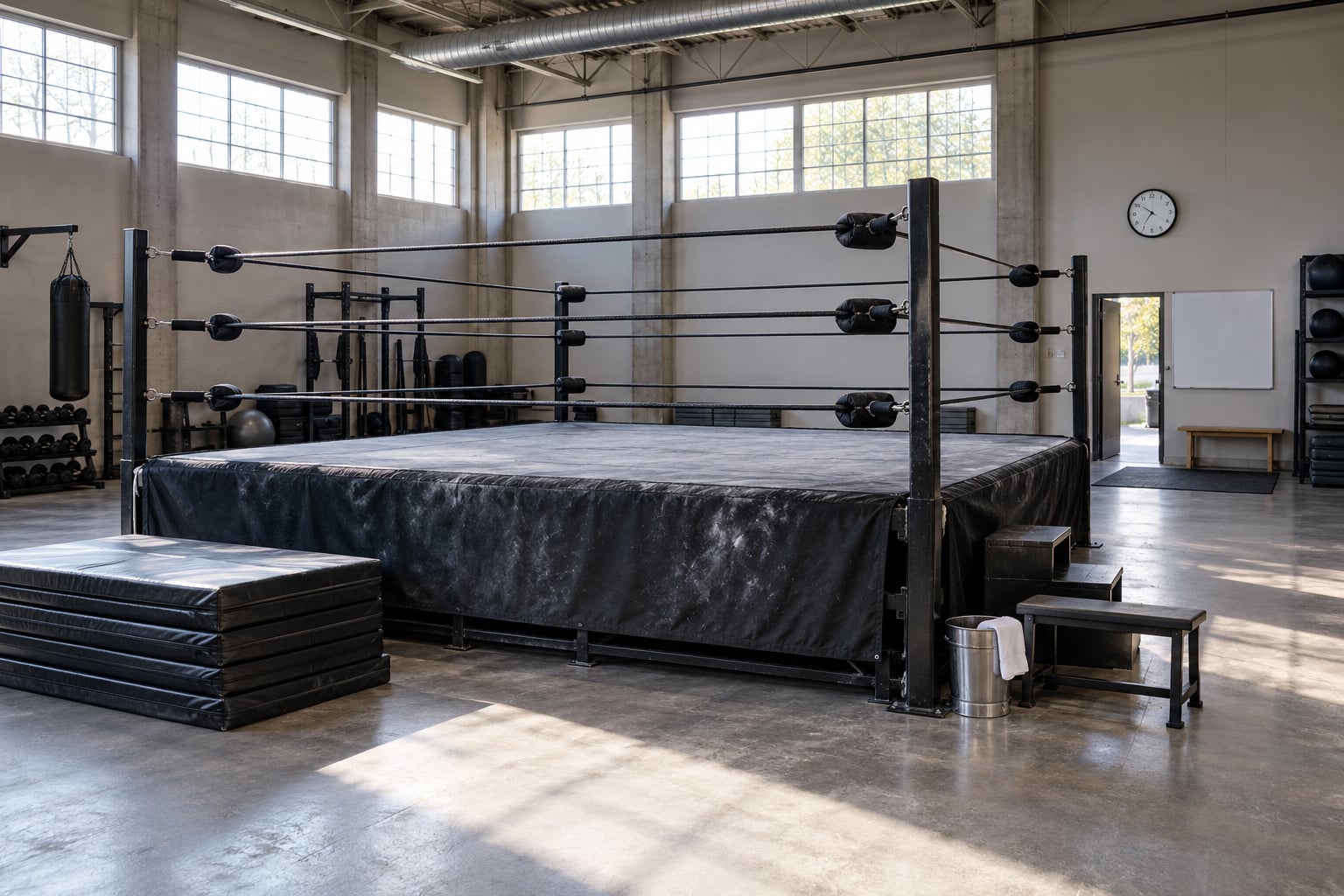
How Japanese wrestling dojos train rookies comes down to repetition, coaching and shared living. A trainee enters through an open camp or an open class, moves into a developmental group under a head coach, trains daily on conditioning and mat work, works ringside on shows, and only then starts taking bumps in matches. Nothing is skipped, and nothing is rushed into a public match early.
The part outsiders miss is how much of rookie training is not wrestling at all. Rooks sweep the floor, cook, live in a company dormitory, and spend hours watching senior matches from the apron before they are ever allowed near the ropes.
Here is what the process actually looks like, what a daily session involves, and what a newcomer should do first if that is what they want.
Table of Contents
- What Does a Japanese Wrestling Dojo Teach a Rookie?
- How Dojo Training Usually Progresses?
- How Japanese Wrestling Dojos Build Physical Foundations
- How Japanese Wrestling Dojos Train Rookies
- How Rooks Learn Ring Work and Sell Techniques
- What Role Does the Senior Rookie Play?
- How Do Coaches Teach Character and Match Psychology
- How Do Rooks Move Toward Live Training?
- How Japanese and American Rookie Development Differs
- What Should You Do First If You Want to Join a Dojo?
- Frequently Asked Questions
- Can anyone join a Japanese wrestling dojo?
- How much does rookie training in a Japanese wrestling dojo cost?
- Do Japanese wrestling rookies train every day?
- Do I need previous wrestling experience to join a dojo?
- How long does it take to debut after joining a Japanese wrestling dojo?
- Conclusion
What Does a Japanese Wrestling Dojo Teach a Rookie?
A dojo teaches six things at once, and a rookie is usually weakest in the first two. In broad strokes, how Japanese wrestling dojos train rookies looks like this:
- Athletic preparation. Running, strength work, mobility and body-weight drills that make the later mat work survivable.
- Ring fundamentals. Stance, positioning, chain wrestling, escapes, holds and bumps taken correctly.
- Character and match psychology. Why a wrestler moves, reacts and paces the way they do in front of an audience.
- Dojo etiquette. Bowing, cleaning, being on time, treating the ring and the roster’s seniors with respect.
- Mentorship. Regular correction from a head coach and from more experienced classmates who model the work habits.
- Evaluation. A coach assessing whether a trainee is safe, reliable and ready for the next level of responsibility.
Nobody skips to the third bullet first. Trainees who arrive able to throw a flashy move but who cannot hold a position or take a fall properly get pulled back, usually with a lot of repetition.
How Dojo Training Usually Progresses?
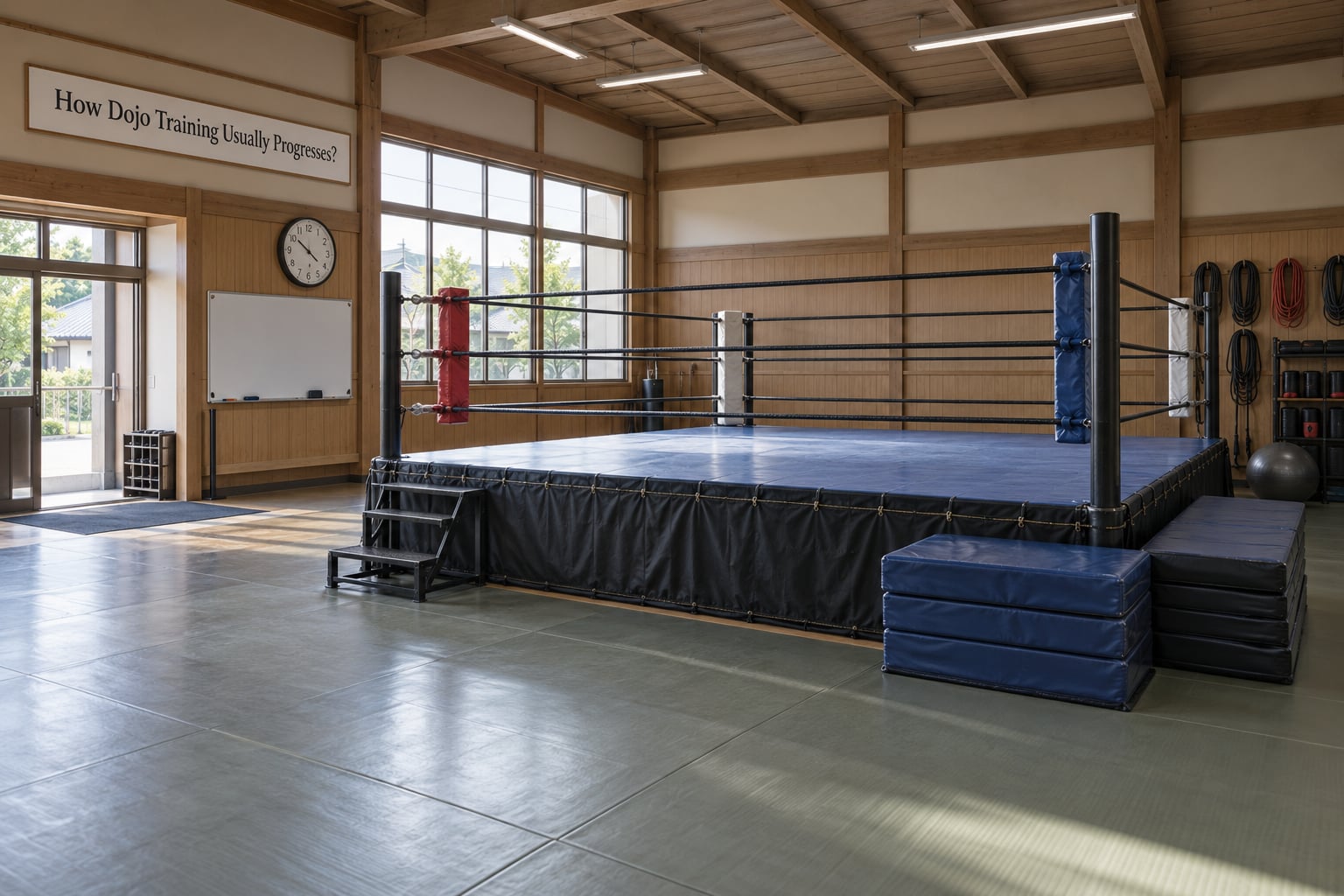
The stages overlap, and a dojo might compress or extend them. The usual order runs like this.
- Orientation. Rules, schedule, conduct and what the promotion expects. Newcomers learn the room before they learn the ring.
- Conditioning block. Running, squats, core work and stretching, usually the first thing scheduled and the last thing abandoned.
- Fundamentals. Drills broken to their smallest parts. One partner holds a position until it is clean, then the pair moves on.
- Supervised mat work. Longer sequences with a coach walking the ring, stopping the work to correct a hand position or a hip placement.
- Ring drills and movement. Running the ropes, working from the mat, transitions between standing and grounded, pacing.
- Live training. Rounds with a partner and feedback afterwards, only after the basics hold up.
- Senior-rookie preparation. Handling workload, taking more rounds, working in front of people and eventually competing publicly.
Rossy Ogawa has pointed out that practical limits shape this more than any training manual. Noise restrictions from neighbours, ceiling height high enough to set a ring up, ring size and access limited by a busy show schedule all dictate how much time a group actually gets on the mat.
How Japanese Wrestling Dojos Build Physical Foundations
Conditioning is not a punishment phase before the real work. It is part of the work. A wrestler who cannot do a round without gassing will not be trusted with a long match, so the gym time gets protected.
Katsuyori Shibata described one foreign trainee who arrived at his dojo already doing 500 squats a day, and treated that kind of self-driven preparation as the baseline rather than an achievement. In practice, rookies tend to work on running and roadwork first, then lower-body strength and core stability, then balance and flexibility for the awkward positions on the mat.
Recovery and injury awareness get attention too. Wrestlers learn which kinds of soreness to ignore and which signs mean a joint needs rest. Schedules and expectations differ sharply between dojos: a full-time developmental group has hours of mat time, while a beginner class in the evening might get two sessions a week.
How Japanese Wrestling Dojos Train Rookies
Rookie training in Japanese dojos runs on a simple loop that repeats most days: warm up, condition, drill a small piece of technique until it is repeatable, apply it in a short sequence, then do it under fatigue. The coach corrects in the moment and reviews at the end. Progress comes from doing the same five minutes of mat work hundreds of times until nobody has to think about it, which is why it looks slow from the outside.
How Rooks Learn Ring Work and Sell Techniques
Chain wrestling is the backbone. A wrestler links one hold into another without a break, controlling the opponent’s head and limbs the whole time. Escapes come next, because a sequence is only useful if the other person can genuinely get out of it. Holds, transitions and reversals follow.
Bumps are taught as a skill, not a punishment. A rookie learns to fall on the back of the head, the shoulder and the side, distribute the impact across the mat, and protect the neck on landing. Selling teaches the same idea from the other direction: making a move look like it hurts so the crowd reads it correctly.
Communication runs through all of it. Partners agree beforehand on what a spot is, who moves first, and where the move finishes. Pacing matters too — a ten-minute match has a shape, and beginners need to be told where the rests go so they do not exhaust themselves in the first two minutes.
What Role Does the Senior Rookie Play?
The senior rookie is the most underrated part of any dojo. In NJPW’s developmental system the rookies are called Young Lions, and the more senior ones take on the newest arrivals almost by default.
In practice that means demonstrating a basic sequence correctly, absorbing extra rounds when a coach is short on bodies, and being the person who explains how a match got put together after the fact. Newer trainees who stand near the ropes during training work get to watch the negotiation behind a good match — the handoff, the hesitation on a kickout, the agreed pace — in a way they would never pick up from a finished match on television.
Ringside duties reinforce the same habit. Young Lions who work shows keep the area clean, hold and collect gear, keep order near the ring, and watch from apron level. That vantage point is closer to the action than any broadcast camera.
How Do Coaches Teach Character and Match Psychology
Coaches rarely hand a rookie a finished persona. They work on the parts: what a character wants, how that person stands when nobody is watching, how they react to being hit somewhere specific, and how they walk to the ring. Movement gets studied closely, because movement tells a crowd more than words do.
Match psychology is taught as sequencing. Where does the tension build, where does the audience get a rest, what does the underdog need to do to keep the match believable. Shuji Kondo, describing the Marigold dojo, put the philosophy plainly: fundamentals before flashy moves, because flashy rookies were getting injured rather than getting better.
Kayfabe is handled the same way. A trainee learns to treat the character’s situation as real inside the match, which mostly means having a reason for every move and not breaking character halfway through.
How Do Rooks Move Toward Live Training?
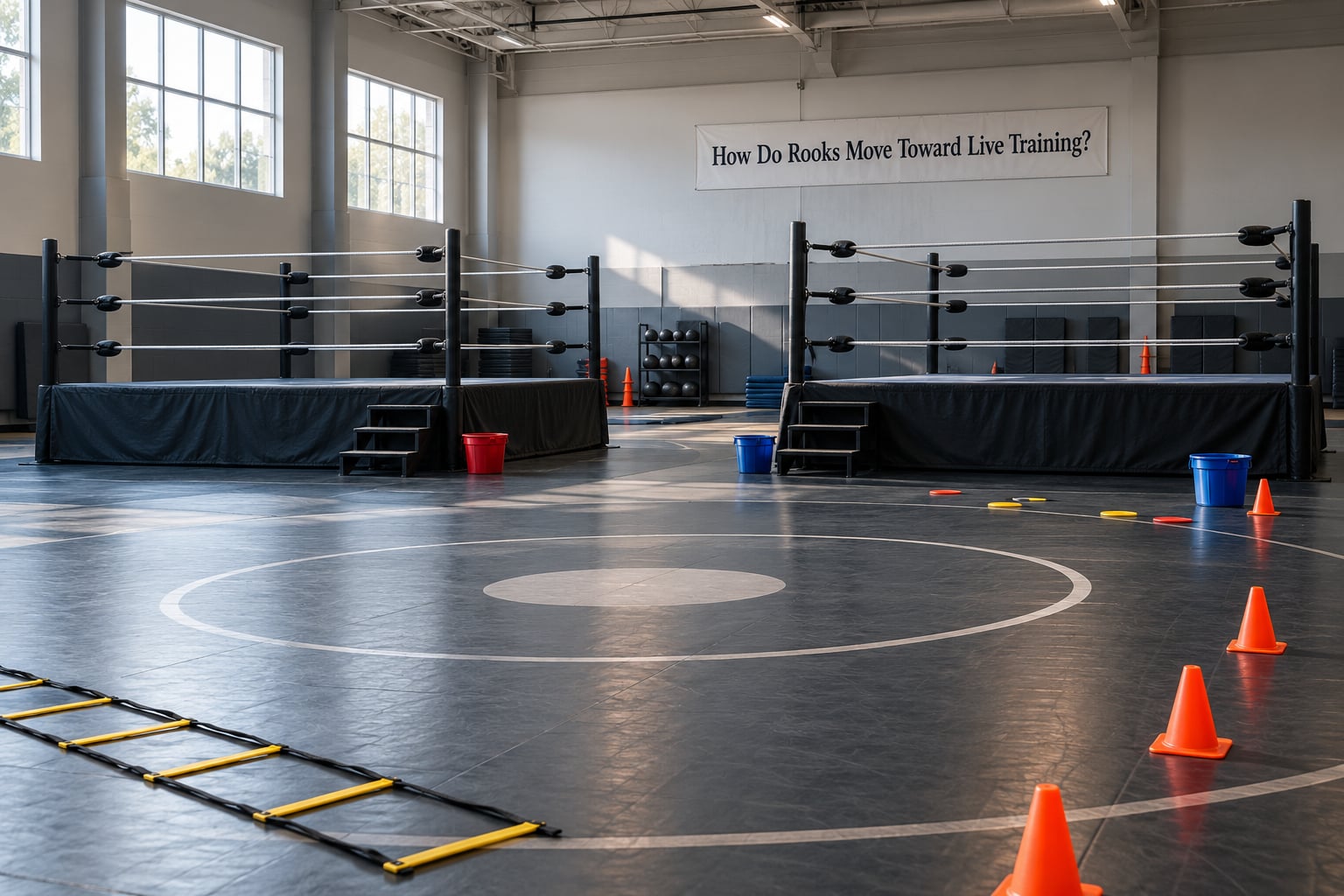
Live training is gated, not scheduled by date. A coach usually wants three things first: the rookie can take a bump safely without coaching, they can call a hold clearly enough for a partner to work with, and they can finish a sequence without losing position halfway through.
Training exchanges are usually constrained before they are open. A round might be limited to a time limit with a no-disqualifier rule, or restricted to a list of agreed spots, with the coach stopping to give feedback. Round count rises in steps.
Signs of readiness include steady pace through a full round, honest communication with the partner, visible improvement between attempts, and handling a mistake without hiding it. Competitions and tours like the Young Lion Cup serve a similar purpose, putting a short match in front of judges who are evaluating specific technical points rather than entertainment.
How Japanese and American Rookie Development Differs
Both systems produce wrestlers who can work. The difference is structure, not talent. Treating one as inherently better is the wrong conclusion, because the two models answer different questions.
| Factor | Japanese dojo model | Many US independent programs |
|---|---|---|
| Time commitment | Full-time daily training, often with dormitory living | Often nights and weekends around other work |
| Feedback | Head coach plus senior rookies, near-daily | Head trainer plus rotating regulars |
| Match frequency early | Matches come after months of fundamentals | Booked relatively quickly once basics are reliable |
| Evaluation | Progression stage by stage, gear and duties as markers | Promotion depends on bookings and promoter relationships |
| Travel and excursions | Learning excursions to affiliated promotions abroad | Independent tours organised per booking |
The apprenticeship culture is the loudest difference. Shibata has spoken about foreign students who treated the dormitory and the lifestyle as a place to sleep between sessions, and about how that had to be corrected before the wrestling itself could be. Living with the work tends to come before the work itself.
Structure is not free, either. Living on a developmental roster in Japan means limited income, limited control over booking, and little privacy. Forum discussions about why wrestlers leave promotions tend to circle exactly those pressures.
What Should You Do First If You Want to Join a Dojo?
The honest answer to how to get in is that there is no single published route, which is why so many people searching for it come away empty-handed. A workable sequence looks like this.
- Start with promotions, not gym names. Look at which promotions run developmental groups and which run open classes. The promotion decides who trains, where, and what happens afterwards.
- Verify the coaching and booking details. Check the promotion’s own site and recent social posts rather than third-party summaries, because rosters and programs change often.
- Attend an open training session. Open camps and beginner courses are the realistic way in. Watching a session honestly tells you more than any article, including this one.
- Ask specific questions. Fees, schedule, contract or no contract, who supervises on the day, what protective equipment is required, and what the injury policy is. Ask about travel too if you are coming from abroad.
- Judge the room. A good gym has a coach who corrects you, a beginner-friendly pace, and students who are being taught. Volume of yelling is not a training method.
Two structural questions matter more than the rest. Is the coach present for every session, and does anyone in the group actually get booked? Those two answers tell you most of what you need to know.
Frequently Asked Questions
Can anyone join a Japanese wrestling dojo?
Mostly yes, though the route depends on your goal. Beginner classes and open camps are open to anyone above a minimum age and basic fitness level, with no prior wrestling experience needed. Full developmental groups are different: those are recruited, often from open camps or auditions, and expect full-time commitment including dormitory living. Foreign applicants also need to sort out a visa before they can train on a resident basis.
How much does rookie training in a Japanese wrestling dojo cost?
There is no single figure, and dojos rarely publish one, so ask the promotion directly. Beginner classes usually charge a per-session or per-term fee, while developmental rookies are often paid a stipend or salary instead of paying to train. Travel, housing, food and equipment sit outside the training fee entirely, and for international trainees they are usually the larger cost. Ask what is included before committing to a term.
Do Japanese wrestling rookies train every day?
Full-time developmental rookies usually train most days of the week, with gym work, ring work and conditioning split across the schedule. Day sessions often include matches on the promotion’s shows, which are treated as training rather than separate work. Open-class and beginner students typically train two or three times a week, because most of them hold jobs. Schedules are published by each dojo and change with the show calendar.
Do I need previous wrestling experience to join a dojo?
No. Beginner courses exist specifically for people who have never trained, and they assume you start with the fundamentals: stance, falling safely, then basic holds. Amateur wrestling, judo or a strong conditioning base helps you progress faster, but plenty of professionals started from nothing. What matters more than experience is the willingness to train consistently for months before getting any match time.
How long does it take to debut after joining a Japanese wrestling dojo?
For a full developmental rookie in Japan, plan on roughly a year to a year and a half before a debut match, and longer if you are starting from zero fitness. Beginner classes never move that fast because they are not designed to produce debut-ready wrestlers on a fixed clock. The variable that matters most is how quickly you become safe and reliable in the ring, not how many months you have been enrolled.
Conclusion
How Japanese wrestling dojos train rookies is a question about patience and structure. Rookie development runs on conditioning, repeated technical drills, ring etiquette, close mentorship and regular assessment, with match time deliberately placed at the end rather than the start.
As of 2026, the most useful first step is still simple: research which promotion you actually want to be part of, find out whether it runs an open camp or beginner class, and attend one session before you commit anything. Watch how the coach corrects people, and how the older trainees show up. That tells you more than any guide, including this one.