Canadian wrestling feeds the US indies through four connected channels: a dense cluster of wrestling schools in Southern Ontario, Quebec and British Columbia; regional independent promotions that hand out hundreds of reps a year; promoters on both sides of the border who co-book tours; and a work style that American bookers already know how to use on a card. This guide traces how those channels work for US independent promoters, for Canadian wrestlers trying to cross over, and for fans who keep seeing the same surnames on both sides of the line.
Here is the short version of how canadian wrestling scenes feed the us indies: a wrestler trains in Canada, gets matched on Canadian indies until the work is dependable, picks up a reputation that travels through promoter networks, and then books a US weekend. That is the pipeline. Everything else in this article is detail on one of those four steps.
One warning before we start. There is no single Canadian scene. Quebec, Ontario, Calgary and Vancouver have separate traditions, separate crowds and separate booking cultures, and lumping them together is the fastest way to sound like you have never read a Canadian wrestling tape.
Table of Contents
- How Canadian Wrestling Scenes Feed the US Indies
- Why Canadian wrestling has such a strong US influence
- Talent exchanges and the migration of Canadian wrestlers
- How training partnerships raise the quality of US indies
- Booking networks that connect both sides of the border
- How Canadian styles change US independent wrestling
- Women’s wrestling and cross-border talent development
- Audiences, online discovery, and shared fan communities
- What US promotions gain from the connection
- How the US indies can build sustainable cross-border ties
- Frequently Asked Questions
- In what ways do Canadian wrestling scenes feed the US indies?
- Which Canadian wrestling promotions have the biggest influence on US independents?
- What is the main difference between Canadian and US indie wrestling?
- Why do so many Canadian wrestlers try to work in the United States?
- Do Canadian wrestlers need a visa to work US indies?
- Where can American fans discover Canadian independent wrestling talent?
- Conclusion
How Canadian Wrestling Scenes Feed the US Indies
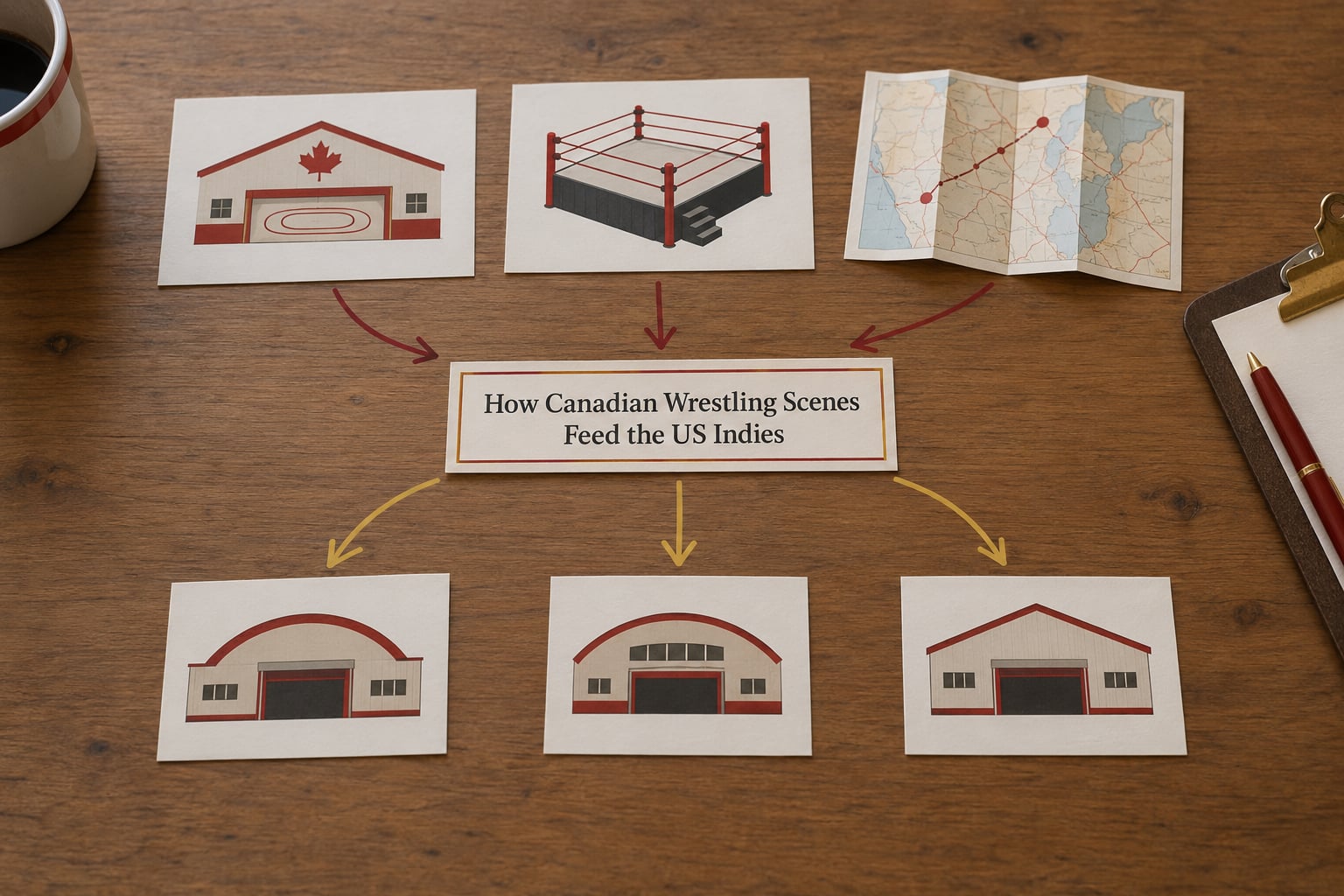
The mechanisms are simple to describe and fiddly to explain, because each one runs through people rather than rules. Here is the map most US promoters end up using once they have booked their first Canadian guest.
| Pathway | What actually crosses the border | Who it helps |
|---|---|---|
| Wrestling schools | A rookie with ring reps, mat work and a character that reads on the first show | US indie bookers filling a short-notice gap |
| Regional indie reps | Several hundred worked dates at SMASH, Alpha-1, High Impact, Mystery Wrestling, Maple Leaf Pro, Border City Wrestling, NCW or the IWS | Promotions that want a name with a body of work behind it |
| Cross-border tour runs | Booked weekends where van, hotel and per diem costs get split | Independent bookers on both sides of the 49th parallel |
| Style vocabulary | Reliable, high-workrate, story-first wrestling that needs little translation | US matchmakers building a card |
| Talent programs | Formal development tracks, including Create-A-Pro Wrestling’s dojo-to-show model and Mystery Wrestling’s 25-wrestler initiative framed around opening US dates | Promotions that build a roster instead of renting one |
| Women’s wrestling depth | A pool of experienced, well-trained performers who are already used to working hard matches | US promoters building a credible division |
Read that table bottom-up and you get the honest version. Style and reps are what people notice. The schools, the tour economics and the permit paperwork are what actually keep the thing running.
Why Canadian wrestling has such a strong US influence
The influence runs both directions and it is old. Maple Leaf Wrestling opened in Toronto in 1930, and the National Wrestling Alliance territory system gave Canada four recognised centres: Montreal, Toronto, Calgary and Vancouver, each with its own promotion, its own booking office and its own television slot. Stampede Wrestling in Calgary ran one of the sharpest weekly programs in the business for decades.
What that system produced was a professional class that spoke the same wrestling language as the United States. Kayfabe, work rate, babyface and heel, the face turn, the hot tag. A wrestler who learned in a Calgary wrestling school in 1985 could take a US booking in 1986 without anyone having to explain the vocabulary.
The Hart family turned that shared language into a whole dynasty. Stu Hart’s Dungeon in Calgary trained a generation that worked everywhere, and the family’s Montreal roots put them in the middle of both countries’ business at once. Pat Patterson and Earl Hebner came out of that world and ended up running American television. Shawn Michaels, Bret Hart, Edge and Chris Jericho all broke out of it into major American promotions.
Geography keeps the loop tight. Windsor sits across the river from Detroit. Vancouver and Seattle are a short hop. Montreal and Buffalo are the same drive. A promoter in Ohio can send a car to Windsor and be back the same night, which turns a Canadian date from a road trip into an errand.
Talent exchanges and the migration of Canadian wrestlers
Talent moves in a predictable order. A wrestler trains, gets on local shows, gets a name that means something inside a 200-seat room, and then starts booking further out. The jump to the US usually happens on somebody else’s card, not on their own.
Brodie Lee’s route is the one people still argue about on r/SquaredCircle: regular dates on Canadian independents including Alpha-1 and C4 before a WWE contract with The Wyatt Family. Grind the regional scene, prove you can work a long match, get picked up. That is the template, and it is not a rare story.
The mechanics are unglamorous. Tryouts happen at Canadian shows that Americans attend. Agents and publicists pass names along. A wrestler on a hot run in Ontario gets asked to fill a US card when somebody pulls out. Personal ties matter as much as tape, which is exactly why r/IAmA threads about booking keep circling the same point: bookers book people they have already seen work.
Not everyone crosses. Plenty of Canadians take US dates once a year and build a career at home, and that is a healthier outcome than the internet suggests. The r/WredditSchool thread about the Canadian scene is full of people asking the reverse question, whether moving to Canada could supply steady indie work, which tells you how fluid the direction of travel feels from either side.
How training partnerships raise the quality of US indies
The trainer is the export nobody measures. Wrestlers from Quebec, Ontario and British Columbia cross south to work US schools and independent promotions, then take that experience back into Canadian rooms as coaches, managers or former wrestlers running their own programs. The United States sends trainers and bookers north for the same reason.
What crosses with them is technique. Ring psychology and pacing come from the territory tradition. Catch wrestling and mat scrambles come out of Quebec’s French-language lineage, where Lutte Internationale and Grand Prix Wrestling built an audience that still watches masked work today. Lucha libre crosses through touring circuits that have run Montreal and Toronto for decades. Strong-style offence and hard-hitting exchanges get picked up at Smash Wrestlings’ shows and at Alpha-1 events.
None of it is better than what the US produces. It is a different set of defaults, and a US promotion gains something useful when it mixes them with what it already has. A card built entirely of high-workrate technical wrestlers is a hard sell in a 300-seat room. A card built entirely of personalities with no structure is a different failure.
Formal programs make the transfer deliberate rather than accidental. Mystery Wrestling signing 25 Canadian wrestlers to an initiative framed around opening doors to work in the United States is the clearest recent example of the pipeline being built on purpose instead of by accident. Create-A-Pro Wrestling in Toronto has long run the same idea in a different shape: a dojo that feeds its own shows.
Booking networks that connect both sides of the border
Booking is where most of the actual work happens, and it is the part no outsider sees. Agents carry Canadian talent into US rooms. US promoters call Canadian bookers when a card needs a specific style or a reliable name to anchor a segment. Tour operators build a weekend in one province, then fly or drive the same roster into the next.
Logistics set the ceiling. Booking lead times in independent wrestling run long, and a US promoter who wants a Canadian guest needs the date confirmed months ahead so travel can be shared. Insurance, van costs and hotel nights come out of a gate that is usually smaller than anyone admits.
Immigration paperwork is the part wrestlers talk about most and promoters mention least. Canadians working paid dates in the United States generally need US work authorisation, and the route depends on the situation: an entertainer classification for established performers, a treaty status for citizens of a country with a visa waiver arrangement for the US, permanent residency, or US citizenship. Rules change and individual cases differ, so anyone booking across the border should confirm current requirements with an immigration professional rather than a message board. Announcing visa approval publicly has become its own milestone among touring wrestlers, which tells you how much friction there is.
Then there is exclusivity. In 2026, Create-A-Pro Wrestling founder Pat Buck issued a statement after TNA pulled talent from matches against AEW talent, a dispute over who had the right to use those performers. That kind of friction is the pipeline’s cost of doing business. When a wrestler has two promotions’ calendars in the same month, somebody loses a segment, and the argument rarely stays about the wrestling.
How Canadian styles change US independent wrestling
Style transfer is the least visible and most durable part of the exchange. The table below maps the main currents and the kind of match each one tends to produce on a US independent card.
| Style current | Where the connection is strongest | Match concept it produces |
|---|---|---|
| Technical chain wrestling | Ontario and Quebec independent cards | A worked main event built on one limb target and a single late counter |
| High-impact offence | Bookers mixing veterans with unproven newcomers | Veteran protects the rookie for eight minutes, then eats the finish |
| Lucha libre | Tours pairing a Canadian luchador with a regular US masked wrestler | Mask-versus-mask framed as a titleholder’s open challenge |
| Character-driven comedy | Long-running GTA shows with standing weekly crowds | A comedy heel betrayed mid-scene, forcing a straight-face payoff match |
| Sports-oriented psychology | Card builders who want a structure they can teach | A feud final built from an injury arc and a missed time-limit draw |
| Women’s wrestling | Filled cards on both sides of the border | A four-way tag built around two trained veterans rather than two personalities |
The most-copied Canadian asset is not a style but a finish. The piledriver known as the Canadian Destroyer came out of Team Canada’s act in TNA and later became Petey Williams’ finisher, and it is now attempted in small rooms across the United States. It is also the clearest example of a signature move getting flattened when it travels. A finisher means nothing the first time a stranger uses it, and the argument on r/SquaredCircle about when it was actually great versus when it just got copied over is long-running.
Women’s wrestling and cross-border talent development
The women’s side of the Canadian scene is one of the deepest independent talent pools anywhere, and it feeds US indies constantly. Taya Valkyrie is the most obvious example, booked on both sides of the border, but the wider list of Canadians working American independents in 2026 is long enough that most US cards could name three names off it.
Two things travel with those wrestlers. The first is fundamentals: Canadian independent women are put in long matches early, which is why so many of them can work a fifteen-minute bout without padding it with heat. The second is character work, because the same cards that demand a stiff technical match also ask performers to sell a character in three minutes.
What US promotions get is depth. A booker who wants a credible women’s match for a card does not have to build it from scratch. That also means the audience crossover is real: a US fan who follows one Canadian wrestler on social media ends up watching the promotion that trained her.
One thing to avoid is the framing that treats this as a one-way export. Canadian women’s wrestling has its own history, its own Quebec lineage and its own crowds, and treating it purely as a talent source for American shows gets the relationship backwards.
Audiences, online discovery, and shared fan communities
Discovery is where the pipeline turned into a two-way street. Streaming platforms, event databases, podcasts, mailing lists and short-form video let an American fan follow a wrestler’s whole career instead of catching the tail end of it. A wrestler can build a US following years before appearing on an American show.
That changes promoter behaviour. A US independent that books a Canadian name with a real online audience can sell a few extra tickets on the strength of a clip. The flip side is that a promoter who treats a Canadian booking as pure promotion, with no thought to how the wrestler is introduced, gets nothing extra from that investment.
Podcast culture has also made the booking side audible. Independent bookers explain their thinking out loud, and fans have gotten better at reading who is reliable, who travels well and who works a crowd in a 200-seat room. That knowledge used to sit entirely inside the industry. Now a promoter in Ohio and a promoter in Ontario are working from the same information.
What US promotions gain from the connection
The practical gains are unglamorous and easy to measure. A deeper talent pool for short-notice dates. Match concepts that are new to a US audience without being foreign to it. Guest cards that pair a Canadian regular with a local name in a way that lifts both segments. Audience growth in cities with Canadian communities, and in cities with none.
The costs are equally real. Travel eats margin on a small gate. Communication across time zones breaks schedules. Style mismatch can make an otherwise strong wrestler look flat. And a cross-border appearance means nothing if the booking is a thrown-together guest spot rather than something built into the show.
The promotions that get this right treat a Canadian booking the way they would treat a strong TV opponent: a reason to rebuild the card, not a name to fill a hole.
How the US indies can build sustainable cross-border ties
Everything here is aimed at promoters and wrestlers who want the exchange to keep working. The first step is scouting more than one Canadian promotion and one training school, because no single scene holds the whole talent pool. The second is building direct ties with bookers instead of routing every date through one intermediary.
Budget the travel honestly before the date is confirmed, not after. Share the van cost and the hotel when a run of shows allows it, since that single habit is what makes a second and third Canadian date possible. Book complementary opponents rather than stacking two similar styles, which turns a guest spot into a match worth watching.
Test the fit with a smaller run first. One Canadian wrestler on one US show, filmed properly and put online, tells a promoter more than a spreadsheet of survey answers. Keep contacts on both sides even in the off season, because independent wrestling moves in bursts and the promoter who calls in February is often the one with dates in April.
For wrestlers, the practical version is simpler: work Canadian indies hard enough that promoters on the other side have seen you, keep your dates in writing so exclusivity problems surface early, and confirm work authorisation before you announce a US run.
Frequently Asked Questions
In what ways do Canadian wrestling scenes feed the US indies?
Mostly through four channels: training schools that turn rookies into dependable workers, regional Canadian promotions that give wrestlers hundreds of reps, promoters who co-book tours on both sides of the border, and a familiar work style that US bookers can use without explanation. Booking relationships matter as much as any of those four.
Which Canadian wrestling promotions have the biggest influence on US independents?
SMASH Wrestling, Alpha-1 Wrestling, High Impact Wrestling, Mystery Wrestling, Maple Leaf Pro Wrestling, Border City Wrestling, NCW and the International Wrestling Syndicate all supply talent to American independents. Create-A-Pro Wrestling matters more for development than for dates, since its dojo feeds its own shows and trains wrestlers other promotions later book.
What is the main difference between Canadian and US indie wrestling?
Card structure and economics rather than wrestling itself. Canadian indies lean more on regional identity, longer bookings and tighter promoter networks, with venues often in the 150 to 500 seat range. US indies offer more dates and larger markets but higher travel costs. Both sides share the same vocabulary and, increasingly, the same talent.
Why do so many Canadian wrestlers try to work in the United States?
Larger markets, more dates per month and a clearer route to television contracts are the usual reasons. Some also want the variety that comes from working in front of unfamiliar crowds. Others move in the opposite direction, and a few build a full career on Canadian indies without ever needing to cross the border.
Do Canadian wrestlers need a visa to work US indies?
Paid work in the United States generally requires US work authorisation, and the route depends on your citizenship, permanent residence status and career level. Options can include an entertainer classification, treaty status or a green card. Requirements change and individual cases differ, so confirm current rules with an immigration professional before booking a run.
Where can American fans discover Canadian independent wrestling talent?
Start with the promotions themselves. SMASH, High Impact, Mystery Wrestling and the National Wrestling Federation of Canada all release matches on their own channels, and event databases list dates across both countries. Podcasts, fan accounts and short-form video do the rest, and most working Canadian wrestlers keep an active online presence between tours.
Conclusion
If you watch one cross-border show and want to know what to look for, the first things to spot are the talent exchanges and the booking relationships. A Canadian wrestler on that card probably learned the work in a Canadian room, got reps on Canadian dates, and got the American booking through a promoter who had already seen them wrestle.
That is the honest answer to how canadian wrestling scenes feed the us indies. Not an invasion and not a one-way drain of talent, but a working circuit that keeps sending trained, reliable performers in both directions because the promoter networks on either side have been connected for nearly a century. Pick a recent US independent show with two Canadian names on it, and you can watch the whole mechanism in one night.