To support independent wrestling promotions, buy tickets from the promotion itself rather than a resale site, buy merchandise straight from the wrestlers at the merch table, show up again at the next show, and share accurate event information online. It takes about ten minutes of research to find a legitimate show, and the whole thing costs less than most weekend outings.
That answer matters more in 2026 than it did a decade ago. Independent wrestling is a self-contained ecosystem of more than 11,000 events a year from over 400 promotions worldwide, and it is where a huge share of today’s mainstream talent learned the craft. Kenny Omega, Bryan Danielson and MJF all came up in rooms much smaller than an arena. Those rooms survive on door money, and door money is you.
It helps to know what you are buying into. The televised companies, WWE and AEW in the United States or NJPW in Japan, run a different business: a global media property, a touring production with a crew, and a scouting pipeline. Independent promotions run a business too, just a much smaller one, and the names are worth knowing before you go looking. GCW, MLW and Progress Wrestling operate as their own companies with their own business models, while Beyond Wrestling, House of Glory, WXW and the long lineage that grew out of Chikara built audiences by touring the same buildings repeatedly and letting the crowds recognise each other.
What follows is the order I would use. Find a show, buy direct, come back, buy a shirt, share it properly, and only then think about bigger gestures like crowdfunding or sponsorship. It is deliberately ranked so you can stop after step two and still be a genuinely useful supporter.
Table of Contents
- What You Need
- Step-by-Step: How to Support Independent Wrestling Promotions
- Step 1: Find a Promotion You Can See Live
- Step 2: Buy Tickets Directly and Attend Consistently
- Step 3: Buy Official Merchandise and Subscriptions
- Step 4: Stream or Purchase the Product Legally
- Step 5: Share Shows and Credible Updates
- Step 6: Engage Respectfully With the Community
- Step 7: Bring a Friend and Respect the Promotion
- Step 8: Choose Long-Term Support That Fits Your Budget
- Common Mistakes
- Frequently Asked Questions
- How much money do independent wrestlers actually make?
- Do indie wrestling shows sell merchandise, and should I buy it?
- Can you buy wrestling tickets at the door?
- Is it okay to film an independent wrestling show?
- Why do indie wrestling rings look so bad compared to WWE?
- How do I find independent wrestling shows near me?
- Conclusion
What You Need
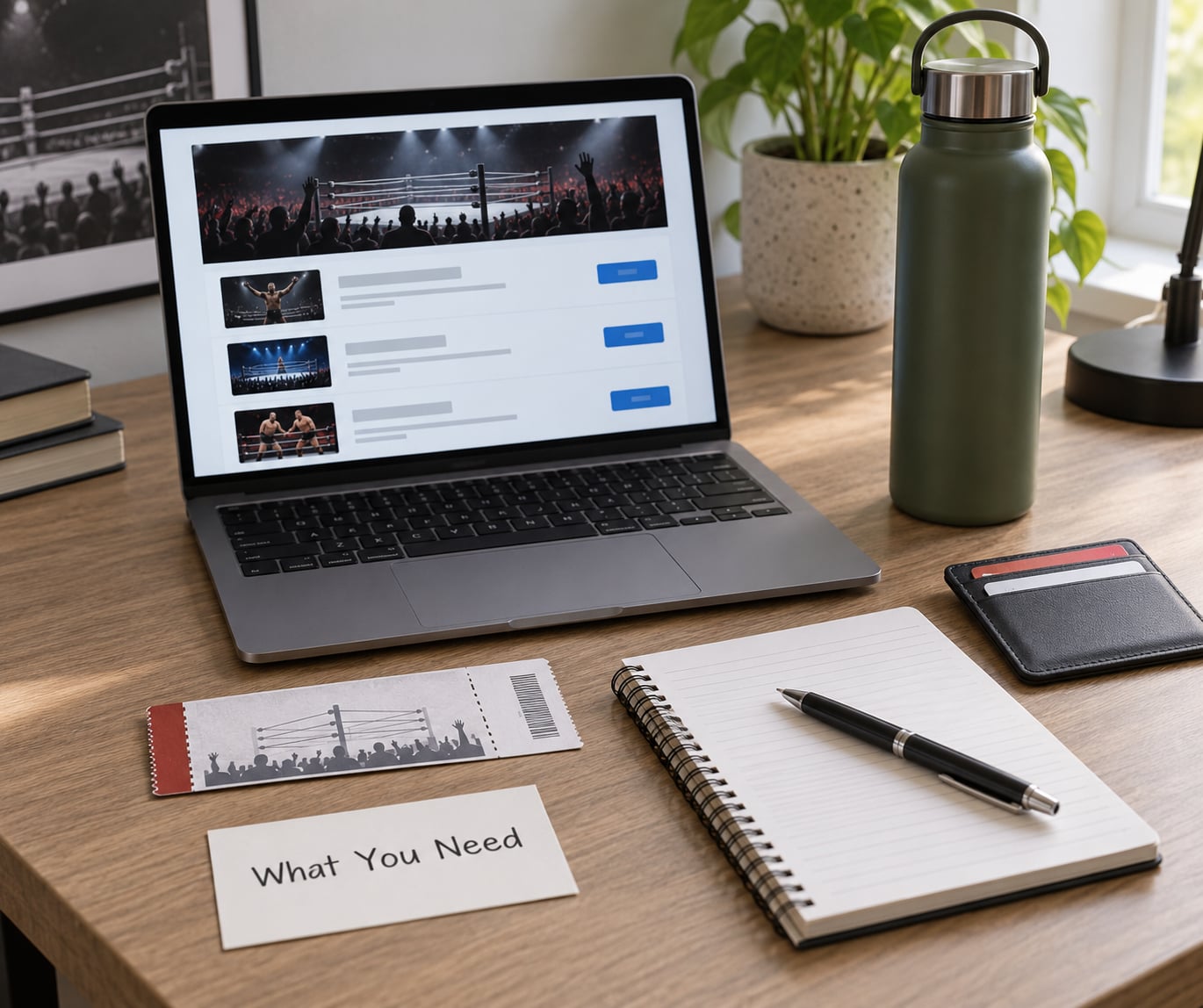
You need very little, but you need it in the right order. Skipping the verification step is how well-meaning fans end up sending money somewhere that is not the promotion at all.
- A verified event listing. A promotion’s own site, its official social page, or a wrestling school in your area. If you found the show through a resale marketplace or a random aggregator, you have not found the promotion yet.
- A direct payment channel. A link the promotion controls, a box office window, or a person at the merch table. This is the whole point of the guide.
- A small amount of cash. Small venues and merch tables still run on it more often than card readers, and card readers fail in buildings with bad signal.
- Some context on the card. Knowing two or three of the wrestlers’ names and gimmicks beforehand makes the show far better, and it gives you something specific to say at the table.
- A number you are comfortable repeating. Decide what you will spend across a few months before you go, not in the queue.
One more thing worth checking before you commit: whether the promotion carries public liability insurance and rents a proper ring. It is not exciting information, but a company willing to pay for both is a company that respects the people standing in its ring, and that is a reasonable signal about how it treats its fans and workers.
Step-by-Step: How to Support Independent Wrestling Promotions
Step 1: Find a Promotion You Can See Live
Search for the nearest wrestling school before you search for shows. Training schools are the backbone of the indie scene, and their social pages almost always list upcoming cards, because the school is a large part of the roster. If a school runs a weekly show, that show is the easiest entry point in the country.
Second, search social platforms for the word wrestling plus your city or region, then check who actually posts event dates consistently rather than reposting someone else’s photos. A promotion that changes venues often is fine, but one that never confirms a date is a bad bet.
Third, think about travel honestly. A show an hour away that you can reach four times a year is worth more to that promotion than a show you skip because it fell on a bad weekend, but the reverse is also true: a local room with a small door is helped far more by a full building than by an empty one you drove to.
You will know this step worked when you can name the date, the venue, the bell time, and the promotion’s official link without having to search again.
Step 2: Buy Tickets Directly and Attend Consistently
Buy through whatever channel the promotion publishes, and expect general admission more often than assigned seats. General admission means first-come, first-served, so arriving early is not a nicety, it is how you get a good spot. A promotion that sells reserved seating will say so plainly on the listing.
Tier structure is usually simple: general admission at the door, a discounted early-bird or presale, and a ringside or VIP package that gets you a better view and sometimes a meet-and-greet. Buy presale when the promotion offers it, because the money is committed earlier and presale counts are how promoters forecast a room.
Then come back. A promoter who sees the same face at four shows learns your name, sometimes gives you a presale code, and builds a relationship that makes the fifth show easier. Repeated attendance is the single most useful thing a fan can give a small promotion, and it costs nothing beyond showing up.
Check the details before you travel: bell time versus door time, whether the venue is all standing, whether there is parking, and whether the room is heated. Community halls and armories are famously cold in winter and un-airconditioned in summer, and nobody will complain if you brought a layer.
Where a promotion runs regularly, the format varies enough to be worth researching. Some rooms seat everyone for the whole show, some let a standing section form at ringside, and some hold the standing section for the headliner only. Knowing which you are walking into means you pick the right spot on arrival instead of spending the first twenty minutes squeezed between two people who also want to see over them.
Step 3: Buy Official Merchandise and Subscriptions
This is the step most fans underestimate. Merch sales are often a bigger and steadier slice of an independent wrestler’s income than the flat appearance fee they get for the night, and the wrestlers usually keep the larger share of that table. Buying the shirt is a purchase, a souvenir, and the easiest way to meet the person whose work you just enjoyed.
Use the table the way you would use a signing line. Wait your turn, keep it short when a line forms, and say something specific about the match rather than only asking for a photo. Specific praise lands differently, and people remember it.
Beyond the table, there is a mailing list. Signing up for a promotion’s newsletter or updates costs nothing and is one of the most valuable things you can do, because it means you get card announcements before the public post and you can tell people about shows. The same goes for a fan club or digital membership if one exists.
One caution on merch: verify the seller. Buy from the promotion’s official store, the wrestler’s own storefront, or the table at the show. A bargain tee with a misprinted design is a counterfeit, and the money goes to nobody involved in wrestling.
Step 4: Stream or Purchase the Product Legally
Plenty of people have no local scene, and that is the situation most support advice ignores. Independent wrestling is scattered across subscription streaming services, on-demand video stores, and pay-per-view platforms, and buying any of it directly funds the production rather than a middleman.
When a live streamed show goes wrong, you have no complaint mechanism. Ask before the card goes in, and if the stream fails, a promoter who is straight with you about it is a promoter worth supporting with the next show.
Digital newsletters, Discord servers and back-catalogue VOD are the cheapest ways to follow a promotion you cannot see live. You learn the storylines, the roster and the venue changes, and when a card finally tours near you, you already know what you are walking into.
Step 5: Share Shows and Credible Updates
Amplification is free money for a promotion, and it is badly underused. Post the date, the venue, the link, and the start time. Confirm those details yourself first, because a confidently wrong post sends people to the wrong building on the wrong night, and a promoter who does that once loses the room for a long time.
There is a specific trap here, and fans on r/SquaredCircle and r/WredditSchool keep warning each other about it. Tagging a promotion in a video clip of their show can trigger a copyright takedown, because the promotion often does not hold the rights to the footage shot by fans or by other companies. Post your own short clips, keep the tag off other people’s footage, and if you want to help, just link the show.
Leave reviews on the venue, the event listing, and anywhere local people look. Ask the promotion’s volunteers to be named in your post if they are comfortable with it. Local press coverage is rare and disproportionately valuable to a small company, and a reader who sends them a link to a well-written local show review can sometimes make that happen.
Step 6: Engage Respectfully With the Community
Independent wrestling crowds are small enough that one loud person changes the room. Fans who throw objects, heckle the company, or treat the wrestlers as props make the venue hostile, and the wrestlers working in front of a handful of spectators notice it immediately.
New fans worry constantly about not knowing enough to react properly. You do not need to know anything. Chanting, laughing at the intended joke, and applauding a good exchange are all legitimate. Kayfabe, if nobody has explained it, means the performance is treated as real by everyone in the room even though the people doing it are working. Staying inside that agreement is a courtesy, not a test.
Do not grab wrestlers for photos or handshakes uninvited. They are working, and in some cases recovering from the match you just watched. Ask first, accept the answer, and keep the interaction short if a line is forming behind you.
Step 7: Bring a Friend and Respect the Promotion
Bringing one person to a show genuinely changes a promotion’s finances, because ticket revenue scales with heads and a full room changes how the wrestlers work. A friend who has never seen indie wrestling is worth more than a friend who already goes to four of them.
Set expectations beforehand. Explain the seating, the cold, the cash, the volume, and the fact that some wrestlers will not break character. Someone who expects an arena is a bad convert; someone who expects a community hall is a lifer.
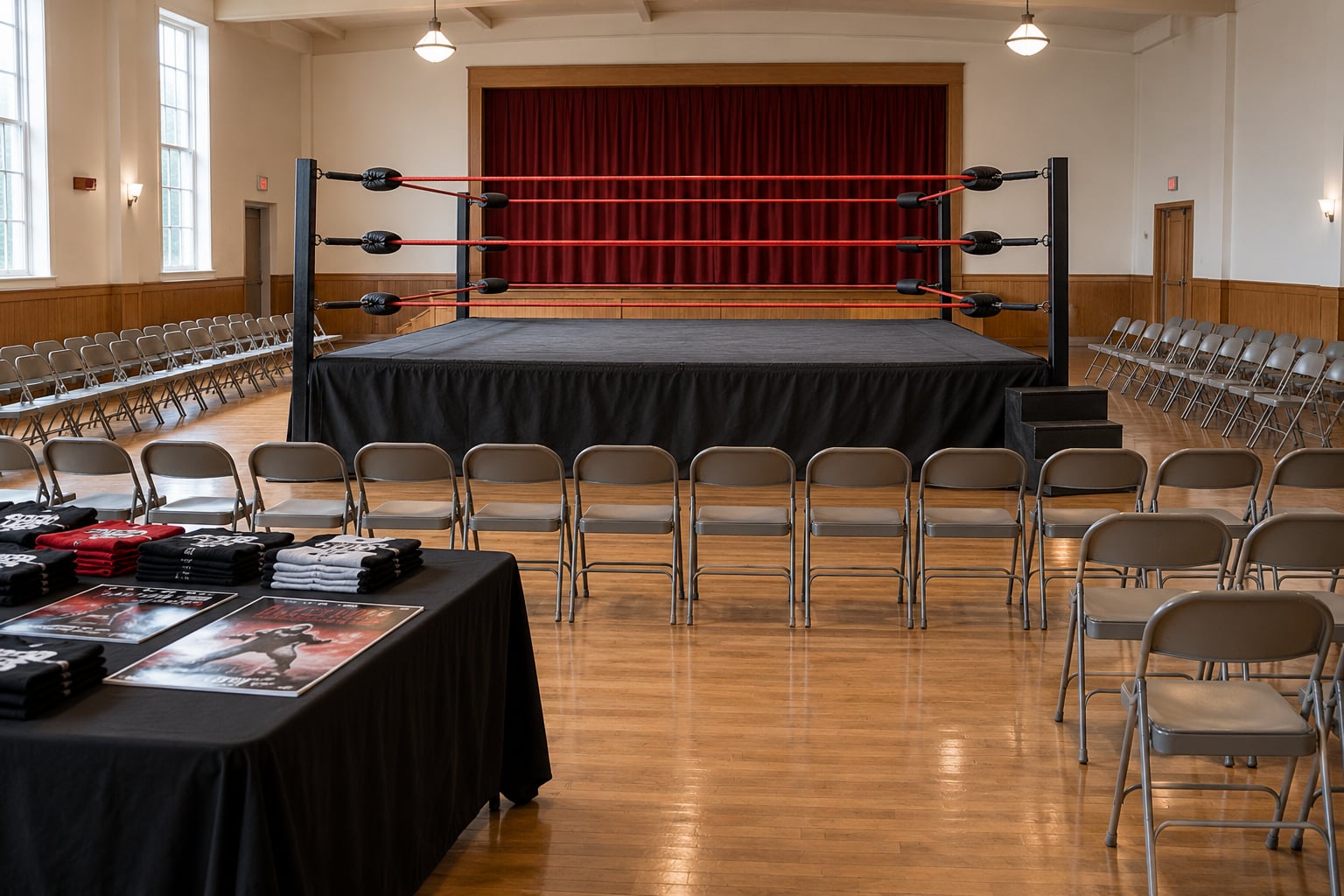
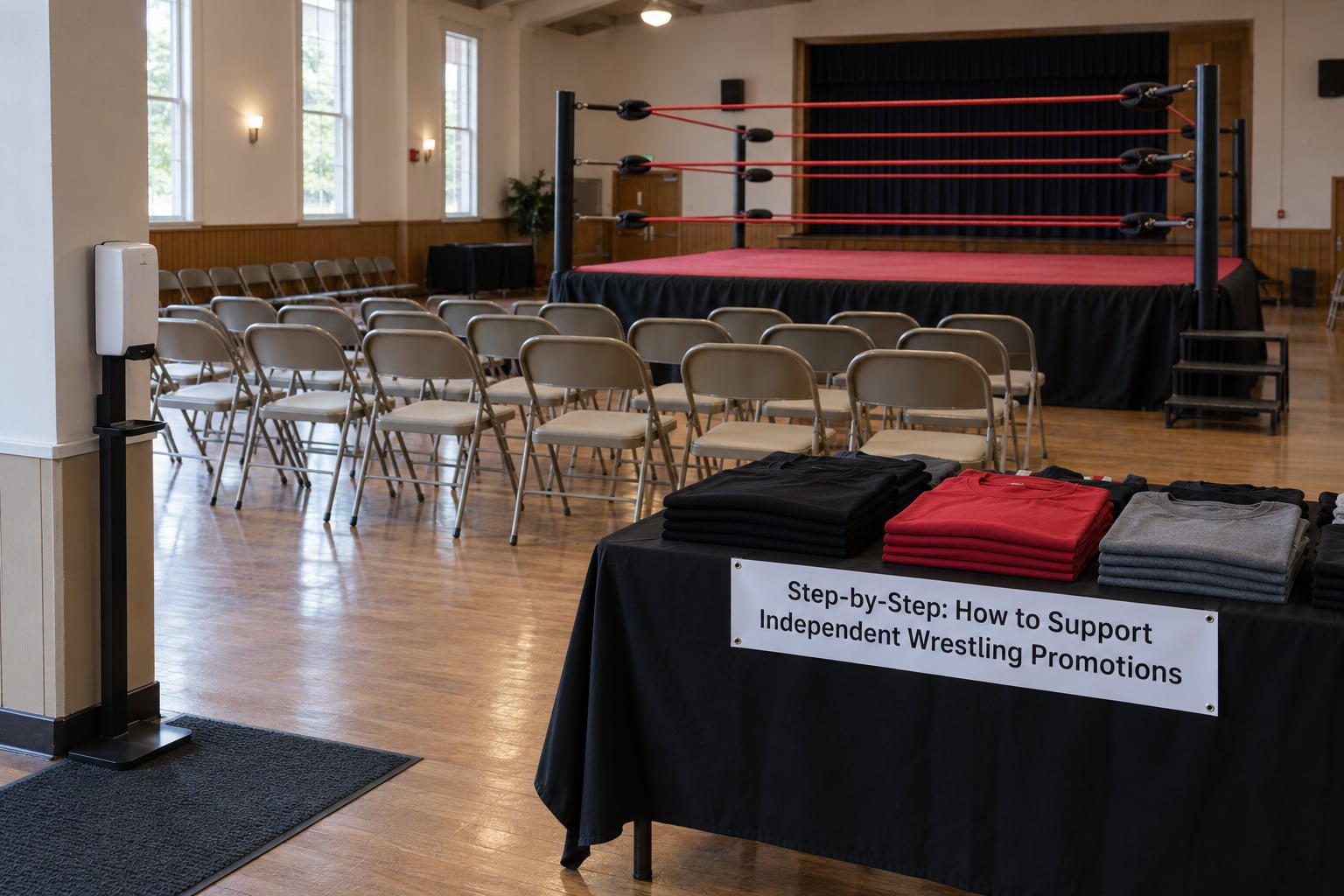
Show basic respect for the operation: be on time so the row of folding chairs fills evenly, follow the venue’s rules about bags, food and phones, and stay through the main event. Leaving early shrinks the visible crowd for the match the promoter is billing the room on. Stay for autographs afterwards, where they offer them, because the talent spends its own unpaid hours doing that.
Step 8: Choose Long-Term Support That Fits Your Budget
There are four levels, and only you know which one is honest for your situation right now.
- One-time purchases. A ticket, a shirt, a poster. This is where most people start and it is genuinely useful.
- Regular attendance. A handful of shows a year, the same promotion, no big spending. Fans who go to every show in their own city are the rarest and most valued supporters in the whole scene.
- Memberships and subscriptions. Steady and predictable revenue, which is far easier for a promoter to plan around than a spike.
- Giving money directly. A 50/50 raffle you run yourself, a group buy, a crowdfunding campaign for a specific show or a wrestler’s medical leave, a sponsorship of a local card by a business you actually own, or a donation to a wrestling school. The universal rule from a promoter PSA that circulates on r/SquaredCircle: if you cannot afford to run an event, do not run an event, and if you can, stick to your budget.
Pick the level you can repeat for a year rather than the one that feels generous in one weekend. Consistency is what lets a promoter book a wrestler they can actually pay, and that is the most valuable thing a fan can do for anyone in that ring.
It also helps to know what the promoter is working against. A first independent show typically costs a few thousand dollars before a single ticket is sold: ring rental, venue hire, public liability insurance, the appearance fees for the whole card, and marketing. Breaking even is a matter of filling the room, which is why ticket revenue, merch and a reliable stream are the three things a promoter thinks about constantly. Volunteers absorb the rest, which is the part outsiders rarely see.
Common Mistakes
Buying tickets on a resale marketplace. The extra goes to an unknown seller, and the promotion sees none of it. Fix: buy from the promotion’s own link, or buy general admission at the door.
Buying suspiciously cheap merchandise. A shirt priced far below everything else is usually a knockoff, and nobody in the building gets paid. Fix: official stores, the wrestler’s own storefront, or the merch table.
Tagging a promotion in someone else’s footage. It can pull a takedown notice and does nothing for the company. Fix: link the show instead of reposting clips.
Attending to start something. A room full of people who came to be obnoxious costs the promotion money, because the promoter is the one who answers for the atmosphere. Fix: if a show is bad, say so afterwards, not from the front row.
Buying a ringside seat in a general admission room and then guarding it. You will be asked to move, and you will have made an enemy for nothing. Fix: sit where the ushers point, or sit at the back and watch the whole room.
Expecting one purchase to fix a company’s finances. A single show is funded by the whole room, not by one generous fan. Fix: spread support over the year, and across wrestlers rather than one merch table.
A few quick tips from people who go to these shows every month: bring cash and small bills, arrive before the bell rather than before the doors, learn two names before the show starts, and treat the merch table as a tip jar for people who mostly do this for love of the craft.
Frequently Asked Questions
How much money do independent wrestlers actually make?
Most independent wrestlers earn an appearance fee that varies enormously with draw and travel, plus a percentage of the merch they sell at the table, often more than the promoter keeps. Fans on wrestling forums consistently describe merch as the more dependable half of the income, which is why buying a shirt is treated less like a souvenir and more like a tip. Some wrestlers also take bookings for appearances, coaching or community work.
Do indie wrestling shows sell merchandise, and should I buy it?
Yes, and you should. A merch table is standard at almost every independent show, usually run by the wrestlers themselves or by a family member between matches. Shirts, hoodies, hats, photos and sometimes handmade items are the norm. Buy from the table, the wrestler’s own store or the promotion’s official page, and skip anything priced far below what you see on the rack.
Can you buy wrestling tickets at the door?
Usually yes. Independent promotions commonly sell general admission at the box office until the door opens, and many offers a discounted presale or early-bird tier online beforehand. Buying ahead helps the promoter forecast attendance, which is how they decide how many seats and how much staff to plan for. Bring cash, because card terminals fail in small buildings.
Is it okay to film an independent wrestling show?
Take photos and short personal clips for your own use, but be careful posting them. Tagging a promotion in a clip of someone else’s footage can trigger a copyright takedown, since the promotion often does not own the rights to footage shot by fans or other companies. That is why fans on r/SquaredCircle and r/WredditSchool advise linking to a show rather than reposting it. Follow the venue’s phone policy too.
Why do indie wrestling rings look so bad compared to WWE?
A WWE ring is built and maintained for a national television production, with a dedicated crew and a budget behind every element. A small promotion rents a ring, transports it, builds it and strikes it in a few hours, often on a volunteer crew, and skips the things that do not show up in the crowd’s eye line. Ringside railings, padding and a working microphone are where quality differences become safety differences.
How do I find independent wrestling shows near me?
Start with the nearest wrestling training school, since they almost always list the shows they help run. Then search social platforms for wrestling plus your city or region and follow the accounts that post confirmed dates rather than reposts. Local wrestling media and fan groups are useful, as is asking promoters directly. If there is genuinely nothing nearby, the promotion’s streaming and on-demand options are the only route in.
Conclusion
To support independent wrestling promotions, do four things in order. Identify one legitimate promotion near you and confirm the date and venue yourself. Buy the ticket from them, not from a resale page. Go again next month, buy one piece of official merchandise, and stay for the autograph table. Then post the next show’s details accurately, without tagging the promotion into other people’s footage.
That sequence takes an evening, costs less than one arena show, and puts real money into a room where the talent often work for the exposure alone. Everything after that, streaming, memberships, raffles, crowdfunding, sponsoring a card, is a bonus on top of a habit that already helps.