How wrestlers design their ring attire is a repeatable process: lock the character, gather visual references, take measurements, hand the brief to a gear maker or draft the look yourself in a template, agree on stretch fabrics and detailing, then sign off on a finished garment after it has been fitted and worn through a full movement test. Most of the work happens before a needle touches fabric.
The finished kit is only part of the story. Gear has to sell a character from thirty feet away under arena lighting, survive a fall onto a canvas, and still look right on a camera cut four seconds later. That combination of theatre and engineering is why ring attire gets designed the way it does.
Key takeaways
- The character comes first; the drawing is just the second step.
- Measurements and body shape decide the pattern, not the sketch alone.
- Stretch fabric, lining and fastenings matter as much as the artwork.
- In-ring gear and entrance attire are designed to different rules.
- Gatekeepers exist at major promotions, including a say over coverage.
- Nobody publicly credits a gear maker, which is why fans keep guessing.
Table of Contents
- What Does a Wrestler’s Ring Attire Need to Communicate?
- How Wrestlers Design Their Ring Attire From a Character Idea
- How wrestlers design their ring attire, step by step
- How Do Wrestlers Choose Colors, Logos, and Patterns?
- What Materials Do Wrestlers Use for Ring Attire?
- How entrance attire is designed differently
- How Does Ring Attire Have to Allow Movement?
- How Is a Wrestler’s Ring Attire Tested and Approved?
- How Do Ring Attire Designs Change for Different Wrestling Styles?
- Frequently Asked Questions
- Who designs WWE outfits?
- Where do WWE wrestlers get their ring gear?
- Do WWE wrestlers have to pay for their own ring gear?
- How much do wrestlers pay for their gear?
- What do you wear to a wrestling match?
- Do wrestlers wash their own trunks and tights?
- Conclusion
What Does a Wrestler’s Ring Attire Need to Communicate?
Ring attire has to establish a character before the performer says a word. Colour, silhouette, logos and the way a garment moves during an entrance do that work first, and the crowd reads them in seconds.
A wrestler usually starts from a persona with a fixed set of references: a masked luchador, a biker, a 1980s heel, a monster. The attire pulls visual cues from that world rather than inventing something new. Rowdy Piper’s kilt read instantly because kilts are worn by a specific type of character, and Ric Flair’s colour-coordinated boots and trunks worked because every element repeated the same scheme.
Silhouette does a lot of the heavy lifting. Long tights with covered boots create a bigger, heavier shape; short trunks and bare legs read as speed and athleticism; a singlet reads functional; a robe or trench coat reads ceremony. Materials add a second signal, because matte stretch fabric behaves differently on camera than a shiny or sequinned surface that catches every light.
Readability under lights is a design constraint, not decoration. Details that look rich in a studio can vanish in a dim arena, so high-contrast colour blocking and a clear outline usually survive the lighting rig better than subtle tonal work.
How Wrestlers Design Their Ring Attire From a Character Idea
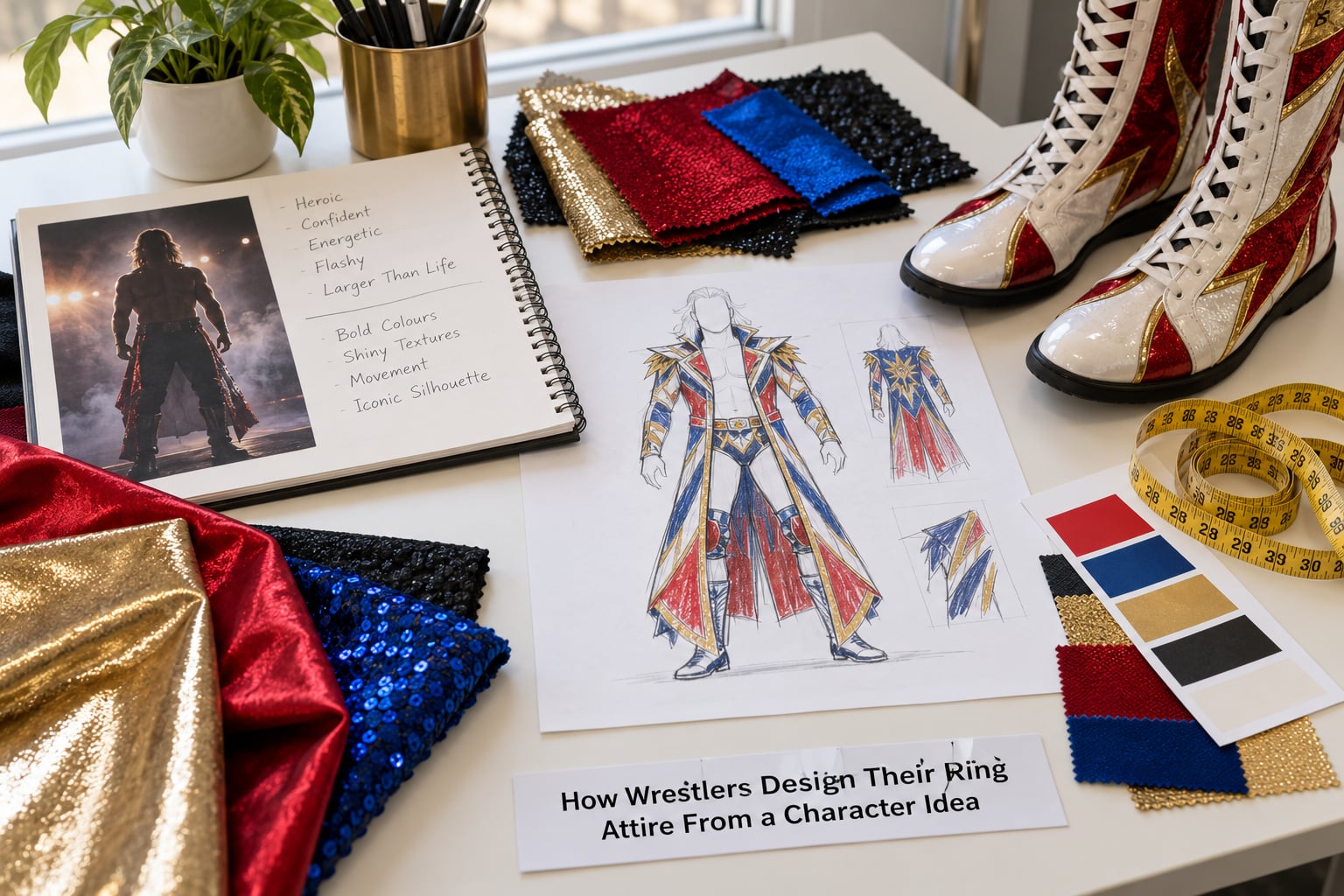
The jump from persona to garment is where most amateur designs go wrong: the character is decided, a picture is found, and the picture goes straight to a maker with no measurements, no fabric notes and no second opinion. A working design process inserts a few deliberate stages between those two points.
How wrestlers design their ring attire, step by step
- Lock the character. Write down the gimmick in a sentence, including what the wrestler wants the crowd to feel.
- Collect references. Build a mood board of colours, shapes, textures and photographs that point the same direction.
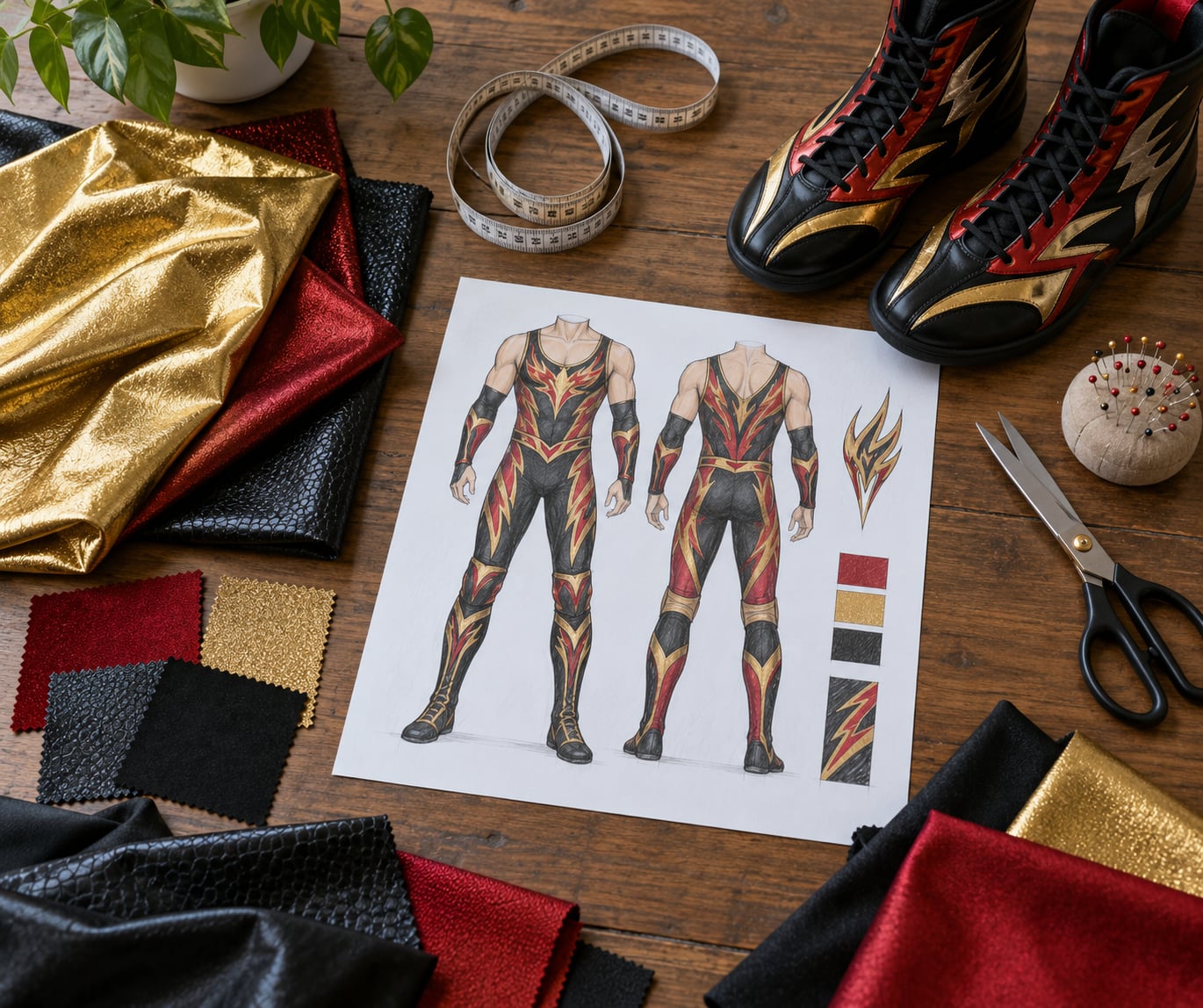
- Take measurements. Record the body, note how the fit needs to behave, and flag the parts that will stretch or tear first.
- Sketch and revise. Expect two or three rounds of drawings, with the colour scheme settled before detailing begins.
- Choose a route. Commission an independent gear maker, or draft the look yourself using a template tool and send that file in.
- Choose materials and detailing. Confirm the fabric, lining, fastenings, and how logos and decoration get applied.
- Fit and move in it. Run, jump, kneel, fall and wrestle in a sample before approving the final version.
- Approve and deliver. Sign off the finished set, then plan repairs and re-fitting between booked dates.
The order matters. Settling colour after the fabric is picked, or picking decoration before the base garment is drafted, is how a design ends up looking good on a screen and bad under a camera.
Designers who came up through theatre costuming say the same thing about both jobs: it is easier to dress a character than to dress yourself. A wrestler who asks a maker to reflect their own taste usually gets something generic, because the wrestler is not the point. The persona is.
| Stage | Who leads it | Time involved | Common snag |
|---|---|---|---|
| Character concept and mood board | Wrestler | A few days | References pull in three different directions |
| Measurements and fit notes | Wrestler and maker | Same session | Measured once and never re-checked |
| Sketches and colour revision | Maker | Several days per round | Too many rounds, deadline ignored |
| Pattern drafting | Maker or seamstress | Several days | Drafted from a generic size instead of the body |
| Fabric and detailing choice | Both | A few days | Decorative trim chosen before the base garment |
| Construction | Maker | One to three weeks | Longer if decoration is applied by hand |
| Fitting and movement test | Wrestler | One session | Approved without actually moving in it |
| Approval, delivery, rework | Wrestler, production | Days to weeks | No time allowed for a second round |
A wrestler who came through the indie circuit described commissioning yellow and black gear inspired by Bruce Lee after watching a film, and said the finished set gave them the confidence to walk out in trunks for the first time. That reaction is common, and it is a design outcome as much as an emotional one.
How Do Wrestlers Choose Colors, Logos, and Patterns?
Colour is chosen to reinforce the persona and to stay distinct in a wide shot. Most makers work from a fixed palette of two or three colours plus black, which keeps a look recognisable even when the artwork is busy.
Logos and patterns serve the same goal. A repeated motif across tights, kickpads and the back panel makes a wrestler look designed rather than assembled, and a name on the back of the tights matters on television because it is the only readable text when a wrestler is facing away from camera.
There are three common ways artwork reaches the fabric. Sewn-on appliqué is the most durable and the least flexible, because every added layer reduces stretch. Sublimation prints dye into a polyester stretch fabric, which allows unlimited colour with no added thickness and no stitching to fail. Hand-applied decoration such as individually placed rhinestones looks the most theatrical and takes the longest, since each piece is set by hand.
Faction looks need a different discipline: the design has to survive on four or five different bodies and still read as one unit. That usually means a shared palette, one repeated emblem, and identical treatment of boots and kneepads.
What Materials Do Wrestlers Use for Ring Attire?
Stretch knit is the default for anything worn in the ring, because it moves with the performer and returns to shape after a match. Most gear is drafted from a spandex-blend stretch fabric, usually fully lined so the garment keeps its structure and does not become see-through under arena lights. Fastenings like drawstrings and elastic at the waist get the same scrutiny as the fabric, since a loose waistband ends a match early.
| Material | Where it works | Watch out for |
|---|---|---|
| Spandex-blend stretch knit | Tights, singlets, trunks, compression wear | Cheaper versions lose elasticity after a few washes |
| Mesh panels | Ventilation in trousers and around the shoulders | Tearing if the mesh sits under a reinforced seam |
| Satin and lycra | Entrance pieces and jacket-style gear | Not made for mat work; no grip, no durability |
| Vinyl and leather look | Biker and villain characters, entrance coats | Heavy, hot, and stiff through a long match |
| Sequins and rhinestones | Flash pieces, coats, boots, gear for entrances | Snags on ropes, transfers to skin, weakens the seam |
| Sublimated polyester stretch | Full-coverage printed tights and singlets | Limited to what the printer stocks |
Weight is an underrated factor. A wrestler who works a heavy style in thick vinyl spends the match overheating, and gear that looks superb on the entrance ramp becomes the reason a bout feels slow. Experienced wrestlers pick fabric for the match first and the entrance second, then build a separate garment for the walk-out.
How entrance attire is designed differently
Entrance attire follows a different set of rules because it is worn for a few minutes on a ramp, often under lights and often with a microphone. It can be heavier, more structured and far more decorated than ring gear, and stage costuming is the natural reference point for it. That is where many gear makers come from, and why the skills transfer: a coat, robe or mask built for theatre transfers to a wrestler walking out to the ring far more easily than it transfers to a grappling exchange.
The practical split is simple. Anything worn through the bell needs stretch, coverage, secure fastenings and a shape that survives impact. Anything worn to the ring can prioritise silhouette and shine. A wrestler with a strong entrance look usually commissions two separate pieces rather than one compromise, and that is a design decision, not overspending.
How Does Ring Attire Have to Allow Movement?
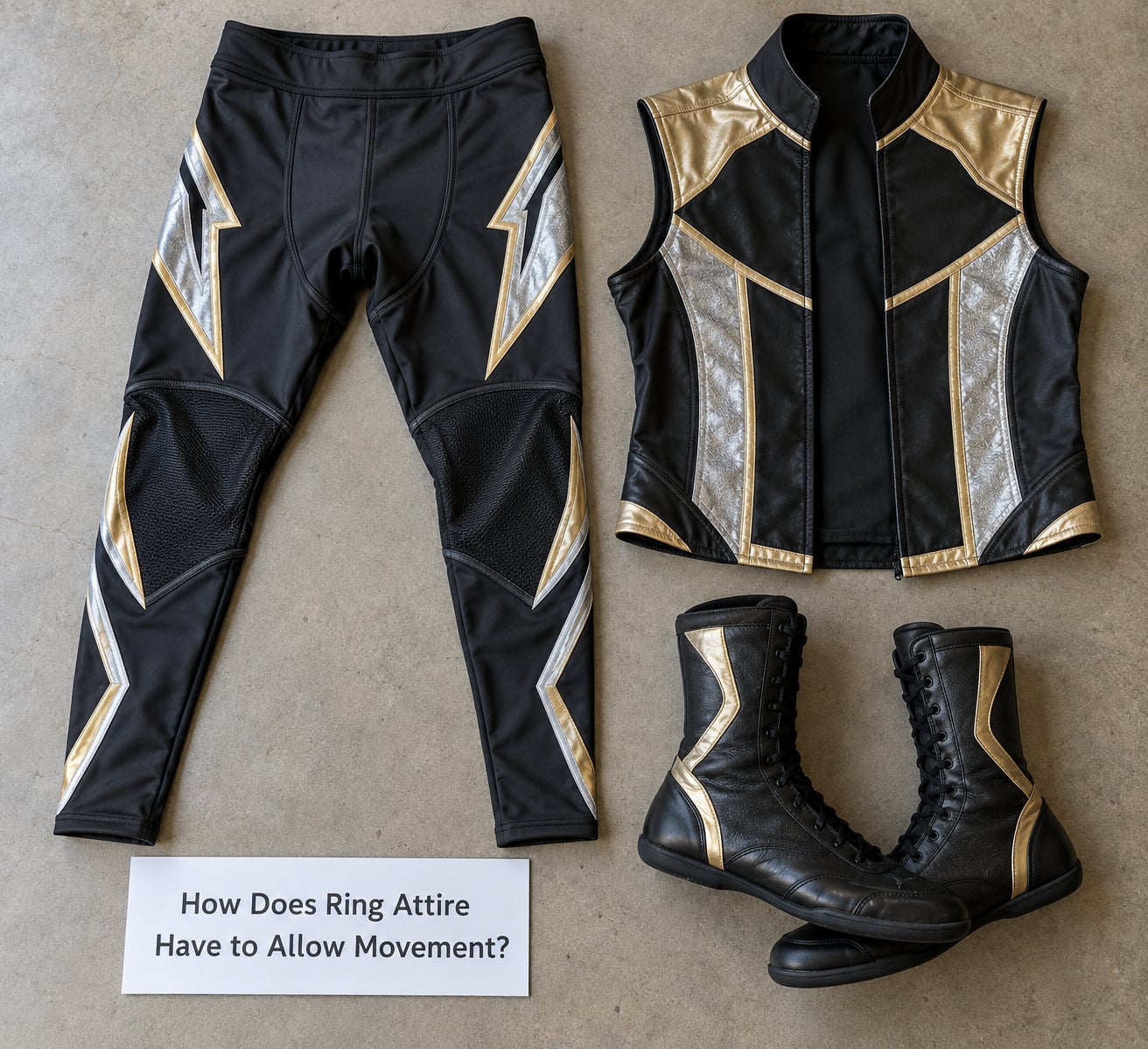
Ring attire has to survive running, jumping, climbing, falling and mat wrestling, so the design is judged on movement before anyone asks whether it looks good. A garment that restricts the hips, rides up, or pulls at a shoulder seam fails the test no matter how well it photographs.
Range of motion drives the pattern. Tights are drafted with enough stretch through the seat and inner leg to allow a bridge or a kneeling hold, and the waistband is built to stay put under a load. Boots get reinforced where a wrestler plants, and seams get doubled where gear is grabbed, such as the crotch and shoulder areas.
Fringe, tassels, laces and loose fabric trim look fantastic on an entrance and cause problems in a match. They tangle, they can catch on a rope or a boot, and they pull the garment out of shape. Any loose element needs to be short, light, or fastened so it cannot swing freely.
Wrestlers who work a fast, aerial style also care about weight and drag. A long coat that weighs more than a couple of kilos gets removed before the bell, and boots are picked for ankle support rather than looks alone. Padding exists for a similar reason: it protects the wearer and gives the gear a shape the design needs.
How Is a Wrestler’s Ring Attire Tested and Approved?
Approval comes in stages. A sample is fitted and worn through a movement session, durability checks look at seams, fastenings and decoration under stress, and a visual review checks the look against the original concept.
Feedback usually comes from several directions at once. The wrestler judges comfort and whether the character feels right. Wardrobe staff judge how the garment handles repeated wear and washing. Medical staff weigh in on protection and restriction of movement. On a television production, creative staff may request a change, and the request has to be treated as final.
That last point is the part fans get wrong most of the time. Wrestlers on wrestlingforum.com described washing their own trunks and tights and confirmed that the promotion does not choose their outfits, while also noting it can ask a wrestler to change something, such as switching long tights to trunks. The wrestler usually owns the look; the production owns the broadcast.
Who gets credit is murkier still. There is no public system for naming the person who made a given look, which is why a thread on r/njpw recently asked who designed a specific wrestler’s gear and drew mostly guesses. If you want to know, the practical routes are the promotion’s own credits, the maker’s client list, or asking the wrestler’s connections directly.
How Do Ring Attire Designs Change for Different Wrestling Styles?
The same concept adapts differently depending on how a wrestler works. High-impact power wrestlers want coverage and protection, so tights, thicker fabric and reinforced panels serve both the character and the body. Agile performers who dive off the top rope tend toward lighter, shorter garments that will not drag or shift in flight.
Body shape changes the drafting, not just the sizing. A pattern drafted for one body and resized for another often pulls at the waist or gaps at the shoulder, so a wrestler working a larger or smaller frame than the maker’s usual client usually needs a pattern drafted fresh. Seamstress interviews about the difference between drafting male and female bodies point to the same underlying issue: proportions, not measurements alone, decide whether a garment sits correctly.
Valets and managers rarely enter the ring, so their attire is designed to stage costume rules instead. It can be heavier, more structured, more decorated and far less concerned with stretch, and it usually takes longer to make because of the detail work.
Masked identities add another constraint. A lucha mask has to fit the head precisely, stay on through a match and still match a specific colour scheme, so it is often drafted alongside the tights rather than ordered separately.
Frequently Asked Questions
Who designs WWE outfits?
Mainstream roster wrestlers work with a small circle: an independent gear maker or seamstress, sometimes a designer inside the promotion’s art department, and wardrobe staff who handle fittings and repairs. The wrestler supplies the character idea and the measurements, the maker drafts the pattern and builds the garment. A production can still request changes before anything airs.
Where do WWE wrestlers get their ring gear?
Mostly from independent custom gear makers rather than from an in-house wardrobe department, and a growing number of those makers sell template tools so wrestlers can draft a look themselves. Independent wrestlers commission the same makers directly, one piece or one set at a time, and pay out of pocket.
Do WWE wrestlers have to pay for their own ring gear?
Mostly, although contracts differ and a promotion may supply or subsidise pieces for a storyline. Independent wrestlers pay everything themselves. One wrestler posting on r/WredditSchool described commissioning a singlet, shorts and kickpads from a maker who was also a former wrestler and cosplayer, and treated it as a normal working expense.
How much do wrestlers pay for their gear?
Prices vary more than most industries because the quote follows the tier of customisation. One custom piece costs far less than a full set, and a set drafted from scratch with fully sublimated artwork sits at the top of the range. Padding, fringe, rhinestone work and a rushed turnaround all add to it. Ask for a written quote per piece before committing.
What do you wear to a wrestling match?
A wrestling kit is tights, trunks or a singlet, plus kickpads, kneepads, boots, and wrist or elbow tape. Masked performers add a lucha mask, and valets usually wear entrance outfits that never make it into the ring. Everything worn in a match is chosen to read on camera and survive falls, kicks and repeated washing.
Do wrestlers wash their own trunks and tights?
Most do. Wrestlers on wrestlingforum.com described washing their own gear between shows and drying it quickly so the stretch fabric keeps its shape, since snaps and elastic warp in a hot tumble. Air drying or a cool cycle is the usual habit. The same thread notes the promotion rarely dictates an outfit, though it can ask for a change.
Conclusion
Ring attire gets designed in a fixed order: character, references, measurements, sketch, materials, construction, fitting, approval. Skipping any stage shows up later, either as a garment that restricts movement or as a look that says nothing about the person wearing it.
When you study a wrestler’s kit, start with three things. The character concept explains the colours and the silhouette. The construction tells you what the wrestler does in the ring, because the fabric and the fastenings match the style. And the way the finished outfit handles movement is the test everything else has to pass.
Updated for 2026.