Nobody in wrestling sits in a chair and plays art critic on your shirt. Approval is a paperwork chain: you clear the intellectual property, you clear the brand rules, you get a written sign-off from whoever owns the name or logo, and only then does a printer run the order.
There is no single approval board. Who signs off depends entirely on whose name is on the shirt — a high school, a youth club, an independent promotion, or a wrestler selling their own gear — and each of those comes with different documents, different reviewers and very different turnaround times.
This guide walks through who reviews the artwork, what rights you need to own first, how the review sequence runs, and why most rejections come down to paperwork rather than taste.
Table of Contents
- How Wrestling T Shirt Designs Are Approved
- Who Reviews and Approves the Design?
- What Rights Must a Designer Own Before Submitting?
- What Happens During the Approval Review?
- How Promoter-Specific Rules Affect Approval
- Do Independent Wrestlers and Promotions Follow the Same Process?
- What Makes a Design Likely to Be Rejected?
- What Approval Allows You to Sell
- How Royalties, Minimums, and Quality Control Work
- A Practical Approval Checklist for New Wrestling Shirt Creators
- Frequently Asked Questions
- Can I sell a wrestling T shirt with a wrestler’s name?
- Who owns the copyright on official wrestling merchandise?
- How long does wrestling T shirt design approval usually take?
- Can I make a fan shirt without the promotion’s permission?
- Is a logo or portrait enough to establish merchandising rights?
How Wrestling T Shirt Designs Are Approved
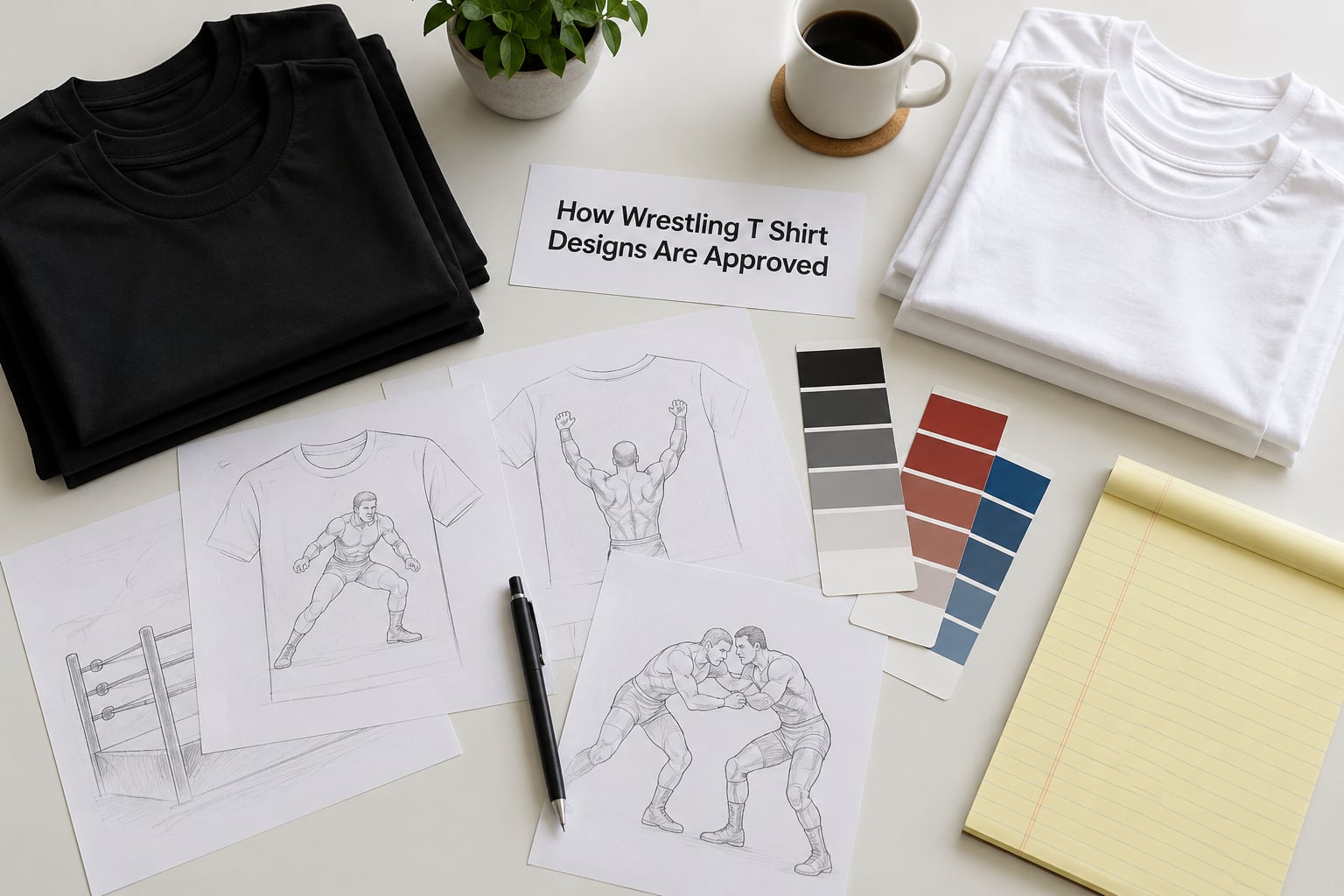
Approval comes down to four things: the rights to the artwork, permission to use the name or likeness on it, compliance with whatever brand rules the owner has written down, and a licence that says you may sell it commercially. Miss any one of those and a design that looks finished stays in the file.
The part people get wrong is assuming approval is about the design. Reviewers rarely care whether your layout is beautiful. They care whether you can prove you had the right to make it and that it will not embarrass the person whose name is on it.
Who Reviews and Approves the Design?
Usually one person with real authority, sometimes three or four. In a scholastic program that is typically the head coach first, then an athletic director or the compliance office that owns the school’s marks. Club and youth teams usually have a shorter chain, often just the club operator or a parent committee.
In independent professional wrestling the reviewer is usually the promotion owner, a booker, or the wrestler themselves. Major organizations route merch through their licensing representatives and legal teams, which is why outsiders rarely get an answer at all.
Vendors and fulfillment partners add a layer of their own. They are not approving your rights, but they will refuse a file they cannot print or a logo they have been told not to run, and that refusal can happen after you thought you were already cleared.
What Rights Must a Designer Own Before Submitting?
You need the right to the artwork itself, plus written permission for anything protected you did not create. That includes wrestler names and likenesses, promotion logos, event branding, slogans, photographs, typefaces and any music you sample.
A licensed idea and an unauthorized replica look identical on a screen and are completely different in a dispute. One has a paper trail showing where every element came from; the other has a Pinterest board.
Trademark covers names, logos and slogans. Copyright covers the original illustration. Likeness rights cover a recognizable person’s face or persona. Knowing which one you are leaning on matters, because each one has a different owner and a different permission you need.
What Happens During the Approval Review?
The normal sequence runs submission, rights and brand review, requested revisions, final approval, licence terms, a production sample, and then authorization to sell. Each step has an owner, and skipping one tends to surface later as a problem with the printer or the promotion.
Turnaround depends on how many people are in the chain. A club coach can answer the same day. A scholastic athletic department reviewing vendor paperwork often takes a couple of weeks. A large promotion’s legal review can take longer than the design work itself.
Revision rounds are normal. One to two rounds is typical, and asking up front for all feedback in a single consolidated message saves weeks compared with trading individual emails about individual elements.
How Promoter-Specific Rules Affect Approval
Every promotion and wrestler controls their own name, logo, roster references, event branding, colour palette and typography. Some publish a style guide; most do not, which means the reviewer is working from memory and preference, and that makes written confirmation more important rather than less.
Prohibited imagery varies. Offensive language, political endorsements, alcohol or sponsor marks, and references to departed or suspended talent are the usual flashpoints, along with anything that mocks a promotion or another wrestler.
Former talent is a special case. A design built around a wrestler who has left the roster can be approved once and dead later, so ask specifically how long permission lasts and what happens when a roster changes.
Do Independent Wrestlers and Promotions Follow the Same Process?
No, and the difference runs the other way from what people expect. Formal scholastic review is slow because there are institutional checks. Independent wrestling moves faster because the decision-maker is usually one person who owns everything outright — but that person is also far less likely to hand out permission casually.
At an independent promotion, if you are the owner, approval is a self-review. Write it down anyway, dated, with the scope of what you are authorizing. If you are outside, expect a short conversation, a fee, or a flat refusal, and expect the answer to hinge on whether the talent involved is actually on that roster.
What outsiders get refused most often is third-party merch. Promotions tend to see unofficial shirts as competition with their own store rather than as free publicity, particularly when the design uses event names or championship imagery.
Proof of authorization matters more here, not less. With no legal department to catch mistakes, the person who says yes may not own what they are granting. Ask directly who holds the trademark, and get an answer in writing.
What Makes a Design Likely to Be Rejected?
Unlicensed trademarks and wrestler likenesses top the list. So do copied logos, including hand-drawn versions of a promotion mark that look “close enough.” Neither passes review, and the closer the copy, the faster the refusal.
Outdated roster references fail too. A design naming talent who left six months ago reads as careless to an owner reviewing it, whether or not it is technically still legal.
Production quality is a rejection reason people underestimate. Low-resolution images, unreadable lettering at garment size, or artwork that will not survive screen printing or sublimation all come back marked up, and rework costs a full revision round.
Unsupported claims get flagged as well — championship claims, “official” language, or implying an endorsement that does not exist. Design conflicts with a promotion’s visual identity are softer rejections, but they are still rejections: off-palette colours, the wrong type of display font, or a layout that clashes with existing event artwork.
And there is plain inappropriate material, which usually ends the conversation without a revision request.
What Approval Allows You to Sell
Not every green light means the same thing. Conceptual feedback is a coach saying “I like the direction.” A digital proof is a mockup that shows how it looks. Verbal approval is a phone call. Written authorization is an email that names the design and confirms you may print it. A full licence is a signed agreement covering products, territories, channels, duration, quantities and royalties.
Only the last two survive contact with a disagreement later. Keep the written version with the file, with the date, with the exact elements it covers.
Written scope matters more than written sentiment. “Looks good” tells you nothing about whether you may also sell hoodies, or sell at a tournament, or keep selling after the season ends. Ask for the scope in the approval itself.
How Royalties, Minimums, and Quality Control Work
Pro promoters and larger organizations usually want something in return for permission. The terms below are the ones that come up most, and most are negotiable.
| Term | What it usually means | Watch for |
|---|---|---|
| Advance payment | A guaranteed sum paid on signing, before any units sell | Whether it is recouped from later royalties |
| Unit minimum | A guaranteed first order, so the print run exists regardless of sales | What happens to unsold units |
| Royalty rate | A percentage of net revenue or retail sales | Net versus gross, and who pays fees |
| Production oversight | The right to see or approve the sample before production | How many proofs you get |
| Delivery deadlines | A date the finished shirts must reach the owner or vendor | Penalty language for late delivery |
| Sample inspection | A physical pre-production sample checked for colour and print quality | Who pays for shipping and re-runs |
You can negotiate all of this. What you cannot do is skip it and assume silence means yes.
A Practical Approval Checklist for New Wrestling Shirt Creators
Before you submit anything, run this list. It catches most of what slows an approval down.
- Rights documentation for every element: original artwork you made, written permissions for anything protected, and proof of where each licensed font, photo or clipart came from
- The brand brief, if one exists — colour palette, approved fonts, logo clear space, correct primary logo variant
- Print-ready files in vector format where possible, plus a high-resolution raster version, in the colour mode the vendor asked for
- A mockup showing the design on an actual garment colour, since contrast changes completely between a light and a dark shirt
- Wording checked against prohibited imagery, roster accuracy and anything that implies an endorsement
- Quantity plan, including the unit minimum and what happens to extras
- Pricing that leaves room for the royalty or advance being asked for
- Sales channels named in advance: online store, event table, tournament floor, team store
- Contract terms written down, including duration, territory and renewal
- Signatures from an authorised person, not an enthusiastic text message
- An approved production sample in hand before the full run goes out
If you are a vendor or designer waiting on approvals, keep a tracker with the date sent, the date promised and the date revised. Approval requests die in inboxes, not in disputes.
Frequently Asked Questions
Can I sell a wrestling T shirt with a wrestler’s name?
Only with written permission from whoever controls that name. A wrestler’s ring name is usually a trademark, and their appearance adds a separate likeness right that belongs to the person or their promotion. Both need to be cleared before you print, and both are usually granted for a fee, a royalty, or both. Selling first and asking later is the version that ends in a takedown notice and an unsold pallet.
Who owns the copyright on official wrestling merchandise?
The copyright in the artwork generally belongs to whoever commissioned or created it, which is often the promotion, the wrestler, or the design studio under a work-for-hire clause. Trademark rights in the name and logo stay with the brand that registered them. Those are two different rights, and merchandise deals usually grant you a licence to one while assuming you hold the other.
How long does wrestling T shirt design approval usually take?
A club or independent promotion can often decide in a day or two. A high school athletic department reviewing vendor paperwork typically takes one to three weeks, especially around season start. A large promotion with legal review can run longer than the design phase itself. Send your artwork with every file format requested at once, because a single missing logo file is the most common reason a review stalls.
Can I make a fan shirt without the promotion’s permission?
You can make one for yourself to wear. Selling it is a different question, and the answer is usually no. Promotions generally treat unauthorized shirts using their name, logo, roster or event branding as a trademark or copyright issue rather than as free publicity, so a fan shirt sold at a tournament can be a real problem. Selling shirts that parody a promotion raises fair-use arguments that are genuinely unsettled, so treat them as risky.
Is a logo or portrait enough to establish merchandising rights?
No. A logo proves a trademark exists; a portrait hints at a likeness right. Neither gives you the right to sell. What you need is a document showing the owner of that trademark or that likeness granted you permission, in writing, covering the products, territory and time period you plan to sell in. Someone showing you their logo on a phone is not authorization, and it is a surprisingly common mistake.
Start with the paperwork, not the artwork. Document who owns every element in the design, get written approval from whoever controls the name or logo, and hold an approved sample before anything goes to print. Everything else in this process is detail.