MMA fighters adapt to pro wrestling by keeping what already transfers on day one — athleticism, cardiovascular conditioning, pain tolerance, striking and a comfort in front of a camera — while deliberately unlearning cage instincts that get a new wrestler hurt or boring: the need to finish fast, the reflex to attack a submission, and the habit of treating every strike as real. The rest is a rebuild: shot-and-chain grappling, selling, character work and an endurance base built for continuous ten-minute-plus matches rather than explosive rounds.
That is the honest answer, and it is more useful than any list of “best MMA fighters who could make the jump.” Watching Brock Lesnar, Ronda Rousey, Shayna Baszler, Bobby Lashley or Shinsuke Nakamura tells you the outcome. It doesn’t tell you why some crossover athletes get booked immediately and others stall on indies for a decade.
Updated for 2026, this guide breaks the adaptation into three parts: what transfers, what has to be rebuilt, and roughly how long each part takes.
Table of Contents
- Why Do MMA Fighters Move Into Pro Wrestling?
- Competition and continuity
- The Japan pipeline
- Character appeal
- Career pivots and second acts
- The women’s division
- Which MMA Skills Transfer Directly to Pro Wrestling?
- What transfers fastest
- The criticism worth taking seriously
- How Do MMA Fighters Learn Professional Wrestling Fundamentals?
- Chain wrestling
- Holds, escapes and pins
- Bumps
- Selling
- Working with a partner
- The timeline, phase by phase
- How MMA Fighters Adapt to Ring Movement and Match Structure
- Ropes, corners and spacing
- The duration gap
- Microrecuperation
- How Do They Turn Combat Skills Into a Wrestling Style?
- What Changes When MMA Fighters Develop a Character?
- Selling and kayfabe
- Presentation
- Storylines and reversals
- How Do MMA Fighters Avoid Making the Transition Look Fake?
- Which Famous Transitions Best Show the Adaptation Process?
- Why the reverse direction is harder
- Frequently Asked Questions
- Can MMA skills help someone become a professional wrestler?
- Are MMA fighters usually better strikers than trained wrestlers?
- Why do MMA competitors struggle with chain wrestling?
- What is the biggest adjustment for an MMA fighter entering pro wrestling?
- Does a successful MMA career guarantee success in professional wrestling?
- Conclusion
Why Do MMA Fighters Move Into Pro Wrestling?
The reasons are less romantic than fans assume. Pro wrestling offers a career that does not end at the first bad loss, and for fighters whose style gets them noticed rather than their résumé, that matters.
Competition and continuity
A fighter can be an excellent MMA competitor and still not be paid for it. Wrestling, even on the independent circuit, pays for travel and hotel and puts a gym in front of them. Several crossover athletes describe wrestling as the sport that let them keep training at a high level after their fight career narrowed.
The Japan pipeline
New Japan Pro Wrestling imported combat athletes deliberately, starting with Antonio Inoki’s close relationship with shoot-style and strong-style promotions in the 1970s and 80s. Pancrase in the 1990s gave the lineage its crossover showcase, and Josh Barnett’s run made the route famous. Japan is arguably where the transition is least of a culture shock, because nobody there treats an MMA background as odd.
Character appeal
Promotions want people an audience already recognizes. A wrestler with a UFC record walks into a tryout with a storyline attached before he throws a punch. That is a real advantage over an unknown 22-year-old with better mat wrestling.
Career pivots and second acts
Some arrive after injury. Others arrive because a weight cut, a loss streak or accumulated damage closed the cage door. Wrestling lets them stay in front of an audience, and a few of the most convincing crossover characters are built on exactly that kind of frustration.
The women’s division
Women’s MMA crossover is now routine rather than novelty. Shayna Baszler and Ronda Rousey established the path at the top of WWE, and Janai Kai’s background in Taekwondo before MMA feeds a kick-heavy wrestling style. Women’s promotions in particular have used crossover athletes to fill technical and striking roles that were previously thin.
Which MMA Skills Transfer Directly to Pro Wrestling?
A lot of what makes an MMA fighter marketable survives the move, and a lot of what makes them dangerous in a cage has to be reconfigured for a ring. Here is the honest split.
| MMA skill or habit | Pro wrestling equivalent | What has to change |
|---|---|---|
| Athleticism and power-to-weight | Spots, slams, lifts, match speed | Almost nothing. This is the biggest asset. |
| Cardiovascular conditioning | Working ten-plus minutes of continuous action | A full conversion. Cage cardio is burst-based; ring cardio is rhythm-based. |
| Striking | Shoot-style offense, strike exchanges, strikes on the mat | Target the sound, not the damage. Movement has to be safe on a hard surface. |
| Submission grappling | Submission offense and escapes as match currency | Hold positions long enough for the crowd. Stop trying to finish. |
| Takedowns | The shot, chain wrestling, mat control | Chain the shot into control. A takedown that resets is wasted. |
| Pain tolerance | Selling, bumps, taking hard matches | Real tolerance helps. Learning to visibly react matters more. |
| Camera comfort and trash talk | Promos, crowd work, character presence | Convert aggression into a voice that reads as a character, not a threat. |
| Finish-the-fight urgency | Pacing and scheduled callbacks | This habit has to go. Ending the match is the match’s job, not yours. |
| Cage-distance striking | Ring spacing between ropes and corners | The ropes take away your exit and return you to your opponent. |
| Post-round recovery | Continuous output through the sequence | Rest is scripted, brief and rarely where you expect it. |
What transfers fastest
Strike ability and athleticism show up immediately. A fighter can walk into his first training session and hit harder than anyone else in the room, and that earns him reps faster than being the best pure wrestler there.
So does pain tolerance. Rope burns, mat burns and legitimate stiffness from a long match are survivable for someone used to a broken nose and a deeper cut.
The criticism worth taking seriously
The strongest objection to crossover talk comes from the amateur wrestling community, and it is usually led by elite grapplers. Their point: MMA wrestling is not wrestling.
It is largely correct. MMA grappling optimizes for a few explosive seconds of position advancement against a resisting opponent who wants to scramble. Freestyle and folkstyle optimize for continuous control under a scoring system with a very long time horizon. An MMA champion can be terrible at both. If you have watched an elite MMA fighter get taken down and held down by a good NCAA wrestler, you have seen the gap directly.
The useful takeaway is not that crossover athletes are bad wrestlers. It is that the skills are different, so the on-ramp has to be deliberately built rather than assumed.
How Do MMA Fighters Learn Professional Wrestling Fundamentals?
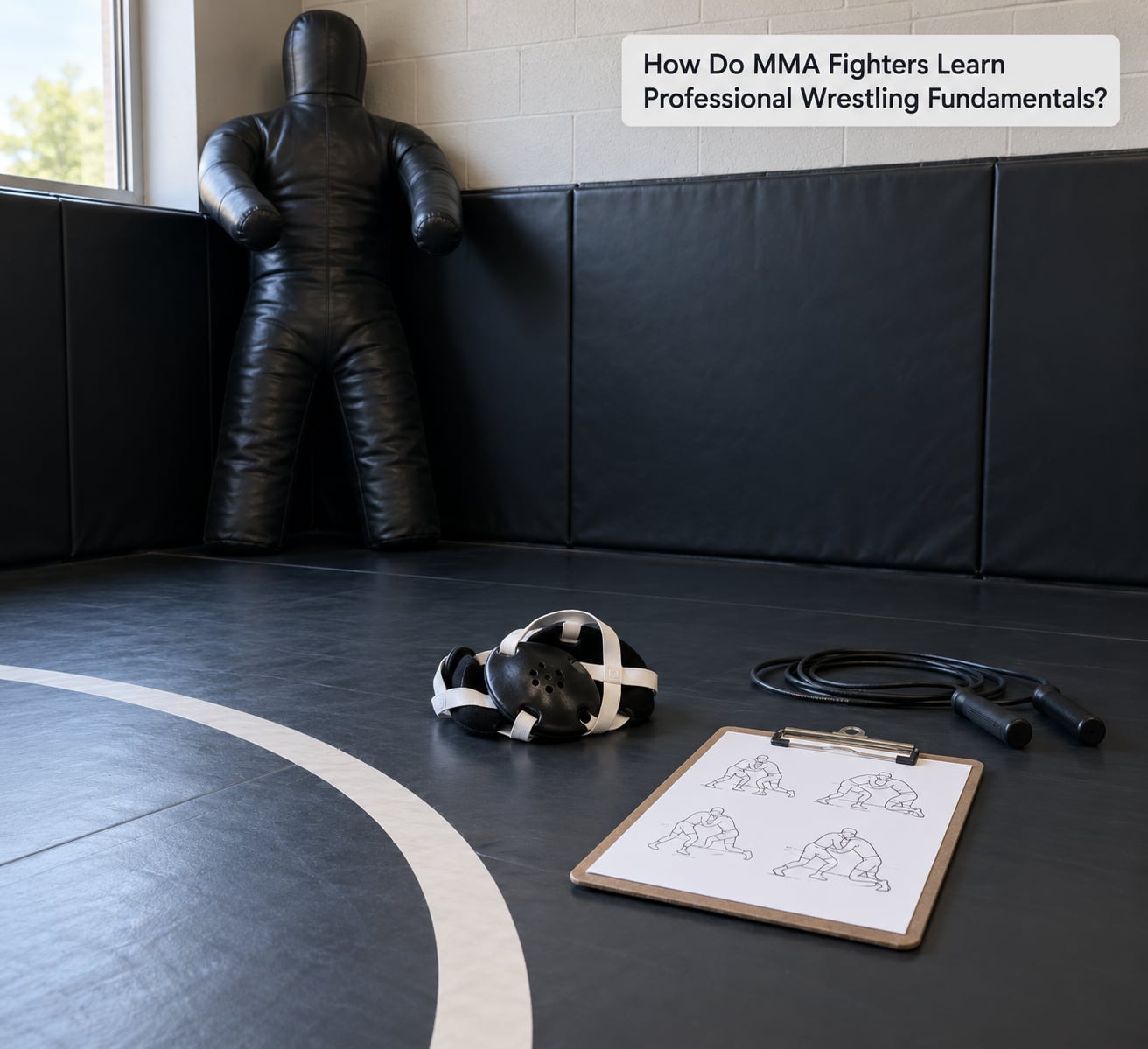
The first six months are the least glamorous and most necessary part of the whole thing. Almost nobody skips it. The curriculum is short on surprises and long on repetition.
Chain wrestling
This is the single biggest gap. Chain wrestling is a continuous sequence of holds and reversals with no reset, no break and no fresh opponent. An MMA fighter knows how to pass guard and sweep a scramble. A wrestler needs to move from a closed guard to a top position to a front headlock to a side control in one uninterrupted flow, and to keep going when nothing works.
The fix is unglamorous: drill reversals at a low intensity for long unbroken stretches. A good wrestler can keep a sequence going for several minutes without a pin. A crossover athlete usually cannot get past one minute.
Holds, escapes and pins
Every position has a named hold, and every hold has a standard escape. Pro wrestling adds pin geometry, which is a different skill from MMA’s finish-focused grappling because a pin is about body position and hook placement, not damage.
Bumps
A bump is taking impact on purpose, from a move whose realistic outcome would be an injury. Learning to take one properly — chin tucked, arms in, breath out — takes weeks and hurts for days. It is also where an authentic-looking wrestler separates from a man trying to protect himself.
Selling
Selling means performing a move with an exaggerated reaction so the audience reads intent rather than injury. A real armbar in a cage is a different object from a worked armbar in a match, and the crowd knows the difference instantly. Combat athletes resist this most because it feels dishonest.
Working with a partner
Nothing happens alone. A new wrestler learns a sequence from a partner, calls it, runs it and adjusts it. This is a social skill rather than an athletic one, and it is the part most newcomers underestimate.
The timeline, phase by phase
| Phase | Typical span | What it looks like |
|---|---|---|
| Fundamentals at a wrestling school or with a coach | 0 to 6 months | Two to four sessions a week. Chain wrestling, escapes, bumps, basic strikes. |
| Match rhythm and pace | 3 to 9 months | Working full-length sequences on the mat. Learning where the rest is going to be. |
| First booked indies | 6 to 18 months | Small shows, short matches, learning to work in front of a live crowd. |
| Character work and promos | 6 to 24 months | Entrance, gear, a name, a microphone voice, a consistent angle. |
| Major promotion tryout or developmental contract | 1 to 3 years | NXT tryouts, Performance Center signings, agent referrals. |
| Full-time mainstream roster work | 3 years and up | Travel schedule, creative direction, brand obligations. |
One caveat on that timeline. It describes a fighter starting with no wrestling background, which is the group this article is about. Lesnar is not the model; he came in with a national championship in amateur wrestling and finished wrestling in the state of Iowa. Rousey came in with judo, a teenage national judo title and Olympic trials experience. Those careers are exceptions precisely because the fundamentals were already installed.
How MMA Fighters Adapt to Ring Movement and Match Structure
The ring is a smaller space with fewer escape routes and a longer duration. Both facts change how a fighter moves, breathes and spends energy.
Ropes, corners and spacing
A cage fighter can circle until he finds an angle. A ring wrestler cannot circle, because the ropes are there. He can be sent into them, held there, and walked around by an opponent who knows the geometry. Learning to run the ropes safely, to bounce off them correctly and to use a corner deliberately is a specific skill with a real learning curve.
The duration gap
MMA is three five-minute rounds with clear corners for rest and recovery. A wrestling match is commonly ten to twenty minutes of near-continuous work with rest decided by the other person. That difference is the single most cited complaint from people who trained in MMA or BJJ and then started wrestling.
| Factor | MMA | Pro wrestling |
|---|---|---|
| Structure | Three five-minute rounds | One continuous sequence, often 10 to 20 minutes |
| Rest | Sixty seconds in the corner | Brief and scripted, decided by the match plan |
| Surface | Canvas over padding | Canvas over a frame, no padding at ringside |
| Escape | Always available | Blocked by ropes and corners |
| Success metric | Finish or decision | How the match read |
| Recovery mindset | Recover between rounds | Breathe through everything |
Microrecuperation
The practical answer most crossover veterans land on is unglamorous drilling. Wrestlers with martial arts backgrounds describe running full three-minute periods, not MMA-style intervals, so the body learns the actual rhythm of a match. They drill the transitions until they cost almost nothing, because in wrestling the transitions are where the energy goes.
That is why a striking-heavy crossover athlete often looks worse in the fifth minute than the first. The first minute is their sport. The fifth minute is somebody else’s.
How Do They Turn Combat Skills Into a Wrestling Style?
Once the mechanics are in place, an MMA background tends to produce a recognizable type of wrestler rather than a generic one. There are a few common shapes.
Shoot-style wrestlers work off striking, hitting an opponent with a kick or a level change and taking them down. It looks violent and it usually is, which is why it needs more selling discipline than it first appears.
Catch wrestlers blend collar ties, headlocks, throws and suplexes into one continuous system. This is the closest stylistic match to MMA, and it is the reason catch wrestling shows up so often in crossover backgrounds.
Submission-first wrestlers use holds as match currency rather than as finishes. A kimura that ends a fight becomes a hold applied while the crowd is still reacting to something else, released after eight seconds so the sequence keeps moving.
Mat-control specialists do the unglamorous version well because MMA taught them to pass and to stay heavy. In wrestling that reads as control, and control is what makes a match feel like a match.
The same move often means two opposite things across the two sports. A spear is a takedown in MMA, a score attempt under wrestling rules, and a finishing spot in a match. An armbar is a submission in the cage and a hold in a match, which means it gets applied slowly, shown, and released.
What Changes When MMA Fighters Develop a Character?
Everything up to this point is physical. Character work is the part where a combat athlete either adapts quickly or never does, because it asks for something the cage never did: repetition on purpose.
Selling and kayfabe
Kayfabe is the presented fiction of professional wrestling, the agreement between performer and audience that the story is real. A fighter’s instinct to be authentic works against it here. Authenticity is exactly what a worked match does not need.
The mindset shift is bigger than learning to grimace. A fighter has to accept that a sequence is planned, that his reactions are part of someone else’s design, and that being reliable inside that design is the job.
Presentation
Entrance music, gear, walk, and the first thirty seconds on the microphone are all new craft. Interviews are closer to a fighter’s comfort zone than the ring is, and most crossover athletes are competent there within a few months. Consistency is what takes longer, because a character has to say the same thing in week one and week forty.
Storylines and reversals
An MMA career is usually a straight line of results. A wrestling career needs reversals, injuries that are not real, alliances that break and rematches that arrive years apart. Learning to lose on purpose, and to lose in a way that builds something, is a skill most fighters develop only once and only with coaching.
How Do MMA Fighters Avoid Making the Transition Look Fake?
Watch a crossover debut with this checklist rather than with a fan’s instinct to look for wrestling.
Movement. Does he move like an athlete or like a stunt performer? Untrained movers hit the ropes with their backs and land stiff.
Consistent reaction. Do the same things get the same reactions all match long? Inconsistency is what makes a crossover look borrowed.
Convincing sells. Does he take a move on the follow-through and sell on the reaction, or does he sell first and land after?
Coherent psychology. Does the character do things for reasons, or does he change direction every two weeks because something got him heat?
Respect for the basics. Bumps, holds, escapes and tags. A fighter who skips fundamentals gets exposed in the fourth minute, in front of people who know what they are watching.
Patience with the calendar. The matches that go wrong are almost always the ones booked too early.
The cautionary cases are as instructive as the successful ones. Muhammad Lawal turned down a developmental deal rather than take a shortcut he wasn’t ready for, which is a defensible call and a common one. On the other side, wrestlers who jump into sanctioned MMA without real fight experience get exposed in a way no amount of ring time can fix.
Which Famous Transitions Best Show the Adaptation Process?
Ten careers illustrate different versions of the same problem, and between them they cover most of the routes in.
Brock Lesnar arrived with an NCAA wrestling title and a University of Iowa background, went to the top of both sports, and returned to wrestling as the single most credible athletic figure in the promotion. His case is the exception that proves the rule: he did not need the fundamentals rebuilt.
Ronda Rousey came in with Olympic-level judo, a national judo title as a teenager and years of striking and submission grappling. Her first WWE appearances sold a storyline rather than a wrestling career, which is the most common route in.
Shayna Baszler had years of in-ring reps before WWE and became one of the most dangerous strikers in the division. Her fight background reads as an addition to a wrestling base, not a substitute for it.
Bobby Lashley came through NCAA Division I wrestling and an undefeated amateur career before fighting, then returned to wrestling as a champion. Again, the amateur base came first.
Alberto Del Rio arrived with a lucha libre background, which meant he already knew ring movement, tag work and the promotional side of the business in a way most crossover athletes do not.
Shinsuke Nakamura spent his career in New Japan Pro Wrestling, the promotion with the longest deliberate combat-sports crossover tradition, and entered WWE with a fully developed wrestling identity rather than a borrowed one.
Josh Barnett went the other way, from wrestling and Pancrase to a notable UFC run, and is the clearest example of someone who learned to fight after learning to wrestle.
Ken Shamrock and Dan Severn both crossed over repeatedly, building careers in Japan and the United States that mixed shoot-style striking with catch wrestling rules.
Antonio Inoki is the source of the whole pipeline. He deliberately imported martial artists into Japanese wrestling, and the New Japan lineage he created is why a promotion there treats an MMA background as normal rather than novel.
Janai Kai is a useful current example of the other order: martial arts first in a different discipline, then MMA, then a kick-heavy wrestling style that uses all of it.
Why the reverse direction is harder
A wrestler attempting to move into MMA has to learn to fight, which is not a skill you can borrow. The crossover works in one direction much better than the other for a simple reason: combat sports are a preparation system for taking damage under pressure, and wrestling is not.
A wrestler’s instinct is to position and control. An opponent’s first genuine striking exchange ends that. The community view on this is close to unanimous — the technique transfers one way far better than the other — and any fighter who had to learn to take a real punch before they could compete will tell you the same thing.
Frequently Asked Questions
Can MMA skills help someone become a professional wrestler?
They help more than any other single background, but they do not get you there on their own. Athleticism, conditioning, pain tolerance, striking and camera comfort all transfer to pro wrestling immediately. What has to be built separately is chain wrestling, selling, character work and ring endurance, and that build usually takes one to three years of regular training before anyone pays you for it.
Are MMA fighters usually better strikers than trained wrestlers?
On raw striking power and timing, yes, and it shows in their first match. Trained wrestlers strike to keep an opponent honest rather than to win a standup exchange, so their striking often looks uncommitted. A crossover athlete’s kicks and punches can look sharp in a wrestling match, though they have to be toned down because the target is the sound of the strike rather than its effect.
Why do MMA competitors struggle with chain wrestling?
Because MMA grappling and wrestling are different disciplines, not one skill with two names. MMA optimizes for explosive position advancement in seconds against an opponent trying to scramble. Chain wrestling requires staying in a continuous sequence of holds and reversals for minutes without a reset, which is a longer and much harder problem. Most crossover athletes can pass guard well and then stall once the scramble is over.
What is the biggest adjustment for an MMA fighter entering pro wrestling?
The biggest adjustment is selling, not cardio. Fighters arrive expecting to work harder and having to work less, and to react instead of following a plan. Learning to perform a move with an exaggerated reaction, to take a bump properly and to accept that a sequence is arranged in advance takes longer than conditioning does, even though conditioning is what gets discussed more.
Does a successful MMA career guarantee success in professional wrestling?
No. A strong amateur wrestling base matters as much as a strong fight record, and several of the most famous crossover careers, including Lesnar’s, Lashley’s and Del Rio’s, were built on wrestling first. Fighters with no amateur or folkstyle background usually need a longer route through independent wrestling, and getting booked somewhere reliable takes longer than the athletic part.
Conclusion
When you judge a crossover, start with four things and ignore the hype: where the fighter’s grappling came from, how they move before contact, what they do in minute five, and whether their character says the same thing every week.
The athleticism is already there. That is the easy part. How MMA fighters adapt to pro wrestling comes down to rebuilding one skill at a time — chain wrestling first, selling next, pacing after that — and being honest about which of the cage habits need to go.