Understanding how a wrestling card is ordered from opener to main event tells you what a promotion wants you to care about tonight. The run goes pre-show and dark matches first, then the opener, then early and mid-card bouts, then a semi-main or co-main event, and finally the main event that closes the broadcast. Promotions build it backwards, choosing the headliner first and filling the rest of the night around it.
The trouble for a lot of new fans is that nobody formally teaches this vocabulary. You get told a match is “undercard” or that someone “got buried” without any idea which slot either phrase refers to, so the running order ends up looking arbitrary.
It isn’t arbitrary. Card order is the clearest signal a promotion puts on the table about what it thinks matters tonight, and once you can read the slots, a rundown stops being a jumble of names and starts telling you a story about the promotion’s plans. Here’s the whole system, from the first bell of the pre-show to the last pinfall of the main event.
Table of Contents
- What Does a Wrestling Card Mean?
- How a Wrestling Card Is Ordered from Opener to Main Event
- The seven canonical slots, in order
- What each slot usually gets in the time budget
- The Pre-Show and Opening Matches
- Why openers get squashed
- How Promoters Build Momentum Through the Middle of the Card
- What changes the middle on the night
- What Usually Comes Before the Main Event
- Why the Main Event Closes the Card
- How Different Wrestling Cards Change the Order
- How to Read a Wrestling Card Before the Show
- Frequently Asked Questions
- What is the first match on a wrestling card?
- Are title matches always the main event?
- How many matches are usually on a wrestling card?
- Why do wrestlers change their matches on the night of a show?
- Is the co-main event always better than the opening match?
- How can I know the order of matches before watching?
- Start at the Bottom of the Card
What Does a Wrestling Card Mean?
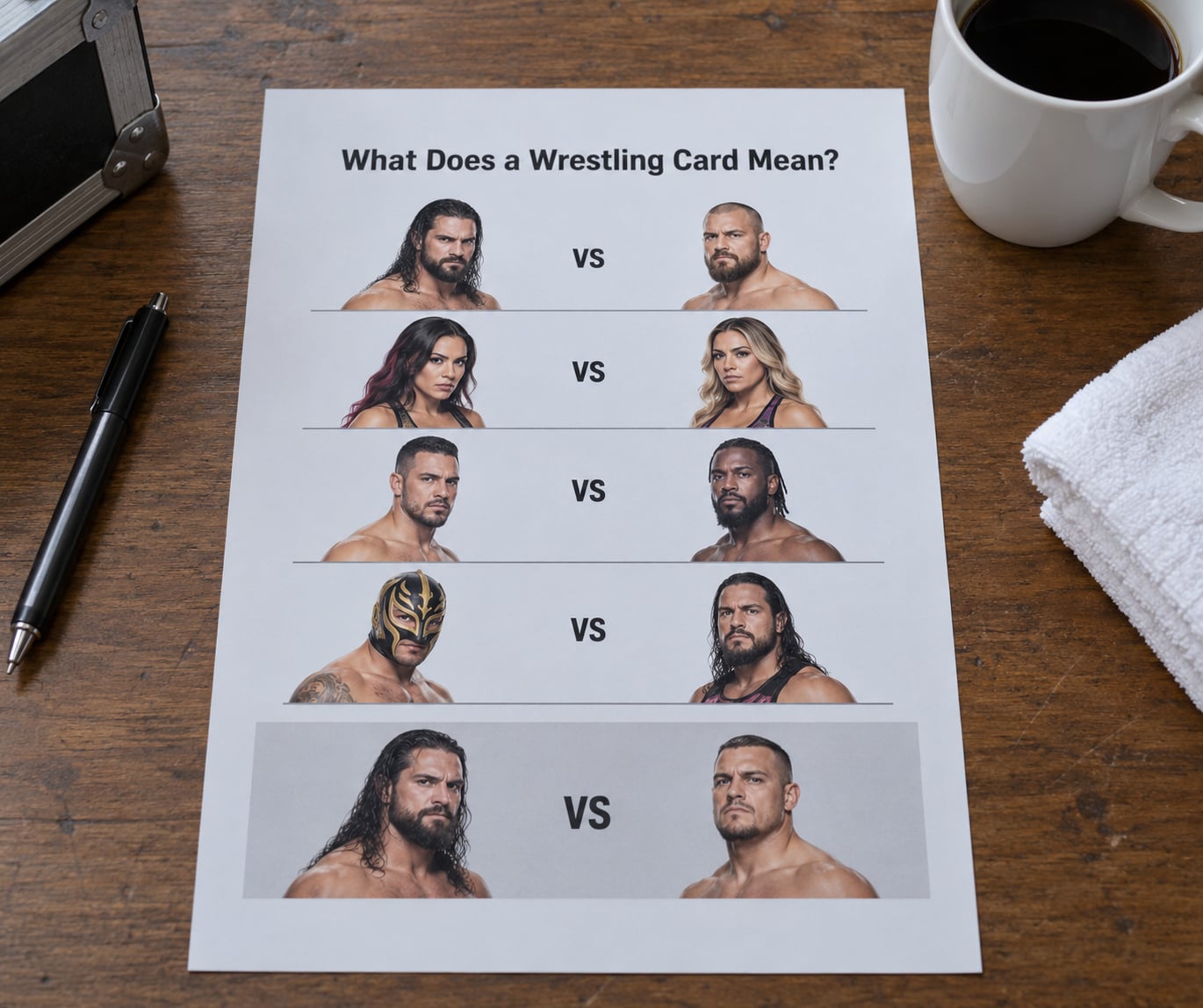
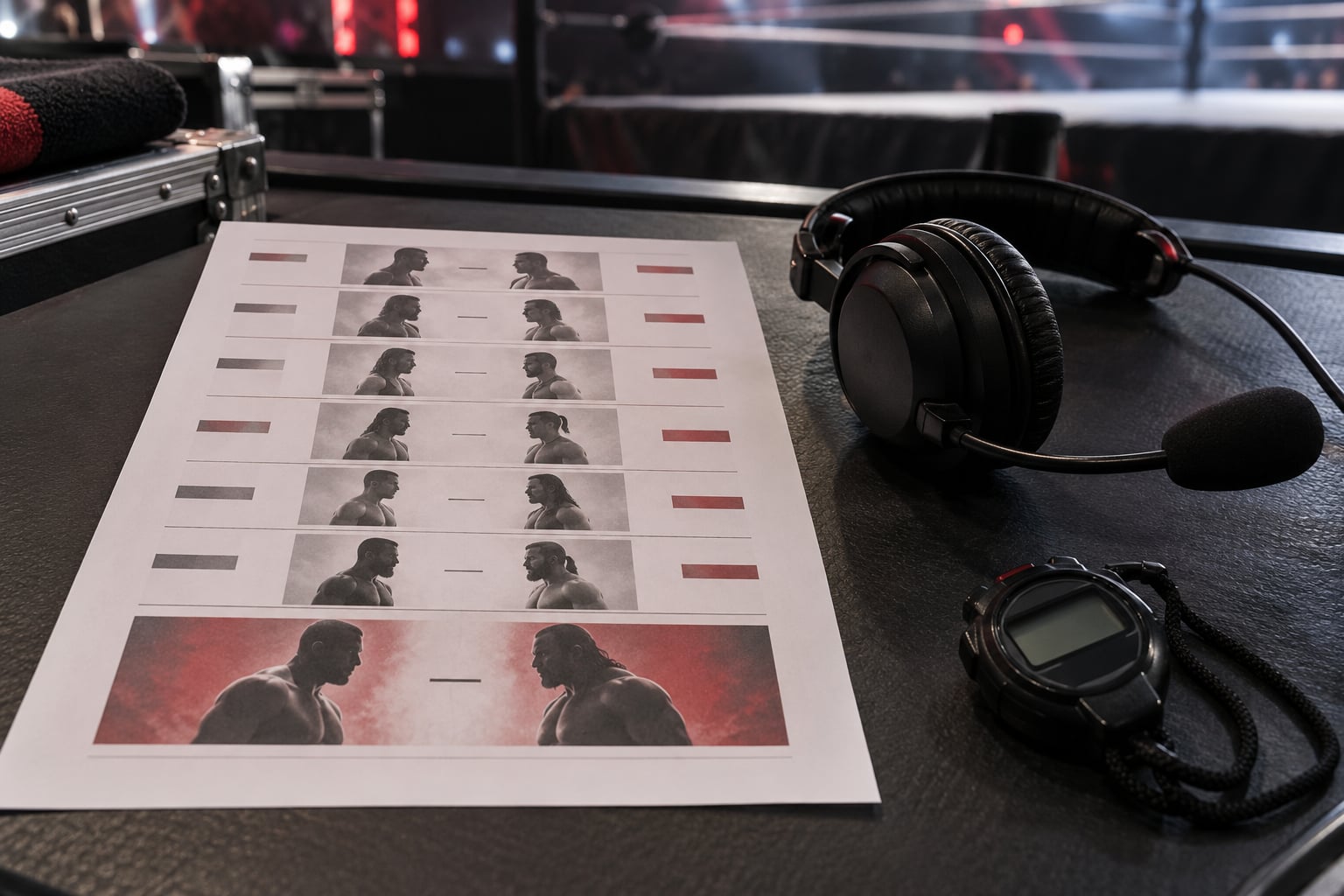
A wrestling card is the ordered list of everything a show contains: matches in the order they happen, plus promos, segments, recaps and any post-show material. Promotions publish it days or weeks ahead so fans can follow along, and it is usually drawn up as a vertical list with the headliner written at the bottom.
The word comes from the physical program. Before anyone posted a match order online, a venue handed you a printed card with the running order on one side, and the main event sat in the largest type at the foot of the page.
It is different from an event. The event is the whole night, the card is the running order inside it, and one event can contain more than one card if it runs across two nights. It is also different from a tournament bracket: a bracket tells you who faces whom and what happens if someone loses, while a card only tells you what happens tonight and in which order.
Order is deliberate because a broadcast has a fixed clock. A two-hour weekly show has roughly two hours of ring time, entrances, commercials and promos to fill, and the promoter needs the biggest match of the night to land at the end, when the audience is most invested and the tuning audience is least likely to click away.
How a Wrestling Card Is Ordered from Opener to Main Event
How a wrestling card is ordered from opener to main event follows a fixed escalation: dark and pre-show matches first, then the opener, the early matches, the mid-card, the semi-main, the co-main event, and the main event last. Seven slots, each one weighted a little heavier than the one before it, so the show peaks rather than flatlines.
The seven canonical slots, in order
- Dark match — an untelevised bout with no storyline attached. It exists to give wrestlers ring time, test someone out, or burn a match nobody was ever going to miss.
- Pre-show match — televised, but scheduled before the main broadcast begins. AEW built a whole pre-show around this slot. It’s the easiest place to debut new talent because nobody is watching closely yet.
- The opener — the first match of the actual broadcast. Traditionally the shortest match of the night, often a squash, designed to get the show started rather than to matter.
- Early or second match — still short, but a place where tag teams and mid-level singles competitors usually work. If a name gets extended here, it’s a sign they’re about to be pushed.
- The mid-card — the middle of the card, where feuds, returns and debuts land. Nothing about the mid-card is fixed; it’s simply whatever sits between the opener and the semi-main, and its weight depends entirely on what the promotion is selling that week.
- The semi-main or co-main event — the second-to-last match, usually a title match or the payoff to a long-running angle. On modern cards you may see two co-main events instead of one.
- The main event — the last match, the one on the poster, with the biggest entrances, the longest video package and the most time reserved for it.
What each slot usually gets in the time budget
| Slot | Typical length | Stakes level | Common format |
|---|---|---|---|
| Dark match | 4 to 8 minutes | None | Singles or tag, untelevised |
| Pre-show match | 8 to 12 minutes | Low, but televised | Debuts, returns, tag teams |
| Opener | 5 to 10 minutes | Low | Squash or showcase bout |
| Second match | 8 to 12 minutes | Low to medium | Tag team or singles |
| Mid-card | 10 to 18 minutes | Medium | Feud bout, debut, stipulation match |
| Semi-main or co-main | 15 to 25 minutes | High | Title match, singles grudge |
| Main event | 20 to 40 minutes | Highest | World title, triple threat, tag |
Those numbers are averages, not rules. A fast-paced card will run every match under twelve minutes and save its length for the main event, while a slower card can stretch a mid-card bout past twenty minutes if the crowd is loud.
The Pre-Show and Opening Matches
The night starts before the broadcast does. Dark matches happen with no cameras and no storyline, and they’re how a promotion tests a debut or gives a pair of wrestlers a run without committing them to television. Pre-show matches are different: they’re televised, but they run before the main program, which makes them ideal for introducing someone to a wider audience without the pressure of a main-event slot.
Then the show proper begins, usually with a recap package and a short promo or two before the bell rings. The opener follows, and the opener has a specific job. It is rarely a match anyone will argue about on Monday morning. It’s short, the entrances are quick, and it exists to confirm that the broadcast is live and to get the crowd on its feet.
Why openers get squashed
A squash is a one-sided match where one wrestler wins cleanly and the other exists to be beaten. Fans sometimes read a squash against a returning legend as an insult, and it’s worth being honest that that reaction isn’t baseless. But the slot explains most of it: an opener is a showcase, and a showcase needs a clean result that doesn’t muddy the star’s momentum later in the night.
There is a logistics side too. WrestleMania 39 put Austin Theory against John Cena in the Night 1 opener rather than the main event, and the reasoning people at Fightful Select reported was largely practical — get the big name on, get him off, keep the schedule moving. At WrestleMania 42 the same logic showed up again with talk of Brock Lesnar opening so he could leave straight after his match instead of sitting backstage for hours.
If you want a rule of thumb: if a famous name is booked to open, read it as a scheduled appearance rather than a headline. It tells you something real about the promotion’s plans for them, just not the one most fans expect.
How Promoters Build Momentum Through the Middle of the Card
Once the show is running, the promotion starts spending its more valuable material. The mid-card is where feuds actually develop, where a masked wrestler debuts, where a returning name gets an introduction that the crowd has to be told to react to, and where the first genuinely contested match of the night tends to sit.
The escalation is about stakes as much as clock time. An opener rarely has anything at stake. The second match might introduce a challenger. The mid-card might have a title shot on the line or an argument the audience already has an opinion about. Each step up makes the audience care about the next one, which is exactly the momentum the main event needs.
What changes the middle on the night
Crowd reaction is the biggest variable. A debut gets a genuine pop and the match runs longer; a returning name gets silence and the bout gets cut short. Injury is the other one. If someone calls in the back, the card gets rebuilt in a hurry, and slots after the affected match usually absorb the change.
Match length also feeds back into the order. If the opener blows past its allotted ten minutes, everything downstream loses time, and the main event becomes the match that gets squeezed rather than the one that gets extended. Bookers watch the clock all night for this reason.
What Usually Comes Before the Main Event
The match directly before the headliner is the co-main event, and on most cards it is a championship match. It’s positioned there because it needs to feel like an event in its own right while still leaving the crowd something to look forward to, so it gets a proper entrance, a video package, and often a stipulation or a title with history attached.
A single co-main isn’t guaranteed. Since WWE split its world title into two championships in 2004, the number of matches with legitimate claims to the top slot went up, and double main events stopped being unusual. WrestleMania 40 put a champion and his partner in a tag team match above both world title bouts, which is a good illustration that a slot can outrank a single’s importance when the storyline and the available crowd reaction demand it.
So when someone asks whether a title match is always the main event, the honest answer is that titles reliably fill the semi-main and co-main slots, and the main event is usually a title match too, but position and importance are not the same thing. Fans have argued about that split on fan forums for years, and the modern broadcast makes it worse: on a weekly show, the final segment is often a promo rather than a match at all.
Why the Main Event Closes the Card
The main event gets the biggest introduction, the longest video package, the most time, and the last word. That placement is a promise to the audience: whatever you came for is coming, and you’ll be here when it happens.
It’s also how a promotion resets. A main event usually pays off something months in the making, and whatever happens in it sends the next several weeks of storylines in a new direction. Win, lose, draw, cash in — all of it feeds forward, which is why this slot is usually decided before anyone else on the card.
Creatives build the show backwards. The main event is locked, then the matches that feed it are placed, then the remaining broadcast time is filled downward with whatever fits. That’s also why the last match occasionally moves: if the headliner needs more time than expected, the match before it is the one that gets trimmed.
How Different Wrestling Cards Change the Order
The opener-to-main-event principle holds everywhere, but the shape of the night varies a lot by promotion and by show type. A weekly television show has two hours and has to be economical. A WrestleMania night runs three hours and can carry a match that would never survive a Saturday night broadcast.
| Show type | Typical match count | Character of the order |
|---|---|---|
| Weekly television | 6 to 9 | Compact, promo-heavy, main event often shortened |
| Streaming weekly broadcast | 10 to 14 | More matches, longer mid-card, in-ring segments between bouts |
| Pay-per-view | 5 to 7 | Every slot weighted, longer matches, fewer cutaways |
| WrestleMania night | 8 to 10 | Longest matches, biggest entrances, crossover bookings |
| House show or indie | 8 to 12 | Less TV time, more wrestling, order built around who travelled |
| Tournament | Fixed by bracket | Order constrained by standings rather than by story |
The indie case is the most different. On an independent show there may be no broadcast clock at all, so the card is built around travel and pay rather than television structure, and the person who drew the main event is often whoever the promoter most wanted to headline rather than whoever has the strongest angle that month.
How to Read a Wrestling Card Before the Show
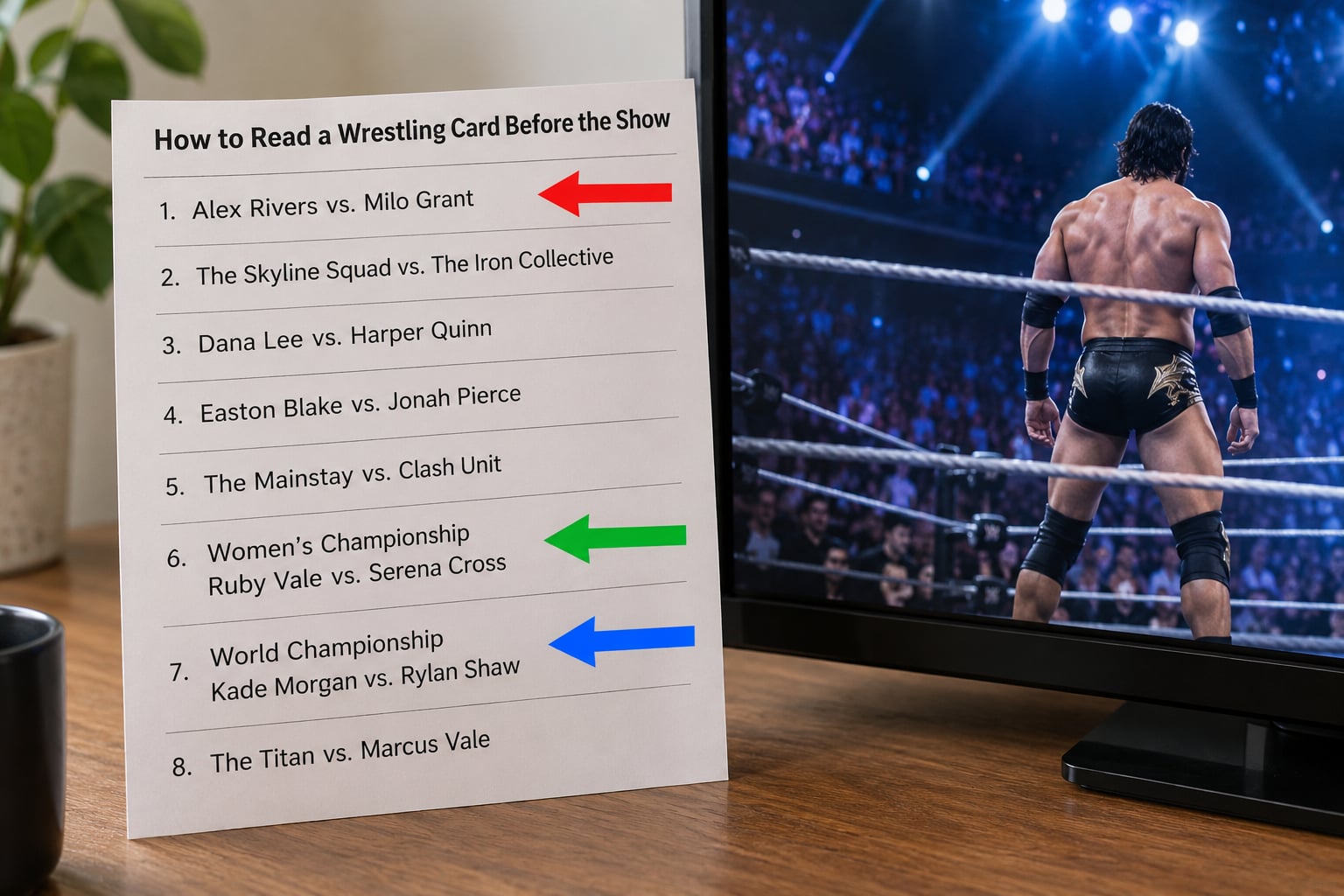
You can get a lot out of a published card in about a minute. Here’s the method I’d use: start at the bottom and work upward.
- Find the advertised main event. It’s usually written last and in the biggest type, and it’s often named as a match rather than as participants in a tournament.
- Note every title match. Two or three of them tells you the promotion is running a multi-main card, which means the order matters less than usual.
- Separate pre-show and dark matches. Anything labelled pre-show or dark doesn’t count toward the televised card, so don’t include it in your count of the night’s matches.
- Read who returns. A debut, a return, or a first-time pairing is a signal about where that person’s storyline is going.
- Expect changes. Cards get rearranged on the day for injury, travel and crowd response, so treat any published order as a plan rather than a promise.
Once you’ve done that, you can predict the shape of the night. If the main event has three participants and there’s a stipulation match above it, expect a long card with two heavy finishes close together. If the card is six matches with two title bouts, expect tight pacing and a main event that has to earn its length in the final fifteen minutes.
Frequently Asked Questions
What is the first match on a wrestling card?
The first match is the opener, which comes after any dark and pre-show bouts. Openers are usually five to ten minutes, often a squash, and they exist to confirm the broadcast is live and put the crowd on its feet. A famous name booked there is normally a scheduled appearance rather than a headline, which is what happened with Austin Theory versus John Cena at WrestleMania 39.
Are title matches always the main event?
No. Title matches reliably fill the semi-main and co-main slots, and the main event is often a title match too, but position and importance are not the same thing. Since WWE split its world title in 2004, cards have regularly featured two title matches, and WrestleMania 40 placed a tag team match above both of them.
How many matches are usually on a wrestling card?
A weekly television show usually carries six to nine matches. A pay-per-view typically runs five to seven, while a streaming weekly broadcast can hold ten to fourteen because of its longer runtime. House shows and independent cards often run eight to twelve with little television time to fill. Tournament cards are fixed by the bracket instead.
Why do wrestlers change their matches on the night of a show?
Cards get rebuilt for injury, travel schedules and live crowd reaction. If a debut gets a genuine pop, its match usually runs longer; if a returning name draws silence, it gets cut short. If an opener runs long, every slot after it loses time, so the main event is sometimes the match that gets trimmed rather than the one that gets extended.
Is the co-main event always better than the opening match?
In terms of what the promotion is selling, yes. The co-main usually carries a title, a stipulation or the payoff to a long angle, and it gets a full entrance and video package. The opener is a showcase slot, deliberately short and low stakes. That said, a card with a bad match in the co-main spot can still disappoint, so slot position is a reliable guide to intent rather than to quality.
How can I know the order of matches before watching?
Start at the bottom of the published card and find the advertised main event, then list every title match above it. Ignore anything marked pre-show or dark, since it isn’t part of the televised card. Note debuts and returns, because those signal where a storyline is going. Treat the whole order as a plan rather than a promise, since it can shift on the day.
Start at the Bottom of the Card
If you do one thing differently after reading this, read the next card from the bottom up. The main event tells you what the promotion wants you to care about tonight, the title matches tell you how the night is structured, and everything above them is the road getting you there.
Card order changes week to week, and sometimes on the night, so keep expectations loose. But once the slots make sense, a rundown stops being a list of names and starts being a sentence you can finish: this is the story they’re telling, and the main event is the word it ends on.