A wrestling booking sheet is the promoter or booker’s internal document that turns a storyline into a scheduled match with a time slot, a stipulation, named participants and a decided outcome. One row per match. The rows stack into a running order, and the whole thing is worked top to bottom on show night.
What follows is a field-by-field look at how wrestling booking sheets are structured, built from how major promotions, independent shows and wrestling schools actually plan. No promotion uses a single universal template, so treat the field list below as the industry norm rather than a fixed standard.
Table of Contents
- What Is a Wrestling Booking Sheet?
- How Are Wrestling Booking Sheets Structured?
- The Core Sections of a Typical Booking Sheet
- A Simplified Weekly Booking Sheet at a Glance
- How Story Arcs and Match Goals Connect
- How Finishes, Payoffs, and Follow-Up Are Written
- Why Weekly Booking Documents Are Not Identical
- How Promotions Set Weekly and Event-Level Priorities
- What Readers Should Notice on a Wrestling Booking Sheet
- Common Misunderstandings About Wrestling Booking Sheets
- Frequently Asked Questions
- Do all professional wrestling promotions use the same booking sheet?
- Are wrestling booking sheets public documents?
- Does a planned match finish always happen?
- Why can a booking sheet change before an event?
- Can one booking sheet explain an entire wrestling show?
- Conclusion
What Is a Wrestling Booking Sheet?
A booking sheet is a working document, not a publication. It sits somewhere between a creative outline and an instruction sheet: the booker writes it weeks ahead, the promoter signs off on it, and the wrestlers get their own version of it, often in person, before anyone steps in the ring.
The distinction matters more than fans expect. The match card the audience buys is a projection of the sheet, stripped of notes and open to last-minute changes. The booking sheet is the version with the instructions still attached, and it usually never leaves the production office.
Think about what a fan is really asking when they search for this. It is rarely a question about one promotion’s spreadsheet. It is a question about the machinery: who writes it, how far ahead, what each column means, and why a match you expected to end one way ends another way.
There is also a smaller job the sheet does that never gets mentioned. It is the memory. A booker running eight to twelve matches a night cannot remember every finish from the last forty shows, so the sheet, and the results file attached to it, is how the same match with the same outcome does not happen twice in a row.
How Are Wrestling Booking Sheets Structured?
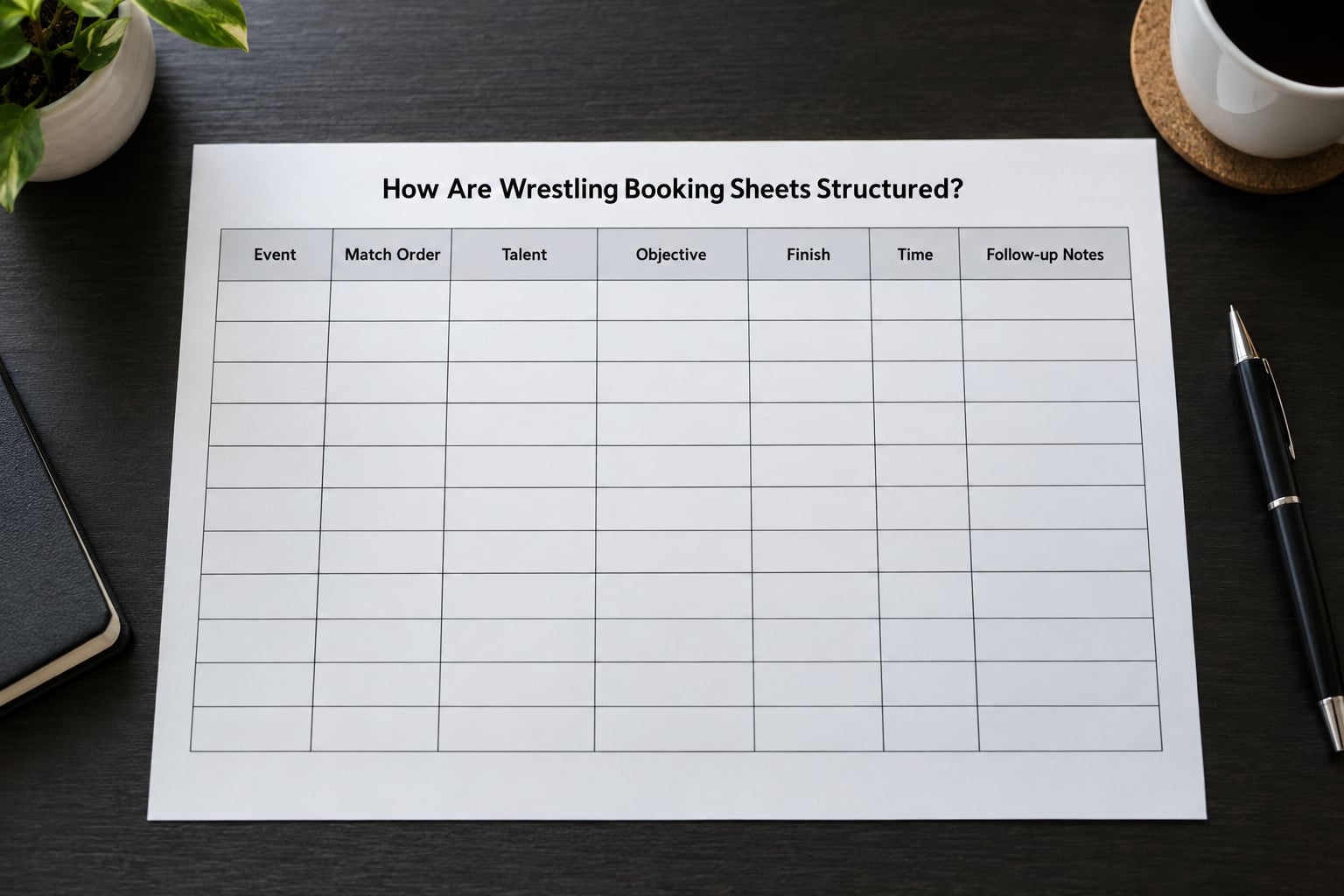
Most usable booking sheets connect a show’s creative direction, match objectives, participants, story beats, finishes, time allocations and follow-up notes, ordered either week by week or event by event. Each row answers one question: what is this match for, how long does it run, and what happens at the end of it?
The columns differ by promotion, but the industry norm is roughly a dozen fields. Order matters more than labels. A sheet that lists the finish before the match objective is hard to use, because the booker has to work backwards from a result to a reason for it.
The Core Sections of a Typical Booking Sheet
Here is the field list in the order a booker tends to work through it, followed by what each column actually holds.
- Event or date
- Segment order number
- Segment type
- Participants and opponents
- Character and story context
- Match objective or stipulation
- Key beats
- Planned finish
- Time limit
- Notes and allowed variations
- Follow-up or payoff
- Status flag
| Field | What it holds | Who fills it |
|---|---|---|
| Event or date | The show, brand or event name and the tape date | Promoter |
| Segment order | A running number that fixes where the segment sits in the show | Booker |
| Segment type | Match, promo, interview, squash, in-ring segment | Booker |
| Participants | Names, plus champions, managers and seconds where relevant | Booker, negotiated with agents |
| Story context | Which thread the match serves and where the wrestlers left it | Booker |
| Objective | Stipulation or the job of the match: put over, beat, protect, heat | Booker |
| Key beats | The decisive moments in order, plus any false finish | Booker |
| Finish | The planned winner and the finishing move | Booker, approved by promoter |
| Time limit | Minutes allocated, often split by quarter hour | Booker and production |
| Notes | What is flexible, what is not, and where to look for scripting | Booker |
| Follow-up | Next week’s consequence, the payoff owed, or the thread to park | Booker |
| Status | Planned, changed, cut, re-run, done | Updated after the show |
Two of these deserve more attention than the rest. The notes column is where a booker tells talent how much room they have, and the status column is the one almost nobody outside the production team knows exists. It exists because the sheet is revised after the show airs, not just before it goes on.
A Simplified Weekly Booking Sheet at a Glance
Here is a fictional sheet for a single weekly show, condensed to the columns a small promotion would actually use. The names are invented. The structure is not.
| Order | Talent | Objective | Finish | Time | Follow-up |
|---|---|---|---|---|---|
| 1 | Open prospect vs returning veteran | Put the prospect over cleanly | Prospect, roll-up | 6 min | Veteran puts the prospect on the notice tape |
| 2 | Championship rematch | Protect the champion | Champion retains, clean | 12 min | No follow-up, rest the champion |
| 3 | Two heavyweights | Fill the middle, no angle | Draw | 10 min | None, pure filler |
| 4 | Rival heel vs face | Cheat the face at the bell | Heel wins by count-out | 9 min | Face demands a rematch in 30 days |
| 5 | Tag team title match | Establish the new champions | New champions win | 11 min | Old champions chase a rematch |
| 6 | Main event, singles | Cash in on 8 weeks of build | Face wins, but the heel sells injury | 16 min | Heel returns in 6 weeks |
Add the promos and the show is about two and a half hours with commercials. That arithmetic is the real discipline of booking. A card with eleven to fourteen matches over four to four and a half hours, the format AEW tends to run, and a card with five or six matches over three hours, which is closer to a typical independent show, are built with the same columns and very different budgets.
The 11 to 14 match comparison is community-circulated rather than published by either promotion, so treat it as a working rule of thumb. The five-match major-event figure is better sourced: lastwordonsports.com noted that WWE capped premium live events at five matches after WrestleMania 40, with Raw and SmackDown running four to five.
How Story Arcs and Match Goals Connect
A match never starts with a finish. It starts with a job. Finish the job later, and the job dictates almost everything else: how many spots, how much selling, whether the time limit protects the loser or the winner.
Long-term booking shapes that job from above. If a heel turn is being built over twelve weeks, matches six through nine may have no finish worth remembering at all. They are there to move the two wrestlers from one position to the next. Short-term booking does the opposite, giving a match its payoff immediately because the audience is being asked to tune in next week.
How far ahead a promotion writes varies as much as the column layout. One writer on r/FantasyBookers described planning three to six months of pay-per-views on paper first, targeting six to eight matches per major show. Working professionals tend to plan a season outline and fill in detail weeks out. Fantasy bookers and wrestling schools often start with a single sheet and grow a tracker.
The honest version is that no single answer wins. What matters for a reader trying to understand a document is the planning horizon printed at the top of it. If a sheet has no horizon on it, treat everything in it as provisional.
How Finishes, Payoffs, and Follow-Up Are Written
The finish field is one short line: who wins, and how. A good one leaves room for the performers. A clean win over a working opponent protects the booker, but an overprotected champion is a card nobody watches to the end.
A false finish does the opposite job. It is a spot near the end of a match where the outcome looks decided and then is not, which buys a crowd the feeling of a close contest and gives the winner a reason to cheat or to steal. One to two in a match is normal. Five is a comedy.
The follow-up column is what stops a good match from being a dead end. It answers a single question: what does this cost someone next week? A count-out win earns a rematch clause. A squash match earns nothing and needs no follow-up. A title change earns a whole new thread.
After the show, the sheet gets a revision pass. Rows that went out differently get marked changed, rows that never happened get marked cut, and the actual result gets written back so the next booker can see it. This is the mechanism that answers the most common complaint from fantasy bookers, who say they keep re-running the same match with the same two people because they have no way of tracking what already happened.
Why Weekly Booking Documents Are Not Identical
Everything so far describes a canonical layout. Real promotions run several documents at once, and they do not agree with each other by design, because they answer to different people at different moments.
| Document | Who reads it | What it leaves out |
|---|---|---|
| Booking sheet | Booker, promoter, sometimes talent | Production cues, music, timings to the second |
| Match card | The audience | Notes, beats, instructions, anything about outcomes |
| Running order or run sheet | Production, announcers, talent | Story context, which is assumed known |
| Promo script | The performer | Match structure entirely |
| Talent and fee sheet | Promoter, business side | Everything creative |
The booking sheet is the only one of these that carries creative intent. The run sheet is the only one that carries timings to the minute. Keeping them separate is what lets a booker rewrite a finish without reprinting the production copy, and it is why the four documents get confused constantly in fan conversation.
There is a fifth document that older readers will recognise. In the territory era, a great deal of this lived on paper cards circulated between promotions, sometimes alongside a sheet where attendance was recorded row by row for the next booking partner. The logic has not changed much: the document tracks the show and the audience, because the audience number was often the reason the direction changed.
Tools have changed more than the fields have. Google Sheets and Excel still dominate, which is why templates for independent promotions are usually spreadsheet-shaped. Purpose-built software such as TrackWrestling exposes the same underlying information in bracket form, sorting on division, round, opponent and score. Browser tools have made the once-rare luxury of drag-and-drop running order ordinary, which is how a subreddit devoted to territory booking sims now describes reshaping the card order.
And the sheet deliberately does not contain some things fans expect. Crowd reaction, entrance music cues, lighting states and the wording of promos live elsewhere, usually in a production document and the talent’s own materials. A booking sheet tells two wrestlers what the match is for. It does not tell them how to sell it.
How Promotions Set Weekly and Event-Level Priorities
Priorities cascade. A season-long arc sets the direction for a quarterly block, the block sets the weekly goal, the weekly goal sets the order of segments, and the order sets the time limit for each match. A writer who breaks that chain usually gets a card that is technically fine and emotionally inert.
Nobody owns the document alone. The promoter sets the direction and approves finishes. The head booker writes the rows. Agents negotiate talent onto and off them, which is the part most fans never see, and which forum discussion suggests is the most contested step in the whole process. A greydogsoftware thread described a promotion whose booking team had a member who joined and left, framed as classic old-school booking, which is a fair description of a lot of small independents.
Production then imposes its own layer. An overrun on segment two eats minutes from segment three, and the run sheet absorbs the damage. Wrestling Andy’s promoter-sourced account of show night lists getting everyone’s music together, setting matches and absorbing last-minute changes, with staff wearing several hats at once. The booking sheet is what makes that survivable.
What Readers Should Notice on a Wrestling Booking Sheet
Look for verbs. The language of a good notes column is conditional and specific: the heel may extend the count, the champion should be on the outside for two minutes, the finish is protected but the pin is not. A sheet written entirely in absolutes usually means the writer was not careful.
Separate a goal from a result. Put over, take the heat, protect the finish, collect the crowd reaction. These are intentions about how a match will land. Who wins is a different field, and the discipline is in noticing which one you are reading.
Watch the time column, because it is where a card’s priorities become visible. A match allotted six minutes is a decision about importance, and it is the one a booker can get wrong most visibly. Look too at the finish column for repetition: the same person winning the same way three times in a month is a symptom, not a style.
Finally, date the document. Sheets go stale. An unofficial copy from years ago describes a booking team that no longer exists, and a leaked sheet shows intent, not outcome. If it does not carry an event name and a date, treat every row in it as fiction.
A short glossary helps more than it sounds. A booker plans angles. A promoter owns the company and pays for the show. An agent negotiates for a wrestler. A finish is the planned ending. A beat is a story development, written or not. Heat is the hostility a wrestler is meant to draw. A squash match is a loss designed to build someone else, usually in one move. Protection means keeping a wrestler strong regardless of result. Rub-and-earn is a long, grinding story built up over many weeks.
Common Misunderstandings About Wrestling Booking Sheets
The belief that every promotion uses the same template is the most common one, and it is wrong. The roughly dozen fields described here are a shared vocabulary, not a shared document. Small promotions often merge the notes and follow-up columns into one, and larger operations split the sheet by brand or by taping session.
The idea that a listed finish always happens is also wrong. What gets written on Monday can be changed on Tuesday, changed again on the day, and changed in the ring if talent cannot deliver what was planned. The sheet records intent; the result column records what actually occurred, and the two are frequently different.
Ratings and audience numbers do not decide bookings on their own, though the habit of reading them that way is widespread enough to have a name among critics: the Spreadsheet Society. Jonathan Snowden’s Hybrid Shoot essay makes the point carefully. Attendance data can explain why a booker changed direction, why a wrestler lost a position, or why a territory collapsed. It cannot tell you whether the matches were any good, and treating it as a verdict on creative quality is a habit inherited from how the Monday Night War framed wrestling as a weekly sporting result.
Finally, one sheet does not explain an entire show. A booking sheet covers the matches and segments. The rest of the night, ring crew, production problems, the merch table, is nobody’s spreadsheet. Promoters describe show night as chaos, and the chaos happens around the document, not inside it.
Frequently Asked Questions
Do all professional wrestling promotions use the same booking sheet?
No. The core fields are broadly consistent, but the layout, the labels and the number of columns change from promotion to promotion. Small independents often fold notes and follow-up into one column, while larger operations split sheets by brand or by taping session. Most also start from a spreadsheet template rather than a shared industry file, so no two sheets look alike.
Are wrestling booking sheets public documents?
No, they are internal working documents. The audience sees the match card, which is a cleaned-up projection of the sheet with all notes and instructions removed. Occasional copies surface online, and they tend to be old, unofficial or fictional. Anyone presenting a current sheet as fact is usually guessing at a layout from a fan template.
Does a planned match finish always happen?
Rarely without at least one change. What gets written a week or more ahead can be revised by the promoter, altered by agents, cut for time, or abandoned on the night when talent cannot deliver it. The row is usually updated afterward so the actual result is on record. A listed finish is an intention, not a guarantee.
Why can a booking sheet change before an event?
Three reasons dominate. A story beat that was set up too early can be pulled forward or pushed back. A wrestler’s availability can shift, and agents negotiate matches on and off rows up to the day. Production also cuts segments for time, and overruns early in the card can shorten everything after it.
Can one booking sheet explain an entire wrestling show?
Only the wrestling part of it. The sheet covers matches and segments, but the rest of the night, ring setup, music, production problems and last-minute no-shows, sits outside any spreadsheet. Promoters routinely describe show night as chaos, and most of that chaos happens around the document rather than inside it.
Conclusion
A booking sheet is a chain: a creative goal, then match details, then a finish, then a consequence that gets carried into the next row. The columns are the same everywhere in spirit, but the layout, the tools and the planning horizon belong to whichever promotion wrote it.
If you want to read one properly, start with three questions. Which promotion and event is this, how far ahead was it written, and does the time column add up. Everything else on the page is detail in service of those three.