Wrestling fan clubs and memberships are paid (or sometimes free) programmes run by a promotion, an event organiser or a wrestling media site. You sign up, pay a recurring fee, and get member-only things in return: early ticket access, exclusive merchandise, guaranteed autograph sessions, private community spaces and content nobody else sees. This guide explains the mechanics, what members actually receive, what the fees cover, and how to tell a real club from a fake one.
One note before we start, because it trips people up constantly. When you search for wrestling clubs, a chunk of the results are about youth training clubs and USA Wrestling charters, not about being a fan. Different world entirely. Everything below is about entertainment fan memberships.
Table of Contents
- How Wrestling Fan Clubs and Memberships Work, Step by Step
- What Is a Wrestling Fan Club?
- Fan clubs are not the same as wrestling training clubs
- What Do Wrestling Memberships Usually Include?
- Ticket presales
- Member merchandise and kits
- Check-in and member areas
- Meet-and-greets, autographs and photo ops
- Community access
- Member-only content
- Surveys, voting and small extras
- Are Wrestling Fan Clubs Official?
- How Do You Join a Wrestling Fan Club?
- How the different wrestling memberships work side by side
- What Do Wrestling Memberships Cost?
- Where the extra charges come from
- Working out whether it is worth it for you
- Can a Fan Club Get Tickets or Meet Wrestlers?
- Ticket access in practice
- Meeting wrestlers
- What Is the Difference Between a Fan Club and a Newsletter?
- How Can You Tell If a Wrestling Membership Is Legitimate?
- Five things real memberships do
- Four things that mean stop
- Frequently Asked Questions
- What is the difference between a wrestling fan club and a paid membership?
- Are official wrestling fan clubs worth the membership fee?
- How can I tell whether a wrestling fan club is legitimate?
- Does a fan membership guarantee tickets or wrestler meet-and-greets?
- Can I cancel a paid wrestling membership and get a refund?
How Wrestling Fan Clubs and Memberships Work, Step by Step
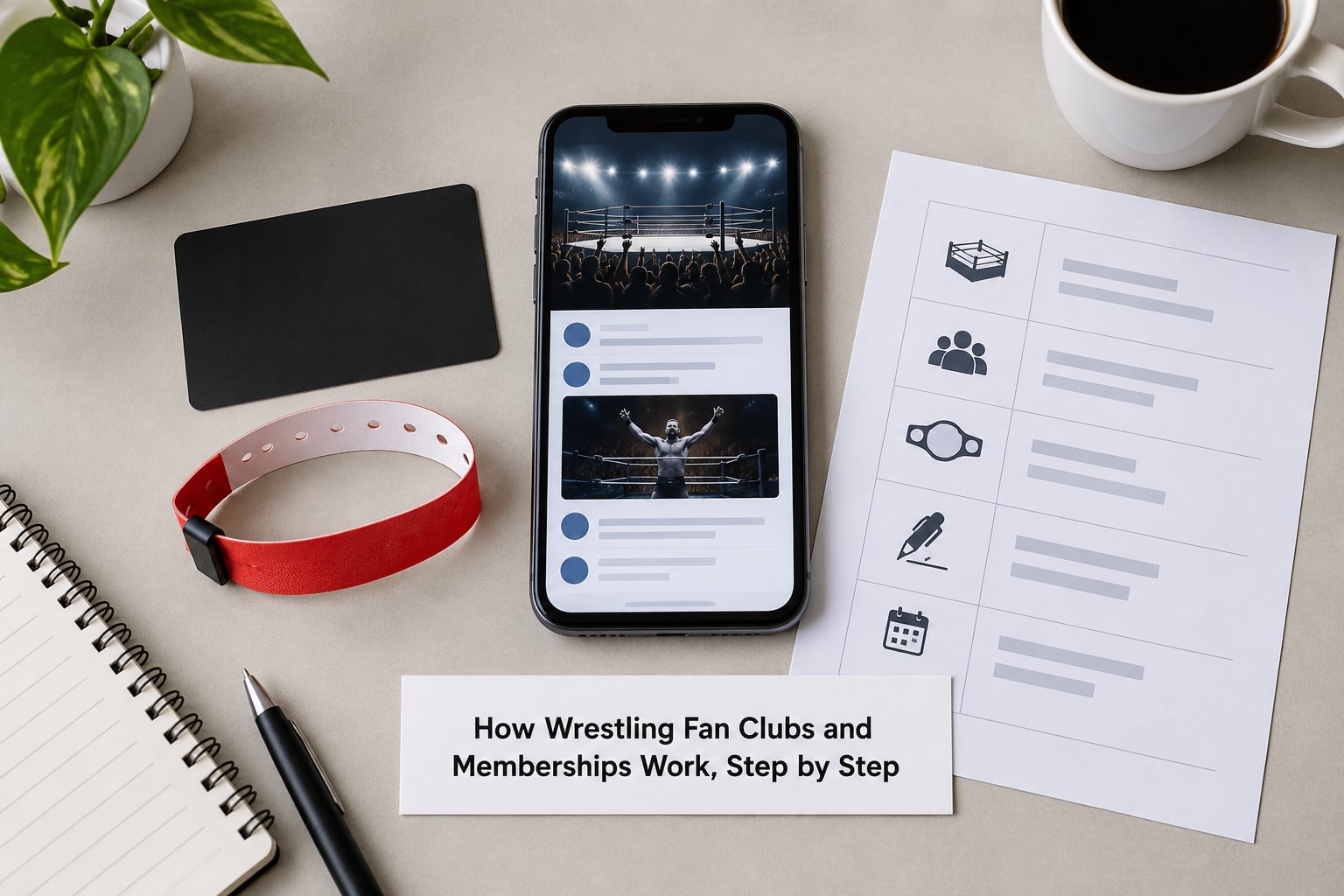
You pay an annual fee on the promotion’s website or through a membership platform, receive a member ID or a linked account, and then redeem it. Presale codes land in your inbox before tickets go on public sale, member merchandise arrives at your address, and staff check your membership at the door. Anything gated, like archived content or a private chat server, unlocks while your subscription is active and locks again when you cancel.
That is the whole loop. Money in, benefits out, benefits tied to an account rather than to you personally.
Most programmes work through one of three arrangements, and knowing which one you are in tells you exactly what to expect:
- Promotion-run clubs — the promotion itself operates the membership and sells it on its own site. Club WWE and AEW Heels are the current examples. Tiers, presales and member kits come directly from the company putting on the shows.
- Platform-run clubs — an outside company builds and hosts the membership. AEW Heels, for example, has been built on a vendor platform that handles accounts, payments and the member area.
- Media and community memberships — a wrestling news site or a creator sells membership through a crowdfunding platform like Patreon. Fightful Select is the well-known one, with tiered access to posts, podcasts, Q&As and an ad-free site.
There is a fourth, looser category: fan-run supporter groups. Nobody sells you anything, nobody takes your money, and there is no membership card. Some are large and organised, others are a group chat that happens to share the same interest.
What Is a Wrestling Fan Club?
A wrestling fan club is a membership programme that gives fans member-only benefits in exchange for a recurring fee. The benefits are usually early access to tickets, merchandise made for members only, some form of meet-and-greet or autograph opportunity, and access to content or community spaces that the public does not get.
The term gets stretched, so it helps to know the pieces.
Fan club — the programme itself, usually with a membership card, ID number or linked account.
Membership tier — a level of the programme with its own price and its own list of benefits. Cheaper tiers tend to be digital. Pricier tiers add physical items and in-person access.
Presale window — a block of time, often 24 to 72 hours, when members can buy tickets before the public sale opens.
Member-only content — posts, videos, podcasts, archives or chat channels that only paying subscribers can open.
Auto-renewal — the setting that quietly charges you again next year unless you turn it off. Read about that further down.
Fan clubs are not the same as wrestling training clubs
Search results for this topic are polluted with pages about youth programs, club charters and athlete development through USA Wrestling. Those organisations are for parents, coaches and young athletes who train and compete. They have insurance, registration fees and coaching staff.
A fan club has none of that. There is no membership fee paid to a sanctioning body, no eligibility test, no training schedule. You are a customer, not a club member in the sporting sense.
What Do Wrestling Memberships Usually Include?
Every programme sells a slightly different mix, but the benefits fall into a handful of repeatable categories.
Ticket presales
The headline benefit for most people. Members get to buy into an event before the general sale, which matters most for shows that sell out. Club WWE has advertised a 24-hour head start on WWE events, and AEW has run similar windows for its own shows. A presale does not promise a cheaper ticket or better seats. It promises the chance to buy at all.
Member merchandise and kits
Physical items produced for members: a card, a lanyard, a shirt, a poster, a yearly gift box. Some tiers get one item, some get several. Team NJPW members describe receiving a membership card and magazines along with access to autograph sessions and photo ops before shows.
Check-in and member areas
Being a member changes what happens at the door. Staff scan your membership or check your name against a list, and you may get a member queue, a separate entrance, or an assigned area for autograph lines. NJPW fan club members have described showing their card on the way into events in Japan, with perks handled before doors opened.
Meet-and-greets, autographs and photo ops
Structured chances to meet wrestlers, often attached to a specific show and sometimes to a tier. Club WWE has advertised tailored perks at superstar meet-and-greets along with hospitality opportunities. Treat these as a real category of benefit, but check the fine print on how many you get and whether attendance is required.
Community access
A members-only chat server, forum, Discord channel or group. This is where members talk about bookings, trades tickets and argue about results. For some fans it is the main draw; for others it is worth nothing.
Member-only content
Media memberships sell access rather than access to events: exclusive interviews, members-only podcasts, Q&A shows with wrestlers or journalists, post archives, early access to news, and an ad-free reading experience.
Surveys, voting and small extras
Occasionally members get polled on name changes, theme music or event ideas, receive a digital voucher for merchandise, or enter a sweepstakes. These vary year to year and rarely justify a fee on their own.
Are Wrestling Fan Clubs Official?
Some are run by the promotion. Others are run by an independent organiser, a media company, or a group of fans with no connection to the wrestlers at all. Only the first is “official” in the sense people usually mean.
Four checks settle it quickly.
- Go to the promotion’s own site, not a link someone sent you. Type the address yourself. If the membership page is not reachable from the main navigation, be careful.
- Look for the club on the promotion’s verified social accounts. Official clubs are announced by the promotion, not only by an account with a similar name.
- Check who receives the money. Payment goes to the company, or to a named membership platform operating for them. It should never go to an individual fan’s personal account.
- Read the terms page. A real programme states what you get, how long the term runs, and what happens on cancellation. An impersonator avoids all three.
One useful clue is how benefits are described. Official promotions are usually specific and slightly cautious, with conditions attached. Fake clubs promise the moon, then ask you to pay through a link that only works once.
How Do You Join a Wrestling Fan Club?
It takes about ten minutes if the programme is straightforward. The steps below cover the general case.
- Find the official membership page by navigating from the promotion’s or media site’s homepage rather than from a search ad.
- Read the terms before you pay. Check the length of the term, whether it auto-renews, what happens to digital benefits when you cancel, and what shipping is covered for physical items.
- Create or link an account. Most programmes attach the membership to an existing account so presale codes, content access and your member ID stay in one place.
- Pay. Use a card or a payment method your bank can reverse if something goes wrong. A reputable programme will not ask for gift cards, wire transfers or cryptocurrency.
- Claim your member ID. Some programmes issue a number you show at shows; others just look up your name. Note where to find it.
- Activate the benefits. Opt in to the member mailing list, join the community space, add your presale codes to your email filter, and check whether merch delivery needs a separate shipping confirmation.
How the different wrestling memberships work side by side
A promotion club and a media membership are not substitutes. The promotion club is about physical access: presales, kits, autographs, check-in. The media membership is about information: posts, podcasts, archives, ad-free reading. Plenty of fans hold one of each and never regret it; others pay for two and use neither.
Plenty of fans also hold memberships with more than one promotion. There is no rule against it, and no organisation has a claim on your loyalty. What there is, according to recurring arguments on wrestling forums, is a running debate about whether a promotion owes its paying members anything at all when shows sell out. The bluntest version of that argument shows up repeatedly on r/SquaredCircle.
What Do Wrestling Memberships Cost?
Fees vary by promotion, by tier and by year, and they change often, so treat any figure you find as a snapshot and confirm it on the programme’s own page. What does not change is the structure: some clubs are free, most are annual, and a few let you pay in monthly instalments instead of one lump sum.
WWE fan forums were full of this exact arithmetic when Club WWE launched in 2025. Fans took the annual price, divided it by twelve, and worked out the monthly equivalent to judge the fee. The annual figure looked a lot more reasonable that way, and that framing is the one most programmes push.
Here is how the main models compare, with the structure rather than the numbers:
| Membership model | Cost pattern | What the fee mainly buys | Best for |
|---|---|---|---|
| Free supporter club or newsletter | Free, usually an email sign-up | News, match results, announcement emails, sometimes a community chat | Fans who watch and rarely travel |
| Promotion fan club, standard tier | Annual fee, often payable monthly | Ticket presales, member ID, club communications, entry to the community space | Fans who attend a handful of live shows |
| Promotion fan club, premium tier | Higher annual fee | Adds physical merchandise, meet-and-greets, hospitality or photo opportunities | Fans who want souvenirs and in-person access |
| Shirt or gift club | Recurring monthly cost per item | A themed item each month, billed repeatedly | Collectors, or anyone who wants the gear regardless of other benefits |
| Media site membership | Monthly, tiered, often with a lower and a higher level | Members-only posts, podcast archives, Q&As, ad-free reading, chat access | Fans who follow wrestling news closely and mostly watch on screen |
Where the extra charges come from
A headline annual fee is rarely the whole cost. Look for these before you commit:
- Shipping and handling. Physical member items are usually covered for domestic orders and frequently not covered internationally. Fans travelling to shows have run into this more than anyone.
- International fees. Some programmes add a handling charge or restrict delivery addresses for member merchandise.
- Auto-renewal. The default is usually on. A membership quietly renews next year unless you cancel in advance, and people report realising this weeks after the charge hit.
- Tier upgrades. Moving from a digital tier to a physical one mid-term often means paying the difference, sometimes plus shipping.
- Platform convenience fees. Third-party membership platforms may add a small processing charge at checkout, depending on your payment method and country.
Working out whether it is worth it for you
Count your own live events first, because that number decides most of it. Attend four or more shows a year and a presale benefit alone can justify the fee. Attend one show a year and the maths rarely works, no matter how good the kit looks.
Then check what you would genuinely use. Skip the tier with physical items if you will not display them. Skip the meet-and-greets if you would not queue for one. Members in wrestling forums are blunt about this: the fee hurts more when you are paying for a benefit you never redeemed.
A fair test: multiply the annual fee by the number of events you attended last year, then ask whether the tickets, travel, food and merch you already bought came to more. Most fans already know their answer.
Can a Fan Club Get Tickets or Meet Wrestlers?
No membership guarantees tickets or a meeting with a wrestler. What they do is improve your odds, and understanding the difference stops a lot of disappointment.
Ticket access in practice
A presale means a window before the public sale. If your local show sells out in the first hour, that window is the whole value. If it sells out in three days, the presale matters less. Some promotions also run lotteries or code allocations for members rather than a straight presale, which changes your odds very little.
There is a second effect members rarely enjoy talking about. A presale makes tickets scarce before the public sale, which feeds the resale market. If a show would have sold out anyway, the presale can make life harder for fans who were planning to buy at full price later. That trade-off is exactly what wrestling communities argue about online.
Meeting wrestlers
Autograph sessions, photo ops and meet-and-greets are the perks members care about most, and also the ones with the most conditions. Watch for these:
- Attendance requirements. Many are tied to specific shows, so you need a ticket for that event.
- Tier limits. Premium tiers may get a signed item or a photo; lower tiers may get nothing on that particular date.
- Queue position. A separate member line helps, but it does not put you at the front of a long list.
- Booking changes. Wrestlers get pulled, travel is delayed, sessions get cut. Every programme’s terms recognise this and none can prevent it.
Members in the NJPW fan club community describe exactly this arrangement working in practice: you show your card before the event, you get the session or photo op, and staff handle the process in an orderly way. That is the redemption step people find least clear before they join, and it is usually simpler than they expect.
What Is the Difference Between a Fan Club and a Newsletter?
A newsletter tells you what is happening. A membership sells you something the public does not get. They overlap more than fans expect, because most free fan clubs are newsletters with a different name.
| Format | Typical cost | Interaction | Typical benefit |
|---|---|---|---|
| Newsletter | Free or a small email subscription | One-way, occasionally replies | Announcements, results, presale news |
| Social group or chat | Free, joined through an invitation | Constant, member driven | Discussion, ticket trades, advice |
| Free supporter club | Free with an email sign-up | Light, mostly announcements | Early news, occasional member offers |
| Paid membership | Recurring fee, annual or monthly | Members-only space plus a defined benefit list | Presales, merchandise, content, in-person access |
The practical distinction is whether there is a defined benefit list attached to your payment. If you cannot find a page listing what members receive, you are in a newsletter.
One more category worth naming. A monthly shirt club is not a membership at all: you pay for a recurring physical item and get no presale, no ID and no community access. Wrestling fans on Facebook treat it as a separate purchase from a paid insider club, and it is worth keeping the two apart in your budget.
How Can You Tell If a Wrestling Membership Is Legitimate?
Impersonation of wrestling promotions is common because the audience is loyal and the brand names are widely known. A fake page can look convincing right up until you enter card details. Here is what separates the real thing.
Five things real memberships do
- They are reachable from the official site. The promotion’s own navigation links to the membership page. Nothing else matters as much as this.
- They state a clear benefit list and clear terms. Tier names, term length, renewal rules, cancellation process, shipping coverage. Vagueness is the warning sign.
- They use a normal checkout. A real promotion’s payment page is encrypted, on the company’s domain or a named platform, and offers a payment method your bank can reverse.
- They use real, established contact details. A business address, a support email that has existed for a while, terms and privacy pages.
- They make realistic promises. Official language is careful, sometimes hedged, and full of conditions. Claims of guaranteed tickets or guaranteed autographs with no fine print are a bad sign.
Four things that mean stop
- Payment by gift card, wire transfer or cryptocurrency. No legitimate membership takes those.
- A request to pay a friend or a fan who offers to “help you sign up.” Money moving between individuals is the oldest scam in the sport.
- A countdown or a discount that resets when you reload. Manufactured urgency.
- An official account unverified, or an email arriving from an address that is not the promotion’s domain. Check the actual domain before you trust the sender name.
If something feels off, the simplest test is to close the tab and navigate to the promotion’s homepage by typing the address yourself. If the membership is real, you will reach it without any of this.
Frequently Asked Questions
What is the difference between a wrestling fan club and a paid membership?
A fan club is the group or community itself. A paid membership is what you buy for access to benefits inside it. In practice most official wrestling fan clubs are paid memberships, while a free supporter club is usually a newsletter and an email list. If a page has no written list of member benefits, you are looking at a mailing list, not a membership.
Are official wrestling fan clubs worth the membership fee?
They are worth it if you attend several live events a year and value presale access, or you genuinely use the merchandise and community access. For fans who attend one or two shows, the fee rarely pays for itself. Count your events from last year, check which perks you would actually redeem, and pick the lowest tier that covers them.
How can I tell whether a wrestling fan club is legitimate?
Reach the membership page by typing the promotion’s web address yourself rather than following a link. A real club has a written benefit list, terms and a renewal policy, takes normal card payments on a secure checkout, and lists real contact details. Any request for gift cards, crypto or payment to another fan is a scam.
Does a fan membership guarantee tickets or wrestler meet-and-greets?
No. A membership gives you an earlier purchasing window, not guaranteed admission, and meet-and-greets usually carry conditions such as attending that specific show, holding a certain tier, or joining a member queue. Bookings change and wrestlers get pulled. Read the benefit terms for each event rather than relying on the launch announcement.
Can I cancel a paid wrestling membership and get a refund?
You can usually cancel at any time from the account page where you joined, and cancelling stops the next renewal. A refund for the current term is a separate question and most programmes decide case by case within a short window. Keep your cancellation confirmation, and check first whether physical merchandise already sent to you affects the decision.
Start by counting the live events you attended last year, then pick the cheapest format that covers them: a free newsletter if you watched from home, a standard promotion tier if presales matter to you, and a media membership only if you read wrestling coverage daily. Whatever you choose, find the terms page before you pay and turn off auto-renewal if you do not want it quietly charging you again.