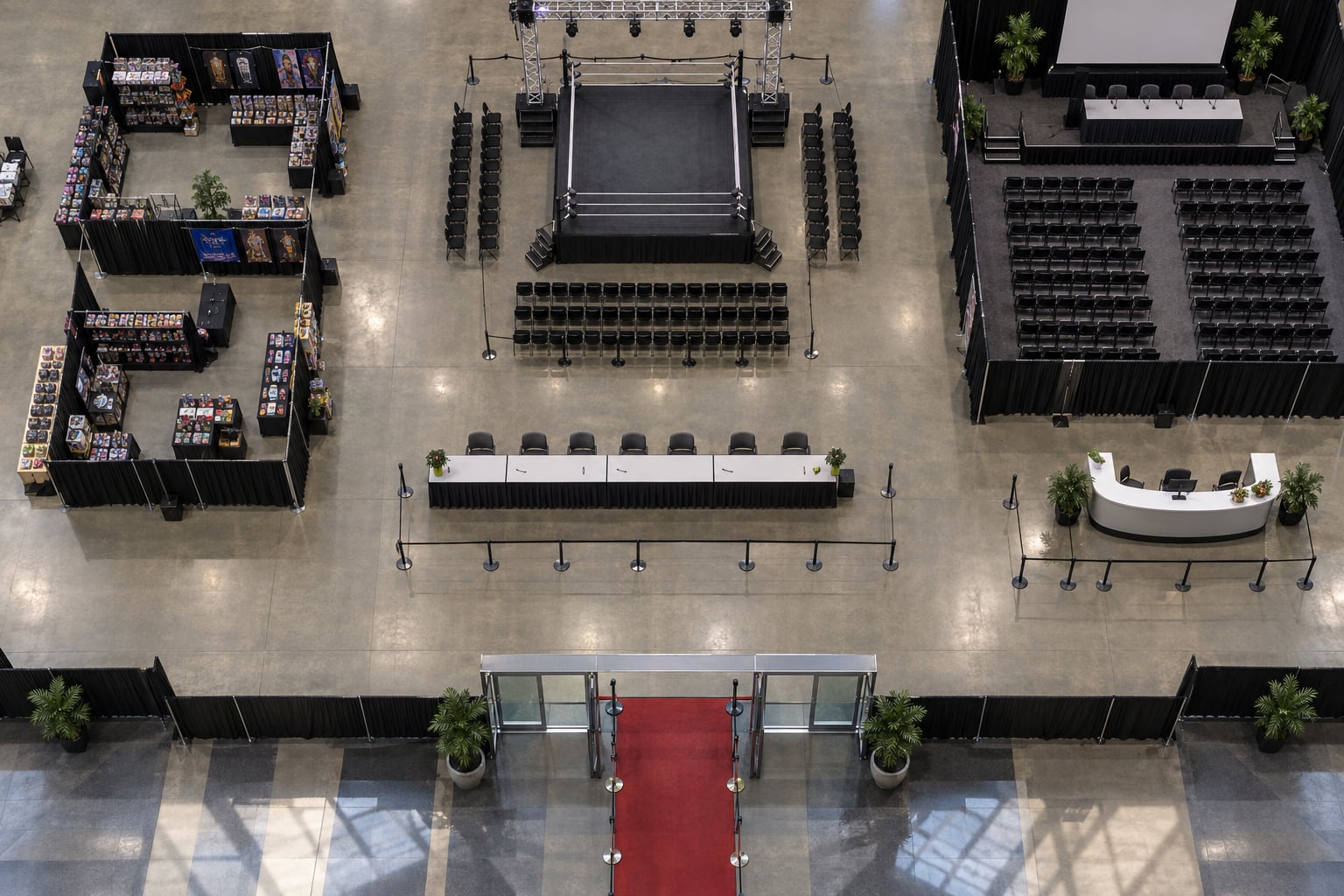
Wrestling conventions are run by a promoter who books roughly ten to fifteen wrestlers, rents a hotel ballroom or convention hall, and splits the floor into a dealer and merchandise area, a row of autograph tables, panel rooms, and a main auditorium for live matches and Q&As. Once you understand how wrestling conventions are organized, you can plan your day instead of wandering the floor wondering where to stand.
The whole thing runs on a printed schedule and a floor plan. Everything else — the queues, the tickets, the wristbands — hangs off those two documents.
Table of Contents
- How Wrestling Conventions Are Organized at a Glance
- Who Organizes a Wrestling Convention?
- How the Convention Is Put Together Before Doors Open
- How the Venue Is Divided into Convention Zones
- How the Convention Schedule Works
- How Wrestling Conventions Are Organized by Time
- How Talent Appearances and Meet-and-Greets Are Managed
- How Registration, Credentials, and Admission Work
- How Booths, Merchandise, and Sponsor Areas Are Arranged
- How Staff, Security, and Crowd Safety Are Coordinated
- What Changes During the Convention Day
- Frequently Asked Questions
- Are wrestling conventions usually organized like comic conventions?
- How early should I arrive at a wrestling convention?
- Can I meet wrestlers at every wrestling convention?
- Do wrestling conventions have a map or assigned seating?
- Can I leave and re-enter a wrestling convention?
- Are children allowed at wrestling conventions?
- Conclusion: What to Check First
How Wrestling Conventions Are Organized at a Glance
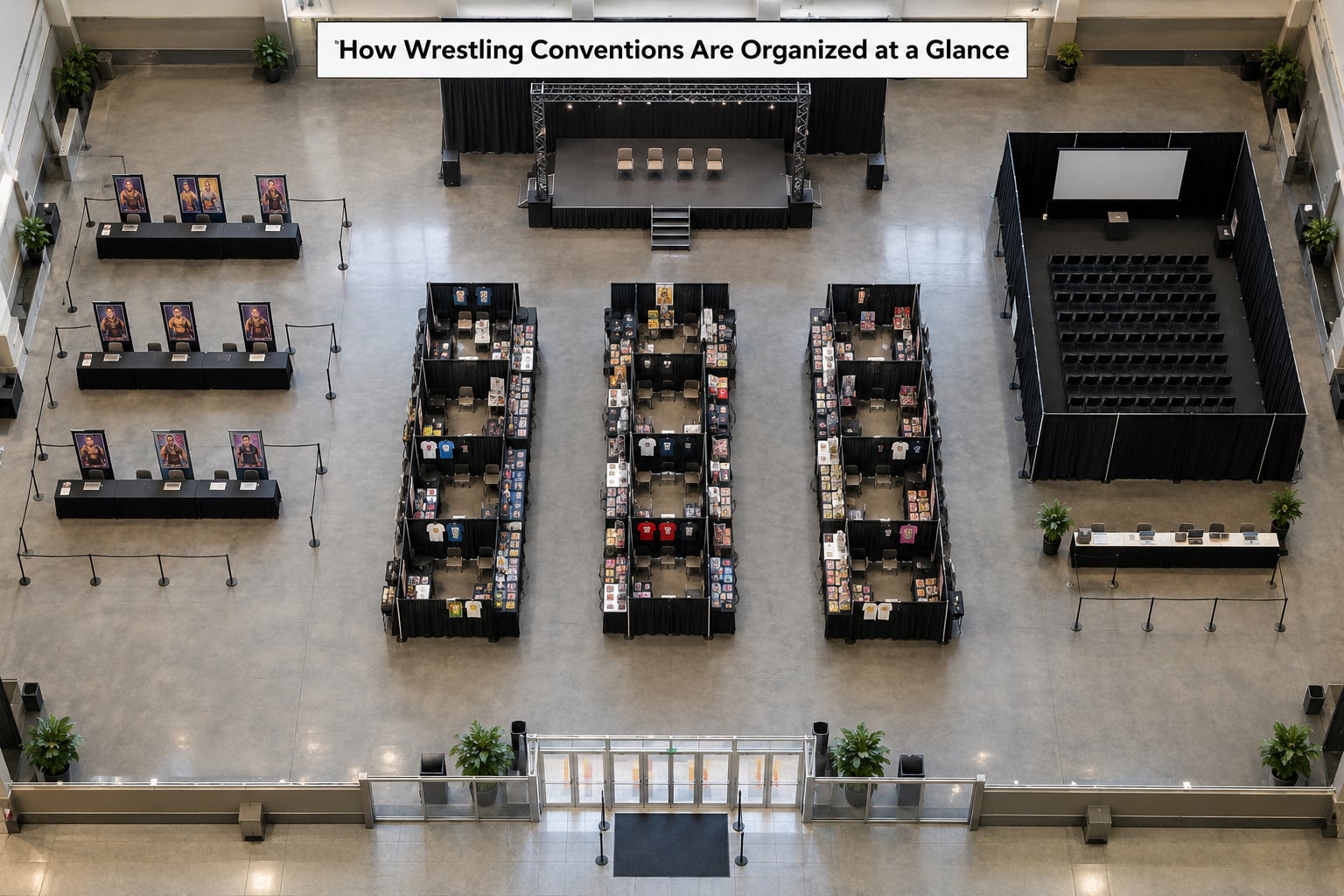
Nearly every wrestling convention, large or small, is built from the same set of zones. If you know what each one is for, you can walk in and orient yourself in about a minute.
| Zone | What is in it | What you do there |
|---|---|---|
| Entrance and registration | Badge pickup desk, will-call, floor plan handouts | Collect your badge, get the map, ask about the day |
| Autograph area | A row of numbered tables with seated wrestlers and staff | Queue for a signing, buy a photo at the table |
| Dealer and vendor floor | Tables selling wrestling memorabilia, books, cards, apparel | Buy, browse, hunt for vintage items |
| Merchandise booths | Official wrestler and promotion merchandise | Buy shirts, figures, replicas |
| Panel rooms | Seated stage with microphones and an audience mic | Listen to a Q&A, ask a question |
| Main auditorium | Ring or raised stage, seating, a video screen | Watch live wrestling segments |
| Photo op area | Backdrop, lighting, sometimes a themed set | Pay for a posed photo with a wrestler |
| Press and backstage | Restricted rooms, green room, staff only | Nothing, unless you have a press credential |
The zoning exists for a practical reason. Signings pull long lines, and those lines block the walkways if they are not contained, so the autograph area gets its own space away from the dealer floor.
Who Organizes a Wrestling Convention?
One company owns the event and makes the calls that matter. Around that company sits a set of partners who each own a piece of the weekend.
- The promoter books the talent, signs the venue contract, sets ticket prices and tiers, and pays everyone at the end.
- Event producers and the show runner write the schedule, decide table assignments, and run the day-of timing.
- Venue and hotel staff handle the ballroom, the loading dock, house power, tables, chairs, and janitorial between days.
- Talent representatives and agents negotiate appearance fees, travel, hotel rooms, and what gets sold at each table.
- Table staff and volunteers run each signing: taking money, selling photos, passing items, and keeping the line moving.
- Security manage queues, wristband checks, and any disagreement about tickets or autographs.
- Vendors and sponsors pay for booth space and often supply signage, giveaways, or stage branding in return.
- Outside partners — the hotel, the convention hall, local shops, and fan associations — fill gaps the promoter does not run directly.
How the Convention Is Put Together Before Doors Open
The promoter starts months out, and the order of operations matters more than people expect.
- Book the venue. A hotel ballroom for a weekend is the standard choice because it puts the convention, the restaurants, and the room block under one roof.
- Book the roster. Ten to fifteen wrestlers is the commonly recommended range for a show that runs well, because each one needs a table, staff, and a time block.
- Sign a hotel room block. Talent and often staff get a contracted rate, and the promoter collects a per-room fee from the hotel.
- Draw the floor plan. Table rows, booth sizes, panel rooms, and aisles get assigned on a grid before anyone arrives with a van full of tables.
- Publish the schedule. Each wrestler gets a table number and a time block, and the promoter publishes a printed grid so fans can plan.
- Recruit staff and vendors. Volunteers and paid table staff get placed, and booth space is sold to dealers and sponsors.
- Load in and inspect. On the day before, equipment goes in, the ring or stage is built, cable runs are covered, and exits are checked.
If a wrestler does not get picked up from the airport on schedule, the whole block slips. That single failure cascades into late table starts, which is why transport is treated as part of the booking, not an afterthought.
How the Venue Is Divided into Convention Zones
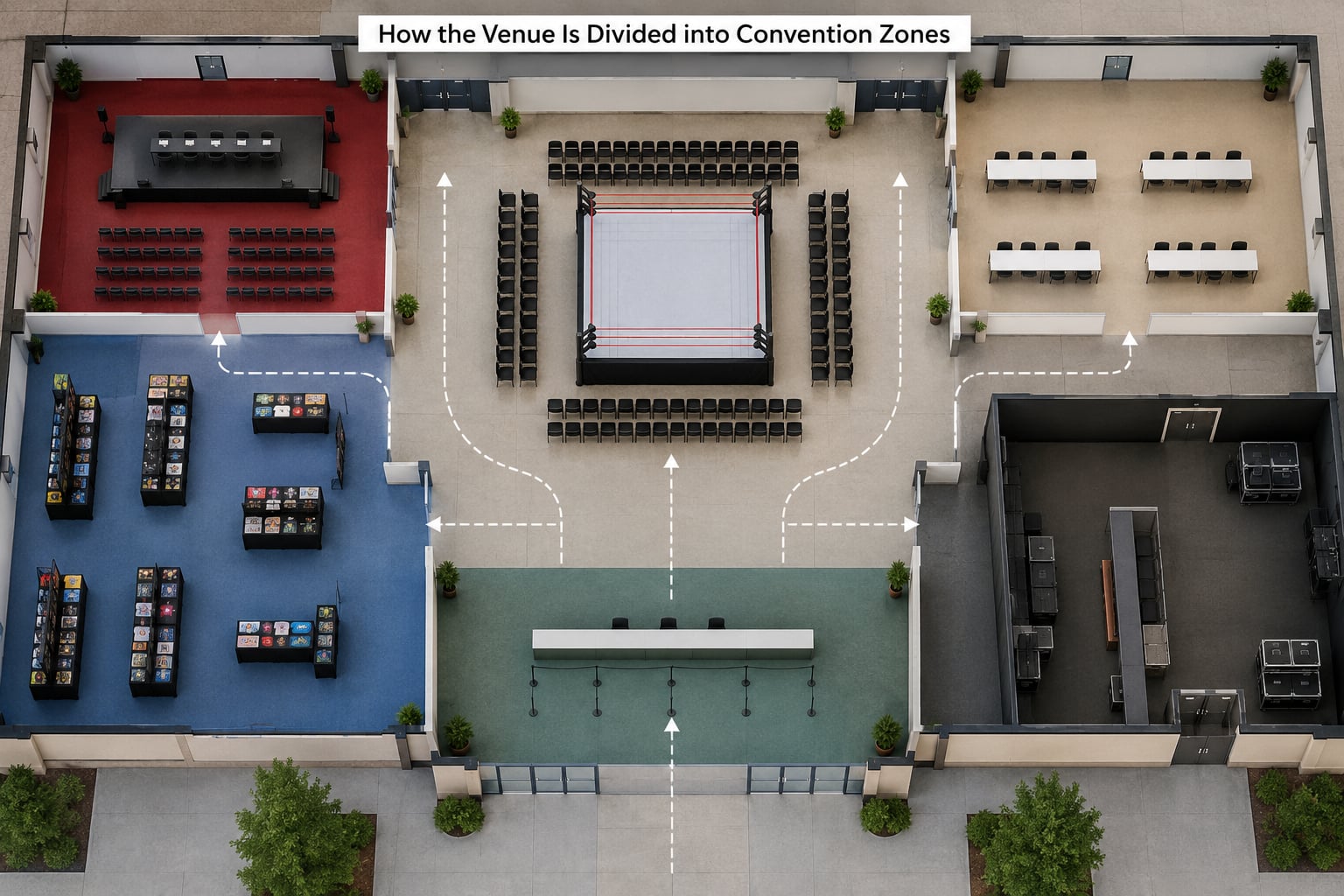
Zoning starts at registration. Everything else branches from the entrance so the busiest flows — the signing queues — never cross the main walkway.
Entrance and registration sits at one end of the hall, usually near the loading dock so staff can handle badge sales and deliveries without crossing guest traffic. Handouts here usually include a printed floor plan with table numbers, which is the single most useful thing you can pick up.
The autograph area is a row of tables with deliberate gaps between them. Industry convention advice is firm on that spacing: tables need room for the line to form, for staff to walk behind, and for two or more people per table, one working the camera and one handling money.
Panels and Q&A rooms are usually side rooms or the back of the hall, away from the noise. They have a small stage, microphones, a projected screen, and a roped or miked audience area.
The main auditorium is the largest single space, with the ring or stage at one end and seating for everyone holding a ticket. Some promoters guarantee a seat there regardless of tier, which is the clearest example of a published policy fans trust.
Vendor and merchandise areas fill the perimeter. Official merchandise tends to sit closer to the entrance for impulse traffic, while dealers cluster where collectors can browse without blocking anyone.
Backstage and green room are credentialed only. Talent rest there between blocks, merchandise is pre-packed in some VIP packages, and unauthorized entry is a genuine problem for promoters.
Reading a printed floor plan is simple. Find the autograph block, note the table numbers you care about, then trace the shortest path from the entrance to those tables so you are not walking the full hall three times a day.
How the Convention Schedule Works
Schedules are built around signing blocks, not individual appointments. A wrestler is booked for a table slot at a set time, and the promoter publishes that grid in advance.
Panels, meet-and-greets, photo ops, and live matches are slotted around those fixed signing blocks, which is why a running late panel rarely delays autographs but a delayed wrestler does.
When two events interest you, pick the one with no second chance. An autograph block does not repeat. A panel may be re-scheduled or may be joined by the promoter at another point in the weekend.
| Time | Typical activity |
|---|---|
| Day before, setup | Vendors load in, tables placed, signage installed, staff briefing |
| Doors open | Registration and badge pickup, early VIP entry on some shows |
| First signing block | Popular tables open, longest queues form first |
| Midday | Panels and photo ops run alongside the second signing block |
| Afternoon | Live wrestling segments in the main auditorium |
| Final block and teardown | Last signings, packing, ballroom reset for the next day |
How Wrestling Conventions Are Organized by Time
A three-day weekend is the most common shape. Friday and Saturday are the heavy attendance days, Sunday is lighter, and dealers often arrive a day ahead to set up.
Each show day runs roughly from late morning into the evening with breaks for teardown and re-setup. Longer events stretch across more days, but the pattern holds.
How Talent Appearances and Meet-and-Greets Are Managed
Appearances are contracted in advance, and each booking sets out exactly what the wrestler does and for how long.
- Table appearances are autograph blocks with a posted table number and a fixed end time.
- Autograph sessions are often limited to a set number per ticket, one item per person, so the line keeps moving.
- Photo opportunities are sold at the table, usually a printed photo handed to you on the spot.
- Fan interactions include short conversations or meet-and-greets, which are limited by the schedule and usually by a separate ticket.
- Live segments put the wrestler in the ring in front of the auditorium crowd.
Access gets restricted for a reason. A signing is a fixed-length block against a contract; when a wrestler signs far past the posted time, everyone behind them in the queue loses time they were promised, and staff will step in to close the line.
That closure is the single most common source of frustration at these events. Two hours is a realistic wait for a popular guest, and it is worth deciding in advance which names are worth it.
How Registration, Credentials, and Admission Work
Admission is rarely one flat ticket. Most conventions sell a weekend pass plus day passes, then layer priority tiers on top.
- Advance tickets are sold online ahead of the event and usually cost less than buying at the door.
- On-site registration handles walk-ups, will-call pickups, and badge replacement.
- Wristbands and badges control re-entry and identify ticket tier, and losing yours can mean trouble getting back in.
- Priority credentials like VIP or platinum packages usually bundle an item signed in advance, a photo op, and early entry.
- Dealer bundles combine booth space with admission for staff and sometimes a guaranteed main-event seat.
One distinction trips people up. Guaranteed admission to the main auditorium is not the same as a guaranteed autograph. A seat in the room and a signature at a table are sold and scheduled separately, so read what your tier actually includes.
Age and identification rules follow the venue and the promotion. Some halls restrict floor access to a minimum age, and alcohol service usually requires an ID check.
How Booths, Merchandise, and Sponsor Areas Are Arranged
Booth space is sold before the event, and the promoter decides placement by category rather than by who shouts loudest.
- Independent dealers sell collectibles, vintage magazines, cards, and memorabilia. They get the biggest share of the floor.
- Official merchandise from wrestlers and promotions sits near the entrance, where it converts well.
- Publishers and book sellers often get a shared table and take payment for the whole row.
- Apparel brands sometimes run a booth plus a sponsored area, and their branding appears on signage and the stage.
- Community and charity groups get low-cost or free space, often in exchange for visibility.
At a signing table, the merch a wrestler is selling is usually packed in advance and carried out in boxes. VIP packages sometimes contain items signed the night before, which is why that package exists at all.
How Staff, Security, and Crowd Safety Are Coordinated
Crowd control is the part of a convention nobody sees until it fails. A promoter running a show properly staffs it in layers.
- Entrance and exit points are staffed to count bodies and check tickets or wristbands.
- Queue staff hold the autograph lines, cut people leaving and rejoining, and enforce one item per person.
- Table staff work the money and the photos, which is why two people per table is the standard recommendation.
- Security handles disputes, refuses entry to credentialed areas, and responds to medical calls.
- Medical staff are on site or on call for the length of public hours.
- Volunteers run information desks, hand out maps, and escort attendees who lose a child.
Accessibility is handled at the venue level: accessible parking and entrances, seating in the auditorium, and usually a viewing area near the signing tables. Ask the promoter ahead of the show if you need a specific accommodation.
For lost children and lost property, every large convention has a stated procedure, typically a help desk at registration. Tell your kids what it looks like before you go.
What Changes During the Convention Day
A live floor is never the floor plan. Schedules shift, lines form where you did not expect, and rooms fill up.
Early access often belongs to higher tiers, so the first hour of a signing block can look calm and turn into a solid line within minutes.
Breaks between blocks are the main reason signing tables appear to sit idle. That is the hotel ballroom being reset, not a cancellation.
Operational changes get announced three ways: on the printed schedule posted at registration, on any PA announcement, and on the promoter’s own social accounts. If a wrestler is running late, the table staff and the PA usually say so first.
Teardown at the end of the final day is fast. Collect purchased items, confirm nothing is left at your table, and check the lost and found before you leave the building.
Frequently Asked Questions
Are wrestling conventions usually organized like comic conventions?
Mostly. Both use a badge, a zoned exhibit floor, dealer tables, a printed schedule, and signing blocks with table numbers. The differences are the audience and the density. Wrestling conventions book a smaller roster, so signings dominate the day, and they usually add a main auditorium with live in-ring segments that a comic convention rarely has.
How early should I arrive at a wrestling convention?
Arrive at least an hour before your first signing block. Popular guests draw queues reported at two hours, and those lines fill from the front. If your ticket tier includes early entry, use it. Pick your three target names, find their table numbers on the floor plan, and queue for one before you browse the dealer floor.
Can I meet wrestlers at every wrestling convention?
No. Appearances are booked individually, and a promoter only commits to wrestlers it has a contract with for that specific date. Smaller regional shows may book a handful of local talent and nothing else. Always check the published roster and schedule before travelling, since a promoted name can still be replaced late.
Do wrestling conventions have a map or assigned seating?
A printed floor plan is standard, usually handed out at registration, and it is worth picking up and studying. Most shows use general admission rather than reserved seats for the signing floor. The main auditorium may be seated by arrival order, so arriving early for the live segments matters more than it does for autographs.
Can I leave and re-enter a wrestling convention?
Often yes, but it depends on the promoter’s wristband and badge policy. Most hand out a wristband at entry that controls re-entry for the weekend. Some shows are single-entry per day. Check the ticket page before you go and keep the wristband on your wrist rather than in a pocket or a bag.
Are children allowed at wrestling conventions?
Most conventions welcome families, and the dealer floor and panels are easy to attend with kids. A few restrictions apply, commonly a minimum age on the signing floor or in the main event seating, depending on the promoter and venue. Bring ear protection for a live match, plan a quiet break, and agree on a meeting point at the help desk.
Conclusion: What to Check First
Understanding how wrestling conventions are organized comes down to four checks. Read the official schedule before you leave home, confirm what your ticket tier includes, study the floor plan the moment you pick up your badge, and arrive early for the names you cannot get later.
Bring a permanent marker, a protective sleeve for anything you want signed, and realistic expectations about the queue. That preparation does more for your weekend than anything else.