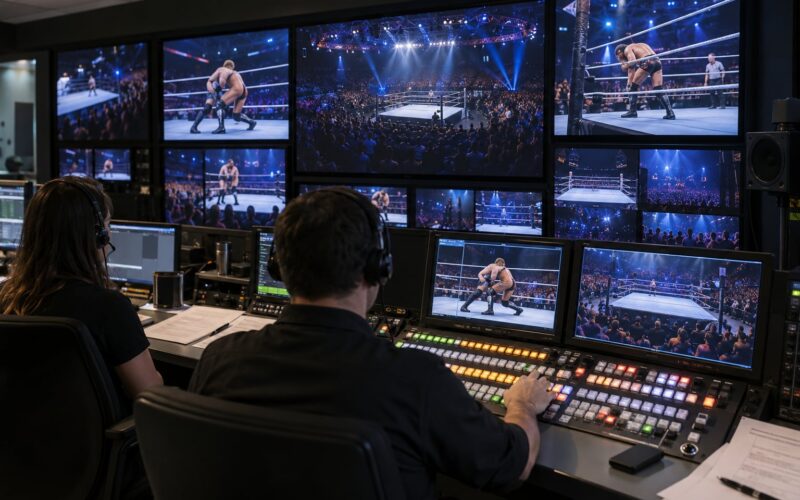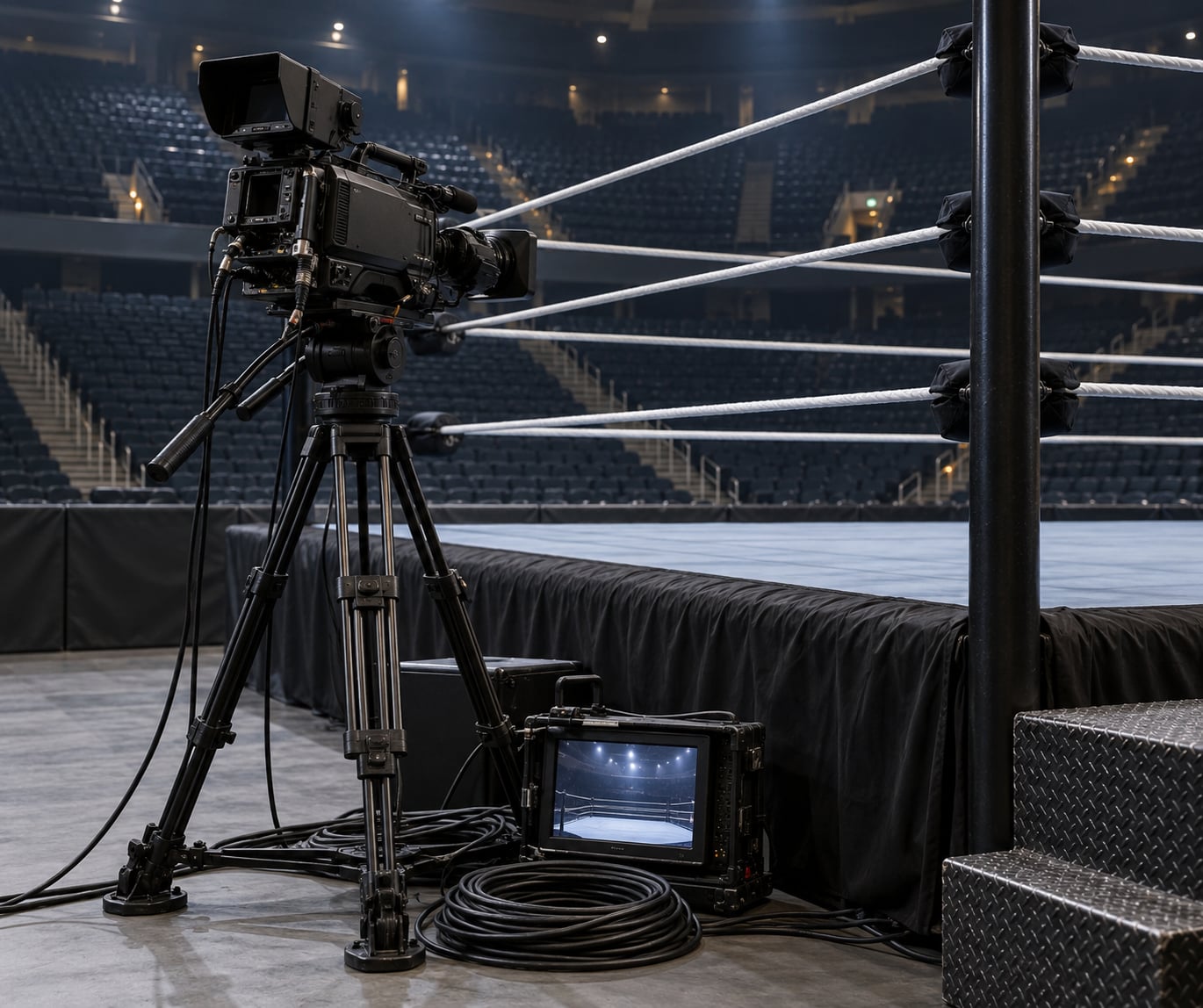
Here is the short version: a wrestling camera crew shoots a match with one locked-off hard camera holding a continuous wide shot of the whole ring, two to four ringside operators working long lenses for close angles, an overhead rig and a roving steadicam unit, while a producer in the production truck calls each camera by number over a headset and decides what airs. Nobody edits the match afterwards. The live switching is the edit.
That single fact explains almost everything wrestling fans complain about on television. When a match feels choppy, you are not watching bad editing, you are watching a live switcher reacting in about a second. When a botched spot seems to vanish, you are watching a producer do exactly what viewers suspect.
The rest of this guide breaks down the positions, the shot types, the headset language and the timing rules. It is written for anyone who has wondered why the same camera angle shows up for every match, or who wants to shoot wrestling at a small show and has no idea where to stand.
Table of Contents
- How a Wrestling Camera Crew Shoots a Match
- What Does a Wrestling Camera Crew Do During a Match?
- The roles inside a wrestling broadcast
- Where the cameras actually sit
- Which Camera Shots Are Used in Wrestling?
- The hard camera wide shot
- Low ringside angles
- Close-ups and reactions
- Crowd and ring-side cutaways
- Entrance and ramp coverage
- Overhead and under-ring shots
- How Do Camera Operators Follow Wrestlers?
- Framing rules keep the shot usable
- Zoom is used sparingly, then all at once
- Focus is the hard part in low light
- Position is limited by the space
- Climbs and off-rope spots get a dedicated camera
- How Does the Crew Coordinate the Live Broadcast?
- How the calls are made
- Working with the commentary
- Live versus live to tape
- How the styles differ by promotion
- What the crew does when something goes wrong
- What the camera does to the wrestlers
- Why Are Replays and Alternate Angles Important?
- What Happens Before and After the Match?
- Frequently Asked Questions
- What is the hard camera in wrestling?
- How many cameras are used to film a televised wrestling match?
- Who chooses which camera angle you see during a match?
- Why does the camera cut to the crowd so often?
- Is a wrestling show filmed live or live to tape?
- How do camera operators keep up with the action in the ring?
- Conclusion: Watch the Match Like a Camera Operator
How a Wrestling Camera Crew Shoots a Match
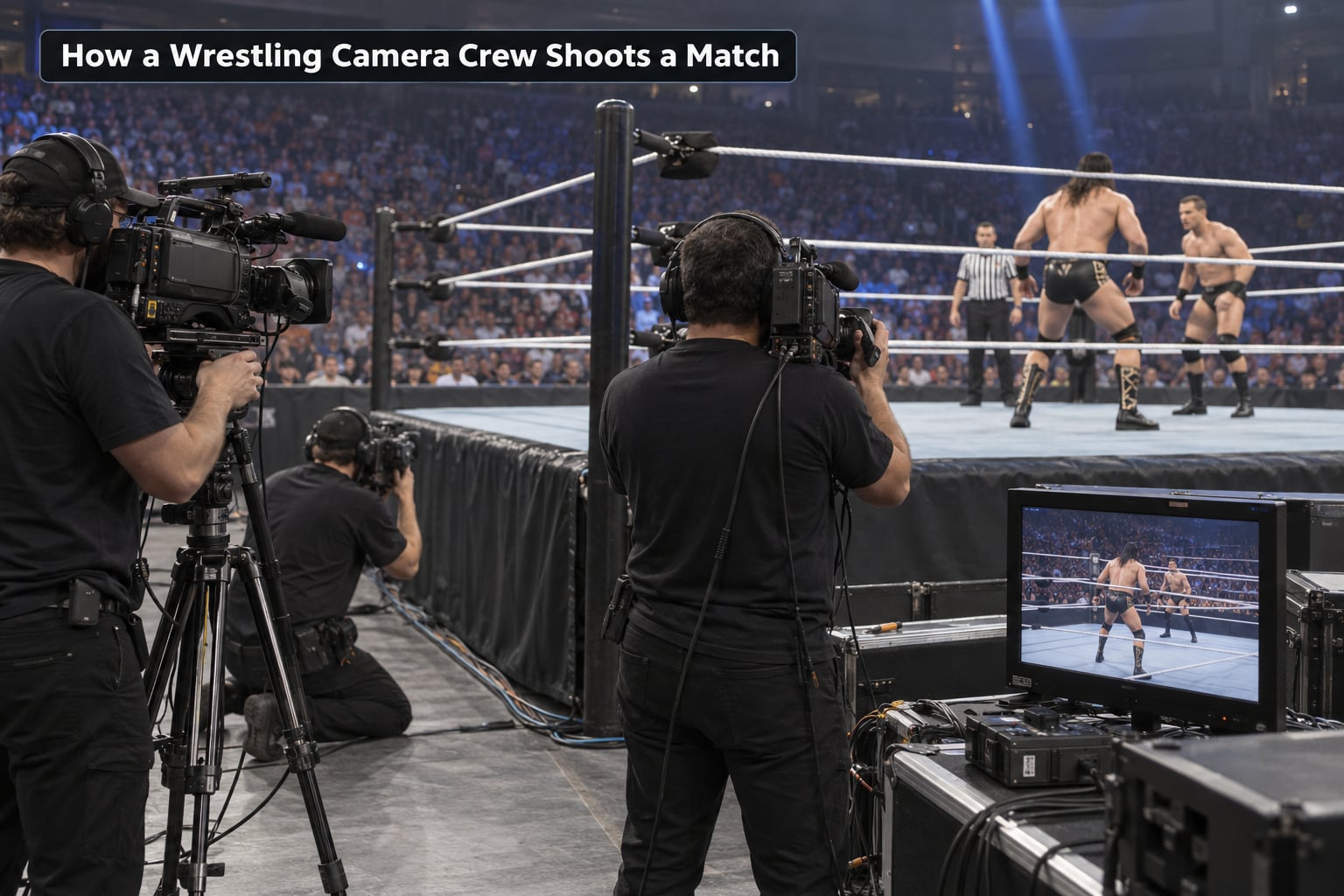
A televised wrestling show runs on a three-part schedule: plan, cover, and pick up the pieces. Talent arrives hours before the audience and works through entrances, promos and lighting checks, but the actual in-ring work happens in front of a full building with a crew of roughly a dozen people making every framing decision in real time.
The planning phase sets the shape of the coverage. Producers mark camera positions on a floor plan, decide who walks out on which ramp, and work out which beats get a dedicated angle. The hard camera is always placed first because everything else is built around it.
During the match, each operator is responsible for one job and one lens. The hard cam operator keeps the entire ring in frame and does not chase the action, which is the whole point of that camera. The ringside operators do the chasing. The producer in the truck cuts between feeds based on what is happening, what the commentary needs and what the crowd is doing.
After the bell, the crew shoots the aftermath. Wins get held poses, losers get a shot of them on the mat, and somebody always has to be ready for the crowd to fill the frame while the next segment is set up on the entry ramp.
What Does a Wrestling Camera Crew Do During a Match?
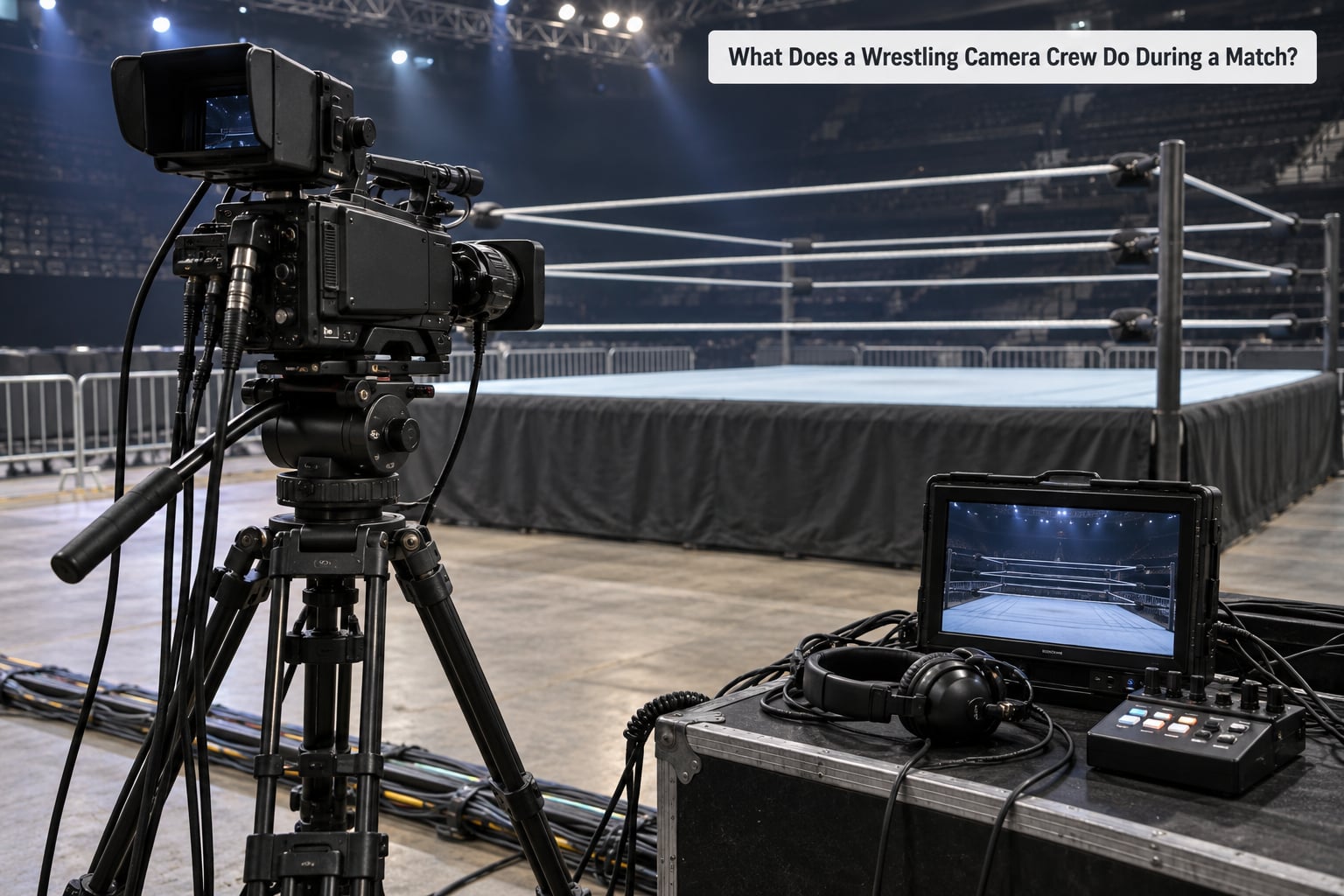
Every broadcast needs someone in charge and someone holding the camera, and in wrestling those two roles are unusually separated. Independent-show operators are trained to shoot while a single vision mixer directs them over a headset from the back of the room, and major promotions run the same split with a full production truck behind it.
The roles inside a wrestling broadcast
Vision mixer / producer. The person actually deciding what the audience sees. They watch all camera feeds on multiview monitors, listen to the commentary, and press the buttons. Sometimes this sits with a head of production, sometimes with a show producer who has final say on the finish of a match.
Hard camera operator. Sits at a fixed position with a wide view of the entire ring and apron. This feed is the safety net, and the operator’s instinct is to hold a level, stable, slightly loose framing that leaves room for the ropes.
Ringside operators. Usually two to four, numbered and assigned to specific sides of the ring. These are the sports shooters. Long glass, fast reframing, constant attention to focus, and a rule about how close they can get to the ropes.
Roving / steadicam operator. One person on a stabilizer who can move through the crowd and up the ramp during entrances, then find a corner for close-ups during the match. This is the shot that makes wrestling feel like television rather than a spectator recording.
Overhead operator. A camera mounted above the ring looking straight down, useful for showing spacing, holds and multi-man collisions that the hard camera flattens.
Camera assistants. They set up the tripods, run cable, manage lenses, and handle the long repositioning moves between segments. On a tight show they are the reason the cameras are where they need to be on time.
Replay operators. Separate crew who capture and package replays during the action, often including the slow-motion and alternate-angle inserts you see after a big move.
Where the cameras actually sit
| Camera | Where it sits | What it covers | When the producer cuts to it |
|---|---|---|---|
| Hard camera | Fixed position at the far side of the ring, elevated | The whole ring and apron in one continuous wide shot | Opening bell, mat returns, pin attempts, anything where the audience must not lose the action |
| Ringside camera 1 | Ringside, usually opposite the hard cam | Low angle, wrestlers at close range | Strikes, throws, a wrestler working the crowd side |
| Ringside camera 2 | Ringside, adjacent side | Second low angle with a different view of holds and pins | Submission holds, near-falls, a finish that needs a different angle |
| Ringside camera 3 | Corner or apron end | Low end-on view looking down the length of the ring | Climbs, dives, spills to the outside |
| Overhead | Mounted above the ring | Top-down spacing and multi-person action | Chaotic sequences, tables or debris, tag sequences |
| Roving / steadicam | Moves through the building | Close-ups, tracking, entrance follow | Entrances, wrestler reactions, anything needing energy and movement |
| Replay operator | Varies by match | Isolated coverage for later replay | Not for live cut; feeds the replay package after the sequence |
These names are conventions rather than law. A show might label feeds differently or add cameras for a bigger arena, but the logic holds: one anchor shot, several specialised angles, one unit free to roam.
Which Camera Shots Are Used in Wrestling?
Wrestling uses a narrower set of shot types than most live sports, and each one exists for a reason. Knowing which shot you are looking at tells you what the production team wants you to feel.
The hard camera wide shot
This is the full-ring view and the default feed. The operator holds the shot rather than tracking, so the framing stays consistent through a long sequence. Kevin Nash described it well when he told Fightful that the back-and-forth cutting between angles is exactly what tells an audience they are watching a television production, which is why he favoured staying on one hard camera.
Low ringside angles
Placed just above apron height, these make the action look bigger and more physical. A strike that looks modest from the hard camera fills the frame from ringside, and the depth of field goes shallow enough that the crowd becomes a blur behind the wrestlers.
Close-ups and reactions
Close coverage captures the part of wrestling that sport does not: the sell. A wrestler holding their jaw, a crowd member covering their eyes, a champion staring across the ring before the bell. Fans on r/SquaredCircle are used to the idea that the hard cam is a near-uninterrupted take, which means everything closer is chosen deliberately.
Crowd and ring-side cutaways
The cutaway to spectators is the most debated shot in wrestling television. It gives the audience a breather, it hides an in-ring reset, and it reacts to a genuinely loud pop. Forum threads describe crowd cutaways as filler inserted to cover a weak moment, and they are sometimes exactly that.
Entrance and ramp coverage
Before the bell, the roving camera earns its keep. It follows a wrestler through the crowd, catches the pyro, and grabs faces on the way in. Much of what audiences remember from an entrance happens here, and none of it comes from the hard camera.
Overhead and under-ring shots
The overhead angle shows spacing and geometry that the hard cam compresses. Under-ring and low-apron views, which WrestleTalk has shared footage of, show how tight the physical placement actually gets when the crew is shooting from beneath and around the platform.
How Do Camera Operators Follow Wrestlers?
Following wrestlers is not about being fast, it is about predicting. Ringside operators spend the match reading the wrestlers’ hips and shoulders, because a power move announces itself a second or two before it lands.
Framing rules keep the shot usable
The standard guidance for wrestling framing, discussed constantly by photographers on r/AnalogCommunity, is that the sides of the ring should fill the frame, with a little spare room because action moves. That is the reason hard camera frames sit slightly loose rather than tight on the wrestlers.
Zoom is used sparingly, then all at once
Constant zoom is the complaint fans raise most. Operators are trained to frame the pair, hold, and only push in for a specific beat such as a submission or a staredown. When the zoom does arrive, it lands because nothing moved for the previous ten seconds.
Focus is the hard part in low light
Arenas are dim on purpose and most cameras run wide open with limited light. Focus cannot be pulled mid-move without the shot softening, so operators zoom, focus, and then hold position rather than chasing focus while panning.
Position is limited by the space
Ringside space is measured in feet, not metres. Operators cannot cross the line where wrestlers will land, cannot step into the path of a wrestler coming off the ropes, and are constrained by the apron, barricade and commentary desk. Anything that sends action to the floor is why the roving camera exists.
Climbs and off-rope spots get a dedicated camera
Any spot with a climb, dive or elevated turnbuckle move gets assigned to a specific operator in advance, because those are the sequences where a lost subject is most obvious to the audience.
How Does the Crew Coordinate the Live Broadcast?
Coordination is the part almost nobody outside the truck understands. A producer watches every feed on multiview monitors, listens to the commentary desk, watches the crowd volume, and makes a decision roughly every two to ten seconds.
How the calls are made
Cameras are referred to by number, which is why you hear the phrase camera two or the number three come up so often in broadcast wrestling discussion. The call is short, the switch is instant, and the commentary follows whatever appears on screen. Bryan Alvarez put the politics of that plainly when he noted that viewers were told other people in production, not one individual, drive the shaking, the zooming and the cuts.
Working with the commentary
The commentary desk needs a face to talk to. If a commentator is mid-story and the in-ring work stalls, the producer has options: hold the hard cam, cut to a listener in the crowd, or find a ringside close-up. Reverse it and the feed follows the story, which is often why an angle changes right as someone names a wrestler.
Live versus live to tape
A live broadcast cannot hide anything, so the crew protects the continuous shot and takes fewer risks. Live-to-tape shows record the room, give the audience a different experience from what airs, and allow more aggressive switching. Independent shows often record a single continuous take with one or two cameras and do their cutting later.
Live-to-tape also changes what the crew knows beforehand. Rehearsal is more thorough, blocking is tighter, and the outcome is settled well before the bell. WhatCulture makes the same point about wrestling production by noting that shows are filmed live or live-to-tape with a makeshift set rebuilt at a different venue every week.
How the styles differ by promotion
WWE is known for heavy cutting and zoom movement, with a hard cam that is rarely the main feed. AEW has been widely described by its own viewers as more open and handheld, with longer takes and producers who pick angles based on how the match is going. NXT runs in a smaller fixed venue with a tighter, more consistent camera plot. Independent shows run one or two cameras, often a single operator shooting a whole match in one take. A multiple-camera setup is not automatically better here.
What the crew does when something goes wrong
A botched spot, a dropped table, a wrestler who visibly sells an injury, or an unscripted genuine moment all get handled the same way: stay on the hard camera, keep the commentary moving, and cut away only if the shot in the ring is unusable. Chris Weaver, directing the WWE Unreal docuseries, described multiple camera groups working at once, including network broadcast cameras alongside the documentary crew, and wrestlers repeatedly asking whether they were supposed to stay in character for the documentary cameras. That is the tell. When talent has to ask, the shot stopped being a shoot.
What the camera does to the wrestlers
Knowing where the hard camera is changes how a match is performed. Moves are sold facing that lens, taunts are timed to hit it, and pauses are held until the audience reaction finishes. The producers who are also seasoned wrestlers, as AEW viewers describe them, recognise that instinct and use it instead of fighting it.
Why Are Replays and Alternate Angles Important?
Replays solve a problem the live feed cannot. In a fast sequence, a hold that looked like a rope break may have been a shoulderblade pressed into the mat, and the wide shot may have hidden a spot completely. Replay is where the broadcast explains what happened.
A replay operator works with a dedicated feed and often a lens or position chosen for that one purpose. They record the sequence, the control room decides whether to use it, and the package plays during a break in the action while the wrestlers reset.
Alternate angles do the same job. A submission viewed from the hard camera can be ambiguous; the same hold from a low ringside position shows the grip and the face. Pin attempts get replayed from a second angle so the audience can see the shoulder or the rope. Slow motion isolates the exact frame of impact, which is the shot wrestlers themselves rewatch most.
Two rules keep replays from undermining the illusion. They are used on significance rather than on any decent-looking move, and they never explain something the live shot already made clear. A replay that shows something went wrong is a production error, not a bonus angle.
What Happens Before and After the Match?
Before the bell, the crew works to a much looser rhythm because there is no match to cover. An establishing wide shot of the building sets the scale, the roving camera catches the entrance and the crowd, and the hard camera sits idle until the wrestlers reach the ring.
Referee preparation gets covered as a matter of course: the check of equipment, the warning, the moment the official hands out the mask or gear. These are simple shots, but they are what tells an at-home audience that this is a regulated contest rather than a brawl.
Entrances are where the roving camera does its most visible work, tracking a wrestler through the crowd from behind, cutting ahead for the face, then holding a wide as the athlete climbs the steps. Commentary fills this with storyline, so the coverage can afford to be simple.
After the bell, the priorities reverse. The finish gets the wide shot, the crowd gets the reaction, and somebody is always ready with a close-up on the winner while the losing wrestler is still on the mat. Celebrations get full coverage because that footage feeds recaps and promos for the rest of the show.
The segment closes with a transition: a wide of the ring as the next act arrives at the entry ramp, a commentary handover, or a cut to the desk. If the show is live-to-tape, that last minute of coverage is often the only real gap, and the tape rolls on whatever the camera is pointed at.
Frequently Asked Questions
What is the hard camera in wrestling?
The hard camera is the fixed, elevated camera on the far side of the ring that holds one continuous wide shot of the entire ring and apron. Its operator does not pan or zoom to follow the action, because the job is to keep every wrestler visible at all times. It works as the broadcast safety net: when any other angle loses the subject, the producer cuts back to the hard cam and the audience is reoriented instantly.
How many cameras are used to film a televised wrestling match?
A televised match usually deploys one hard camera, two to four ringside operators on long lenses, one overhead rig and one roving steadicam unit, with extra replay cameras on bigger shows. Major promotions also run separate groups for backstage and documentary footage, so the number of cameras in the building is much higher than the number actually feeding the match.
Who chooses which camera angle you see during a match?
A producer or vision mixer in the production truck decides, working from multiview monitors, the commentary, and the crowd. Cameras are called out by number over a headset and the switch is instant. Talent may know and play to the hard camera, but they do not control the feed, and on some promotions a head of production can override a cut in real time.
Why does the camera cut to the crowd so often?
Three reasons, often all at once. The audience needs a breather between sequences, the crowd often has a genuine reaction worth showing, and it is the fastest way to cover a reset or a spot that did not land. Forum viewers often assume the cutaway is hiding a botched move, and sometimes that reading is correct, because the switcher needs a second to find a usable shot.
Is a wrestling show filmed live or live to tape?
Both exist. Network television shows are commonly recorded live to tape, where the audience experiences a different event from the one that airs. Some arena shows broadcast live, where the crew protects the continuous hard camera take and takes fewer risks. Independent promotions usually record a single continuous take with one or two cameras and make the cuts in edit afterwards.
How do camera operators keep up with the action in the ring?
They predict rather than chase. Operators read a wrestler’s hips and shoulders, frame the pair with a little spare room, and lock focus before the move starts instead of pulling focus mid-sequence. Any spot involving a climb or dive is assigned to a named operator in advance, because that is where losing the subject is most obvious to viewers.
Conclusion: Watch the Match Like a Camera Operator
A wrestling camera crew shoots a match by building one dependable wide shot and letting a producer decide, second by second, whether the audience needs to see it. Everything else, the low ringside angles, the close-ups, the overhead geometry, the entrance tracking, exists to make that anchor shot more interesting without ever losing the match itself.
So the next time a match goes on television, watch it as an operator would rather than a fan. Notice when the hard cam holds instead of cutting. Count how long the producer stays on one angle before moving. Track which ringside camera picks up each major move, and see whether the crowd cutaway lands during a genuine pop or during a reset. Check whether the replay shows you something the live shot did not.
That is the whole craft in plain sight. Anticipation from the operators, decisions from the truck, and a replay package that explains the moment after everyone has already reacted to it.