A surprise return is kept secret by limiting how many people know the plan, locking the script and staging before the show goes live, and handing the wrestlers already in the ring a time and a general instruction instead of a name. Promotions build on that with written non-disclosure terms, deliberately vague vignettes, rehearsed referee and commentary cues, and travel arranged at the last minute.
The reason a promotion spends all that effort comes down to one number: the pop. A crowd losing its mind is the single loudest moment wrestling can manufacture, and it is also the one moment nobody can fake. Once a return is announced on a poster, in a graphic, or in a tweet, that reaction is gone for good.
I have watched this go wrong more often than it goes right. A return teased on a Monday show has a ceiling of polite applause. A return nobody saw coming stops a card dead. This guide breaks down the actual production side: who knows, when they know it, what the paperwork looks like, and where the plan usually leaks anyway.
Updated for 2026.
Table of Contents
- How Promotions Plan a Surprise Return
- How the Storyline Creates a Mystery
- How a Surprise Return Is Kept Secret
- The H3s Used to Hide a Return
- How Production Handles the Wrestler’s Movement
- How Social Media Helps or Breaks the Secret
- What the Audience Is Supposed to Notice
- How the Reveal Is Timed for Maximum Impact
- Why Some Rumors Are False or Deliberately Misleading
- What Makes a Surprise Return Feel Believable
- Frequently Asked Questions
- Do WWE wrestlers know when there will be a surprise entrant in the Royal Rumble?
- Why does WWE announce surprise returns on social media?
- What is a dirt sheet in pro wrestling?
- What are the greatest surprise returns in wrestling?
- How do promotions keep a return from leaking?
- Which surprise returns got spoiled before the event?
- How can I avoid spoilers for a big return?
- Conclusion
How Promotions Plan a Surprise Return
A believable return is decided long before the wrestler shows up anywhere, usually at a creative meeting where the question is not whether someone returns but what kind of return it is.
Writers pick the payoff first. A heel turn needs an audience already angry at the person. An emotional reunion needs a relationship the crowd still cares about. A surprise match at a premium event needs a storyline thread already in motion, because a cold return with no setup reads as a booking decision rather than a story.
From there the promotion picks a delivery slot: an unannounced entrance, a post-match attack, a run-in during someone else’s match, a championship open, or a masked reveal. That choice determines the secrecy plan, since keeping an unannounced entrance secret is a different job from keeping a post-match interference secret.
Timing is the other half. A return that lands on a low-attendance television show has a smaller audience to surprise. Promotions routinely hold a workable idea for months until the right show, the right opponent, and the right crowd line up. Sometimes that means a plan gets shelved entirely, and a wrestler who was ready to return spends another month in the gym instead of on television.
How the Storyline Creates a Mystery
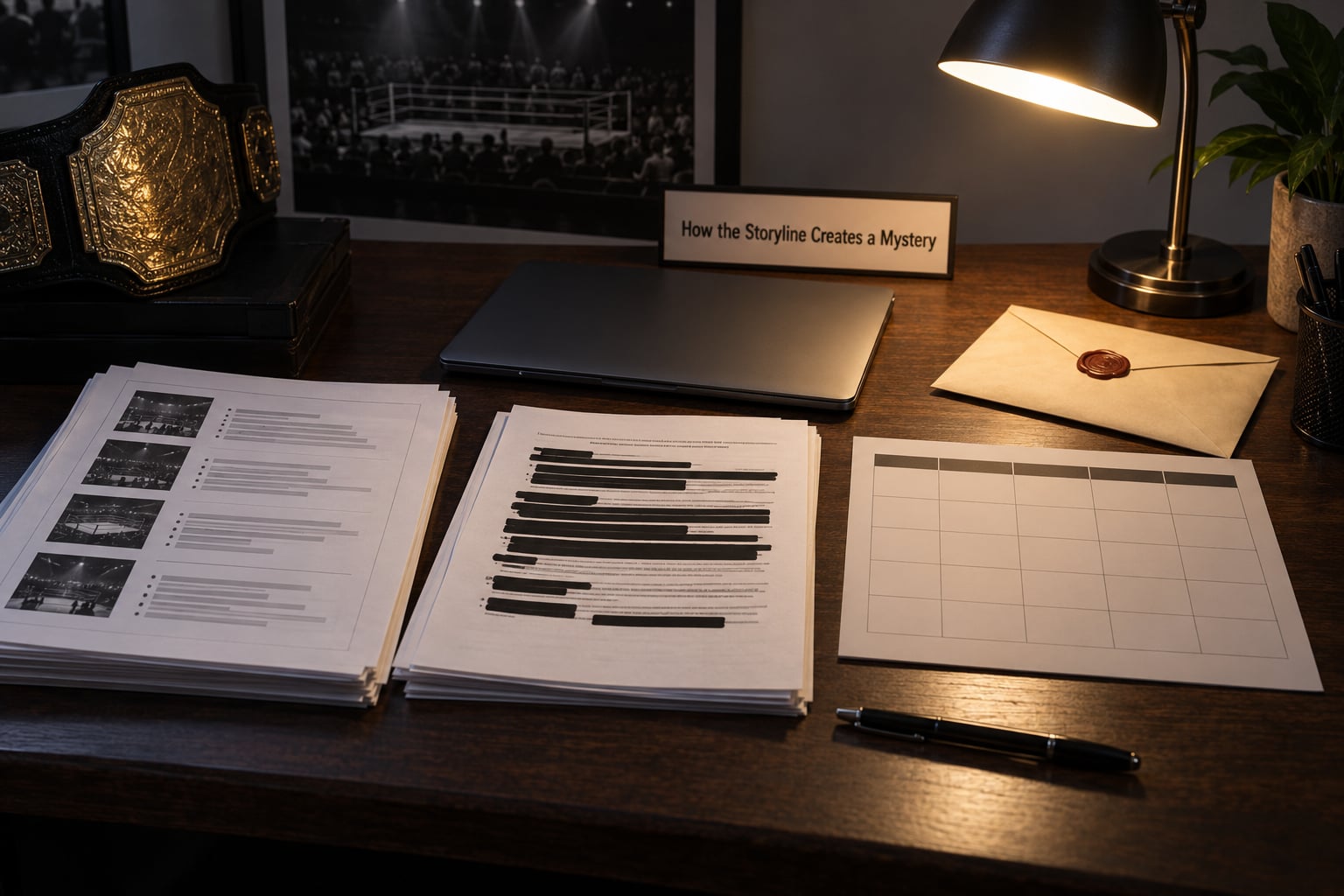
Good storyline writing keeps a return possible without making it likely, so the crowd accepts the reveal as something that had been coming even if nobody predicted it.
Vague contract language is the most common tool. A wrestler is described as being unavailable, under review, or negotiating terms, with nothing that actually resolves. Interviews answer a different question than the one asked. A manager mentions a name in passing and immediately moves on. Someone is shown at an event but never wrestles, and the edit makes that look incidental.
Censored details work the same way. A graphic with a blacked-out name, a contract shown with the signature covered, or a phone call cut off mid-sentence all plant a question without answering it. The goal is not to hide information from fans. The goal is to make fans argue about information they do not have, which keeps them watching.
Suspicious absences do the same work in reverse. A wrestler who is not mentioned on a show, then not mentioned on the next one, gets a longer run of speculation than any announcement would generate.
How a Surprise Return Is Kept Secret
The practical answer to how a surprise return is kept secret is compartmentalization: the plan is split into pieces, and only a few people hold enough pieces to reconstruct it. Nobody in the company knows the whole picture at the same time, early on.
- Need-to-know access. The returning wrestler’s name appears in as few documents and as few conversations as possible. Writers, the head of production, and the wrestlers actually in the segment know; most of the roster does not.
- Written non-disclosure terms. Talent under contract sign agreements that cover unannounced appearances and story details. Nobody pretends this stops every leak, but it changes the cost of one and gives the promotion something to point at.
- Neutral travel language. Schedules are described in general terms. Instead of a date and city, a wrestler tells people they are unavailable, working on something, or handling personal business. A wrong city and a wrong date are often more useful than no answer at all.
- Private entrances and unlisted arrivals. The returning wrestler travels separately, avoids the main production entrance when the venue allows it, and is moved backstage by a route that keeps them out of the sight of talent, crew, and fans on the way in.
- Generic rehearsal. Rehearsals run without the name attached where possible. A segment rehearsed as “the returning heel” gives away nothing to a production assistant, a rigger, or a camera operator who is not cleared for the reveal.
- Rehearsed reaction. The referee, the announce team, and any wrestler booked to interfere all know exactly when the reveal happens and what their line or move is. That is what stops the moment from feeling improvised in front of a live crowd.
- Script and staging lock. Once the return plan reaches creative lock, the segment script, the run sheet, lighting cues, and pyrotechnics stop changing. Leaks get less likely as the air date approaches, mostly because fewer people can still change the plan.
- Deliberate misdirection. When a return is genuinely going to leak, some promotions stop fighting it and push a different story harder, so the attention lands on the wrong name.
The H3s Used to Hide a Return
Strip away the paperwork and there are only three information barriers doing the work. First, access: who is physically and contractually inside the circle. Second, misdirection: clues that point somewhere plausible but wrong, so a leak produces a bad guess rather than the right one. Third, timing: the reveal is scheduled to the minute so the moment lands at maximum volume.
Most failed surprises fail on the second barrier. A single fan in a group chat who half-believes something, passed to a second person who is certain, is enough to turn a locked plan into a spoiled show.
How Production Handles the Wrestler’s Movement
Logistics are the part fans never see, and they are where a good plan survives contact with reality. Someone has to get the wrestler to the venue, get them changed, get them to the right side of the curtain, and hold them somewhere the rest of the roster does not walk past.
That usually means private vehicles where possible, arrival outside the public entrance window, and a dressing room in a different wing than the one the roster uses. Production staff are told only that a segment is running long, or that a cue is being added, rather than what the cue is. On a multi-show week, the run sheet is rewritten late so that a rehearsal slot does not put the returning wrestler in a room with people who will talk.
Wardrobe and gear travel separately from the person where the timing is tight. A title belt can be photographed, packed, and driven to the venue while the wrestler is still in the air, which means nobody has to explain in advance why a championship is suddenly in a security case backstage.
The WrestleMania 42 match card offered a clean example of the delivery side. Bron Breakker’s interference in the Seth Rollins match was staged around a referee distraction and a follow-up after the finish, with the timing rehearsed so the crowd read it as chaos rather than a cue.
How Social Media Helps or Breaks the Secret
Social media is the fastest way to lose a surprise and the most efficient way to build one. Most of the time it loses it, because a wrestler’s feed is a direct line out of the story to the audience.
A posted schedule, an airport shot, a location tag, a rehearsal clip, or an emotional caption about leaving a country can identify a returning wrestler hours before the show. So can a pattern: a wrestler who has been unusually quiet for three weeks, then posts a single photo of gym equipment, has just told you something without saying it.
Planned teases are a different matter. A cryptic post that could mean a dozen people keeps the guessing going and costs the promotion nothing, as long as it stays consistent. The failure mode is the promotion announcing the return itself: a return graphic, a “tonight” post, a video of the entrance music without the entrance. Fans on wrestling forums have been blunt about this for years, and the complaint is fair. A spoiled return still sells tickets. It just does not produce the reaction the ticket was bought for.
There is a real trade-off here. Announcing a return in advance reliably lifts tune-in and social reach, because a name sells a headline. Announcing nothing protects the moment. Promotions make that choice differently depending on how much the return matters to a number, and that is why some returns get a month of teases while others get nothing at all.
What the Audience Is Supposed to Notice
Planted clues are not secret information. They are the opposite. Once a return is planned, the production team decides what the audience is meant to pick up without knowing what it means.
Common ones include a wrestler mentioned in a segment without any contract status attached, an entrance sound played in a video package that has no accompanying name, a storyline thread revived after a long gap, and an announcement so carefully worded that it excludes the actual participant. In February 2026, a mystery box delivered on television with a printed instruction not to open it until a date several weeks out did the same job in a longer form, sustaining a mystery across multiple shows before anything had to be confirmed.
Good clues are recoverable in hindsight. A fan rewinding the run three years later can point at the exact segment and say that was the tell. Bad clues are just noise, added without a purpose, and they give the audience a false pattern to feel clever about.
Commentary is the most reliable plant of all. A host asking a loaded question, or a guest going conspicuously quiet on one topic, reads as a reveal to a tuned-in audience and as nothing at all to everyone else.
How the Reveal Is Timed for Maximum Impact
A return is timed for a reason that has nothing to do with convenience. A rivalry pays off, a championship changes hands, a contract expires on a date the audience already knows, or a major event needs a match the card cannot sell without a name attached.
The technical timing matters too. An entrance that fires while the crowd is still reacting to the previous segment gets swallowed. So a reveal waits for a clean moment, sometimes twenty minutes into a match, sometimes during a post-match celebration when the building is already loud.
The best-kept secrets are not the most unpredictable. Cena entering at number 30 in the 2008 Royal Rumble had a rule, a number, and no announced participants left, so nobody could guess it, and roughly six months of silence before it kept the dirt sheets quiet. Compare that to a return teased on television two weeks out, which fans can predict from the graphic alone. Predictability, not discretion, is usually what people are reacting to when they complain that a return was spoiled.
Why Some Rumors Are False or Deliberately Misleading
Not every report about a returning wrestler is a leak. Some are noise, some are recycled, and some are put there on purpose.
A dirt sheet is a site or account publishing speculative inside information with no verification standard, and it should be read as rumor until the promotion shows you otherwise. A dark sheet is the same kind of reporting, distributed to a much smaller list, usually with better sourcing. Distinguishing the two matters because the quality of a report is not the same as the confidence of its author.
Old stories get recycled constantly. A report that a promotion will not confirm from two years earlier resurfaces every time the same wrestler is discussed, and casual readers treat the second sighting as confirmation. Leaks from indies and former colleagues are another category, and the talent involved are frequently under no agreement at all with the promotion making the announcement.
Then there is the deliberate misdirection, which is the oldest tool in the book. The often-reported story that Sting had signed in 2011, followed by an Undertaker payoff instead, is the standard example of a leak used as a creative asset rather than a failure. If a rumor is going to exist anyway, a promotion can decide which name it points at. Wrestling talent themselves have leaned into this, reacting to rumor reports in real time and posting specifically to contradict them, which makes it clear the promotion and the sheet are not always playing the same game.
Mainstream media is now a genuine leak vector. Sports shows ask leading questions about a name and the internet does the rest, and in January 2026 a segment on a mainstream morning program was reported as having effectively given away a Royal Rumble return before the event.
What Makes a Surprise Return Feel Believable
The returns fans still argue about share a few things, and they are all things a reader can check for.
Consistent clues mean the setup connects to the payoff rather than contradicting it. Believable motive means the wrestler had a reason to be there that made sense before they appeared. A real explanation for the absence covers the time away, usually through injury, contract, or a story that closed properly rather than just stopping.
Credible involvement from other people adds weight. When the announce team, the referee, and the wrestler on the receiving end all react as if it is genuine, the crowd reads it as real. When the talent in the match visibly did not know, fans usually notice, and it can read as either a beautiful bit of theatre or a badly rehearsed mess depending on the night.
Finally, an earned reveal feels like a payoff rather than a random insertion. Pause the show at that moment and ask whether anything was set up. If the answer is no, the pop lasts about fifteen seconds and nobody brings it up again.
Frequently Asked Questions
Do WWE wrestlers know when there will be a surprise entrant in the Royal Rumble?
Generally, no. Talent already in the match are not told who is entering ahead of time, and the segment script stays confidential until it reaches creative lock. Some wrestlers are given only a time and a general instruction, and the referee and announce team rehearse the reveal so it can be delivered to the second. Talent in the match sometimes learn about it live, which is why reactions on camera vary so much.
Why does WWE announce surprise returns on social media?
The reason is reach. A name attached to a return sells tune-in, headlines, and social posts, which are numbers a promotion can measure. The cost is the pop, and fans have complained about it for years, often pointing at promotional graphics that announce a return hours before the person walks out. Some promotions still announce nothing and let the crowd find out, particularly for returns they consider the biggest moment of the year.
What is a dirt sheet in pro wrestling?
A dirt sheet is a site or social account that publishes speculation about behind-the-scenes wrestling news without an editorial verification standard. A dark sheet is a related thing, usually a more closely held report sent to a small list with better sourcing. The difference matters because a confident voice is not evidence. Readers on this topic tend to be heavy users of these sources themselves, so take any single report as a lead rather than a confirmation.
What are the greatest surprise returns in wrestling?
There is no consensus pick, but four keep coming up. CM Punk at Survivor Series 2023 was protected tightly and paid off years of build. John Cena at number 30 in the 2008 Royal Rumble came after roughly six months of silence with an announced number list that gave nothing away. Roman Reigns at SummerSlam 2020 was a shock that split an audience in two, which is a different kind of success. The Rock against Rusev in 2014 is still cited as the moment nobody saw coming.
How do promotions keep a return from leaking?
They split the plan into pieces so no single person holds the whole thing, put the returning wrestler under written non-disclosure terms, use vague contract language and censored details in vignettes, describe travel in neutral terms, and lock the script and staging well ahead of the air date. Once the plan stops changing, fewer people can still change it, which is why most real leaks happen in the weeks before a show rather than the days.
Which surprise returns got spoiled before the event?
Booker T and Kevin Nash entering the 2011 Royal Rumble is the standard example, with dirt sheet reporting and internet speculation widely credited with removing the surprise before the show. Chris Jericho’s 2018 Japan run was carried on the front pages of mainstream outlets. More recently, a January 2026 morning sports show was reported as having given away a Royal Rumble return through a leading question on television.
How can I avoid spoilers for a big return?
Mute or unfollow the accounts that spoil shows, and avoid general news feeds in the days before a premium event, because wrestling returns now get covered by mainstream sports media. Watch the event live rather than waiting for a recap. Spoiler warnings on threads help, but only if you read them before clicking. A surprising number of fans who read dirt sheets for years still skip news for the biggest shows of the year.
Conclusion
A surprise return survives on controlled information: a plan split into pieces, paperwork that raises the cost of talking, wording that keeps the crowd guessing, rehearsal that makes the reveal look improvised, and a reveal placed at the loudest possible moment.
If you want to judge a return for yourself, read the clues as a pattern rather than taking any one report as confirmation. Ask whether the setup connects, whether the motive makes sense, and whether the reveal landed because of the writing or despite it. That is the difference between a pop people remember and one that lasts fifteen seconds.