Wrestlers recover after back-to-back shows with a timed routine, not a single trick: a cool down and cold therapy in the first two hours, fluids and food within six, protected sleep overnight, light mobility work in the morning, and a real warm-up before the next bell. The schedule is what makes it hard, because the recovery window shrinks to hours instead of days.
Ask most wrestlers what happens after a Saturday night show and a Sunday afternoon show 400 miles away, and you get a surprisingly consistent answer. It is not a recovery gadget. It is a sequence, done in an order, with the tired days scaled down instead of pushed through.
Table of Contents
- What Does Recovery After Back-to-Back Shows Involve?
- How Wrestlers Recover After Back to Back Shows
- The post-show protocol: the first two hours
- Cold, heat, or contrast: which one and when
- Sleep and schedule protection
- Travel, hydration, and fueling the next show
- How wrestlers protect performance on the next show
- When fatigue becomes a warning sign
- Frequently Asked Questions
- How long should a wrestler rest after back-to-back shows?
- Should wrestlers train when they are sore after consecutive shows?
- What is the best recovery method for wrestlers after a long show?
- Can wrestlers lose weight by eating less between shows?
- How can wrestlers recover while traveling from one event to another?
- When should a wrestler see a doctor after back-to-back performances?
- Conclusion
What Does Recovery After Back-to-Back Shows Involve?

Recovery after consecutive shows is the full post-match routine a wrestler uses to process two bouts in one night or two nights in a row. It covers four things: immediate damage control, refueling, sleep, and workload adjustment for the next performance.
Consecutive shows are harder than a single show for a simple reason. Damage that would normally clear during a day off has barely started to settle when the next match begins, so inflammation, fatigue and soreness stack instead of resetting.
What counts as a show matters too. A televised taping, a live house show, a dark match before the doors open, and a two-match tournament day each cost something different, and the recovery plan should reflect the one the wrestler actually wrestled.
A dark match or a long match on a televised card burns more than a short house-show bout with planned spots and a clean finish. That difference is why the recovery protocol on a big-league weekend looks nothing like the one an independent wrestler runs out of a trunk in a gymnasium parking lot.
The soreness wrestlers describe 24 to 48 hours after a hard bout has a name: delayed onset muscle soreness, usually shortened to DOMS. It is the soreness from tissue that was loaded hard, and it peaks after the show, which is exactly when the next show is happening.
Over a run of shows, that pattern adds up. Spine, knees, shoulders and neck take the repeated impact and twisting of grappling exchanges, and a wrestler who never gives them a full recovery window is carrying small amounts of unfinished repair into every match. Season-long wear is what ends careers, not any single bout.
How Wrestlers Recover After Back to Back Shows
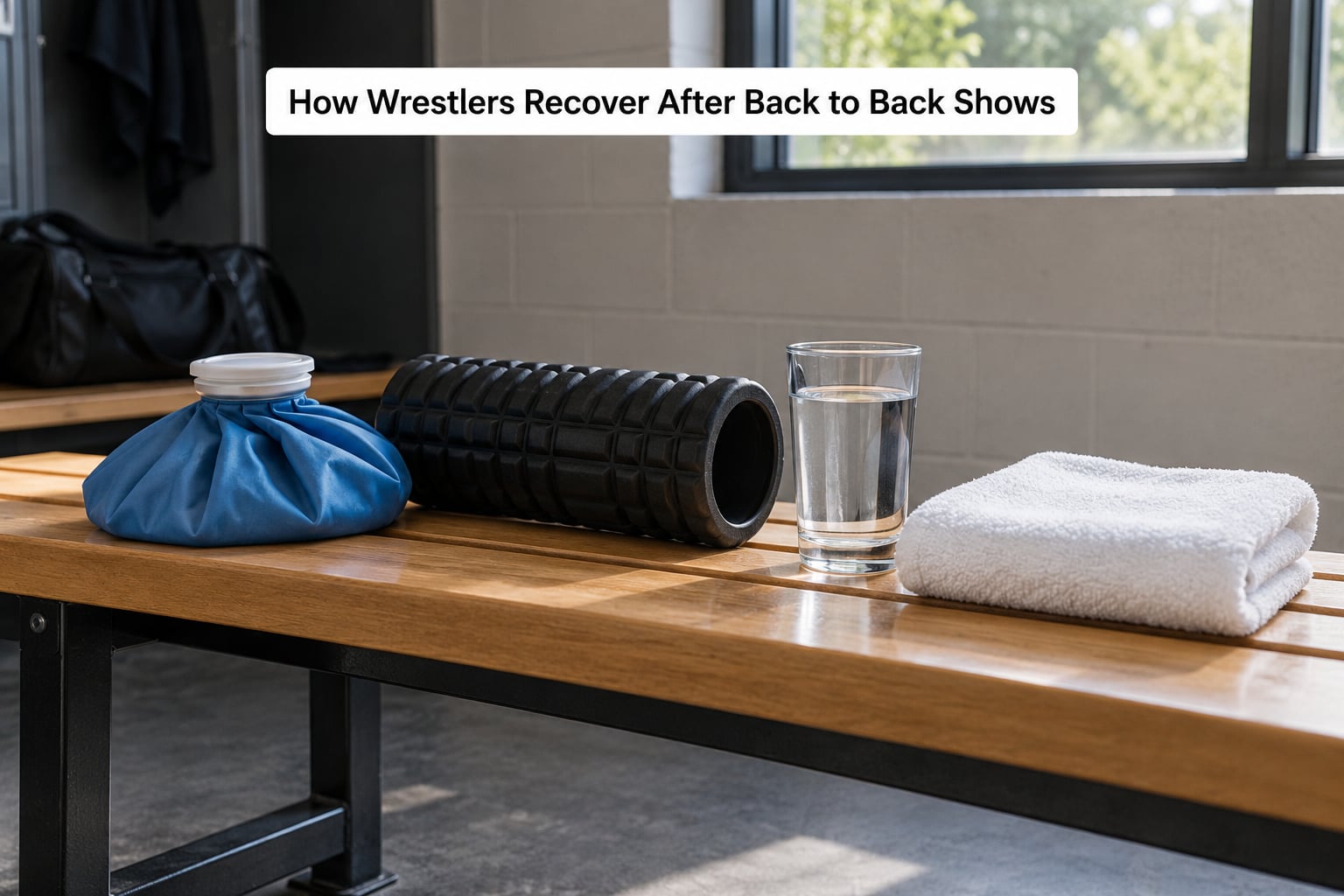
The short answer: protection, refueling, sleep, gentle movement and a managed warm-up, sequenced over the 24 hours between the two bells. Here is the order most wrestlers, coaches and athletic trainers describe, followed by what each piece actually involves.
The post-show protocol: the first two hours
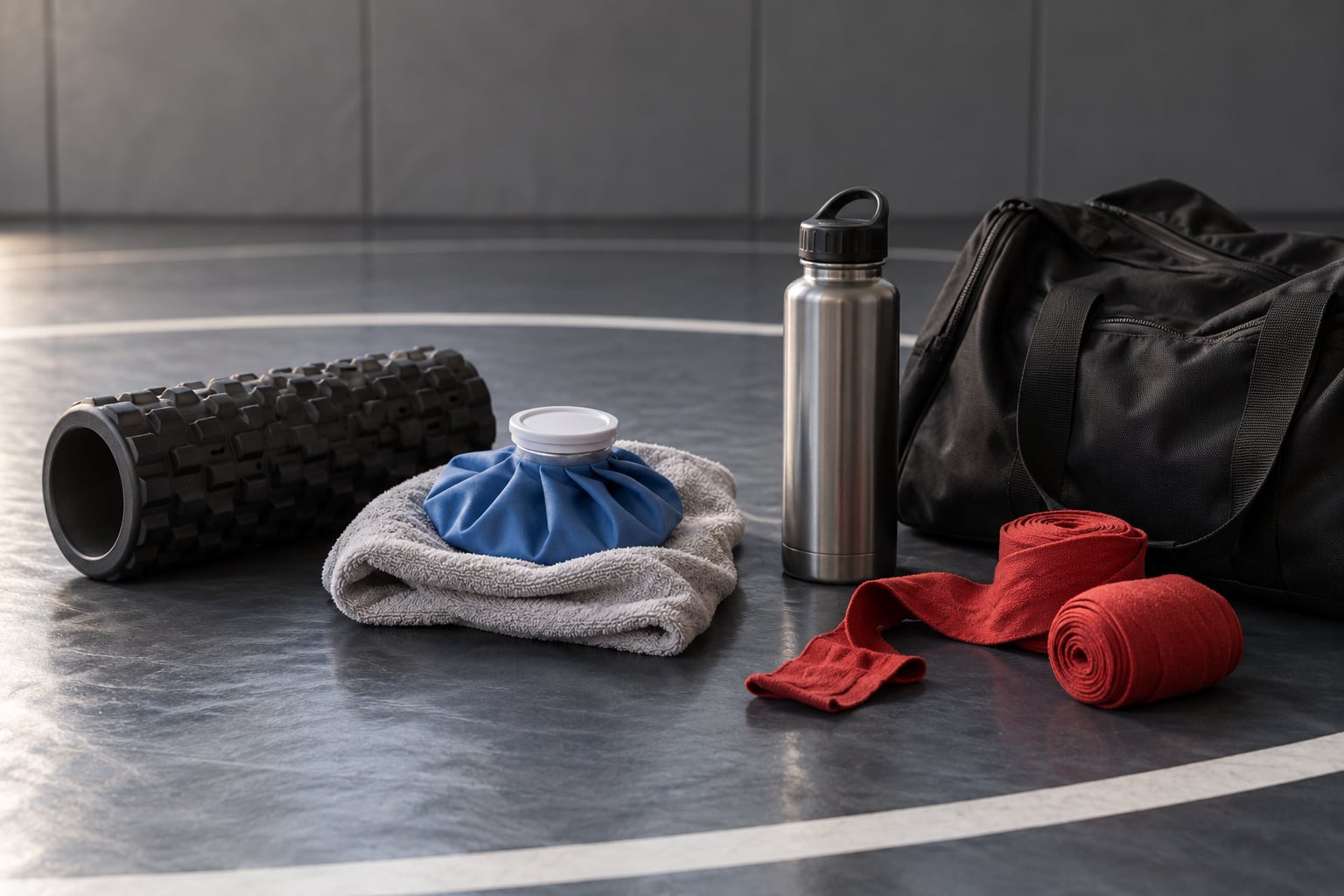
- Walk, do not sit. Five to ten minutes of easy movement, a stationary bike if there is one, gets blood moving through tissue that was compressed and loaded for twenty minutes. The goal is a gentle flush, not a workout.
- Static stretches, 30-second holds. The single most-repeated piece of advice in wrestling recovery circles, and the highest-ranking answer on the r/WredditSchool thread on this exact question, is to hold each stretch for at least 30 seconds. Hit the hips, hamstrings, shoulders and ankles, where range gets squeezed during a match.
- Cold therapy. Ice on sore joints, an ice bath, or a cold shower. On the independent circuit, where an ice bath is usually a rented tub or a stock shower, the cold shower is the realistic version and wrestlers say it works nearly as well.
- Rehydrate. Wrestling sweat carries electrolytes, not just water, so fluid with sodium and a real meal within the hour matters more than chugging plain water. A wrestler who cut weight for a weigh-in has more to replace than one who did not.
- Get out of ring gear, get food. Promotions usually feed the talent at some point, but the wrestler who eats first beats the one who waits for a catering tray at the next stop.
That whole block takes maybe forty minutes and happens whether or not anyone is coaching it. It is also the block most often skipped, because it is the one that happens when the wrestler is tired and being asked to get on a bus.
Cold, heat, or contrast: which one and when
Cold, heat and contrast baths all get recommended after wrestling, and they do different jobs. Sorting them out matters, because the wrong one at the wrong time undoes the work of the other four.
| Method | Best used for | Typical time | When to skip it |
|---|---|---|---|
| Cold immersion or ice bath | Cutting overall soreness and inflammation after a high-impact bout | 10 to 15 minutes | Before a match, since cold can dull muscle recruitment and power output |
| Contrast bath (hot then cold) | Muscles that feel stiff rather than bruised | 3 to 5 minutes per temperature cycle, 3 to 4 cycles | When a joint is hot, swollen or acutely painful |
| Heat (shower, sauna, warm bath) | Loosening tight muscle before light mobility work or on rest days | 10 to 20 minutes | Straight after a new injury, where heat can increase swelling |
| Compression | Reducing swelling in a specific joint during travel | 20 to 30 minutes, or overnight | When circulation is already restricted or a clinician has said otherwise |
| Foam rolling / mobility work | Hip flexors, calves, lats and thoracic spine after long bus rides | 5 to 8 minutes per area | Over a freshly injured area |
Contrast therapy gets underrated because it needs a tub, a timer and two temperatures. In a hotel gym, a hot shower followed by 60 seconds of cold does the same thing in less time.
Sleep and schedule protection
Sleep is where most of the repair actually happens, and a two-show weekend is usually where it gets squeezed first. A wrestler who wrestles at 9 p.m. Saturday and 4 p.m. Sunday in another city has fewer usable hours than a normal week, and travel eats them.
Two things help. First, protecting a fixed wake-up time, because the body reads consistency better than it reads length, and a wrestler awake until 3 a.m. after a show still functions better on a normal schedule than on a completely random one.
Second, using naps as a supplement rather than a substitute. A 20 to 30 minute nap on a bus or in a car between shows takes the edge off without pushing into deep sleep and grogginess, and it does not eat the following night’s sleep the way a three-hour nap can.
Late-night phone scrolling is the quietest sleep killer on the road. Everything else in the protocol is doing less if the wrestler is awake looking at a screen two hours before an 8 a.m. departure.
Travel, hydration, and fueling the next show
Travel is a load in its own right, and on the independent circuit it is frequently the largest one. Three to five hours in a car after a match means a body that has to stay in one position, in a compressed seat, in a room with no equipment and no ice.
Wrestlers who tour a lot treat the vehicle as part of the protocol. Movement breaks every hour or so, fluids within reach rather than in a cooler in the trunk, and a short nap if the seat allows. Some use the drive for audiobooks or a podcast, partly because audio requires no screen.
Jet lag comes with international tours and is mostly a light and clock problem. Daylight exposure at the right end of the day, regular meals on local time, and a short walk rather than a nap in the afternoon tend to help more than anything else a wrestler can do.
Fueling between shows is simpler than it sounds: carbohydrate to refill what the match burned, protein to give tissue something to build with, and enough fluid with electrolytes to cover sweat loss. Wrestlers cutting weight for a weigh-in have the most work here, because they start the window already behind on fluid.
Nobody should be told what supplement to take. What works for a 145-pound college wrestler and a heavyweight touring the UK on a month-long run will not match, and a sports dietitian or a doctor is the right person for that question rather than a thread.
How wrestlers protect performance on the next show
The day after a show is not a training day for most wrestlers, and treating it like one is the mistake that produces a bad match and an injury on Saturday. Gym volume usually drops by half or more during a run of shows, with the volume that remains going to movement quality and joint health rather than maximal loading.
What replaces it is a real warm-up on show day two. Longer than a normal one, because the body is coming off a match rather than coming off a rest day. Ten to fifteen minutes of general movement, then specific rehearsal of the wrestling positions and sequences the match will need, is the difference between working stiff and getting injured trying to look sharp.
Communication matters as much as the routine. Wrestlers who speak to their coach or trainer the morning after a hard bout, out loud, catch problems that feel fine in the moment. That conversation is where the second show gets scaled down, or where a wrestler gets told to sit out and the card changes instead.
Independent wrestlers have less of this support, not more. On the circuit, the person deciding whether the match happens is often the wrestler, alone, in a car park, at 4 p.m. Building a small routine of self-checks helps, but it does not replace a trainer.
When fatigue becomes a warning sign
Normal post-show tiredness resolves with sleep, food and a lighter day. What does not resolve is a signal to stop, and the difference is worth knowing before a bad night turns into a bad month.
Signs a wrestler should stop training and get checked include pain that sharpens rather than settling, swelling that appears during the week instead of easing, dizziness, unusual weakness or numbness, reduced coordination or a noticeable drop in balance, headaches that build through the day, and exhaustion that persists after a full day of rest.
Any suspected concussion means no training and no sparring until a qualified clinician clears it. That is not a soft rule, and it is the one place where a wrestler’s own judgment is least reliable.
Persistent soreness across a season, in the spine or the knees, is also worth a look. Cumulative wear does not announce itself and it does not clear on its own. An athletic trainer, physical therapist or sports medicine doctor can assess what is fatigue and what is damage, and that assessment is worth more than any recovery tool at home.
Frequently Asked Questions
How long should a wrestler rest after back-to-back shows?
Ideally a full day with no hard training between the two bouts: eat, rehydrate, sleep, and keep movement light and comfortable. That day is also when a wrestler honestly checks for pain, swelling or unusual fatigue before agreeing to the next match.
Should wrestlers train when they are sore after consecutive shows?
Gentle movement is usually fine, hard training is not. Light mobility work, an easy walk or foam rolling can reduce stiffness without adding load. Resist the urge to stretch hard into a sore muscle, because aggressive stretching on damaged tissue tends to make the next day worse.
What is the best recovery method for wrestlers after a long show?
There is no single winner, and the order matters more than the choice. Cool down, hold static stretches for at least 30 seconds, use cold on sore joints, replace fluid with electrolytes, eat a real meal, then protect sleep. Each step is cheap on its own and compounds when done together.
Can wrestlers lose weight by eating less between shows?
Dehydrating to hit a weigh-in and then under-eating between shows leaves a wrestler low on fluid and glycogen at the worst possible time. Cut weight gradually, weigh in as close to the bout as permitted, and refuel properly afterward. A sports dietitian can build a plan that fits a real tour schedule.
How can wrestlers recover while traveling from one event to another?
Treat the drive as part of the session rather than dead time. Move every hour or so, keep fluids within reach instead of in a cooler, nap 20 to 30 minutes if the seat allows, and use the trip for audio rather than a screen. On arrival, a ten-minute mobility session beats waiting until morning.
When should a wrestler see a doctor after back-to-back performances?
Any time symptoms persist instead of easing. That includes pain that sharpens over several days, swelling that grows, headaches, dizziness, numbness, weakness or reduced coordination. Suspected concussion means no training and no contact until a qualified clinician clears it, no exceptions and no negotiating.
Conclusion
How wrestlers recover after back-to-back shows comes down to a handful of things done in order: cool down and stretch with 30-second holds, use cold therapy, replace fluid and fuel, sleep on a fixed schedule, move gently the next day, and warm up properly before the second bell.
Start with sleep, fluids and food, then add mobility work and cut the training load. Nobody should copy this into an injury. For pain that persists, or any sign of a concussion, stop training and talk to a doctor, a physical therapist or an athletic trainer who can actually look at the wrestler.