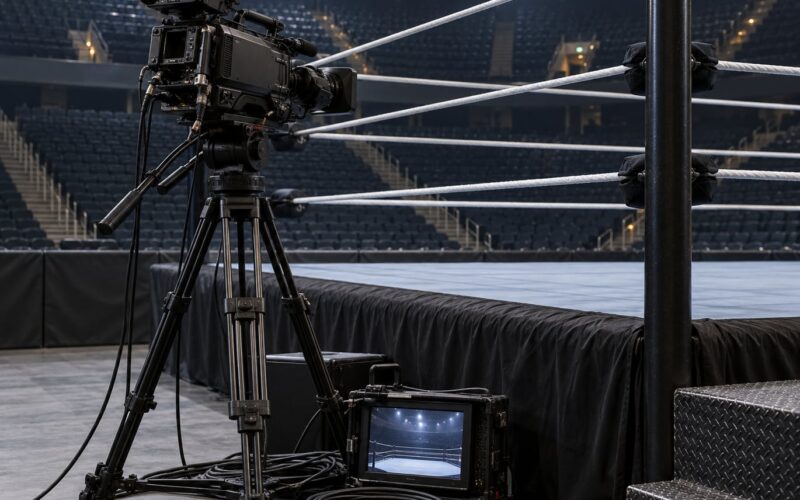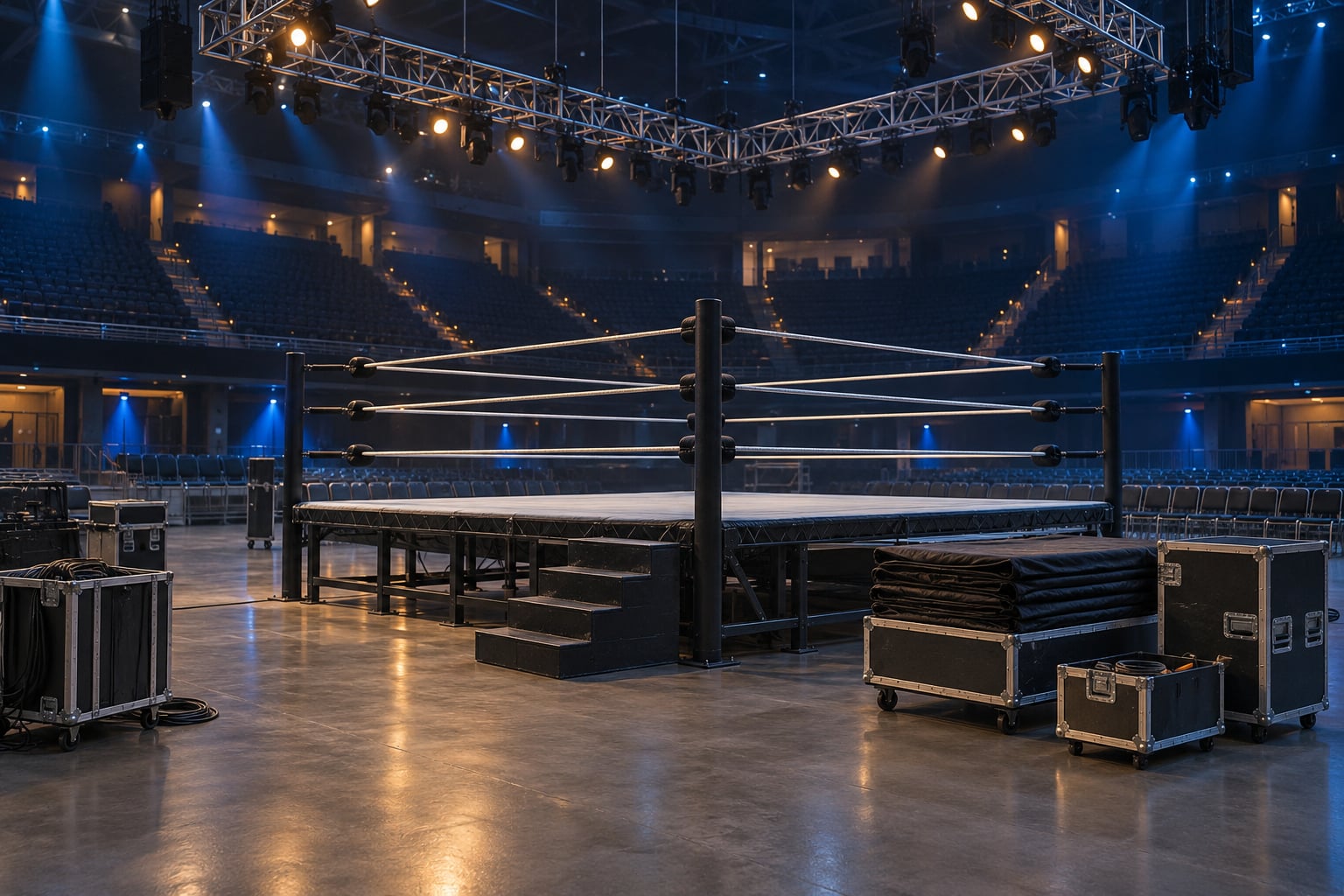
A ring crew builds a wrestling ring from a flat arena floor by bolting together a steel beam frame, laying a wood plank deck across it, adding foam and a canvas cover, then raising the posts, turnbuckles and ropes before tensioning everything. Teardown runs the whole sequence in reverse, ropes first and the frame last. The people doing it are a small, specialized crew that works around the clock, mostly in the hours nobody sees.
Most fans catch a glimpse of this work through time-lapse videos and never think about the timeline behind them. A televised show on a big arena card is not just a three-hour event. Behind it sits a full day, sometimes two, of crews rolling cases through loading docks, arguing about dock doors, and re-tensioning ropes between matches while an audience files past.
This guide walks through how wrestling ring crews set up and tear down a ring, what they carry, how the work changes depending on the show, and what happens when something breaks mid-card. If you are curious about the behind-the-scenes side of a live show, the ring is the best place to start, because every other department has to work around it.
Table of Contents
- What Does a Wrestling Ring Crew Do?
- How Wrestling Ring Crews Set Up the Ring
- How long does it take to set up a wrestling ring?
- What Equipment Does a Ring Crew Prepare?
- How Do Ring Crews Handle Different Show Formats?
- How Do Ring Crews Make In-Ring Changes?
- How Do Ring Crews Tear Down the Ring?
- What Safety Checks Do Ring Crews Make?
- How Do Ring Crews Work Under Time Pressure?
- How Does a Wrestling Ring Crew Coordinate With Production?
- Frequently Asked Questions
- What is a wrestling ring made of?
- How long does it take to set up a wrestling ring?
- What is the typical size of a wrestling ring?
- What are the parts of a wrestling ring?
- Why do wrestlers wipe their feet before entering the ring?
- How do I become a wrestling ring crew member?
- Conclusion
What Does a Wrestling Ring Crew Do?
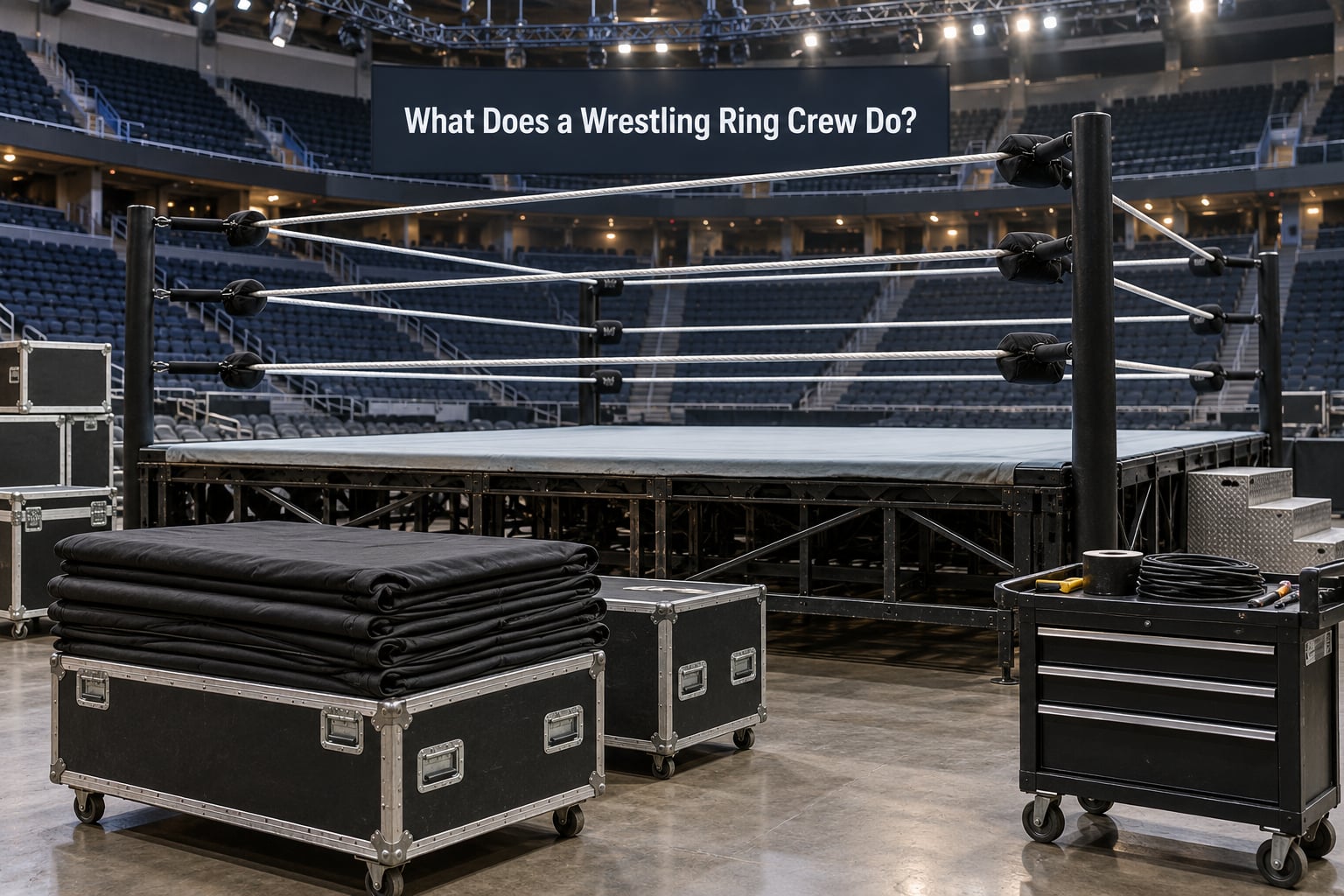
A ring crew handles the physical ring and everything around it: getting the equipment into the building, assembling the ring, keeping it safe, adjusting it during the show, and breaking it down again so it fits back on the truck. On a live show they are also the people who hand props to talent, reset the steel steps, and clear weapons out of the ring between segments.
The crew is not the same as the production team. Production handles cameras, lighting, graphics and audio. The ring crew handles physical infrastructure. A referee checks the ring before a match for legal and safety reasons, but the referee did not build it and would not normally change a rope tension mid-show.
Crew size scales with the venue. An independent show in a wrestling school gym might run with three or four people. A televised arena show usually has more than a dozen hands on the ring at once, split between riggers, stagehands, and production assistants who carry rather than bolt.
| Show type | Typical crew on the ring | Who leads |
|---|---|---|
| Independent school or gym show | 3 to 5 | Promotion owner or head rigger |
| Weekly television taping | 8 to 12 | Setup lead reporting to the stage manager |
| Arena show with a full card | 10 to 16 | Head rigger plus a setup lead and breakdown crew |
| Tournament or special event | 12 plus | Full rigging crew, often with a second ring |
Role titles vary from promotion to promotion, but the jobs break into the same groups. The head rigger owns the truck, the cases and the build sequence. The setup lead works the ring itself with a crew. Riggers handle the truss, the lighting and the overhead elements. Production assistants carry steps, tables and chairs and run small changes. The breakdown crew is the same people, working the load-out in reverse.
How Wrestling Ring Crews Set Up the Ring
Setup begins at the loading dock, not the ring. Cases roll off the truck in an order decided in advance, usually heaviest and longest first, because the frame pieces are what the floor plan is built around. If the ring lands in the wrong spot, everything downstream is wrong.
Here is the sequence a crew follows, in the order they follow it:
- Unload and stage the cases. Every case gets moved to a marked spot away from walkways, keeping the path from dock to ring clear for the venue crew and other departments.
- Lay out the frame footprint. Crews tape or mark the exact square the ring will occupy, checking sightlines from every camera position and the spacing needed for the announce table and barricade.
- Assemble the steel beams. The main beams are laid on edge and bolted together to form the perimeter, with cross beams added inside. This is the stage that carries all the weight.
- Level the frame. Shims and wedges bring the beam tops to the same height so the deck will sit flat. An uneven frame shows up as a bounce in the canvas later.
- Lay the wood plank deck. Boards go across the frame, usually with the grain and seams planned so the finished surface is even and the joins do not line up under the centre of the ring.
- Install the foam padding. Foam panels cover the deck to absorb the impact of a wrestler coming off the ropes or falling off the top. Coverage is the part crews get wrong on a rush job.
- Stretch and fasten the canvas. The canvas cover is pulled taut across the foam and secured around the perimeter. Slack here is what makes a ring feel soft and unstable in the wrong way.
- Raise the ring posts. Posts are bolted to the frame at the corners, checked with a level, and braced. This is where ring height gets decided, and it decides whether an aerial wrestler has room to work.
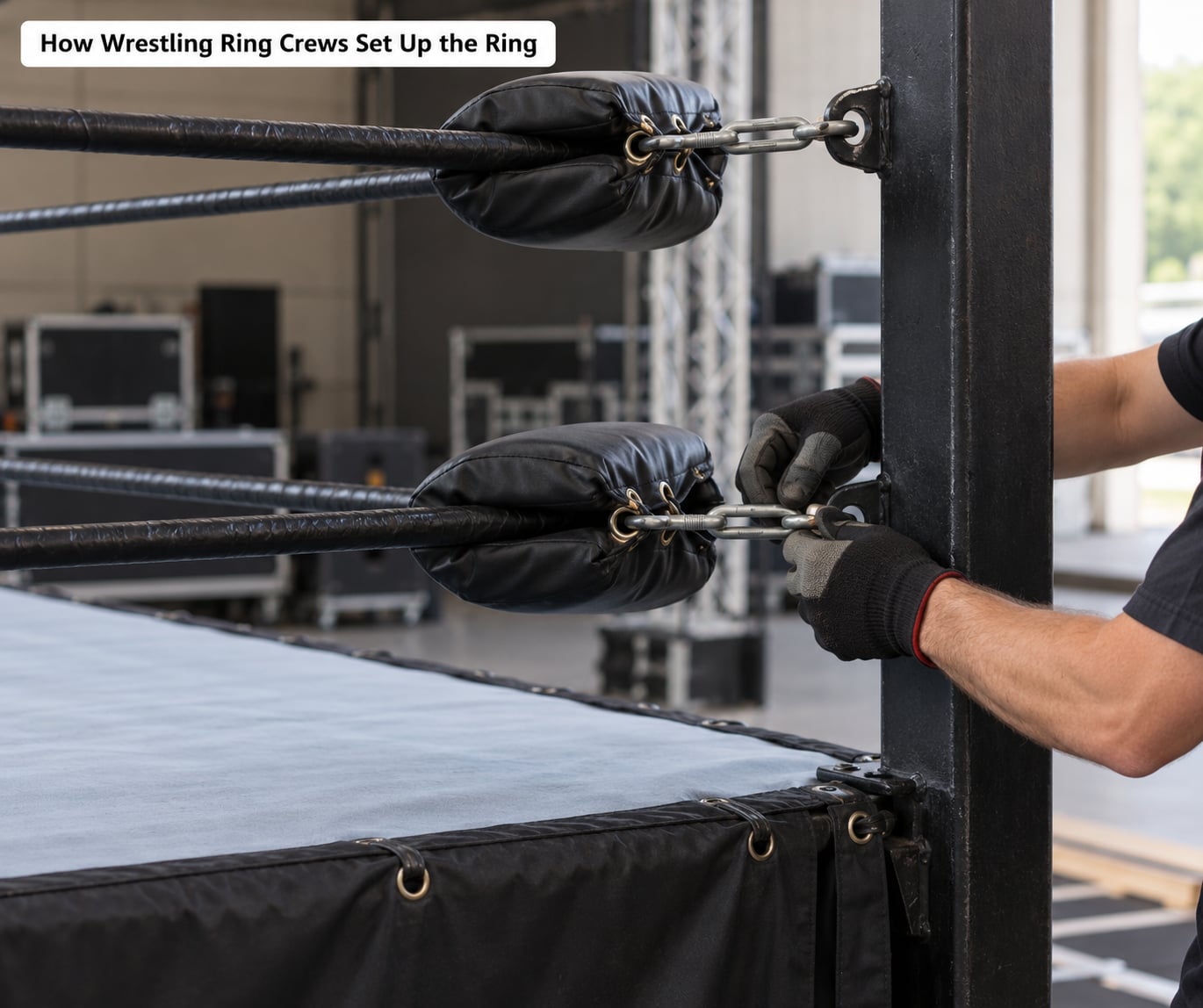
- Fit the turnbuckles. Turnbuckle assemblies attach to the posts at three heights per corner, with pads fitted over them. Loose turnbuckles are one of the most common causes of a mid-show repair.
- Hang the ropes. Ropes run from post to post around the ring. Fiber ropes and steel cable ropes are both used, and the choice depends on the show style and how hard the ropes get worked.
- Tension the ropes. Crews pull each rope to even tension using their tensioning tools, then check it by feel and by sight. A rope tighter than its neighbours reads as a problem to anyone who has wrestled in the ring.
- Fit the apron and skirt. The fabric apron and ring skirt hide the frame from ringside and give the promotion a surface for graphics. It also covers the hardware crews will be working on, so it goes on after the checks.
- Run the safety check. The crew walks the ring, checks every visible bolt, pulls each rope, tests the steps, and confirms the apron is fastened. Only then does the referee get called over for the match check.
How long does it take to set up a wrestling ring?
A full ring build with a trained crew usually takes between sixty and ninety minutes once the cases are in the room. That is the number most crews quote, and it assumes the floor is flat, the dock is close, and nothing needs to be fabricated on site.
Publishers who film time-lapse footage have posted builds at around an hour of real time, which matches that range. UK-style rings with separable middle bars go much faster, sometimes minutes rather than an hour, because the frame comes apart in a handful of large pieces. The trade-off is that those rings are smaller and are built for a different style of wrestling.
| Venue type | Setup time | Teardown time |
|---|---|---|
| Wrestling school or gym show | 60 to 90 minutes | 45 to 60 minutes |
| Hotel ballroom or armory show | 90 minutes to 2 hours | 1 to 2 hours |
| Weekly television taping | 3 to 5 hours, plus rigging | 3 to 5 hours |
| Arena live show | 4 to 8 hours, multiple crews | 4 to 8 hours |
| Backyard or club ring | 1 to 2 days for a first build | 1 to 2 hours to disassemble |
Those figures cover the ring itself. They do not include the truss, lighting, camera platforms, barricades or the announce area, which on a television show often takes longer than the ring build.
What Equipment Does a Ring Crew Prepare?
Everything a crew needs travels in cases that get re-packed at the end of every show. A crew that treats packing as an afterthought loses an hour at load-out the next night.
- Ratchet straps and tensioning tools for pulling ropes to even tension and securing covers during transit.
- Wrenches, sockets and drivers sized to the hardware on that specific ring, since beam bolts are not universal.
- Spare bolts, nuts, washers and pins in a hardware box. Losing one of these mid-build is a classic way to lose twenty minutes.
- Shims and wedges for leveling the frame on an uneven floor.
- Replacement rope, turnbuckle pads and turnbuckle assemblies carried as spares, because ropes are cut and pads get torn.
- Steel steps in pairs, with the bolts kept in the case rather than left in the ring.
- Tape, zip ties, ties and cable ties for temporary routing and cable management.
- Barricade weights and line hardware for the ringside line, which crews set and strike along with the ring.
- Personal protective equipment including work gloves, back supports, safety glasses and steel-toe footwear.
- A cleaning kit with disinfectant, cloths, a mop and a bucket for the canvas between segments.
- Flashlights and a tool bag kept in one place, because work under the ring and behind the barricade happens in poor light.
How Do Ring Crews Handle Different Show Formats?
A televised show and a school-gym show are the same ring built to completely different schedules. The format decides how much time the crew gets, how much of it is visible, and how many ring configurations the card needs.
Television tapings give the crew the most time and the least room to improvise. The schedule runs to the minute, so every configuration change is built into the run of show and rehearsed against the production clock.
Weekly episodes need the ring reconfigured repeatedly. One match needs a table, the next needs no ropes on one side, and a segment later needs an announce table moved. Crews work from a cue sheet rather than reacting.
House shows and indies often run the ring long before doors, and the crew is smaller, so the build is simpler and the changes are improvised. That flexibility is the trade for doing it with fewer hands.
Tournaments and special events usually mean two rings. Crews build both, or build one and move it, depending on the venue and the load-in window. Two rings double the rigger count and halve the time available per ring.
Outdoor and festival shows add the biggest unknown. The floor may be grass or gravel, the load-in may be a field access gate rather than a dock, and every case gets carried further.
Ring size itself varies by region and promotion, and it changes how the build goes:
| Ring type | Inside rope length | Notes |
|---|---|---|
| Large arena ring | 20 feet | Standard for major televised promotions; biggest frame and heaviest build |
| Independent show ring | 18 feet | The most common size at indies and wrestling schools |
| UK-style ring | 14 feet | Smaller and quicker to assemble; requires more running between the ropes |
| Six-sided ring | Variable | Hexagonal layout used for special events; harder on the body and harder to build |
How Do Ring Crews Make In-Ring Changes?
In-ring changes are scheduled work, not improvisation, on any show worth calling professional. The ring crew adds chairs, tables, ladders, weapons tables or extra ropes between segments on a cue from the stage manager, usually during an entrance or while the ring announcer is talking.
The order matters. Anything that changes the ropes gets handled first and needs a new tension check afterward. Anything that sits on the canvas goes in after that. Removing a rope means taking the tension off it properly rather than cutting it, because a released rope under tension whips back hard enough to injure someone standing close.
Steel steps get bolted or set in place with the ring’s own hardware rather than left loose, since a free step slides when someone lands on the ring apron. A crew that rushes a ladder match setup is what turns a planned spot into an injury stoppage.
Clean-up between segments is part of the same job. The canvas gets wiped down, broken prop pieces get pulled out, and the steps go back to ringside before the bell rings again.
How Do Ring Crews Tear Down the Ring?
Breakdown is setup run in reverse, with one difference: it is faster and it happens in the dark while venue staff are trying to close the building. Crews often work under work lights with the crowd gone, and the load-out window is usually shorter than the load-in window.
- Clear props and loose equipment first. Steps, tables, chairs, weapons and the announce gear come out before anything structural is touched. Every case gets checked against a list so nothing travels back to the truck loose.
- Remove the ropes and turnbuckles. Ropes are tensioned off at the turnbuckles before removal rather than cut, and turnbuckle assemblies come off the posts next.
- Take down the posts and the apron. The fabric apron and skirt come off first so the crew can reach the post hardware, then the posts unbolt from the frame.
- Pull the canvas, foam and boards. The canvas is unhooked or unbolted and rolled, the foam panels lift off, and the wood boards come up off the frame.
- Dismantle the steel frame. Cross beams unbolt, then the main beams separate and stack. Hardware goes into the case that belongs to it, not a pile.
- Pack and load. Cases are closed, labeled and counted, then moved to the dock in the reverse of the order they came off, with the heaviest pieces closest to the truck door.
Before the doors open the next morning, someone walks the floor. Rings are heavy and awkward, and a single dropped beam costs a repair visit. That sweep takes five minutes and it happens on every show.
What Safety Checks Do Ring Crews Make?
Professionals are blunt about the standard: every board, bolt, cable and rope gets checked individually, and any of them can be the one that fails. A checklist is not paperwork here, it is the job.
- Bolt inspection on the frame, posts and turnbuckles, with a tap-and-shake check on anything that cannot be seen.
- Rope tension checks after every configuration change, not just once at the start of the show.
- Turnbuckle checks for looseness, since a turnbuckle that shifts under a landing changes the shape of the match.
- Canvas and foam checks for tears, lifted seams and worn spots, plus a look at the boards underneath.
- Step checks for loose bolts and non-slip feet, every time they are placed.
- Barricade and line checks for weights and gaps, plus cable runs taped down at walkways.
- Under-ring inspection for dropped hardware, loose boards and anything the crew left behind.
- Cleaning between matches, which is also a safety measure. Wrestlers wipe their feet before entering because a wet or dusty canvas is a slipping surface, and the wipe-down keeps grit off it.
- Floor condition checks around the ring, especially on surfaces that are not a proper venue floor.
Any item that fails a check gets fixed or replaced before the match, and if it cannot be fixed in time, the segment changes. Nobody has ever heard a safety call get overruled.
How Do Ring Crews Work Under Time Pressure?
Time pressure is the normal condition, not the exception. Television tapings run on a fixed clock, entrances leave a narrow window for changes, and any delay during a match pushes everything that follows.
Crews handle it with a priority order that does not change: safety items first, then the next match’s requirements, then cosmetics. A loose turnbuckle outranks a bent apron graphic every time.
Repairs in front of an audience happen more often than the finished product suggests. A snapped rope can be replaced between matches, a pad can be re-taped, and a step can be swapped. Anything that needs the ring to be empty and the frame to be touched goes to the maintenance list for the next load-in instead of being fixed live.
That distinction matters. Crews track what broke during the show and what was fixed temporarily, because the same failure will show up again at the next venue unless someone changed the part.
How Does a Wrestling Ring Crew Coordinate With Production?
The chain of command keeps a live show from stalling. The stage manager owns the running order and the clock. Crews do not start a change because a match looked like it needed one, they start it when the stage manager gives the cue.
That single rule covers most of the coordination. The stage manager knows what is coming next, what production needs on camera, and how long the transition can take. The setup lead executes, and reports back when the ring is ready.
Camera operators and the production truck influence the ring in practical ways. A ring placed too close to a hard camera position can block the shot or force an awkward angle, and a configuration that hides a wrestler behind a post is a problem worth fixing before the segment rather than during it.
Talent and the referee complete the loop. The referee makes the final match check, wrestlers request adjustments like rope height, and crew changes happen only when the referee has cleared the ring and the stage manager has called the window.
Frequently Asked Questions
What is a wrestling ring made of?
A professional wrestling ring is a portable elevated platform. It starts with a steel beam frame, usually main beams with cross beams inside, topped by a wood plank deck. Foam padding covers the deck, then a canvas cover is stretched and fastened over the foam. Three ring ropes run between steel posts through padded turnbuckles, and a fabric ring apron and skirt hide the frame from ringside.
How long does it take to set up a wrestling ring?
A trained crew building a full ring usually needs sixty to ninety minutes once the cases are in the room. A television taping takes longer because of rigging, camera platforms and barricades, often three to five hours before doors open. UK-style rings with separable middle bars assemble far faster because the frame comes apart in a few large pieces. Teardown runs a little quicker than setup.
What is the typical size of a wrestling ring?
Most major televised promotions use a 20-foot ring, measured between the ropes. Independent shows and wrestling schools commonly run an 18-foot ring, and UK-style promotions use roughly 14-foot rings. Six-sided rings vary by event. Size affects the build: a larger ring has a bigger frame, more boards and more rope tensioning, so it takes longer and moves heavier.
What are the parts of a wrestling ring?
The main parts are the steel beam frame, cross beams, wood plank deck, foam padding, canvas cover, ring posts, turnbuckles with pads, three sets of ring ropes, and the fabric apron and skirt. Steel steps sit at ringside as part of the standard kit. Under the ring there is open space between the beams, which is where talent moves when they go under the ring during an entrance.
Why do wrestlers wipe their feet before entering the ring?
The canvas picks up grit, dust and moisture from the arena floor during a match, and any of those turn a canvas into a slipping surface. Wrestlers wipe their feet at the ropes to keep that film off. Ring crews mop and wipe the canvas between segments for the same reason, and to keep the material in better condition over a long card.
How do I become a wrestling ring crew member?
Start small. Wrestling schools, independent promotions and local armory shows hire the least experienced people for carry and setup work, and that is the normal entry point. Learn the hardware for the ring you are around before you touch it, show up early, and be useful on load-out as well as load-in. Most crews promote from within, and riggers often come from the setup crews first.
Conclusion
Learning how wrestling ring crews set up and tear down a show mostly means learning one sequence and its exact reverse. Steel frame, cross beams, boards, foam, canvas, posts, turnbuckles, ropes, tension, apron, and a safety check before anybody steps inside. Breakdown walks it back in the opposite order, ropes first and frame last.
Start with the structure. Learn what each part does, since every step only makes sense once you know why the piece above it exists. Then build an equipment inventory and a safety list, because that is what separates a crew that can work a hotel ballroom from one that can work a television taping.
Everything else in this workflow is built on those three things.