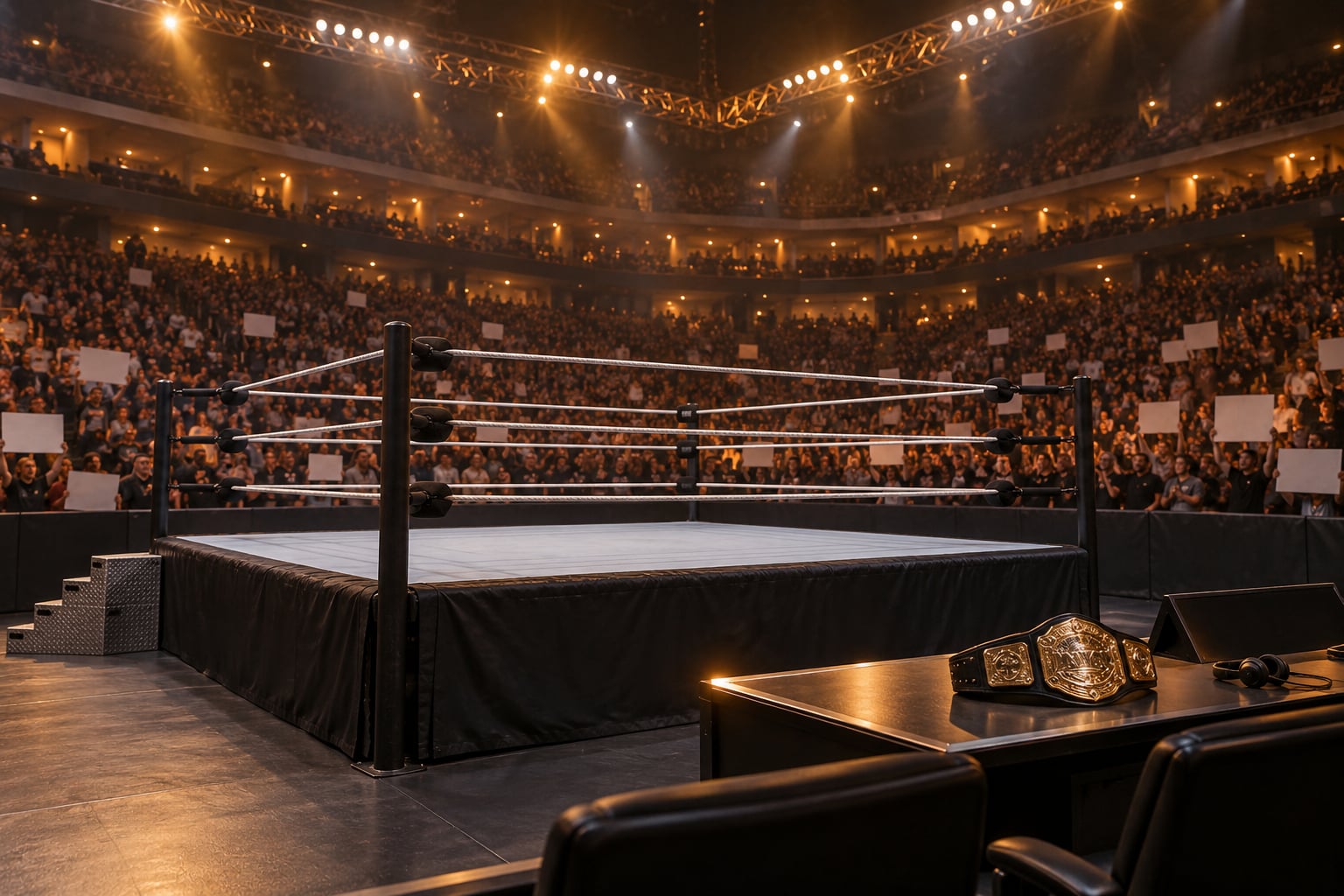
Wrestling crowds became part of the show because professional wrestling was built as theatre in the round with almost no fourth wall. Performers and promoters protect a shared fiction, kayfabe, in front of a live room, then deliberately shape that room’s reactions with entrances, chants, selling and bait. What began as carnival crowd manipulation became a booking feedback loop the industry still runs on.
Table of Contents
- How Did Wrestling Crowds Become Part of the Show?
- Why Did Wrestling Promotions Start Cultivating Crowd Reactions?
- Which Moments Made the Crowd Feel Like Part of the Story?
- How Did Entrance Music, Chants, and Signage Create Shared Rituals?
- How Wrestling Crowds Became Part of the Show in Different Eras
- What Is the Difference Between an Organic Crowd and a Worked Crowd?
- How Do Modern Promotions Invite Crowd Participation?
- Why Do Some Crowds Still Feel Like They Are Watching a Movie?
- Frequently Asked Questions
- Are wrestling crowd reactions always faked?
- Why do wrestlers pause and wait for the crowd after major moments?
- How did Monday Night Raw change the role of wrestling audiences?
- What makes a live wrestling crowd feel like part of the story?
- Can modern wrestling promotions control every cheer or boo?
- Conclusion: Remember the Crowd Shapes the Story
How Did Wrestling Crowds Become Part of the Show?
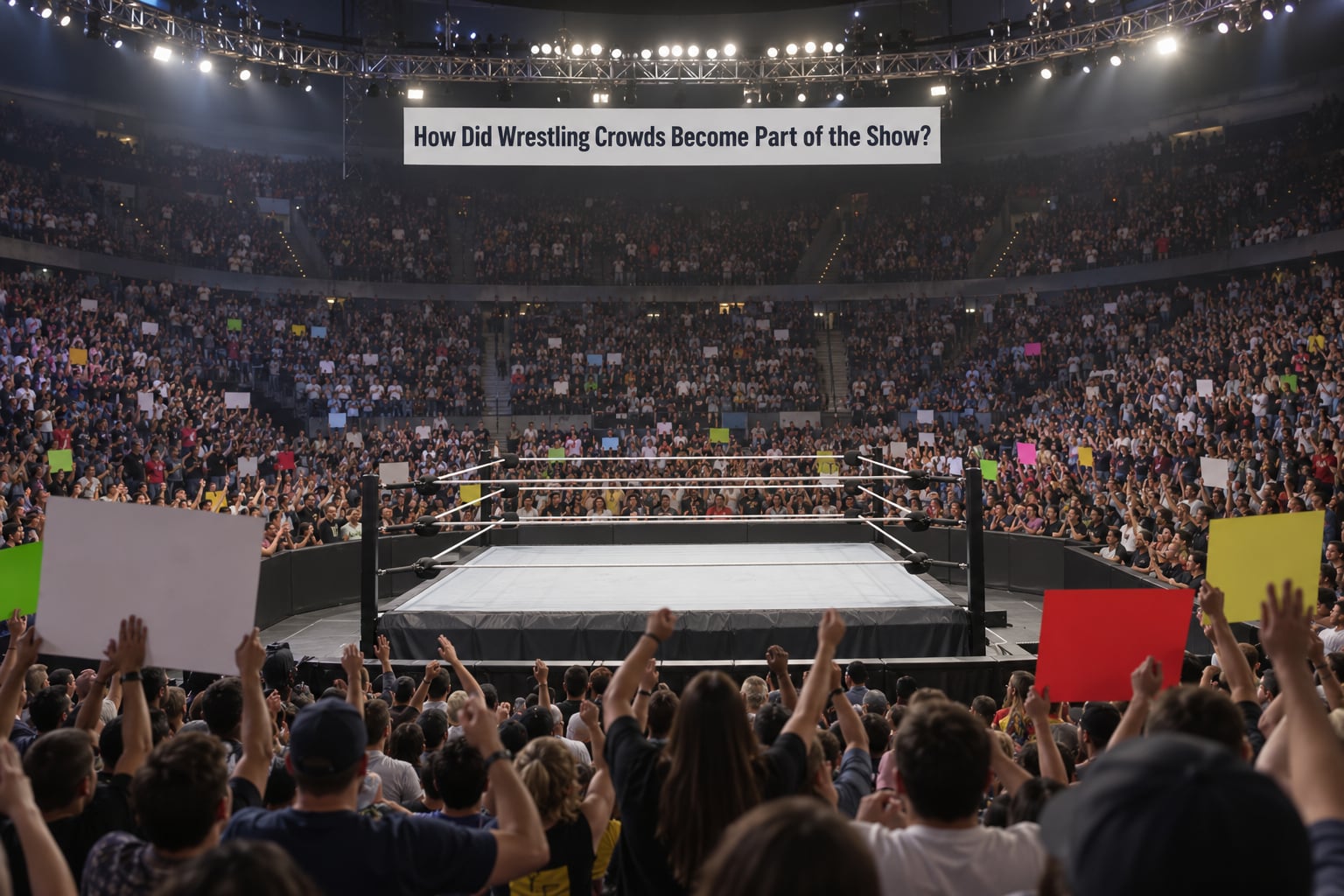
The honest answer has three stages. First, the crowd was an audience watching a contest. Then it became a participant, conscripted into the illusion by the kayfabe contract. Eventually it became the product itself, the thing being sold in the building and on television.
The first stage was never really pure. Carnival wrestling in the late 1800s was a confidence trick wrapped around a genuine athletic contest, and the staged upset was the core unit of the scam: a heavy or second worked man in the audience was planted to let a champion win.
That single device taught the business everything that followed. Spectators became marks to be worked, and the vocabulary of crowd manipulation grew directly out of carnival and sideshow slang. Every later mechanic, from a heel’s staredown to a babyface’s underdog comeback, descends from that one swindle.
Four mechanisms turned spectators into participants:
- Kayfabe is the industry term for the shared fiction that matches are real. Protecting it is a job the crowd is hired for without knowing it.
- Face and heel assignment hands the crowd a required emotional response. One performer needs your cheer, the other needs your hostility.
- Crowd work is the deliberate craft of baiting, selling and stalling to manufacture heat or a pop.
- Booking feedback turns live reaction into decisions about who gets pushed, who turns, and who disappears.
Roland Barthes wrote about wrestling in 1957 as a form of myth, and the crowd is central to that reading. Nicholas Sammond later described wrestling as a performance that depends on its audience for its meaning, and R. Tyson Smith framed the whole business around earning and holding crowd approval.
Why Did Wrestling Promotions Start Cultivating Crowd Reactions?
Because a live room that reacts makes the matches on television work harder, and because a live room that goes quiet tells the promoter exactly what to change.
Television rewired the incentives. A match that runs four minutes on a broadcast needs a story beat every thirty seconds, and the crowd is the fastest available signal for whether a beat landed. Pre-match rants existed largely because television made them necessary, and those rants were described at the time as a way to warm up the audience.
Promotions also learned that crowds are reusable. A chant, a catchphrase or a sign that lands once can be built into the next three cards. A crowd moment that gets a reaction on one show becomes a scheduled segment the following month.
And character credibility runs on crowd consent. A wrestler the room refuses to take seriously cannot carry a main event, no matter how well the match is worked. That is the uncomfortable part nobody outside the business wants to say out loud.
Which Moments Made the Crowd Feel Like Part of the Story?
The moments that work are the ones where the crowd’s reaction is the payoff, not a soundtrack.
Underdog wins are the clearest case. When an obvious favorite loses, the noise in the building is the story resolving, and the person who wanted it most gets to hear it happen. Comebacks work the same way, because a near fall at the right moment gives thousands of people permission to shout at once.
Betrayal is the other one. A turn lands hardest in a live room, where the crowd has spent weeks committing to someone being honest. Conflict with authority figure does similar work. It gives a section of the crowd a shared enemy, and shared enemies are the cheapest way to build belonging in a room full of strangers.
The champion-versus-champion illusion is subtler. When two top wrestlers face each other, part of the crowd wants each man to win. Splitting the room is a form of participation, and the louder half measures itself against the other half.
How Did Entrance Music, Chants, and Signage Create Shared Rituals?
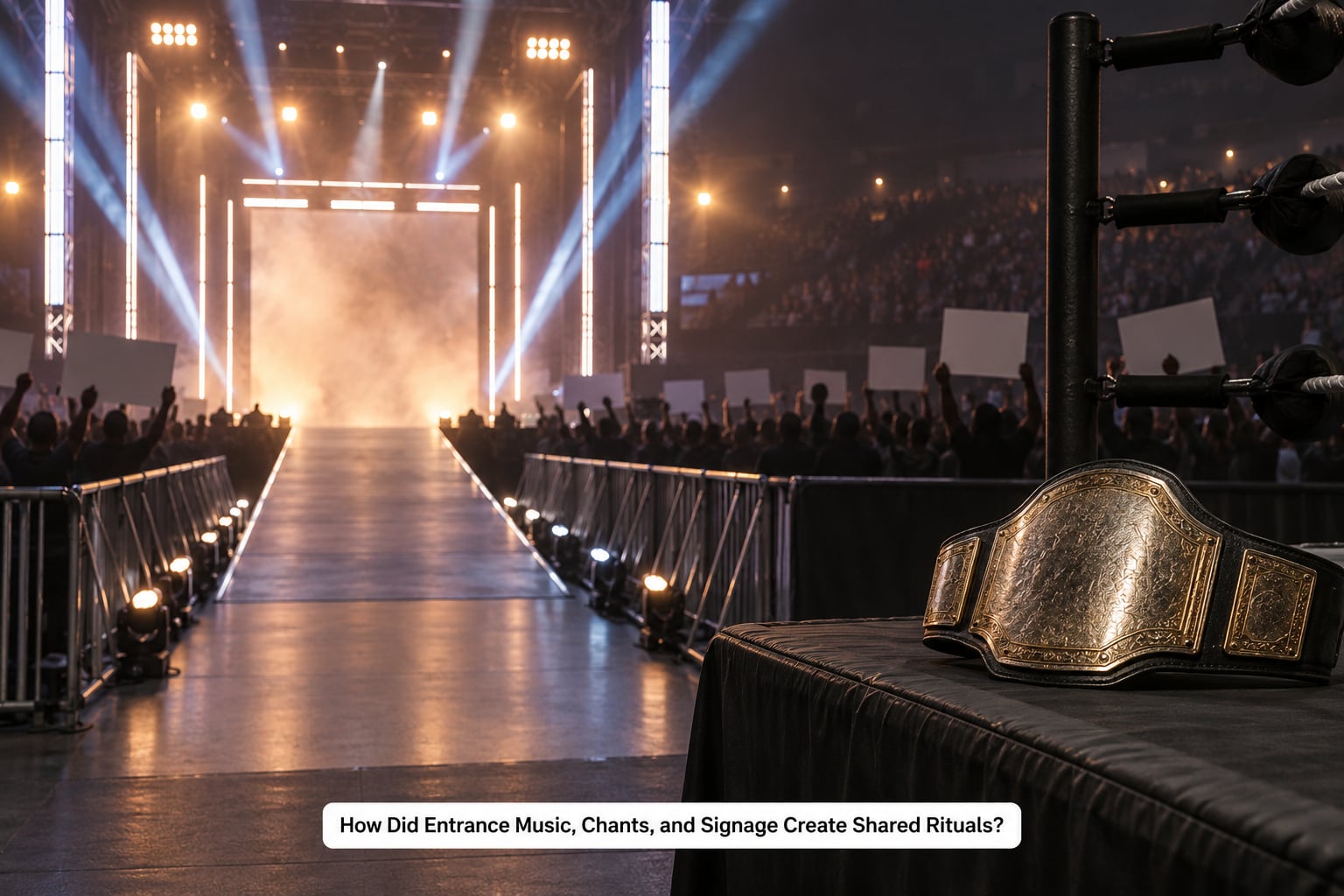
Because a ritual is something a crowd can do without being told, and anything a crowd does by itself is participation.
Gorgeous George is usually credited as the prototype of the modern live wrestling show. Entrance music, a costume routine, a fragrant personality and a doting attendant who handled the crowd for him turned the walk to the ring into a scheduled set piece. His act assumed the room was watching and gave them something to watch.
The audience practices grew alongside. Slow clapping became a way to say the show is boring without leaving. Chants got coordinated enough to travel through sections of an arena. Signs became a form of self-portrait, since a sign is a fan telling a room who they are.
Call and response is the clearest case of a crowd being used as a section of the show. A performer hands a chant to a room, the room hands it back, and the exchange only works if enough people join in. It is the wrestling version of a stadium singalong, and it depends on there being no fourth wall for anyone to hide behind.
How Wrestling Crowds Became Part of the Show in Different Eras
In the territorial era, the crowd was local and knew the performers by name, which meant a wrestler could not be presented to a fresh room. The Monday night boom of the 1980s made crowd energy a headline: announcers would declare a new era loud enough for the crowd to prove it.
The Ruthie Ag era pushed on the cruelty side of participation, with weapon matches and faction warfare that treated the room’s appetite as something to feed deliberately. The era often called sports entertainment broke kayfabe openly and asked the crowd to cheer things it used to boo, which some fans embraced and others never did.
The piped-in-pop era reacted by manufacturing approval through audio and camera rather than trust, and the modern participation era went the other way, building booking around live crowds that are visibly asked to chant, sign and choose.
What Is the Difference Between an Organic Crowd and a Worked Crowd?
An organic reaction is the crowd doing something the performers did not plan for. A worked reaction is a response the show arranged, timed or interpreted after the fact. Most real crowds are a mix of both, which is why the distinction is messier than it sounds.
A pop is a spontaneous positive reaction, and heat is crowd hostility the business treats as success. A hometown pop is the home crowd refusing to cheer the person it came to see, which is a strong enough signal to change a booking. That is the clearest documented case of the crowd overruling the book, and it is usually handled by turning the popular performer into the villain.
Worked reactions happen without any individual fan being directed. A performer points at one section, that section answers, the noise spreads to the neighbours, and the room has produced a pop on its own. Marion Wrenn wrote about how wrestlers and smart fans manage doubt through shared jargon, and that vocabulary is part of why a crowd can be walked toward a reaction without anyone feeling instructed.
Eero Laine’s 2014 work on audience affirmation is useful here too. He argues the crowd’s approval acts as labor that rewards effort and risk, which pushes performers toward more dangerous work, not less. A crowd that cheers a bleeding wrestler is not just enjoying a moment. It is pricing the injury.
How Do Modern Promotions Invite Crowd Participation?
Mostly by asking, out loud. The reliable methods are open microphone sessions before a show, bookings built around reactions the crowd has already given, callbacks to chants the room set up months earlier, and returns announced as surprises so the crowd’s noise is the payoff.
Wrestler-led chants have become a normal part of arena shows, and so has call and response built into entrances rather than left to chance. Crowds at independent shows are usually more participatory than crowds at the biggest events, which tends to get explained as enthusiasm and is more about distance from the performers.
The line to watch is between inclusion and manipulation. The same techniques that let a crowd feel heard can be used to steer a room toward a reaction the creative team already wanted. Forums notice the difference fast. A fan who catches a planted response usually reacts worse to it than to no response at all.
Why Do Some Crowds Still Feel Like They Are Watching a Movie?
Usually because the room has been told in advance what to feel, and the surprise has already been used up.
Predictable finishes are the first cause. When the outcome is settled before the bell and the crowd can tell, the noise stops. Repetitive story beats do the same damage: a wrestler announces the same revenge story every card and the room learns to skip the first two minutes.
Poor pacing is the quieter killer. Long stretches of a match with no story beat leave a room with nowhere to put its energy, and fans have described acclaimed matches falling flat in front of unresponsive crowds, which is an uncomfortable admission that the crowd has become the limiting factor on the audience’s own enjoyment.
Worked interference is a fourth cause. Every manager or faction distraction adds noise without adding emotion, and once a room notices the pattern it starts reacting to the pattern instead of the story. Performers who ignore the room finish the list, because a wrestler who walks through an entrance without looking at anyone reads as a man doing a job rather than a man working a room.
The fix is not volume. It is giving the crowd a job it can finish.
Frequently Asked Questions
Are wrestling crowd reactions always faked?
No. Reactions are shaped, not scripted. Performers bait, sell and time their work to encourage a response, and arenas add crowd noise in post-production for television. But the individual pop that erupts in a building is not controlled note by note. Wrestlers describe chasing a pop they did not plan, and the difference between a worked room and an organic one is usually whether the reaction felt earned.
Why do wrestlers pause and wait for the crowd after major moments?
Because the pause is a request for a reaction, and the reaction is part of the story being told. A wrestler holding a title belt above their head is not posing, they are selling the moment and giving the room permission to react. When the room stays quiet, the pause usually ends quickly. Wrestlers who wait through the silence are giving the crowd one more chance to buy in.
How did Monday Night Raw change the role of wrestling audiences?
It turned the crowd into a nightly broadcast talking point. Announcers would declare that a new era had arrived and hand the mic to the arena to prove it, so the audience became a scoreboard for the show’s own hype. It also ended the territorial habit of introducing wrestlers fresh in each market. National television meant fans already knew who everyone was, and the discovery moment the crowd used to provide had mostly disappeared.
What makes a live wrestling crowd feel like part of the story?
Mostly recognition. Fans who can name who a wrestler is, remember an angle from months ago, and predict the beat they are about to see are reacting as participants rather than spectators. The match results, the entrance, a sign someone brought, or a chant the room catches together are all ways a crowd confirms it understands the story. A crowd that has lost the thread has nothing to react to.
Can modern wrestling promotions control every cheer or boo?
No, and the attempts are usually visible. Promotions can arrange entrances, build around reactions a room has already given, add crowd noise in post-production and put a performer in front of the right section at the right moment. They cannot order two thousand strangers to feel something. The most reliable reactions are still the ones a performer earns by making the moment feel real enough to answer.
Conclusion: Remember the Crowd Shapes the Story
The arc runs from a carnival swindle to a booking model. A staged upset taught the business that spectators are material to be worked, the face and heel split gave every room a job, Gorgeous George turned the entrance into a set piece, and television made live reaction a decision-making input rather than a byproduct.
What to do the next time you are in a building: count how many times the performers stop and wait. Notice which section of the arena gets pointed at and whether the reaction spreads past that section on its own. Watch the faces of people who do not know what is about to happen. That is the crowd doing its job, and once you can see it you cannot unsee it.