To spot resale markup on wrestling tickets, you need three numbers: the announced face value for that seat, the all-in price at checkout once every fee is added, and the all-in price for the same seat on two or three competing marketplaces. The gap between those figures, expressed as a percentage, is the markup.
It takes about ten minutes per event if you know where to look, and it is the difference between buying a ticket at a fair premium and paying a broker’s asking price. This guide walks through nine checks, in the order that saves the most money.
A note before we start: nothing here is legal or financial advice, and rules differ by state and country. Prices move constantly, so every figure below is an illustration of the method rather than a quote for a specific show.
Table of Contents
- What You Need
- Step-by-Step
- Step 1: Open the Full Checkout Breakdown
- Step 2: Find a Reliable Face-Value Baseline
- Step 3: Compare the Seat With the Price
- Step 4: Triangulate the Same Seat Across Marketplaces
- Step 5: Separate Scarcity From Inflated Pricing
- Step 6: Check Fees and Bundled Charges
- Step 7: Verify the Seller and the Ticket Terms
- Step 8: Run the Final Value Check
- Step 9: Know When to Pass
- Common Mistakes
- Frequently Asked Questions
- How much resale markup is normal for wrestling tickets?
- Are official wrestling ticket prices different from resale prices?
- Should I avoid a resale listing with high service fees?
- Is it better to buy wrestling tickets early or at the last minute?
- What should I do if every resale ticket is above face value?
- Conclusion
What You Need
You cannot evaluate a listing until you have a baseline. Gather these five things first, and the rest of the process becomes arithmetic.
The event and seat details. Section, row, seat number, and whether the listing is for one night or a multi-day pass. Wrestling cards are usually stacked, so a Saturday night main event seat and a pre-show ticket are different products with different markets.
A face-value reference. The announced primary price for that event, which you can usually find on the promoter’s own site or the official ticketing page, even when the event has long since sold out.
Comparable live prices. The same section and roughly the same row on at least three resale platforms, captured at the same moment. Prices on different platforms shift through the day, so a comparison built an hour apart is worthless.
The full fee list. Service fee, facility fee, processing fee, delivery charge, taxes, and any required add-on. Some platforms hide these behind an include-fees toggle, some reveal them only on the payment screen.
The final checkout total. The number that actually leaves your account. In wrestling, the difference between the advertised price and this total is frequently larger than the markup you were trying to measure in the first place.
One small habit pays off more than any other: work in all-in prices from the very first comparison. Get-in prices, the headline number on most seat maps, are marketing. They exist to make a listing look cheaper than it is.
Step-by-Step
Step 1: Open the Full Checkout Breakdown
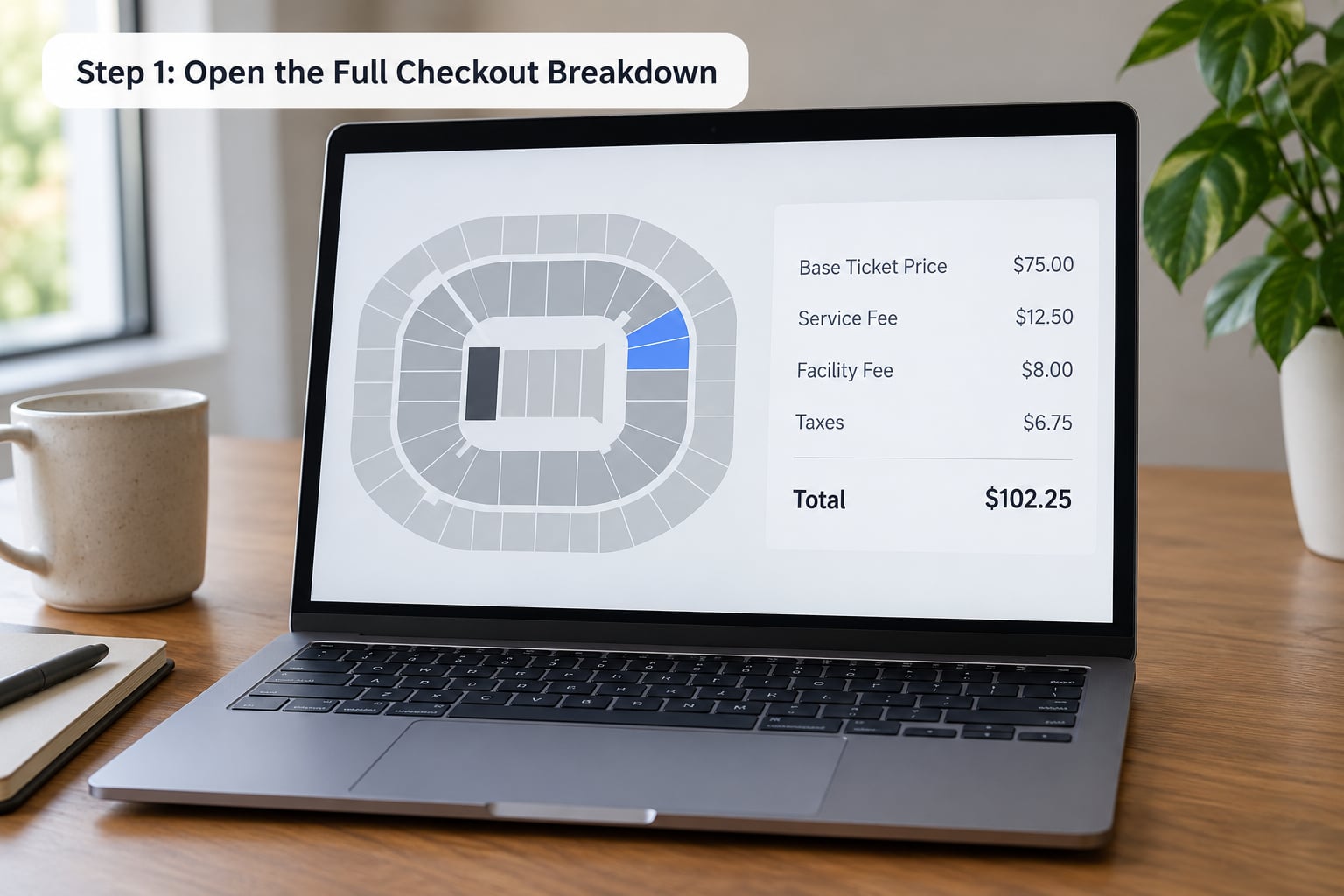
The first thing to do is force every fee into the open before you judge anything. On most resale platforms there is an include-fees toggle near the price filter. Turn it on and the seat map re-sorts by what you will actually pay, which frequently reorders the entire page.
Read the breakdown line by line. Look for the base ticket price, a per-ticket service fee, a facility charge that scales with the face value of the seat, processing fees, delivery or mobile-entry charges, and taxes. Some platforms bundle these into a single figure and some itemise them, which is exactly why two listings can look identical and total very different amounts.
Write down the final total. That is your only working number for the rest of this process. If the platform will not show fees before the payment screen, treat the total as unknown and keep looking elsewhere, because a listing you cannot price is a listing you cannot evaluate.
Step 2: Find a Reliable Face-Value Baseline
Face value is the price the promoter originally charged through the official vendor. It is the denominator of every markup calculation, and without it you are just comparing one asking price to another.
Look for the announced on-sale prices for the event on the promoter’s announcement or the official ticketing page. Those tiers are usually published by section group: floor, lower bowl, upper deck, and riser where risers exist. For premium live events, watch for multi-tier pricing where the same physical seat is sold at several different face values depending on the night.
Do not assume one face value applies to the whole building. Comparing a resale upper-bowl ticket against a floor face value produces a dramatic percentage that means nothing. Establish the baseline for your specific section, on your specific night, and note that multi-day passes carry their own structure that resale listings often price as a single ticket.
Step 3: Compare the Seat With the Price
The same section name does not mean the same seat. Arena configurations change sightlines dramatically, and a front row behind a hard camera position can be worse than a mid-bowl seat twenty rows back.
Check four things: the row, the obstruction flag, the distance from the ring, and whether the view is seats-only or includes a table. Wrestling in particular rewards proximity to the hard camera, because that is the angle the broadcast uses. Fans on r/WrestlemaniaPlans routinely weigh that trade-off when deciding whether to sell a good seat and upgrade to something closer.
The mistake here is comparing premium resale inventory against budget inventory. If the cheapest tickets for the event are unsold upper-deck seats, then a floor ticket priced well above the cheapest listing is not evidence of a scam. It is evidence that floor seats are worth more, which you already suspected. Judge each seat against other seats like it, never against the bottom of the page.
Step 4: Triangulate the Same Seat Across Marketplaces
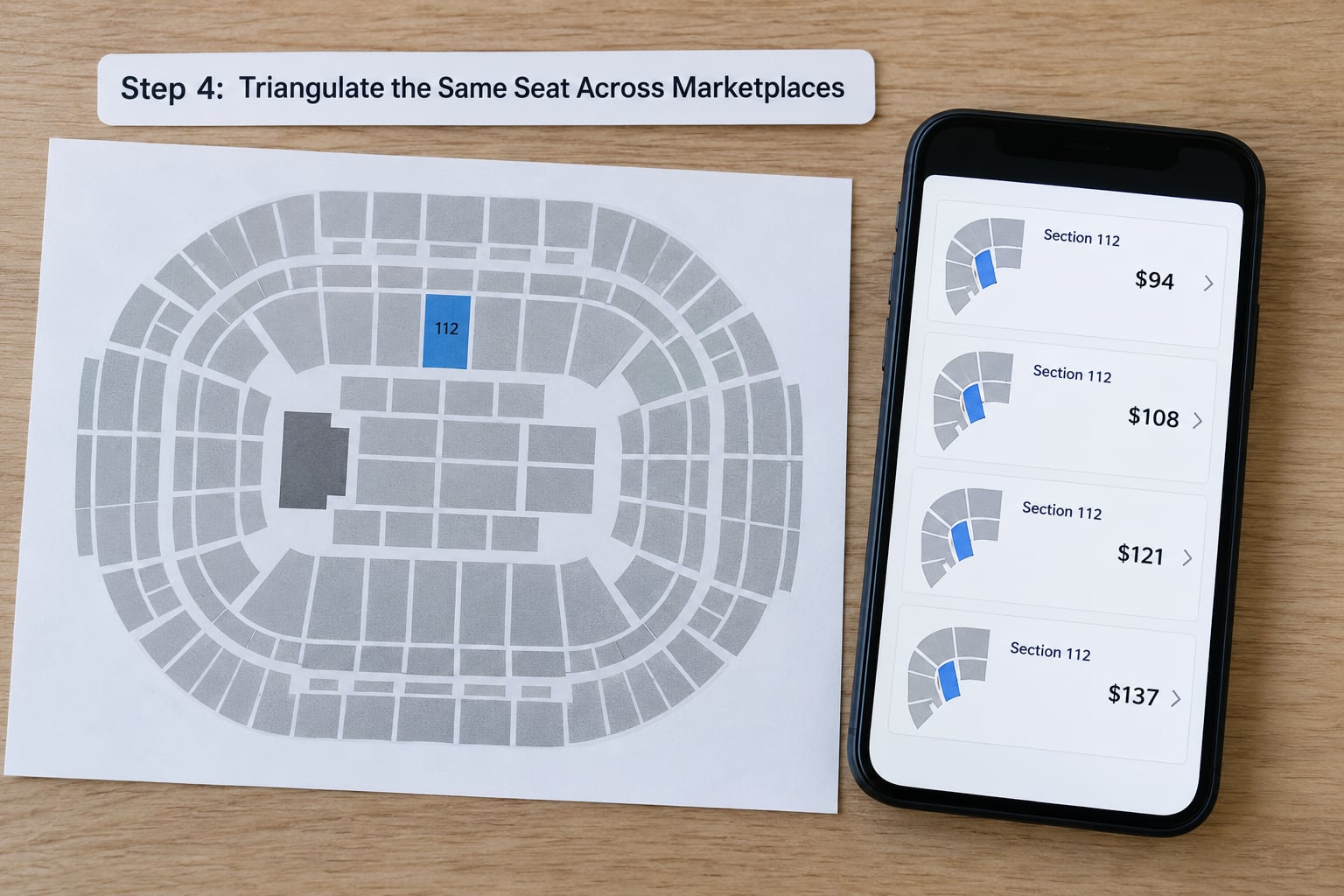
Pick one seat, section and row combination. Open it on at least three resale platforms within the same session and record the all-in total on each. This single habit catches most inflated listings, because a seller who is genuinely offering the market price has no reason to price far above competitors selling the same row.
Cross-listing triangulation also exposes the reverse problem. If a listing looks far cheaper than every comparable seat, that is not automatically a bargain. On a sold-out event, an implausibly cheap listing is a red flag rather than a deal, because legitimate sellers of that seat are not leaving money on the table.
Two platforms handle this differently and it matters. TickPick is frequently recommended in fan communities because it charges the buyer no fee, shifting the cost to the seller. SeatGeek is valued for its include-fees toggle. Comparing one of those against a high-fee marketplace without normalising for fees produces a false gap, which is why the all-in number is the only fair comparison.
Step 5: Separate Scarcity From Inflated Pricing
Some price gaps are real. A sold-out WrestleMania weekend and a Wednesday night television taping are not the same market, and no amount of checking makes one comparable to the other.
Genuine scarcity has identifiable causes: limited floor inventory, a card built around a headlining name, or a small venue where the best seats number in the hundreds. Unjustified inflation has different causes, and these are the ones to look for.
Speculative blocks are inventory a broker has bought and hopes to sell later, often at a price set before demand exists. Duplicate listing screenshots across unrelated sellers mean one block is being pushed by several storefronts. Papering, where complimentary tickets are distributed to create an appearance of demand, has the same effect on pricing without any real willingness to pay behind it.
The diagnostic worth knowing is the gap between tickets sold and tickets distributed. Wrestling attendance reporting draws a distinction between net paid admissions and total circulation, and a house heavily inflated with comps can look scarce on paper while the resale market treats the event as ordinary.
Step 6: Check Fees and Bundled Charges
Fees are where honest listings get expensive. The markup on a ticket can be modest while the fee load is severe, and that combination is where budget buyers lose track of what they are paying.
Check for a per-ticket service fee, a facility charge calculated as a percentage of face value, a processing fee applied at payment, a delivery or transfer charge for physical or digital delivery, and taxes. Secondary marketplaces commonly land in a band of roughly twenty to thirty percent when these are added together, though the exact structure differs by platform and by who is selling.
Also watch for required bundles. Some listings include a mandatory add-on, an unnecessary insurance product, or a premium upgrade that is quietly bundled rather than offered. A listing whose price cannot be separated from its add-ons is not cheaper, it is just less transparent. You should be able to see the price of the seat alone.
Step 7: Verify the Seller and the Ticket Terms
A higher price can be justified by what sits behind it, so read the terms before you decide the number is inflated. Buyer protection, refund windows and transfer method all change the real risk of a purchase.
Look for a named guarantee on the platform, coverage for cancelled or rescheduled events, and a delivery method inside the official ticketing ecosystem rather than an emailed PDF. A ticket that arrives through the original issuer’s transfer system can be verified by anyone; a screenshot can be reused indefinitely.
Seller behaviour is the other half. Sellers who will not transact through a platform with escrow or buyer protection are asking you to accept the risk yourself, and fans on r/SquaredCircle are consistent about one thing: payment sent outside a protected platform is where most wrestling ticket scams happen. Instant transfer apps, wire requests and direct messages offering below-market deals are deal-breakers, not deals.
Step 8: Run the Final Value Check
Now do the arithmetic. Take your all-in checkout total, subtract the fees, and compare what remains with the face value for that exact seat.
Markup percentage = (resale price minus face value) divided by face value, multiplied by 100.
Worked through with round numbers: a seat whose face value was 100, resold and paid at 135 all-in after fees, carries a markup of 35 percent. That is a modest premium and most fans accept it without hesitation for a sold-out event they care about.
The same seat at 250 all-in is a 150 percent markup. On major cards, r/SquaredCircle threads routinely report secondary market markups in that 150 to 200 percent range, which tells you two useful things. First, that premium is normal for the biggest events of the year. Second, that once you are in that range, price stops being a signal of quality and becomes purely a reflection of demand.
Set your walk-away number before you start browsing rather than after you fall in love with a section. For most weekly television shows, anything under roughly 50 percent over face value is defensible. For a premium live event, anything under double is a conversation. Above those lines you are paying for the event’s popularity, not the seat’s quality, and a better section on resale may genuinely be cheaper.
Step 9: Know When to Pass
Some signals mean stop searching, regardless of how good the seat looks.
Pass when the all-in price is more than double the face value for an ordinary show. Pass when a sold-out event carries a listing dramatically cheaper than every comparable seat. Pass when the seller resists protected payment, cannot name the seat view, or sends a screenshot instead of a transfer.
Pass when fees only appear at checkout. Pass when the same seat map image appears across several unrelated sellers, which usually means one speculative block rather than an opportunity.
Also pass when you have checked three platforms and this listing is the priciest by a wide margin. There is no hidden value in being the highest-priced seat in the building when the same row is available elsewhere for less. Reset, compare other sections, and only come back if demand pushes prices down before the show.
Common Mistakes
Most buyers who overpay are not being tricked. They are making one of eight predictable errors.
Comparing advertised prices instead of all-in totals. The cheapest seat map is rarely the cheapest purchase. Turn on fees before you compare anything.
Judging value by the section name alone. Floor in one arena configuration is not floor in another. Check row, obstruction and hard camera sightline.
Anchoring on the single lowest listing. The bottom of the page sets a reference price that has nothing to do with what similar seats cost. Use the median of comparable listings instead.
Treating a cheap listing on a sold-out event as a bargain. It is more often a bait listing or a duplicate of a block being recycled.
Buying without reading the guarantee. A slightly higher all-in price with real buyer protection can be the cheaper purchase overall.
Paying outside the platform. No fee saving survives a ticket that never arrives.
Assuming prices only go up. Last-minute drops are common once sellers realise they cannot fill a seat, and buyers who waited a few days routinely find cheaper inventory.
Ignoring resale limits. Some events cap the number of resale tickets per person and restrict transfers. These rules change between shows, so read the event’s own terms before you build a plan around multiple seats.
Two habits fix most of the above. Compare everything all-in, and always triangulate one seat across three platforms before committing.
Frequently Asked Questions
How much resale markup is normal for wrestling tickets?
It depends entirely on the event. For weekly television tapings, resale prices often sit at or near face value, and anything above roughly 50 percent over is worth questioning. For premium live events and WrestleMania weekend, fan communities routinely discuss secondary markups in the 150 to 200 percent range as normal for a sold-out card. Judge the premium against the demand for that specific show, not against a fixed rule.
Are official wrestling ticket prices different from resale prices?
Yes, and the gap is the whole point. Official tickets are sold first, through the promoter’s chosen vendor, at announced face value set before the event. Once that inventory is gone, resale sellers set their own prices based on live demand, and buyers pay that price plus marketplace fees. The two prices are answering different questions: face value reflects what the promoter chose to charge, resale reflects what fans will actually pay.
Should I avoid a resale listing with high service fees?
Not automatically. High fees are a reason to compare, not a reason to reject. Secondary marketplaces commonly add fees that push the all-in total twenty to thirty percent above the advertised price, and a high-fee listing can still be cheaper than a low-fee listing for a worse seat. Turn on the include-fees toggle, compare final totals for comparable seats, and only walk away if the fee load survives that comparison.
Is it better to buy wrestling tickets early or at the last minute?
Early buying locks in a seat and a price when inventory is plentiful, which suits anyone planning travel or attending with a group. Waiting usually helps on ordinary shows, where unsold inventory drops in the final days and sellers start clearing seats they cannot fill. Waiting is risky for premium live events and WrestleMania weekend, where prices usually climb as the card approaches and good seats disappear entirely.
What should I do if every resale ticket is above face value?
Accept that you are buying from a secondary market and stop treating face value as a target. Instead, pick your seat quality first, then find the cheapest all-in price for that quality across three or more marketplaces. Upper-bowl and riser seats on major cards often cost more than premium seats at weekly shows, which is a market signal rather than a scam. If nothing fits your budget, changing sections or dates beats paying more for the same view.
Conclusion
Start every search with the all-in checkout total, not the advertised price, and compare that number against the same seat on at least three marketplaces before you commit.
When face value is known, the markup percentage takes ten seconds to calculate, and a premium only makes sense when the seat, the seller protections and the event demand all justify it. Otherwise, another section or another night will almost always be cheaper.