A Money in the Bank cash-in is when the wrestler holding the briefcase contract interrupts a match to challenge the reigning champion for their title on the spot. If you win the briefcase, you can cash it in for a title match at any time and any place of your choosing, as long as you do it within one year of winning it. Everything below breaks down how the contract, the deadline and the cash-in itself actually work.
Last updated for 2026. Rules shift from promotion to promotion and from season to season, so the announced stipulations always come first.
Table of Contents
- What Is a Money in the Bank Cash-In?
- How Does a Wrestler Win the Money in the Bank Briefcase?
- What Does the Money in the Bank Contract Allow?
- When Can the Winner Cash In?
- How Money in the Bank Cash Ins Work at a Typical Event
- Why Does the Timing of a Cash-In Matter?
- Can a Wrestler Decline or Lose a Cash-In?
- How Have the Money in the Bank Rules Changed?
- Frequently Asked Questions
- How much money does the winner of Money in the Bank receive?
- Does the defending champion have to defend the Money in the Bank contract?
- What happens if the Money in the Bank winner does not cash in?
- Can both wrestlers cash in their contracts during the same match?
- Does a Money in the Bank contract have to be cashed in at a pay-per-view?
- Conclusion
What Is a Money in the Bank Cash-In?
A cash-in is a title match the holder gets to demand, on their own schedule, because they hold the briefcase. It is not a bag of prize money and it is not a deposit in an actual bank. The case is a prop that represents a written contract, and that contract is the whole point.
The wrestler who grabs the case from above the ring during a Money in the Bank ladder match becomes the holder. They carry it on their shoulder, usually with a custom made for that specific wrestler, and they keep it until they use it.
The traditional promise is simple: any time, any place, any championship, within one year. Those four conditions are what make the gimmick dramatic, because the champion knows a title change could arrive on any show, in any arena, without warning.
How Does a Wrestler Win the Money in the Bank Briefcase?
The standard method is a multi-person ladder match with a briefcase hanging above the ring. Win the match, climb the ladder, unzip the case, and you become Mister or Miss Money in the Bank.
Most events use a qualifying structure. Eight wrestlers face off in qualifying matches on television, four advance, and those four race for the case on the pay-per-view. Ladder match formats vary widely, with fields ranging from about five competitors up to ten depending on the year and the brand.
Not every winner comes from a ladder match. Titles can change hands at qualifying matches, tournaments have their own bracket rules, and a champion can win the contract during a title unification. Some formats put the holder’s defence on the line, meaning the case itself is the prize.
One qualification detail worth knowing: a reigning champion is usually not eligible to compete for the briefcase, so the current titleholder cannot cash in on themselves. That exemption is a booking decision, not a permanent rule of the gimmick.
What Does the Money in the Bank Contract Allow?
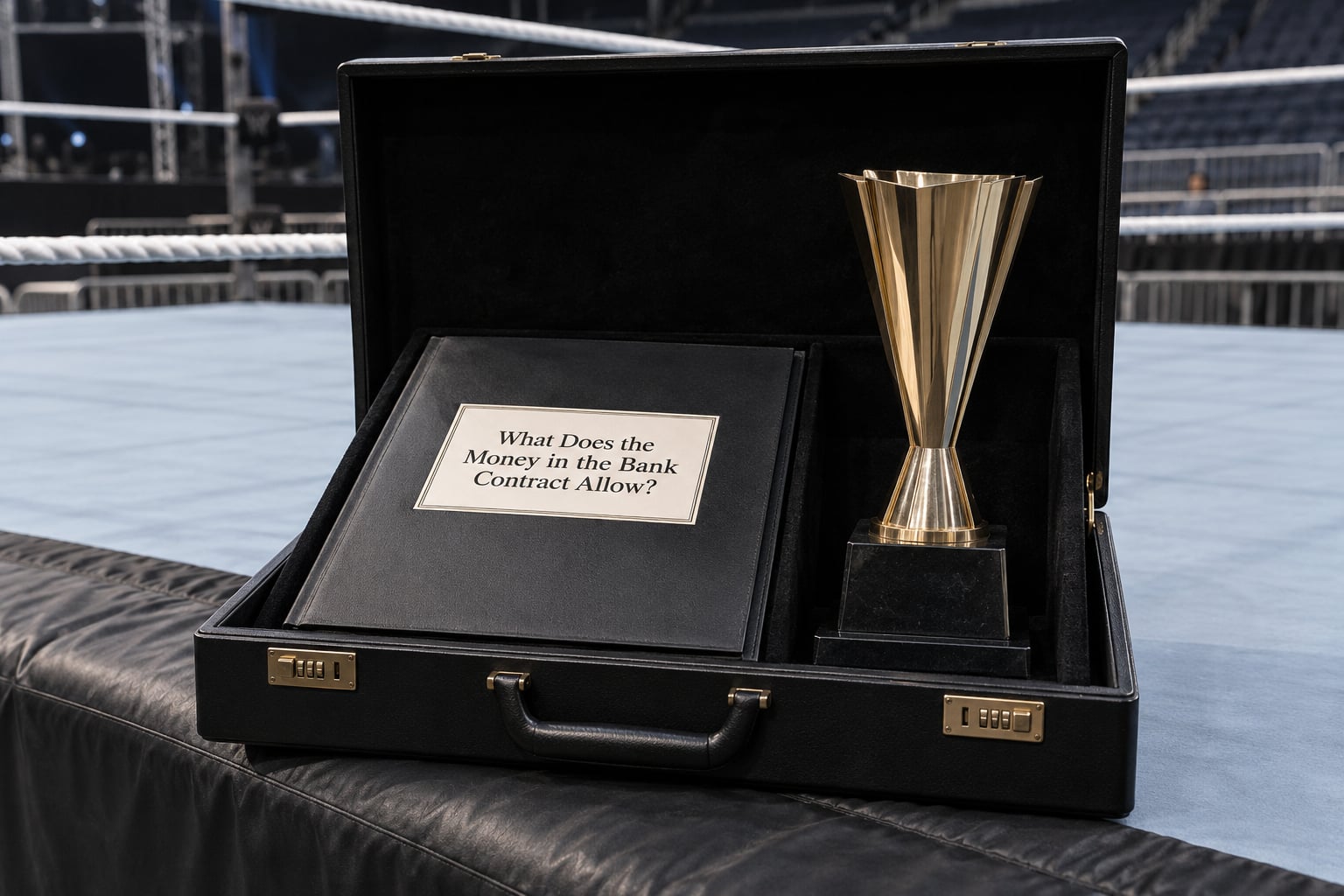
The contract gives the holder one guaranteed opportunity to compete for a championship, not a specific amount of money. The written figure on the paperwork has risen over the years as an in-story nod to inflation, but the payout is negotiated by the promotion.
Which title you go after is usually your decision too. The original deal covers any championship in the promotion, which is why holders have pointed themselves at world titles, secondary titles and tag titles in different years.
| Rule | What it means in practice |
|---|---|
| Any time | The holder picks the moment, on a live show or at an event |
| Any place | The cash-in can happen on television, not only at a pay-per-view |
| Any championship | The holder chooses which title to challenge for |
| Within one year | The contract expires if it is not used before the deadline |
| Must be a title match | Cashing in against a non-champion forfeits the opportunity |
| Briefcase surrendered | The case goes to the referee and the contract is spent once you win |
Physical possession is the proof. If the holder cannot produce the case at ringside, the cash-in does not count. That single detail causes most of the strange situations fans argue about.
When Can the Winner Cash In?
The usual answer is any time within one year of winning the briefcase. There is no mandatory window and no required build-up, so a holder can announce on a Tuesday show and cash in the same night.
The expiration timing matters more than people expect. The clock runs from the moment the case is won, not from the start of the calendar year, and WWE has adjusted the deadline when a holder’s schedule or a championship’s status made the original date awkward.
WrestleMania is the exception people remember. Several years have tied the deadline or the cash-in itself to the biggest event of the season, which removes the suspense of a surprise cash-in because everyone knows the date.
Promotion-specific clauses do exist. If a contract targets a championship that gets vacated or renamed mid-year, WWE has adjusted the terms rather than let the contract sit useless. Always check the stipulations announced for a specific match or season, since the details are not identical every year.
How Money in the Bank Cash Ins Work at a Typical Event
The scene itself is short and repeatable, which is why it works on a two-hour broadcast. Here is the usual sequence.
- The announcement. The holder’s music plays during a match already in progress. That opening moment is the payoff of weeks of guessing.
- The entrance and interruption. The holder walks to the ring, steps through the ropes and usually hands the briefcase straight to the referee.
- The bell rings. A formal match begins with the champion defending the title, and often the cash-in is under explicit no-disqualification or no-contest terms.
- The pinfall. Winning the match takes the championship on the spot. The belt changes hands in front of the crowd with no tournament or rematch clause.
- The exit. The case leaves with the referee and is never returned, so the holder cannot reuse it.
That is the clean version. Modern formats have stretched it: the cash-in can happen mid-match, turning a singles bout into a triple threat, or it can happen on the same card as the ladder match itself. Dean Ambrose, Kane and Alexa Bliss all cashed in on the same night they won their briefcases.
The mid-match version exists for a reason. Interrupting an in-progress match means the holder can pick the moment when one wrestler is already worn down, and that is how a cash-in turns into a main event without anybody scheduling one.
Why Does the Timing of a Cash-In Matter?
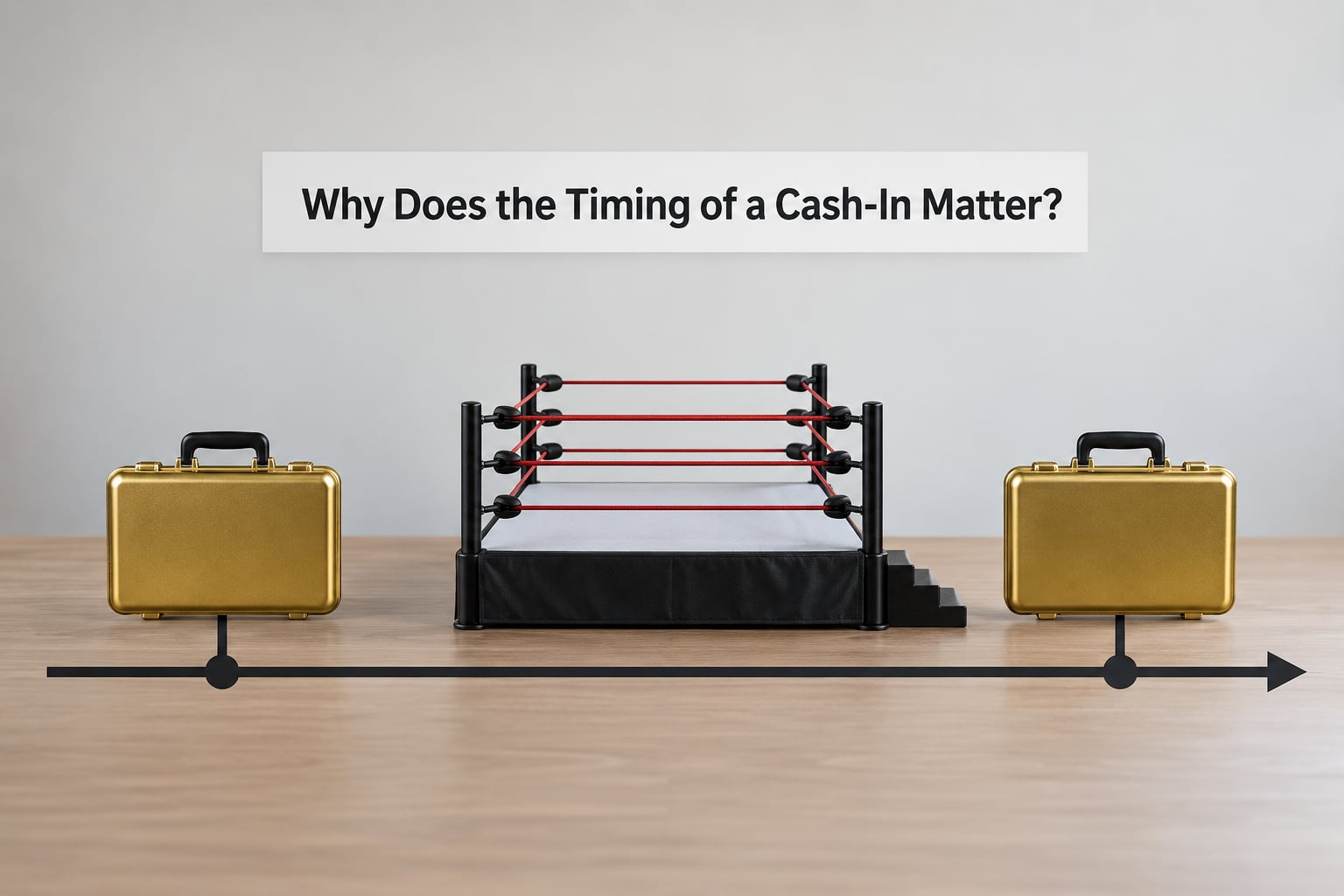
Timing decides whether a cash-in is a headline or a footnote. Cash in immediately after winning the case and you get surprise, momentum and a clean story beat. Wait and you get anticipation, but you also risk the champion having somewhere to go next.
An early cash-in protects the holder. Injuries, booking changes and titleholders moving to other brands can quietly kill a long-held contract. Several wrestlers have held the case for months with no announced plan, and some of those contracts simply expired.
A delayed cash-in builds a story. Edge versus John Cena at New Year’s Revolution in 2006 is the example fans still point to, because the challenger had been the underdog champion for months and the switch felt earned. A year-long setup gives that finish time to land.
There is also the avoidance factor. Cashing in the same night you win is safer but more predictable, so holding the case lets the holder choose an opponent they can actually beat. The theoretical champion can wait for the right match.
The trade-off is that suspense wears down. Fans know the holder will eventually cash in, so a delayed cash-in can feel like waiting rather than tension. That is the complaint that comes up most often in fan forums.
Can a Wrestler Decline or Lose a Cash-In?
Yes, in several different ways, and fans routinely mix the categories up. Knowing how each one works makes the history much easier to follow.
A failed cash-in is the simplest. The holder cashes in correctly, loses the match, and the contract is gone. John Cena against Damien Sandow, Baron Corbin against AJ Styles, Austin Theory against Roman Reigns and Drew McIntyre against Jey Uso are the ones fans cite most.
A reversed cash-in is when the match happens and the finish is overturned on review. Daniel Bryan cashed in against Mark Henry at TLC in 2011 and appeared to have won the World Heavyweight Championship before the decision was reversed.
An aborted cash-in is when the cash-in never becomes a match at all. Cena versus CM Punk at Capitol Punishment in 2011 is the standard example, with the contest ending before any finish.
A lost briefcase is the fourth category. Matches have been made specifically for the contract to change hands, so a case can be taken from someone who has not used it. Transfer rules vary by promotion, which is one reason the current holder’s status is usually announced rather than assumed.
How Have the Money in the Bank Rules Changed?
The stipulation has been rewritten repeatedly since it began in 2005, but the broad arc is steady. The original cash-in matches were plain singles bouts for a title, with the case as the trophy.
The women’s version arrived in 2017, opening a ladder match to a division that had no equivalent opportunity. That change is why records lists now show separate winners for both contracts.
Case designs have been personalised for years, with custom colours, names and strap styles for each winner. Briefcase matching changed too: recent events have put an identical case on the line during a title match, so winning the championship also wins the contract.
Other shifts: direct-entry opportunities without a full qualifying ladder match, WrestleMania exceptions to the deadline, cash-ins on weekly television instead of only at events, and cash-ins interrupted mid-match. Each one trades a little suspense for flexibility.
Record lists are dominated by a small group of names. Edge, The Miz, CM Punk, Seth Rollins and Damian Priest have all taken the case multiple times, and Drew McIntyre has accepted more chances to cash in than anyone else. The exact numbers shift as WWE adds new formats, so check a current record list before quoting one.
One clarification for anyone who searched how money in the bank cash ins work and found video game instructions instead. There is no code or code entry involved in the WWE briefcase. Cash-in menus from WWE 2K Universe Mode are a game mechanic and have nothing to do with how the television stipulation operates.
Frequently Asked Questions
How much money does the winner of Money in the Bank receive?
No real money is involved. The briefcase holds a written contract that guarantees a championship match at any time within one year. The dollar figure printed on the contract has grown over the years as an in-story nod to inflation, but the actual amount is set by the promotion and never paid out on television.
Does the defending champion have to defend the Money in the Bank contract?
Yes. Once the holder produces the briefcase, the champion has to accept the match, and the cash-in is usually contested under no-disqualification or no-contest terms. Refusing is not an option in the gimmick, which is exactly why champions spend months watching for that music cue.
What happens if the Money in the Bank winner does not cash in?
The contract expires, usually one year after it was won, and the briefcase leaves with the holder. Some wrestlers have held the case for months without a stated plan, and a few have let the deadline pass entirely rather than cash in at a moment that weakened their position.
Can both wrestlers cash in their contracts during the same match?
Only if two separate contracts are in play, which is rare but has happened. The usual version is one holder interrupting a match in progress, which turns the bout into a triple threat. Both cash-in wrestlers have to produce a briefcase for the moment to count as valid.
Does a Money in the Bank contract have to be cashed in at a pay-per-view?
No. Any time and any place includes weekly television, and several cash-ins have happened on Raw or SmackDown, sometimes on the same night the briefcase was won. Some seasons have tied the deadline to WrestleMania, so the announced stipulations for that year are worth checking first.
Conclusion
Money in the Bank cash ins work because one physical object carries four promises: any time, any place, any championship, and a title match the holder can demand. Win the ladder match, take the case, hold it until the moment is right, hand it to the referee and win the belt.
The edges are where the interest lives. A cash-in can fail, be reversed, be interrupted mid-match or have its briefcase taken by someone else, and those four outcomes are genuinely different things that fans regularly mix up.
Before you predict how the next cash-in plays out, check the deadline and stipulations announced for that specific season, since the promotion adjusts the terms from year to year.