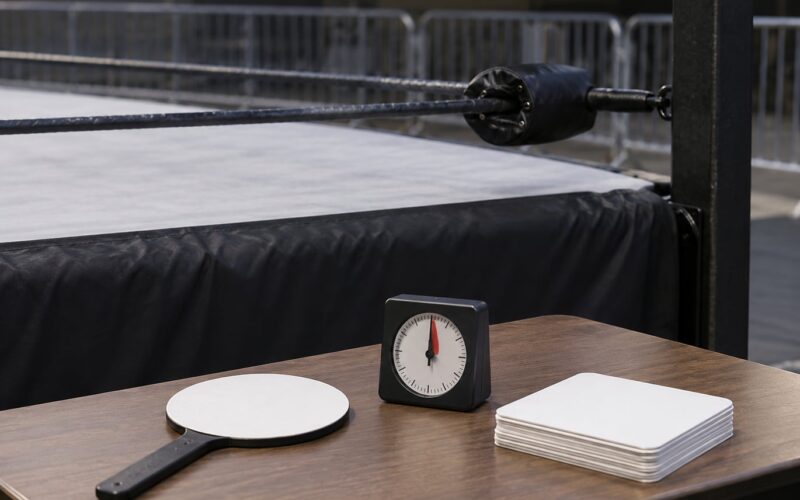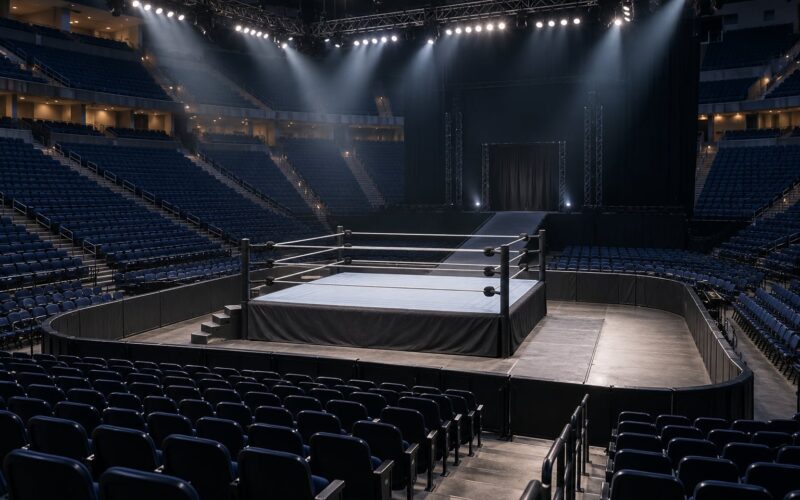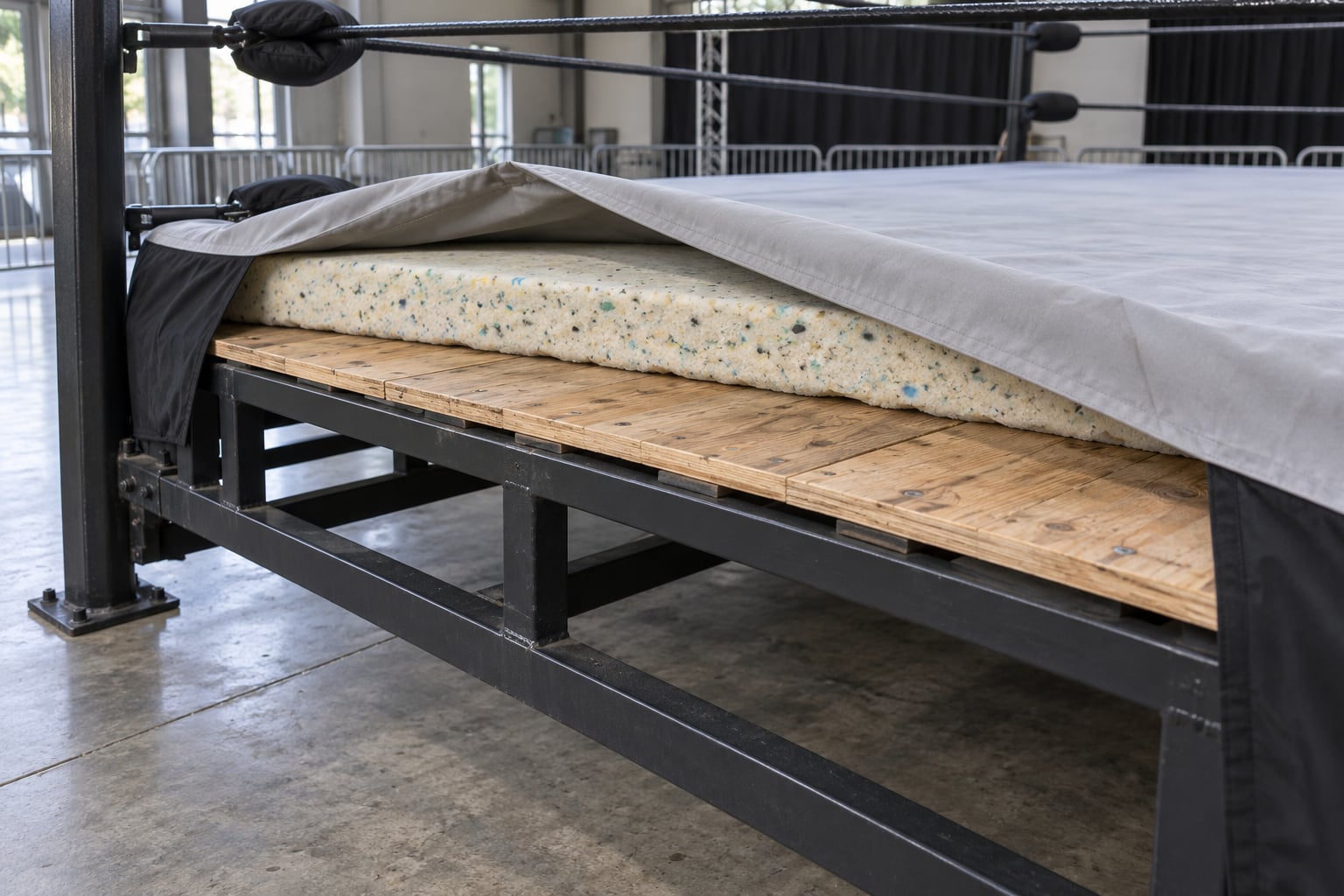
Under the canvas of a wrestling ring there is a steel frame, a deck of wooden planks laid across it, a layer of dense foam padding, and then the canvas cover stretched over the top. That whole stack sits roughly 40 inches off the ground, which leaves a usable space underneath for steps, monitors and gear. Three ropes per side, tensioned at the corners by turnbuckles, form the boundary.
That answer gets you the list. The interesting part is why each layer exists, because none of them is doing what most fans assume. The padding you can see from the cheap seats does very little in a real slam, and the noise you hear on every drop is the boards flexing against the steel.
Below is how a wrestling ring is built and what is under the mat, layer by layer, followed by how the whole thing goes together and what changes between an arena ring and the one in your local gym.
Table of Contents
- What Is Under a Wrestling Ring Mat?
- The layer stack, bottom to top
- How Is a Wrestling Ring Built From the Floor Up?
- Why Does the Mat and Frame Need So Much Support?
- What Are the Main Parts of a Wrestling Ring?
- How Do the Ropes and Turnbuckles Stay Safe?
- Why Do Wrestling Rings Look Different in Arenas, Studios, and Independent Venues?
- Arena rings
- Studio and televised set rings
- Independent and training rings
- Ring size and shape
- How Is a Wrestling Ring Inspected and Maintained?
- What Actually Sits Under the Ring at a Show
- Frequently Asked Questions
- What is under the mat of a wrestling ring?
- Is there foam under a wrestling ring?
- How thick is a professional wrestling ring mat?
- How much does a professional wrestling ring weigh?
- Can a wrestling ring be moved after it is built?
- Who builds professional wrestling rings?
- Wrapping Up
What Is Under a Wrestling Ring Mat?
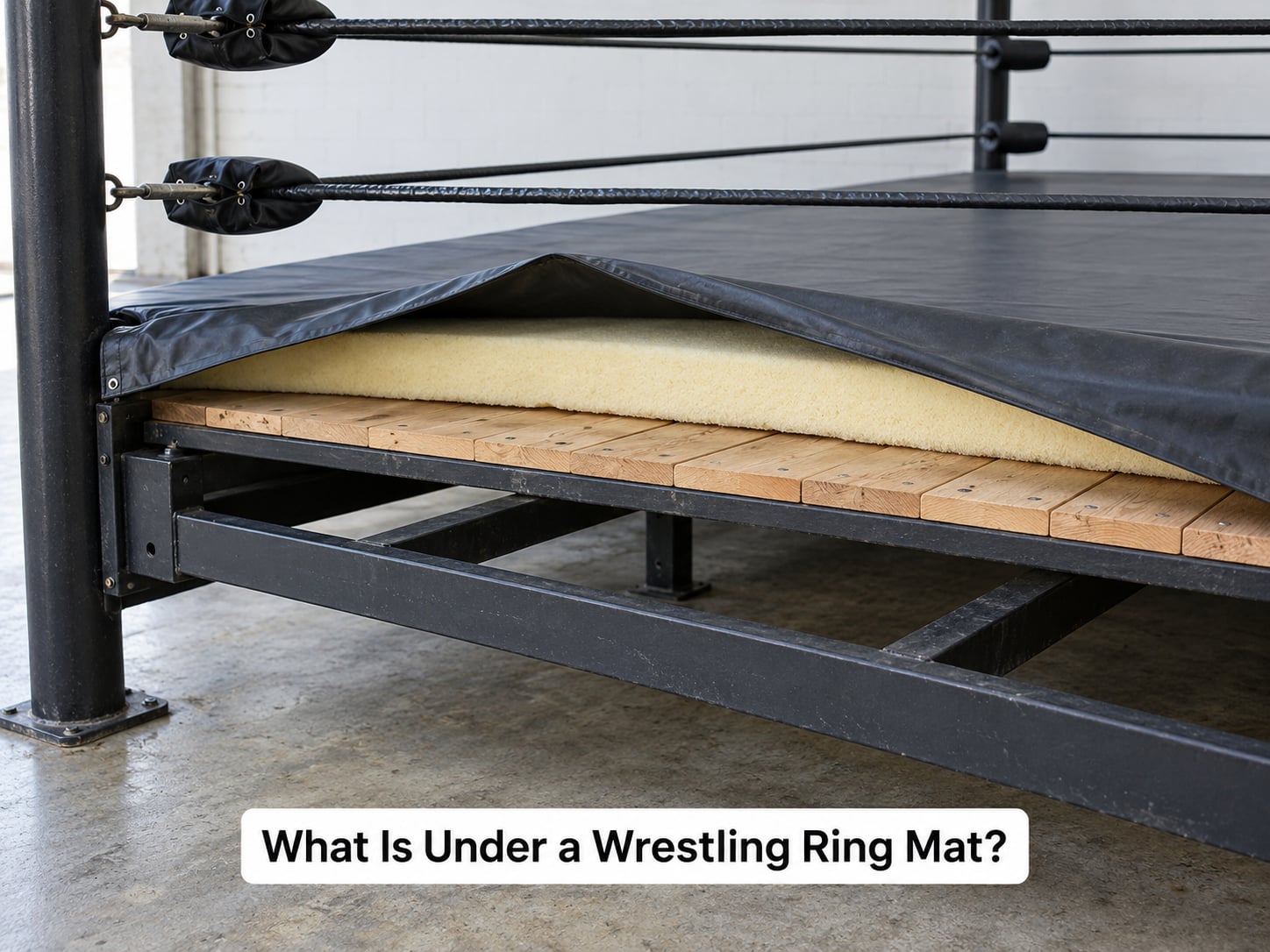
Under the mat, bottom to top, you get a steel frame, wooden decking, foam padding, then the canvas itself. The canvas is the only layer you touch.
The steel frame carries everything else. Wooden planks span across it to make a flat deck. Foam padding sits on the planks, and the canvas is stretched and fastened over that. Underneath all of it is open space, because the deck is raised off the floor.
The layer stack, bottom to top
- Steel frame — corner posts, beams and cross members that carry the load.
- Wooden deck — planks or sleepers laid across the frame to spread weight.
- Foam padding — dense closed-cell foam laid over the planks.
- Canvas cover — heavy duck or vinyl-faced canvas stretched over the padding.
There is usually a thin filler layer or a second padding sheet as well, since one sheet of foam compresses and tears faster than a wrestler expects.
How Is a Wrestling Ring Built From the Floor Up?
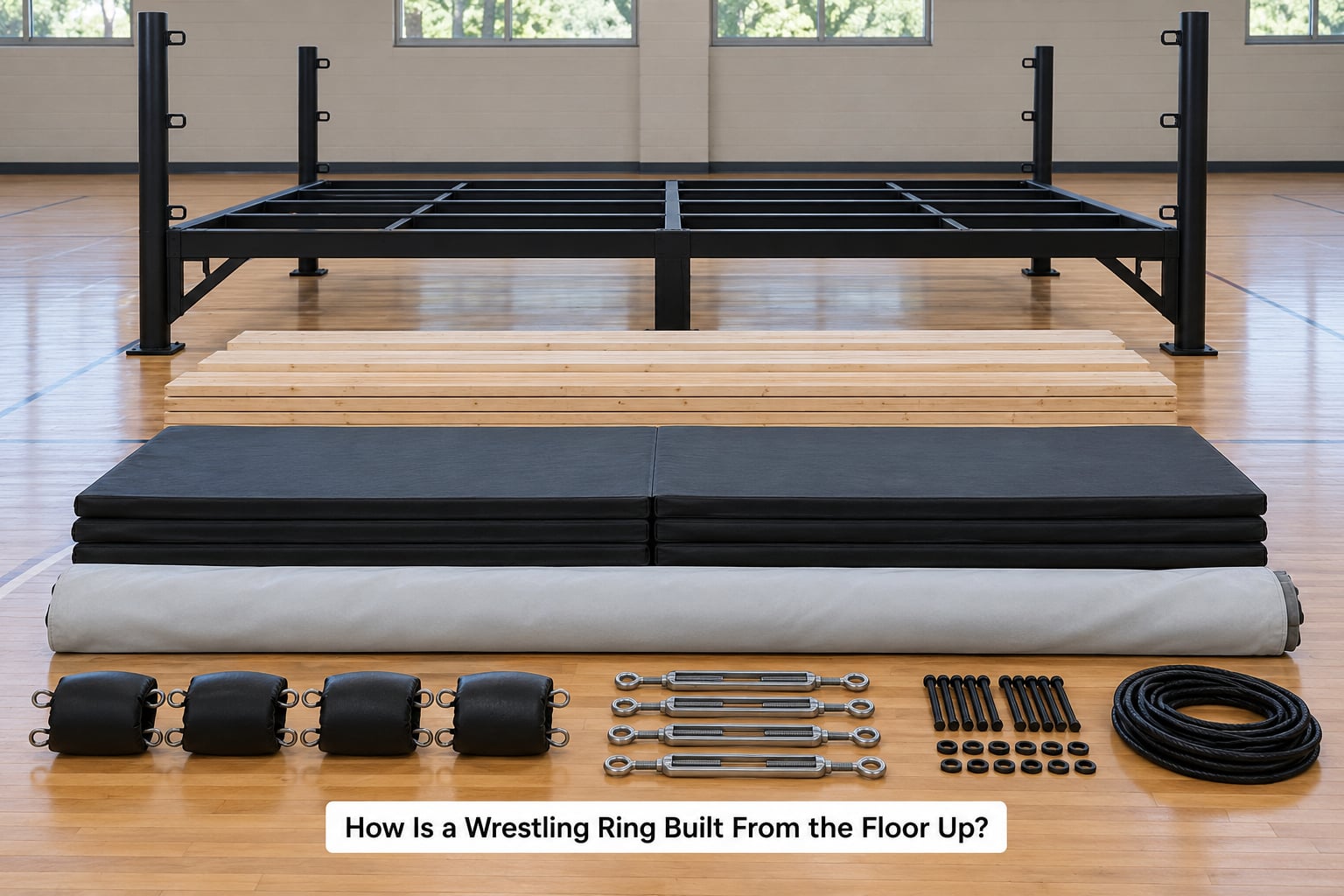
Here is the build sequence a crew works through, roughly in the order it happens on a load-in:
- Mark the floor. The ring footprint gets taped out first, because everything else lines up to those four corners.
- Assemble the steel frame. Sections bolt or pin together into a square, then the corners get squared and the diagonals checked.
- Set the posts. Corner posts mount to the frame and define the height of the ropes. LED-equipped rings route power up inside them.
- Lay the wooden deck. Planks or 2×4 sleepers go across the frame, usually resting on cross beams so the surface stays level.
- Fit the padding. Foam sheets are laid edge to edge and trimmed so nothing leaves a hard lip under the canvas.
- Stretch the canvas. The cover is pulled over the padding and secured to the frame, then tensioned so the mat does not slacken or ripple mid-match.
- Hang the apron and skirt. The apron wraps the outside of the ring at mat level, and the skirt drops from it to hide the frame.
- Fit ropes and turnbuckles. Three ropes per side run between the posts, tensioned and locked at the corners.
- Level and check. The whole ring gets walked, loaded and inspected before anyone steps in it.
Portable rings break down into sections for exactly this reason. A full arena ring comes in on a truck in pieces and goes back up the same way at every venue, which is why you sometimes see crews working the ring during the entrance ramp video.
Why Does the Mat and Frame Need So Much Support?
A wrestler dropping onto a raised platform puts a shock load into the structure that would wreck a table or a floor. The frame spreads that load across a wide footprint so the deck does not punch through, and the beams keep the surface from sagging between corners.
The boards are doing something specific here. They flex slightly under impact, and that flex is what you hear. That hollow clatter every time somebody lands is boards bouncing against steel, not a hollow mat, and it is the single most recognizable sound in the sport.
Independent wrestlers have pushed back hard on the idea that the ring is heavily cushioned. On the independent circuit, one wrestler laid the stack out plainly: canvas, then padding, then 2x4s, then steel. A 400-pound body landing on that is genuinely painful, and working wrestlers say so on the record. The padding you can see from row ten is closer to a quarter inch of foam over wood over steel than a gym landing mat.
Trained feedback from trainees is consistent about the same thing. Learning to take bumps is brutal, and a startling number of people quit in the first session. It is not the theatrics that wears people out, it is the repeated impact through a surface that is built to be firm, level and predictable rather than soft.
Canvas tension matters for the same reason. A slack mat rolls under a landing, which twists an ankle or a knee. A taut mat stays put, and it also gives a clean surface for boots and tape to work against. Wrestlers wipe their feet before stepping in because a dusty boot catches and drags, and grit dragged across the canvas both scuffs the surface and dulls the landing.
What Are the Main Parts of a Wrestling Ring?
Here is the vocabulary, and what each piece actually does.
| Part | What it is | Job it does |
|---|---|---|
| Canvas | Heavy stretched cover over the padding | The surface wrestlers work on; carries grip and tension |
| Padding | Dense foam sheets under the canvas | Takes the edge off light contact and protects the deck |
| Wooden deck | Planks or sleepers across the frame | Creates the flat surface and spreads load to the beams |
| Steel frame | Beams, cross beams and corner posts | Carries the entire deck about 40 inches off the floor |
| Ring posts | Vertical posts at each corner | Anchor the ropes and carry lights or graphics on televised rings |
| Turnbuckles | Tensioning hardware at each corner | Hold and lock rope tension on three rope levels |
| Ring ropes | Three ropes per side | Boundary for moves, holds and rope running |
| Ring apron | Mat surface that extends past the ropes | Where wrestlers stand or lie on the edge, and where announcers work |
| Ring skirt | Fabric hanging below the apron | Hides the frame and the space underneath from spectators |
| Floor area | Concrete or gym flooring around the ring | Absorbs spills out of the ring; stacked with production gear at shows |
Three ropes per side is standard because the spacing gives a distinct height for each one, which is what lets wrestlers run a rope, pull down the middle rope for a submission, or bounce off one specific level. Boxing rings carry four. Wrestling ropes are also not tied to each other along the sides, so a rope can absorb a fall along its length instead of dragging the whole side with it.
How Do the Ropes and Turnbuckles Stay Safe?
Rope material varies by builder, which is the source of most fan confusion. Some rings use natural fiber rope, wrapped where it passes the corner, and some use steel cable run inside rubber hose. Both are in regular use, and both have partisans on forums arguing about which is better.
Turnbuckles are the corner hardware doing the real work here. Each level has a tensioning assembly that pulls the rope tight and locks it at a set length, so every rope on the ring sits at the same tension. Even tension matters because uneven ropes make a rope run unpredictable, and a wrestler going over the top at speed needs to know exactly where that top rope is.
The visible padding on posts and turnbuckles covers the corners where a body hits hardest during a springboard or a dive. It does not change the physics of a fall, but it takes the edge off the metal.
Before any show, ropes get checked for stretch and fraying, turnbuckles get checked for locked tension, and posts and corner hardware get checked for movement. A rope that has gone slack, frayed or deformed comes out of service. So does a canvas tear, no matter how small, because a caught boot in a tear is how matches turn into injuries.
Why Do Wrestling Rings Look Different in Arenas, Studios, and Independent Venues?
The scale and the hardware change with the room, but the safety principles underneath stay the same.
Arena rings
Arena rings are large, modular and built for camera. Corners carry LED posts and screens, aprons match the production design, and the whole thing is designed to be struck, re-skinned and rebuilt in a few hours. Sizes run up to 20 feet square, with WWE, All Elite Wrestling and Ring of Honor among the promotions using the larger footprint.
Studio and televised set rings
A studio ring is the same machine in a different room. It may sit on a raised deck for camera angles, and the space underneath becomes cable routing and crew access rather than gym floor. Nothing about the layer stack changes.
Independent and training rings
Gym-show and home rings are usually smaller, often 14 to 16 feet square, and built for repeated use by the same promotion rather than a one-night teardown. That encourages owners to think hard about impact absorption, because a training ring takes far more bumps per week than a broadcast ring does in a month. Forum threads on r/wrestling and WrestlingFigs keep coming back to that exact problem: the rings available to trainees are firm by design and hard on bodies.
Ring size and shape
Rings run from about 14 to 20 feet square. An 18-foot ring gives a fast match more room to move, while a 20-foot ring makes more space for a big athlete and slightly longer travel. Six-sided rings also exist and were once standard in lucha libre, with notable runs in Japan and in TNA during the 2000s; they are a genuine exception to the square shape rather than a different kind of build.
How Is a Wrestling Ring Inspected and Maintained?
Inspection happens before anyone is allowed in the ring, and it is repetitive. Crew walk the canvas for tears, scuffs and soft spots, check rope tension at all twelve turnbuckle positions, confirm the posts and frame have no movement, and check that the padding still sits flat with no exposed edge.
Between shows, canvas gets cleaned down, inspected for wear, and patched or replaced when the weave goes. Padding gets rotated and swapped out as it compresses. Hardware gets checked for corrosion, especially at a beachside or outdoor venue where salt air is a real problem.
Any damaged component comes out of service rather than getting flagged for the next show. That rule is the reason the sport looks reckless and mostly is not. A ring is a piece of safety equipment first and a stage set second, and the crew treats it that way.
What Actually Sits Under the Ring at a Show
You have probably seen it on a hard-camera shot: the ring skirt hides a working space that runs much deeper than people expect. Steel ring steps sit against the apron. Monitors and cable runs feed the production crew. Under the far side there is usually a case of gear, a stack of chairs for the announced match at the top of the card, and a flat spot where the production team works under the platform.
Because the deck is raised, that space doubles as storage. It is also why a ring skirt has to be secured properly: it is not decoration, it is the thing between the crowd and a load-bearing structure sitting at head height.
Frequently Asked Questions
What is under the mat of a wrestling ring?
Under the canvas is a stack of foam padding, a deck of wooden planks, and a steel frame of beams and corner posts holding the whole platform about 40 inches off the ground. The space beneath that platform is open and is where ring steps, monitors and production gear sit during a show.
Is there foam under a wrestling ring?
Yes. A layer of dense closed-cell foam sits directly under the canvas on every professional ring, usually one thick sheet and sometimes a thinner second layer on top. It is not a soft landing mat. It is closer to a quarter inch of foam over wood over steel, which is why working wrestlers describe hard slams as painful.
How thick is a professional wrestling ring mat?
The whole stack is a few inches thick in total: a thin canvas cover, a foam padding layer of roughly a quarter inch, and a wooden deck of planks or 2×4 sleepers on top of the steel frame. The full build adds up to about 40 inches of height from the floor to the mat surface.
How much does a professional wrestling ring weigh?
A full-size ring is heavy enough that it is moved in sections rather than lifted whole. Portable sections break into manageable pieces, and the steel frame, planks, padding, canvas and apron together put any single section in the range of a few hundred pounds.
Can a wrestling ring be moved after it is built?
Yes, most professional rings are built in modular sections specifically so a crew can tear them down, load them onto a truck and reassemble them at the next venue. Permanent rings in arenas and private installations stay put and are rebuilt in place.
Who builds professional wrestling rings?
Specialist ring builders construct and install them for promotions, arenas and private owners. High Spots is one named builder that has installed full-size rings for private commissions, including a permanent ring built at a ranch. Smaller rings come from a wider set of manufacturers that supply gyms, schools and home setups.
Wrapping Up
If you take one thing from this: the ring is a firm raised platform built for level footing and predictable tension, not a cushion. The steel frame carries the load, the wooden deck spreads it, a thin foam layer takes the edge off light contact, and the canvas is stretched tight on top.
Next time a match starts, listen for the clatter. That is the boards flexing against the frame, and it is the sound of how a wrestling ring is built more honestly than any spec sheet.