If you want a straight answer: how parents can judge wrestling content for kids comes down to four inputs — your child’s age and maturity, the show’s actual content triggers rather than its on-screen badge, how the violence is filmed, and the channel your child is watching it on. Do those four checks once per program and you get a repeatable decision instead of a guess made at 9pm on a Friday.
Most parental wrestling debates stall because two things get mixed together. One group thinks about what wrestling does to a child’s behaviour. The other thinks about whether wrestling is good television. Neither of those tells you whether this clip, on this platform, suits your six-year-old on a Tuesday evening.
So this is a framework, not a verdict. It takes about fifteen minutes to apply the first time, and about two minutes per show afterwards.
Table of Contents
- What You Need to Judge Wrestling Content for Kids
- Step-by-Step: Assess Wrestling Before Your Child Watches
- 1. Check the Official Rating and Content Warnings
- 2. Review the Themes and Types of Matches
- 3. Look at How Violence Is Presented
- 4. Listen for Language, Sexual References, and Adult Themes
- 5. Consider the Characters and Conduct Being Portrayed
- 6. Watch a Representative Episode Together
- Common Mistakes When Judging Wrestling for Children
- Frequently Asked Questions
- What age is professional wrestling appropriate for?
- Is PG-rated professional wrestling safe for young children?
- How can parents preview violent scenes in wrestling?
- Does WWE or AEW differ in how much wrestling is appropriate for kids?
- What should I do if my child sees something upsetting in wrestling?
- Do parents need to watch every wrestling episode with their child?
- What to Do First
What You Need to Judge Wrestling Content for Kids
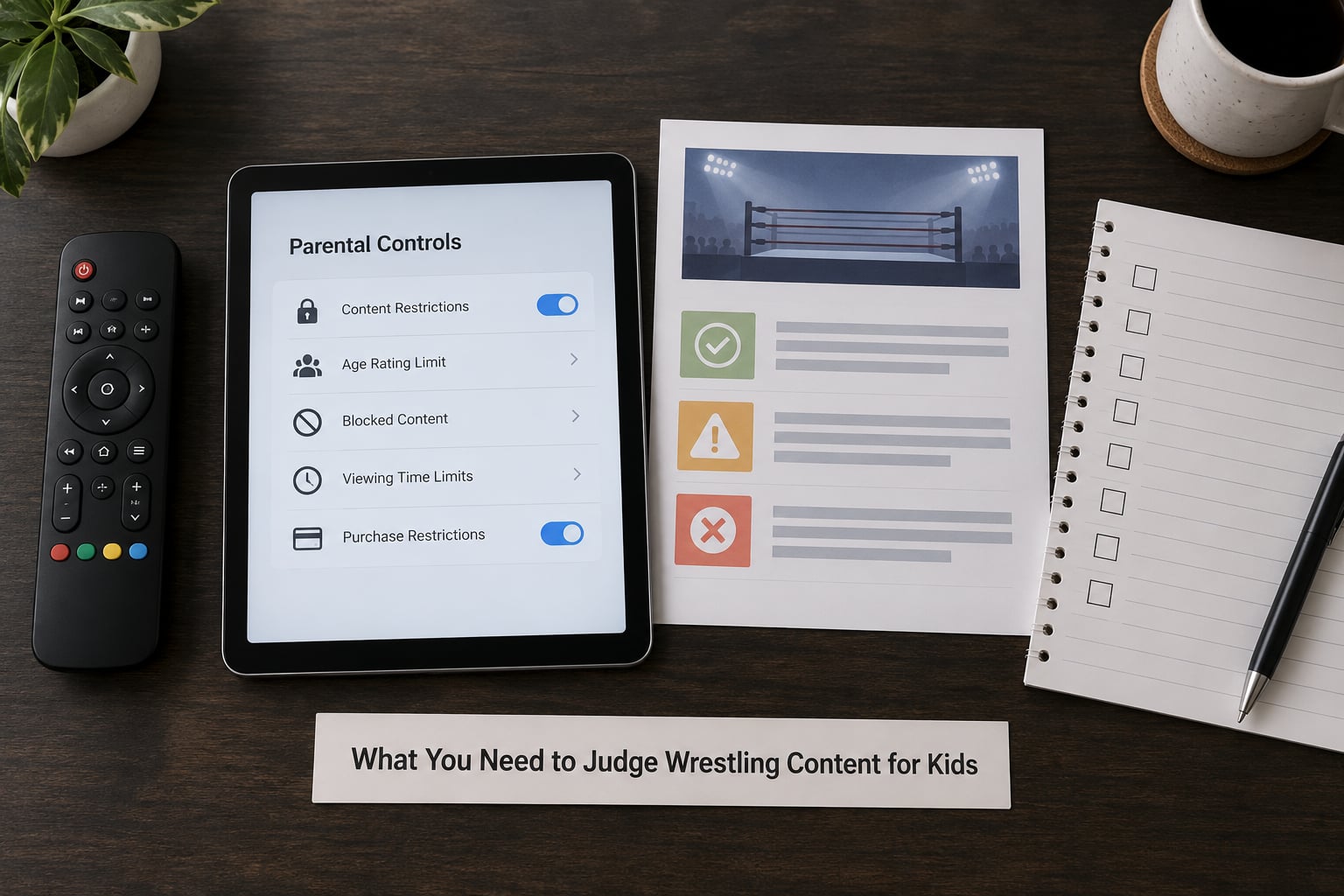
You need five things, and only two of them require effort.
- Your child’s age and what specifically unsettles them. Not a birthdate — a short list. Does this child flinch at hospital shows? Do they fixate on bullies? Do they repeat crude language back at you?
- The official rating and any content warnings. Both the self-assigned badge on the show and the broadcast rating a TV listings guide displays. They often disagree.
- Enough familiarity with the program to spot its patterns. Five minutes of any show tells you its normal temperature. Promos and fights tell you much less.
- A list of recurring themes. Write down the ones your child would struggle with: humiliation, betrayal, a parent figure abandoned, weapons, threats toward a real person, romantic triangle storylines.
- Access to a preview, a trailer, or an earlier episode. Nearly every streaming service and broadcaster offers an episode preview, and that is enough for most judgements.
Here is the checklist in printable form:
Age and sensitivities → Rating badge and broadcast rating → Recurring themes list → Violence style: stylized or realistic → Language sample → Conduct modelled by characters → Channel and viewing time → Preview watched → Family decision recorded.
Why bother with all of it when a rating badge exists? Because wrestling programs frequently label themselves PG while their broadcast listings sit at TV-14 or, in some regions, TV-MA. A self-assigned badge is a marketing choice as much as a measurement. Content standards also shift between seasons, so a guide written for 2026 may not describe the episodes airing now.
The same content also lands very differently on different children. A six-year-old and a twelve-year-old watching the same backstage segment are not having the same experience, and neither response is wrong.
Step-by-Step: Assess Wrestling Before Your Child Watches
Six steps, run in order. Each one produces a note you can write down in a sentence, and the six notes together form the family decision. Stop at any step and you already have enough to say no for now.
1. Check the Official Rating and Content Warnings
Start by collecting both numbers, not one. Note the badge the promotion gives the program and the rating your local TV guide or streaming service displays for the same episode.
Then look past the badge for descriptive warnings, which are far more useful than the letter itself. Platforms usually list specific content triggers: language, violence, suggestive themes, substance use, frightening scenes. Read those triggers and match them against the sensitivity list you made earlier.
What to record: the two ratings, and any warning phrase that maps to a specific worry of yours.
2. Review the Themes and Types of Matches
Different wrestling styles carry different weight, and the type of match is usually the single biggest factor when you are working out how parents can judge wrestling content for kids.
Standard matches with a straightforward contest and a clean finish sit at one end. Comedy segments, mascot characters and cartoonish rivals sit alongside them and are usually the softest material on a wrestling program. At the other end you have stunt-driven wrestling with high-impact moves, championship and rivalry storylines, backstage attacks, weapons, and injury or hospital storylines built around a convincing fake beating.
Children who cope well with one of these often find another genuinely hard. Write down which categories your child can handle and which are a stop.
3. Look at How Violence Is Presented
This is where most judgements should be made, and it is where ratings help least.
Stylized wrestling violence is choreographed, exaggerated and repeated. Realistic-looking violence is filmed tighter to the face, holds on reactions longer, and pairs impacts with blood, weapons or a written threat. A child can tell the difference even when they cannot articulate it, which is exactly why some children find the realistic version far more unsettling than the exaggerated version.
Four factors decide how heavy a scene feels: how often it happens, whether blood or weapons appear, whether anyone makes a direct verbal threat, and whether the story treats the hurt person as a joke. Watch one match with sound on and note which of the four you saw.
Also worth asking whether the child has ever imitated a move on a sibling or classmate. If the answer is yes, weight this step more heavily than the others.
4. Listen for Language, Sexual References, and Adult Themes
You can audit language without sitting through the whole episode. Watch the first ten minutes, which usually set the tone, then scrub the middle at speed with the audio on.
Listen for four things: profanity, including the censored versions that still carry the rhythm of swearing; slurs; suggestive humour and innuendo; and any reference to drinking, drugs or adult situations. Dating and relationship storylines are a separate category and matter more to some families than any amount of profanity.
What to record: a simple line — clean, occasional, or frequent — plus whether innuendo appears. That one word is usually enough to make a joint decision.
5. Consider the Characters and Conduct Being Portrayed
Fictional misconduct is not automatically harmful, and a wrestling program is full of villains by design. Judge the pattern rather than the premise.
A character who cheats, lies or taunts in one segment and is punished for it is a plot. Repeated intimidation, bullying of a weaker character, discriminatory language, or cruelty delivered as humour with no consequence is a lesson. That second pattern is the one most likely to conflict with family values or leave a sensitive child worried.
Write down one sentence about whether characters who mistreat others get consequences on screen. That single test separates good drama from a bad message more reliably than anything else in the assessment.
6. Watch a Representative Episode Together
The last step is exposure, not exposure for its own sake. Preview material, watch clips, or sit through one full episode with your child so that whatever they later meet alone was already framed by you.
Sit down and watch for three specific things: whether your child asks questions about what they just saw, whether they copy catchphrases or mannerisms within the next day, and whether they get bored or tune out. Kids who ask questions are processing something new. Kids who look bored are watching television.
Then ask three questions afterwards. What did you think the loudest guy was about to do? What was the rule he broke? What would you have done instead of him? The answers tell you more about what landed than anything you observed yourself.
Signs the program is working: the child can explain that the falls are planned, uses no real names to insult classmates, and treats the show as something they watch rather than something they are. Signs it is not working: physical play at school built around the show, insults borrowed from it, or visible distress at the injury segments.
Where kids actually meet wrestling also matters. Television gives you airtime control, a fixed duration and adverts you can talk about. A live show gives you controlled duration with no ability to pause. Short-form clips on YouTube or TikTok arrive unfiltered, often with no age gate at all, and wrestling video games show impacts without any framing around them. The same program is a different proposition on each channel, so write down which channel your rule covers.
Common Mistakes When Judging Wrestling for Children
Treating every wrestling show as equally mature. Style varies enormously between promotions, and a comedy-led program is a different proposition from one built around injury storylines. Compare programs directly instead of treating wrestling as a single thing.
Relying on the age badge alone. It tells you almost nothing about the specific episode. Two episodes in the same show can sit at very different levels.
Choosing by favourite wrestler. Kids attach to a personality long before they can evaluate content. Attachment is a reason to co-view, not a reason to switch off the assessment.
Assuming stylized action is always harmless. The concern parents actually report is imitation at lunch and on the playground, not abstract aggression. Judge by whether your child copies moves on real people, not by how tough the material looks.
Forgetting adverts and recommendation feeds. The wrestling episode is rarely the whole exposure. Note what runs around it and whether the platform’s autoplay keeps serving more.
Deciding permanently from one clip. A single outrageous clip tells you almost nothing about a show’s normal temperature. Judge on a full episode or a preview.
A few house settings close most of the remaining gaps: a fixed weekly slot rather than open-ended access, co-viewing for the first few months, a conversation before the first live show rather than after, and a clear answer on wrestling clips outside the agreed slot. The wrestling community’s counter-argument deserves a hearing too — parents on r/SquaredCircle regularly make the case that live shows are a controlled, family-safe outing, and several parents in forums report preferring a live event to television precisely because the content expectations and the duration are predictable.
Frequently Asked Questions
What age is professional wrestling appropriate for?
There is no single correct age, because the answer depends on your child rather than on wrestling. Most families find a light comedy-led show workable from around six, and a harder stunt or injury-heavy show around ten or eleven. Treat the age bands as a starting point, then adjust for your child’s sensitivity, since a calm six-year-old and an anxious one will not follow the same rule.
Is PG-rated professional wrestling safe for young children?
A PG label tells you less than you would hope. Wrestling programs often carry a self-assigned PG badge while their broadcast listings sit at TV-14 or higher, and the letter does not distinguish between staged falls and realistic-looking injury scenes. Read the descriptive content warnings instead of the letter, and preview an episode before treating the rating as settled.
How can parents preview violent scenes in wrestling?
Use an episode preview where the platform offers one, then confirm your decision by scrubbing through a full episode with the audio on and the playback speed raised. Watch the opening ten minutes for tone, note any blood, weapons or direct threats, and check whether characters who mistreat anyone face consequences on screen. Write the result down so the next episode can be judged against it.
Does WWE or AEW differ in how much wrestling is appropriate for kids?
The difference between promotions is real but smaller than most parents expect. WWE carries more brand tie-ins, celebrity involvement and family entertainment, while AEW generally runs leaner on that side and leans harder on athletic in-ring work and adult-oriented storylines. Judge the specific program and era rather than the promotion name, because both change their tone season to season.
What should I do if my child sees something upsetting in wrestling?
Do not take the screen away mid-scene, which signals that they have been caught rather than that the content was hard. Turn the sound down, explain plainly that the falls are planned and the injuries are acted, then ask what worried them. Expect it to fade within a day. If the same distress recurs, raise your rule on that program rather than the whole medium.
Do parents need to watch every wrestling episode with their child?
No. Co-viewing matters most for the first stretch, because that is when your child learns how to read the show rather than react to it. After that, a fixed weekly slot, clear channel rules and an open invitation to bring you something they found usually work. If you already know what appears in an episode, you do not need to sit through it again to keep the boundaries intact.
What to Do First
Start tonight with four things: write down your child’s age and the three things that actually bother you about violence or language, collect both the show’s own badge and the broadcast rating, watch one representative segment rather than a promo, and agree one rule out loud before regular viewing begins.
Then keep the record. One short note per program is enough, and in a few months you will have a far clearer picture of your child’s tolerance than any rating could give you. That running page is the whole of how parents can judge wrestling content for kids, and it fits in a notebook.