Wrestlers bleed for two very different reasons, and telling them apart matters. Sometimes a real impact opens the skin by accident or by design, and sometimes the blood is a worked effect agreed in advance so a scene reads as more dangerous than it is. Neither version is fake liquid poured onto a face, and both leave the wrestler dealing with a cut afterward.
There is also a modern wrinkle. WWE’s PG-era policy pushed intentional bleeding out of televised main roster wrestling, while AEW, NJPW, CMLL and the independent scene kept it, and hardcore promotions lean into it. So the honest answer to how wrestlers bleed in matches and how it is done depends on which promotion and which era you are looking at.
This piece explains the working methods as documented industry practice, the roles involved in keeping a planned effect controlled, and what is actually happening when you see color. It is written for fans who would rather understand the craft than pretend it does not exist.
Table of Contents
- Why do wrestlers bleed in matches?
- How is blood created when a wrestler has a worked injury?
- What happens during a planned bleeding sequence?
- How wrestlers bleed in matches and how it is done safely
- What about wrestlers who bleed from real injuries?
- Hard shots, weapons, and accidental blood
- Does blood prove that an injury was real?
- How can viewers tell planned blood from real blood?
- How is blood cleaned up after a match?
- Frequently Asked Questions
- Do wrestlers use their own blood in matches?
- Are wrestlers allowed to cut themselves?
- Why do wrestlers keep wrestling after they start bleeding?
- Can blood from a wrestling match be dangerous?
- How can I tell whether a wrestler’s bleeding is real or worked?
- What should happen when a wrestler appears genuinely injured?
- What to notice first in a bloody wrestling match
Why do wrestlers bleed in matches?
Wrestlers bleed because blood is the fastest way to make a scripted moment read as real. A closed fist landing on a jaw reads as theatre. The same fist, followed by a red streak down the temple, reads as consequence, and the audience spends the next ten minutes believing the stakes instead of admiring the choreography.
That is the whole reason. Blood sells damage faster than any other wrestling device, and it does it instantly and in every language, which matters for a sport sold on character rather than language. It also carries real consequences that the effect does not: scarring, infection risk, and time away from the ring that no camera angle can edit out.
The other reason is simpler. Some blood is genuinely unplanned, and no amount of storyline planning controls it. A stiff strike to the brow, a botched corner collision, or a wrestler working through an injury they have not mentioned can all produce real color on a schedule nobody agreed to.
How is blood created when a wrestler has a worked injury?
There are five routes to visible blood in wrestling, and only one of them is a theatrical fake. Everything else is real human blood, which surprises people who assume the effect is ketchup or stage blood from a prop department.
Planned skin opening. This is the practice most people mean when they ask how wrestlers bleed. A wrestler arranges in advance to open the skin, usually on the forehead or just under the eyebrow, so blood begins flowing mid-match. It is discussed openly in wrestling media and by wrestlers themselves, and its risks are real, so the rest of this article describes the mechanism and the safety system around it rather than anything a reader should attempt.
Hardway bleeding. A genuinely stiff shot lands on a spot that happens to open the skin, usually above or beside the eye where the blood vessels sit close to the surface. Nothing was planned. This is common enough that some wrestlers treat it as part of the job rather than an exception. Jon Moxley has explained that a clean shot to the face has a high chance of busting a wrestler open, and that a lot of his bleeding falls into this category rather than a worked one.
Foreign objects. Chairs, kendo sticks, barbed wire, glass tables and step ladders do the same job with more force. A spot where a wrestler is thrown into a board or a weapon leaves a mark on camera that reads exactly like a planned cut, which is part of why hard-to-read moments are so valuable to bookers.
Blood capsules and mouth work. A small capsule held in the mouth or cheek can be bitten to produce a convincing amount of blood that runs from the mouth rather than the forehead. Stage blood and theatrical products exist too, mostly in independent and exhibition work, and the crimson mask, a pre-soaked mask that bleeds steadily, is the more famous version of the same trick. Red fabric liners and scarves pre-treated to ooze are used when a costume must appear ruined at a consistent rate.
Unplanned accident. Botched spots, bad falls, a head striking a post or an opponent’s elbow finding a brow on the wrong angle. Nobody planned it and everybody reacts to it. In a scripted match this sometimes becomes useful immediately, which is exactly why the distinction between planned and real matters.
What happens during a planned bleeding sequence?
A planned sequence runs long before the bell. The storyline calls for a wrestler to be hurt badly enough that the crowd believes the finish, so the beat gets written into the match plan, and the two wrestlers work out where it lands.
Next comes rehearsal. The sequence gets practiced until the timing of the cut, the reaction and the camera cut are predictable enough that nobody has to improvise in the moment. Positioning matters here more than most people expect, because a camera angle either hides the moment or exposes it completely.
In the match itself, the sequence usually plays out during a covered moment. The wrestler’s head turns away, an arm comes across the face, or the camera cuts to a wider shot while the blood starts. Then the reaction is sold. A wrestler who has just been opened up holds the face, sells the pain, and often tries to blind the opponent with the blood, which is standard psychology and also genuinely messy.
Sweat does more work than most viewers notice. Once bleeding starts, a sweaty head runs faster and thinner than a clean one, and the mix spreads across the brow in a way that looks like volume. Blood that does not run down the face has usually been applied rather than produced.
Then comes the cleanup and transition. Towels come out during the next sequence, the wrestler wipes down or smears deliberately to keep the effect alive, and by the finish there is a gap built in for medical attention.
How wrestlers bleed in matches and how it is done safely
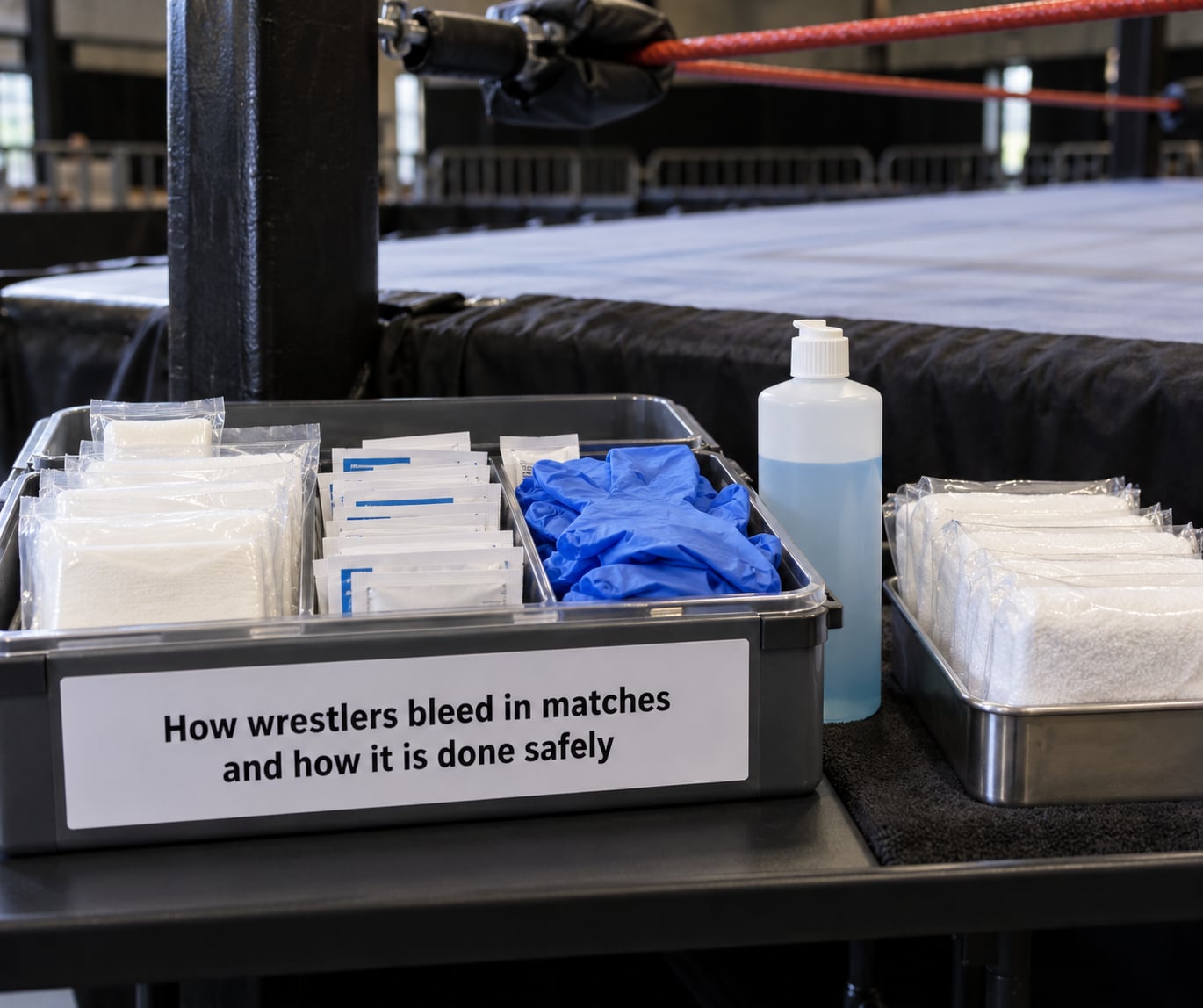
Safety here is a system of people, not a promise. The wrestler who bleeds owns the decision and carries the consequences. The opponent is in on it and knows how hard or soft to hit around the sequence. The referee keeps the action moving so the setup is never exposed. Medical staff stay close and hold the towels and supplies.
Two things reduce the risk. The cut is kept shallow and in a spot that is easy to clean and compress, and the plan always leaves an exit, so the match can move to the finish and the medical team can take over the moment the angle has played out.
The culture around it varies. Some wrestlers and some promotions treat planned bleeding as an ordinary tool, and others have walked away from it entirely. Neither position is unusual, and a promotion’s stance tends to change with its audience and broadcast rating.
What about wrestlers who bleed from real injuries?
Real bleeding is the part nobody negotiates. A hardway cut produces the same blood as a planned one, and in the moment the two are visually identical, which is why the reaction on camera is what the audience reads.
When officials suspect a genuine injury, the standard response is to stop the match. The referee uses a hand signal to indicate a real injury, the wrestlers separate, and the sequence is not part of the story any more. From there, the wrestler goes to the medical area for cleaning and assessment, and often for stitches.
Planned and unplanned bleeding converge in one specific situation, which is a wrestler who was going to bleed anyway and then takes a legitimate shot on top of it. Nobody at ringside can always separate the two in real time, which is why the honest answer is that the same care follows either version.
Hard shots, weapons, and accidental blood
Most unplanned blood in professional wrestling comes from one of three sources: a strike to the brow, a collision with ring furniture, or contact with a weapon. None of them require anything hidden or staged, which is why the footage of a chair shot or a steel steps spot is often indistinguishable from a worked cut.
A match may continue briefly after genuine bleeding because the story is already moving and the crowd is invested. That is a booking decision, and it is where the line gets debated most loudly by fans. The counter-argument is that the cut is superficial in most cases and stopping instantly would cost the audience the payoff they came for.
Either way, a genuine bleed gets looked at. Blood that keeps flowing, blood from a wound that gapes, or a wrestler who becomes groggy gets attention fast, because these are the details that turn a cut into an emergency.
Does blood prove that an injury was real?
No. Visible blood says almost nothing about severity, in either direction. A shallow planned cut can produce more blood than a genuine hard knock, and a wrestler can bleed heavily while being entirely fine.
Blood is a visual signal about narrative, not a medical indicator. The real indicators are elsewhere: whether the wrestler is moving normally, whether they can hold their head up, whether they answer questions coherently, and whether ringside reacts like something is wrong.
This is why an argument about whether a specific match was real is usually unresolvable from the broadcast. The footage was never meant to answer that question.
How can viewers tell planned blood from real blood?
Look at the setup, the repetition, and the reactions. A planned cut usually follows a sequence the match has been building toward, often immediately after a covered camera moment, and it tends to appear at a narratively useful point rather than a random one.
Then watch the selling. A wrestler working a planned beat stays in character throughout, selling the damage to the opponent while the crowd reacts as intended. A wrestler with an unplanned injury often breaks character for a second, looks at the officials, or reacts to the person who caused it in a way the story did not call for.
Repetition is the strongest clue. Long bloody arcs, frequent bleeding across a card, and the same spot used again and again all point toward a planned look rather than a series of accidents. So does blood that appears before the match’s most violent moment instead of after it.
None of this is diagnostic. Viewers cannot judge severity from footage, and treating an image as evidence of an injury is how a lot of bad-faith wrestling criticism starts.
How is blood cleaned up after a match?
Cleanup starts almost immediately. The wrestler gets towels, water and an antibacterial wipe, and the eye or forehead area gets cleaned before anything else is handled, because the priority is limiting contamination rather than preserving the look.
Matches routinely build in a few minutes at the end for this, and in bigger matches the camera stays wide while it happens. The cut gets closed with Steri-Strips, butterfly bandages or stitches when it is deep enough, and the wrestler is checked before being cleared to travel or appear again.
Equipment matters too. Anything that touched the blood, including headgear, masks and tape, is treated or replaced rather than handed to the next performer. Wrestling rings are disinfected between matches for the same reason.
The wrestler’s responsibility is to say something. If someone develops fever, swelling, drainage or persistent pain in the days after a match, that gets reported to a doctor, because an infected cut in a warm, sweaty environment can go somewhere quickly.
Frequently Asked Questions
Do wrestlers use their own blood in matches?
Almost always, yes. The blood you see in wrestling is real human blood, produced by a cut the wrestler opens themselves or by a strike that opened the skin on its own. Stage blood, capsules and pre-soaked crimson masks exist as effects, but they are a small part of what the audience sees. The distinction that matters is planned versus unplanned, not real versus fake.
Are wrestlers allowed to cut themselves?
It depends entirely on the promotion. WWE has restricted intentional bleeding on its main shows since the PG era, while AEW, NJPW and most independent promotions permit it. Some promotions and medical policies prohibit wrestlers deliberately cutting themselves, and talent contracts often include language on it. No rule is universal across the sport.
Why do wrestlers keep wrestling after they start bleeding?
Usually because the story is already moving. If blood is planned, the match has to reach its finish before the medical team can step in. If blood is unplanned, the crowd is invested and stopping immediately costs the payoff they came for. In both cases the wrestler is checked afterward, and a wrestler who looks genuinely hurt gets stopped.
Can blood from a wrestling match be dangerous?
Yes, and the risk is infection rather than the cut itself. Sharing blood between performers has historically spread blood-borne illnesses, which is why modern rings are disinfected between matches and anything that touched blood is treated or replaced. Anyone with a wound after a match who develops fever, swelling or drainage should see a doctor promptly.
How can I tell whether a wrestler’s bleeding is real or worked?
Watch the setup and the selling. Planned blood usually arrives at a narratively useful moment, often right after a covered camera cut, and the wrestler stays in character. Genuine bleeding tends to break character for a second and draws a reaction from ringside. Repetition across a card also points to a planned look. Footage alone cannot tell you severity.
What should happen when a wrestler appears genuinely injured?
The match should stop and the referee should signal for medical staff, who enter the ring and assess the wrestler. Action resumes only if the wrestler is cleared to continue and wants to, otherwise the match is decided or forfeited. A wrestler who cannot answer questions coherently, cannot hold their head up or keeps bleeding heavily should not be allowed to continue.
What to notice first in a bloody wrestling match
Start with the story. If the blood arrives exactly where the match has been building toward, it is almost certainly part of the plan, and the interesting question becomes whether it earned its place.
Then watch the two wrestlers communicate. Partners who know a sequence is coming move around it deliberately, and a wrestler reacting to something that was not agreed reads very differently on screen. That difference is visible even to viewers who know nothing about the production side.
Finally, watch the response. Officials who treat a bleed as routine when a wrestler is genuinely struggling are the thing worth being uncomfortable about, not the blood itself.
Why wrestlers bleed in matches and how it is done comes down to one choice: use real blood to sell real stakes. It works better than anything else in the business, and the price is paid in scars, stitches and lost weeks, which is why the wrestlers who keep doing it tend to be the ones who know exactly what they are buying.