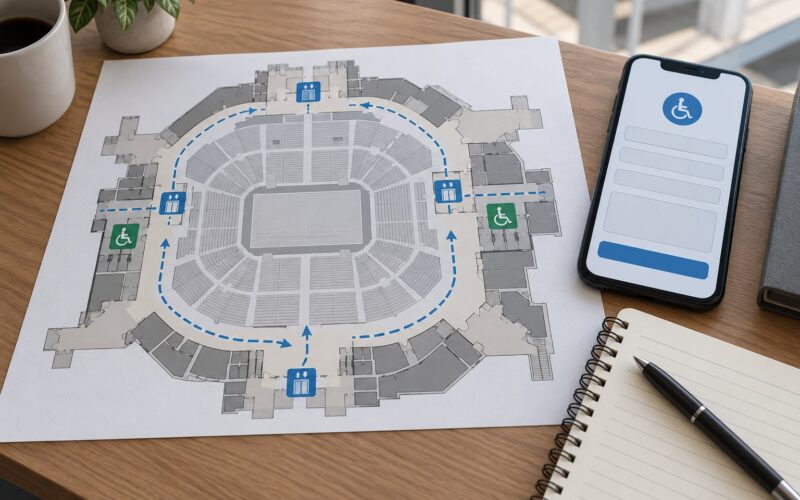
Wrestling events handle crowd safety as a controlled-access live event, not a general-admission night out. Bags and items are checked at the door under a prohibited-items list, the building is zoned into seats, ringside, floor and concourse, trained guards work fixed posts, medical staff sit close to the ring, and a written emergency plan covers evacuation. Most of that system is invisible until something goes wrong.
The part fans notice, and ask about constantly on r/SquaredCircle, is the guard who walks in front of every entrance and then stands opposite the hard camera at the ramp. That position is not random, and it is not the same job as the usher who took your ticket.
Table of Contents
- How do wrestling promoters plan for crowd safety?
- How wrestling events handle crowd safety before a ticket goes on sale
- What happens before doors open?
- How do wrestling events screen entrances and manage tickets?
- How is the crowd divided and controlled?
- What are the main crowd-safety risks?
- How do staff respond to a medical emergency?
- How do wrestling events handle a fight or disruptive fan?
- What happens during an evacuation or severe-weather incident?
- How can attendees support safer wrestling events?
- How do independent wrestling shows handle crowd safety differently?
- The security-vs-atmosphere tension
- Frequently Asked Questions
- Do WWE and AEW hire their own security, or use the venue’s staff?
- Why does a security guard walk in front of the wrestler to the ring?
- What can’t you take into a wrestling show?
- What happens if a fan enters the ring or interferes with a match?
- Is there a medical team at a pro wrestling show?
- Do independent wrestling shows have any security?
- Conclusion
How do wrestling promoters plan for crowd safety?
Safety planning starts long before a ticket goes on sale. A promoter picking a venue is partly making a safety decision, because the building’s capacity, exit count, concourse width and loading access dictate what kind of show can safely be staged inside it.
How wrestling events handle crowd safety before a ticket goes on sale
The planning document usually answers six questions. How many people will be in the room, and how old are they? Where do people enter, and from which concourse? Which exits serve which seating blocks? How many staff are needed per zone? Who is the first person to call for medical help? And who has the authority to stop the show?
Crowd profile matters more than raw headcount. A family-friendly card and a violent, story-driven show generate different behaviour, so staffing and screening get adjusted accordingly. Promotions also work out their relationship with local police and fire officials in advance, so that a show ending at a known hour is not a surprise to anyone downstream.
Medical provision is arranged before load-in, not after something breaks. Arenas normally have first-aid capability on site for concerts and games, and a wrestling show sits inside that existing structure rather than inventing a new one.
What happens before doors open?
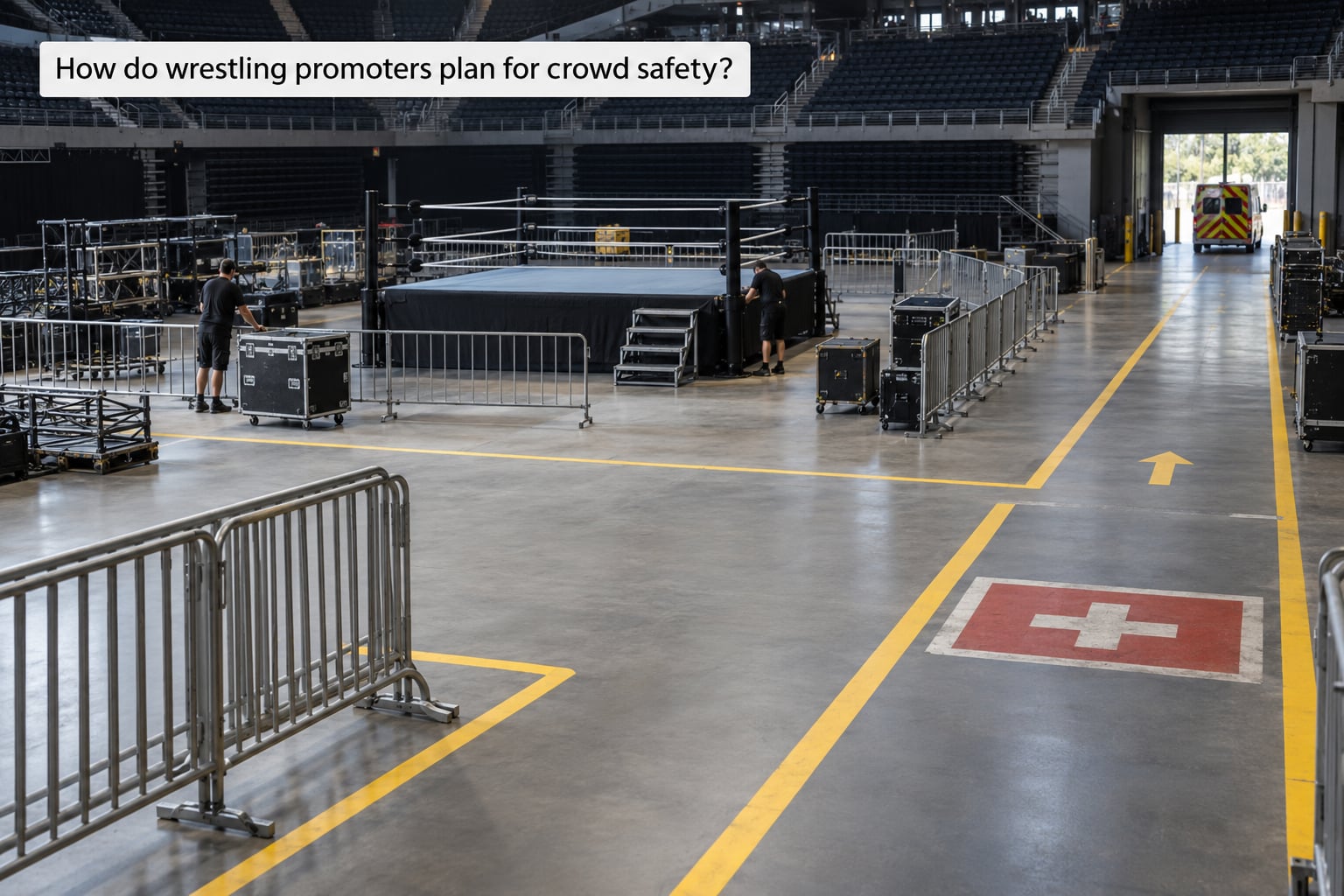
The day of a show has a fixed order. Equipment loads in through the same doors fans will use later, which is why access lanes and staff routes are marked and kept clear. Crews check the ring frame, the ropes, the apron and the announce table, and any temporary structure gets its own sign-off.
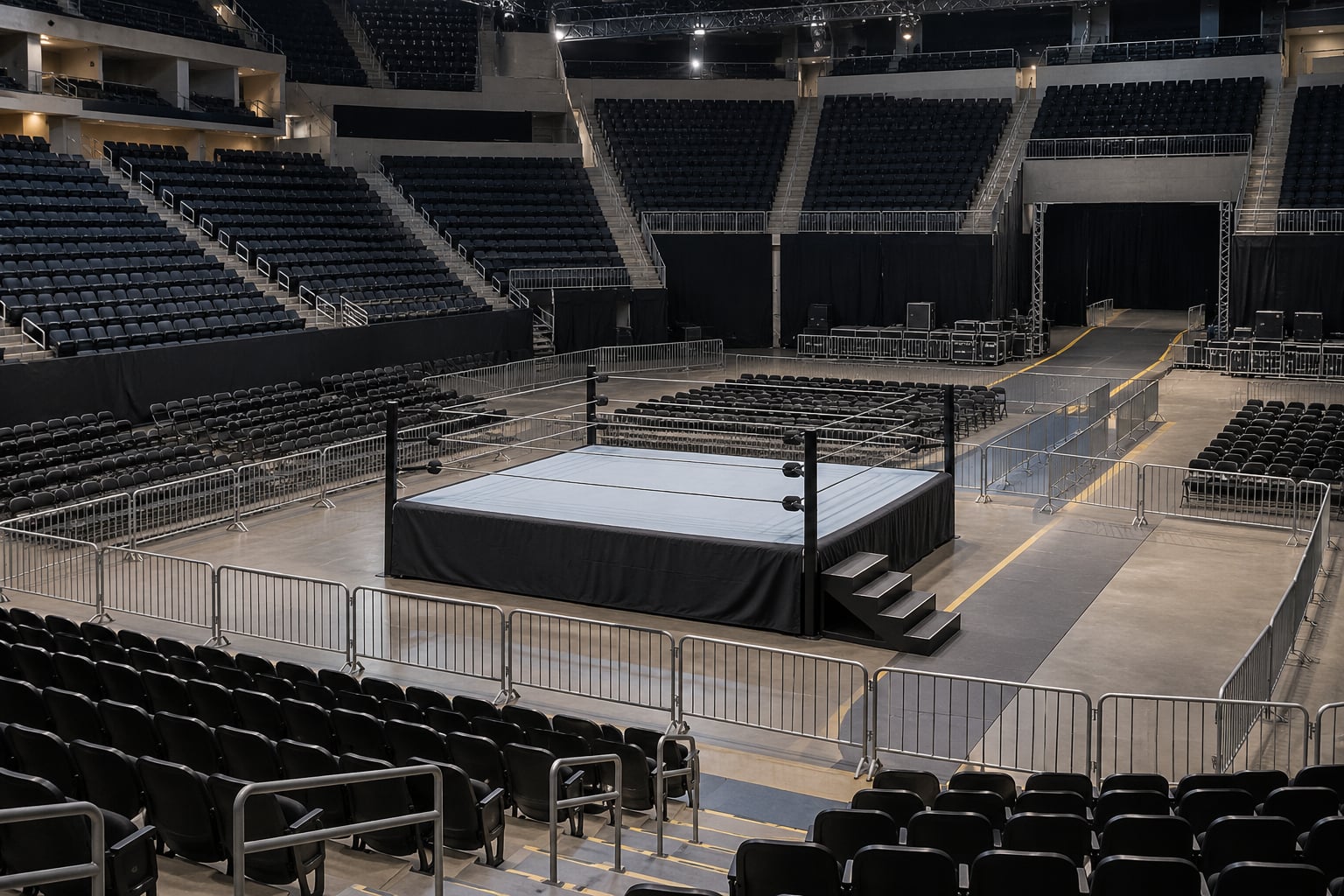
Barricades go up before the crowd arrives, and they are positioned rather than dropped, leaving the exact gap needed for staff to pass and for wrestlers to enter. Then everyone does a briefing. Ushers, guards, medical staff, camera operators and the ring crew all hear the same plan, the same radio channels and the same escalation wording.
Exit doors are unlocked and checked. Emergency routes are walked, not just read off a diagram. By the time the first fan reaches the concourse, the room is already zoned and the people responsible for each zone have been told who is in charge of it.
How do wrestling events screen entrances and manage tickets?
Entry is where most problems get filtered. Tickets are usually digital and tied to a name, which caps resale and duplicates, and scanning keeps the count of people inside matched to the count of tickets sold.
Doors split into lanes: one for guests already inside who are exiting, one for entry, and often a dedicated line for early access, VIP tiers or meet-and-greet pickups. Keeping those lines physically separate is what stops the concourse from locking up an hour before the bell.
At the screening point, staff check bags under a posted prohibited-items list. The recurring categories are bottles and any drink in glass, umbrellas with pointed tips, large rigid signs and inflatables, chairs, weapons of any kind, and anything that could be thrown. Policies vary by promotion and venue, so the sign at your specific building is the version that applies. What stays consistent is the reasoning: an object that can be thrown is treated as a hazard, because thrown objects are one of the most reliably reported problems in the crowd.
Re-entry, identification requirements and guest-list handling are set by the promoter and printed on the ticket. Checking the ticket email before you travel saves a queue argument later.
How is the crowd divided and controlled?
The building is split into zones, and each zone has its own staff. The bowl is seats and aisles. Ringside is rows close to the barricade with tighter spacing rules. Floor seating is a controlled access area handed out with a wristband. The concourse and the fan zone are unzoned but heavily patrolled, because that is where queues form and where most of the show’s social energy happens.
Barriers are the physical line between spectators and the action. A wrestler thrown into the crowd means a section of that crowd just had a fully grown adult land in it, so the ringside buffer exists to absorb exactly that. The r/WWE fan-interference thread is the reason people picture the barricade clearly: a WCW-era fan jumped it and was pulled clear by security before a Hogan beatdown could happen at all. That guard did not improvise. The gap in the barrier is where a trained person is supposed to be standing.
| Safety layer | Who provides it | What it actually does |
|---|---|---|
| Venue security | Arena operator | Building-wide control, concourse patrols, CCTV monitoring, door and egress management |
| Promotion-offered guards | Promotion, in coordination with the venue | Fixed ringside posts, entrance escorts, ring-side reaction, ejection on the promotion’s behalf |
| Ushers and stewards | Venue or contractor | Seat directions, aisle clearing, accessibility help, crowd flow at the show’s start and end |
| Medical staff | Venue medical team plus the promotion’s own | Ringside response, first aid, calling emergency services, escorting an injured person out |
| Front-of-house and ticketing | Venue box office | Scanning, capacity tracking, guest lists, re-entry decisions |
| Local authority | Police, fire, EMS as needed | Called in for a serious incident, a large evacuation, or an offence committed on site |
Ushers, stewards and security guards are three different jobs, and the difference matters if you need help. Ushers and stewards are customer-facing and service-trained; they direct you to your seat and clear the aisle. Security guards carry the authority to eject and, when required, involve police. When someone in the crowd says security is on the way, that usually means a guard, not the person holding your programme.
What are the main crowd-safety risks?
The recurring list is short and stable. Overcrowding or exceeding the occupancy limit. Aisles blocked by people standing in the wrong place. Trips and falls, which cause most spectator injuries at live events of any kind. Thrown objects. Fights. Harassment of other fans or of performers. Guests who are intoxicated or otherwise impaired. Equipment failure in the ring area. Severe weather for outdoor shows. And the one people underestimate, which is the bottleneck at show end when a few thousand people try to use a handful of doors and the car park at the same moment.
Each of those has a control attached to it. Capacity limits and counting handle the first. Aisle-clearing and ushers handle the second. Prohibited-items screening and guards at ringside handle thrown objects. De-escalation training and ejection handle fights. Alcohol policy and removal handle impaired guests. The rest are managed by the parts of the building you are usually not looking at.
How do staff respond to a medical emergency?
The response is a chain, and it works because everyone knows their link in it. The first person to notice alerts the nearest staff member, who alerts the ringside medical team directly rather than waiting for a supervisor. Radios carry that message faster than anyone can walk.
Once medical staff are moving, the area gets secured. Nearby fans are moved back so there is room to work and so people passing by cannot see a treatment in progress. Staff provide first aid only within their training and hand over to paramedics as soon as they arrive. If the incident involves a performer, the match stops, the lights come up, and the arena is held in place while the response runs.
Details of the incident are documented afterwards, including what happened, when, and which staff were involved. That record is what a promotion reviews when it decides whether a process needs to change. In a crowd crush case, the venue’s exposure turns on what it knew and when it knew it, which makes documentation a safety control in its own right.
How do wrestling events handle a fight or disruptive fan?
Escalation is gradual on purpose. Most situations are resolved with a word and a move toward the exit. What follows that is a formal removal request, then physical separation and escort out of the seating area, then ejection from the building with the ticket and any wristband invalidated. From there it becomes a documentation and ban decision, and if the behaviour involved a threat or an offence, it gets referred to the venue’s security lead and, where warranted, to police.
What actually triggers each step is worth being concrete about, because fans consistently say the thresholds are unclear. Persistent standing in an aisle, blocking another fan’s view repeatedly, and shouting abuse at performers or other attendees are the low end. Drunk and lewd behaviour, harassment, throwing anything toward the ring, and physically refusing to leave are the removal end. A r/SquaredCircle thread about the worst fan behaviour anyone has seen at a live show described attendees who were intoxicated and lewd at an NXT show, with children in the same crowd, which is exactly the scenario the alcohol policy and the removal threshold exist for.
Nothing about that is unique to wrestling, and promoters rarely publish a fixed list. What they publish is a code of conduct, and the enforcement is applied to it.
What happens during an evacuation or severe-weather incident?
An evacuation plan is written for the building, not for the show, which is why it works even when the wrestling is irrelevant. Announcements give instructions rather than explanation, using language agreed in advance. Designated exits and staff directions do the guiding, with accessible routes and assistance for anyone who needs it. Assembly points are set away from the building and away from the car park approaches, because a crowd that exits safely into a traffic jam has not finished evacuating.
Staff count people, because a fire marshal’s answer to “did everyone get out” is a number and not an impression. Emergency responders are met at the door by someone briefed, which shortens the handover. For outdoor shows, lightning and wind have their own thresholds; once a threshold is hit, the decision to stop belongs to a named person and not to the crowd’s patience.
How can attendees support safer wrestling events?
Read the ticket email before you leave, including the prohibited-items list and the venue’s code of conduct. Arrive early enough that you are through screening before the queues form. Keep your aisle clear and stay in your own floor or ringside section. Report a hazard, a blocked aisle or an injured person to a steward rather than handling it yourself.
Look after the people you came with. If someone in your group is getting louder with every drink, that is the moment to start walking, not after it becomes a removal. Follow instructions the first time they are given, especially in an emergency, and do not argue with a guard who is asking you to move.
The one adjustment most people find hardest is silence. Fans have said for years that modern wrestling shows feel like a play, where rowdiness is frowned on and raising a sign can get you a look. That complaint is fair and it is a genuine trade-off against safety, and it is dealt with further below.
How do independent wrestling shows handle crowd safety differently?
A 400-seat wrestling school show and a sold-out arena card are the same sport and a completely different safety problem. Independent promoters rent halls and share buildings with other tenants, so capacity is the binding constraint long before staffing is. There is often no venue medical team, so first-aid cover has to be arranged deliberately, sometimes by a volunteer with a certification and a phone. Barricades may be rope, or a row of folding tables, or one capable person with a clipboard standing in a doorway.
| Safety element | Full arena show | Independent hall show |
|---|---|---|
| Capacity control | Ticketed, scanned, counted against a posted limit | Door count and a hard stop at the fire limit |
| Entry screening | Bag check and prohibited-items list at every door | Often a posted list and a table near the entrance |
| Barriers | Engineered crowd barrier with staffed gaps | Rope, tables, or a small number of stewards |
| Security staffing | Venue team plus promotion-offered guards on fixed posts | A handful of volunteers and the promoter’s own crew |
| Medical | Venue medical team with a promotion medic at ringside | Arranged first-aid cover, nearest hospital known in advance |
| Emergency plan | Written, briefed, coordinated with local authorities | Basic plan, often inherited from the hall’s normal events |
The honest version is that independent shows operate on less margin, and the crowd knows it. That is also why the door list matters more there, not less.
The security-vs-atmosphere tension
Here is the trade-off nobody in this business wants to write about. A rowdy crowd is part of what makes a wrestling show feel alive, and it is also the thing that produces thrown objects, attempts to climb the barricade and chants that make a family show uncomfortable. Every control in the list above buys safety with atmosphere, and every one of them is a real cost.
What the complaint is really pointing at is consistency. Fans are not objecting to a guard at the barricade. They are objecting to a sign policy that changes between cities with no explanation, and to an atmosphere that feels managed rather than encouraged. Promotions that publish a clear, stable code of conduct get less friction than promotions that enforce reactively, even when the number of staff is the same.
And the scale argument is not nothing. Reporting around WrestleMania 42 weeks pointed to hotel and venue security being stretched by fan traffic, with talent reportedly unhappy about it. The lesson generalises to any promotion: staffing that is adequate on a Tuesday is not automatically adequate on a Sunday in a different city.
Frequently Asked Questions
Do WWE and AEW hire their own security, or use the venue’s staff?
Usually both. The arena operator runs building-wide security, concourse patrols and CCTV, while the promotion supplies extra guards who work fixed ringside and entrance posts and carry the authority to eject on the promotion’s behalf. That is why the guard you see in front of an entrance is not the same person who checked your bag, and why you can see the same faces at a show in a city the promotion visited last month.
Why does a security guard walk in front of the wrestler to the ring?
The escort is a fixed protocol, not a reaction to anything happening in the crowd. A guard clears the route from the entrance to the ring, deals with fans who step into the aisle or reach over the barricade, and then takes up a post opposite the hard camera, which is the sightline the production team needs kept clear. It also means a performer never has to navigate a crowd alone. The behaviour is consistent enough that fans recognise the same individual doing it at every show, and it is the single most-asked question on wrestling fan boards.
What can’t you take into a wrestling show?
Bottles and glass containers are the usual starting point, then anything throwable or rigid: umbrellas with pointed tips, chairs, weapons, hard-sided bags. Large signs, inflatable items and noisemakers are restricted at most venues. Policies differ by promotion and city, so the list posted at your specific building is the one that applies. The logic behind all of it is the same: an object a fan can pick up is an object that can end up in the ring.
What happens if a fan enters the ring or interferes with a match?
Guards at the barricade move in immediately, the match stops, and the person is escorted out of the seating area and removed from the building. It gets documented, reported to the promotion’s security lead, and normally results in a ban from the venue. Deliberate interference can carry a criminal charge on top of the civil consequences, and the promotion will usually put out a public statement. Fans still debate these cases, which is reasonable: promoter statements after an incident are not a substitute for the incident report.
Is there a medical team at a pro wrestling show?
Yes, and it is placed close to the action rather than at the back of the concourse. Arena shows run a venue medical team for the building, usually with a promotion medic stationed at ringside. Staff are briefed that the first person to spot a problem alerts the nearest staff member, who calls medical directly rather than escalating through a supervisor. Chords, dislocations and concussion are the injuries that come up most often, and access to a real ambulance matters more than anything else in that chain.
Do independent wrestling shows have any security?
Usually a small number of volunteers and the promoter’s own crew, rather than a contracted team. The binding constraint at an independent show is the venue’s fire capacity, so the door count is often the main control, alongside a posted prohibited-items list and a rope or table line at ringside. Medical cover is arranged rather than inherited, and the quality of it varies widely between promoters. Checking the promotion’s own event details before you travel tells you a lot.
Conclusion
How wrestling events handle crowd safety comes down to a layered system that starts at venue selection and ends at the car park: planned capacity, door screening under a prohibited-items list, a building divided into staffed zones, barriers between the crowd and the action, medical close to the ring, and a written evacuation plan everyone has heard. It works because the layers overlap rather than depend on any single one.
What you can do is small and worth doing. Read the ticket email before you travel, find the prohibited-items list, arrive early, keep your aisle clear, and follow the first instruction a steward gives you rather than the second. If you want to know more about how a show is actually built before the doors open, our coverage of venue setup and independent wrestling promotion goes into the operational side in more detail.