WWE championship matches are predetermined. Before a title match goes on the card, the winner, the finish and the story beats are agreed by WWE’s creative team, then rehearsed with the wrestlers and the producers on television. The audience reaction and the in-ring work are the live parts. That is the short version of how WWE decides who wins a championship match, and the rest of the process is what this guide walks through.
It matters because the result rarely belongs to the wrestler who had the better night. It belongs to a booking plan that may have been sketched months earlier, approved by several people, and revised again the week of the show.
Table of Contents
- How WWE Decides Who Wins a Championship Match
- The Main Creative Reasons WWE Chooses a Winner
- How Storyline Direction Affects the Championship Finish
- Why WWE May Change a Planned Finish
- How Major Events Change Championship Decisions
- Do Wrestlers and Producers Know the Finish in Advance?
- What Behind-the-Scenes Reports Can and Cannot Confirm
- Can Fans Predict Who Will Win a WWE Championship Match?
- Frequently Asked Questions
- Who decides who wins a WWE championship match?
- Are WWE championship match finishes decided weeks in advance?
- Why does WWE sometimes change a planned match result?
- Does a champion always lose at a major event?
- How do rumored finishes become unreliable?
- What signs can fans watch before a championship match?
- Conclusion
How WWE Decides Who Wins a Championship Match
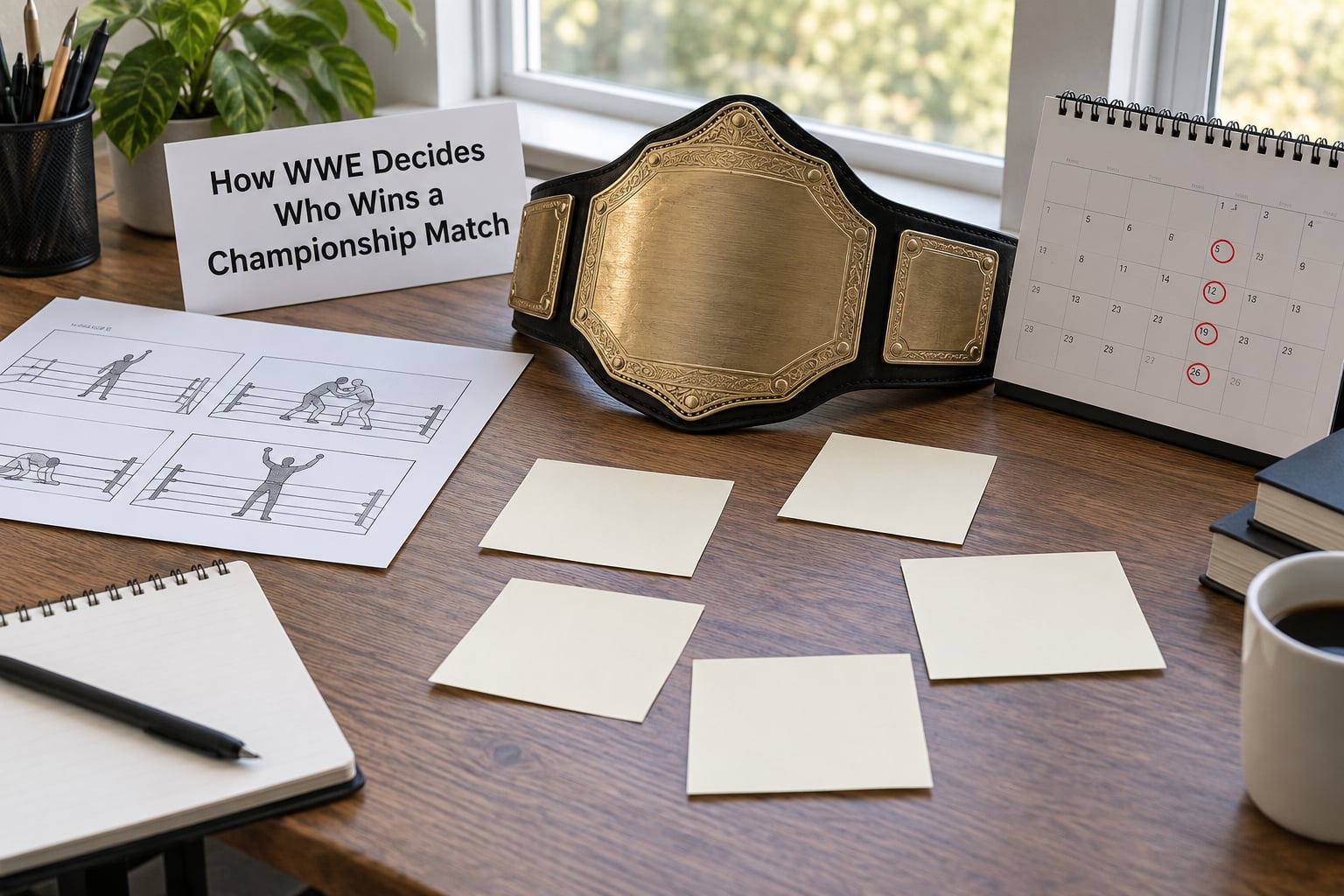
The champion, the challenger, the finish and the story beats are agreed by the head of creative and their bookers before the match is announced, then rehearsed by the wrestlers and the producers assigned to it.
WWE does not work match by match. A title reign is usually sketched out months ahead, which means the result of a match you see on a Monday night was chosen while that wrestler was still working toward being in the picture at all.
The Main Creative Reasons WWE Chooses a Winner
Most finishes come down to one of a handful of story questions: who needs the belt more than the person holding it, who is being introduced to a wider audience, and what happens to the storyline if the champion walks out with it again.
- Someone needs the title. A wrestler being pushed usually wins because the belt is what makes the audience take them seriously. Losing it in their first big match undoes months of setup.
- The champion has run out of opponents. When a champion has beaten everyone credible, the writing has nowhere left to go, so the belt moves to refresh the division.
- The reign needs a milestone. Some reigns are deliberately long to hit a number or a show date. Other title changes are pulled forward so a new star gets a title run before interest fades.
- The finish pays off a long storyline. A payoff built over months, sometimes years, is booked to happen whether or not it is the result people expect.
- The next chapter needs setting up. A challenger picking up a belt immediately opens a new storyline. A champion retaining keeps the feud alive and gives the next match a reason to exist.
How Storyline Direction Affects the Championship Finish
Feuds, heel turns, returns and redemption arcs are all set up so a match produces a specific result. Bookers are not picking a winner on the day. They are building a reason for a winner that already exists.
A squash match is the clearest example. In a squash match the challenger is supposed to get almost no offence, so the champion wins comfortably and the outcome is set well in advance. The match announces that the challenger is not ready, which tells the writing team how long that rivalry needs before a real payoff.
A rubber match works the other way. It is booked when both wrestlers have beaten each other already, so the finish has to feel earned by either one. Those are the matches where the crowd reaction matters most, and where a change late in the week is most likely.
Returns and debuts also decide outcomes. A returning wrestler usually wins because the return itself is the event. A heel turn usually ends with the new heel winning, because the crowd has just invested in them and the payoff is seeing them collect something.
Why WWE May Change a Planned Finish
Planned finishes get changed for concrete reasons rather than because anyone is guessing on the day. Availability is the most common one: an injury or a schedule conflict can force a different result, or no result at all.
Injury concerns get considered too. A wrestler who works a match differently than planned, or who tells the writers they cannot safely deliver a spot, changes what the finish can be.
Live crowd reaction is the other big variable. If a returning wrestler gets a bigger pop than expected, the writers may extend the segment or change the finish to reward it. The reverse is also true when a crowd rejects a turn they were expecting.
Talent negotiation plays a real part. Wrestlers negotiate finishes, and the Cody Rhodes win over Drew McIntyre at WrestleMania 40 is the case most fans still argue about. Wrestling coverage at the time reported that both men were pushing for the change, with audience fatigue cited as the reason a result that had been set up differently was moved.
That last point is the one that frustrates fans most, and it comes up constantly on wrestling forums. Writers are supposed to plan several months ahead; the complaint is that the plan gets rewritten when someone changes their mind rather than when something goes wrong in the ring.
A strong performance can also move a finish. If a challenger works far better than expected in a match that was supposed to be a squash, the decision to protect the champion can be reconsidered. It is rare because it undermines the champion, but it happens.
How Major Events Change Championship Decisions
Championship decisions on a weekly television show and on a premium live event are made with very different weight behind them. A main event on a big show carries the ratings and buyrate of the entire card, so the result gets more scrutiny, more coordination and usually more sign-off.
WrestleMania, SummerSlam, Royal Rumble and Payback all work this way. The finish is typically locked further in advance because of travel, sponsors, cross-brand coordination and the number of people who need to be told. A Raw main event has far more room for improvisation.
Stipulations matter here for a practical reason. A steel cage, ladder match or no disqualification match gives the writers built-in reasons for a non-finish or a double count-out, so a champion can be protected without the crowd feeling shortchanged. Hell in a cell goes further because almost anything can be explained by the structure.
Placing a title match on a go-home show before a big event also narrows the options. A champion who loses on the Monday before WrestleMania usually has to win the title back, which is a scheduling problem writers try to avoid.
Do Wrestlers and Producers Know the Finish in Advance?
Most wrestlers know the finish well in advance, because they have to rehearse the spots that produce it. A champion expecting to win needs the finishers, the near-falls and the reversals timed and safe, so the outcome is locked before anyone steps through the curtain.
Some matches get a partial arrangement instead. A protecting champion may be told the plan is a long match with strong interference and a double count-out, without being told exactly who walks out with the belt. It protects the business, but it is rare.
Wrestlers can also negotiate during rehearsal. A planned spot gets dropped because it hurts, or because the person taking it does not believe it will get a reaction. Producers relay that back to the writers, and sometimes the finish changes with it.
What Behind-the-Scenes Reports Can and Cannot Confirm
Reporters in the wrestling business generally get their information the same way: wrestlers and producers talk after a show, and a reporter with enough sources confirms it before writing. The Wrestling Observer Newsletter has been the most consistent source for decades for that reason.
What that means in practice is that a report naming specific decision-makers and giving a stated reason is usually worth taking seriously. A report saying a match was changed because someone felt it was the right call is weaker, because that covers almost any decision.
Social posts from wrestlers are the hardest to read. A photo of a belt with no caption, an ambiguous workout video, or a wrestler avoiding a question is not evidence of anything. Fans have filled in a year of title scenes from posts that meant nothing, which is exactly why writers keep them vague.
Forum threads are useful for tracking what the audience expects, not what has been booked. If a thread is confident about a finish, that usually means the finish was obvious, not that the reporting is accurate.
Can Fans Predict Who Will Win a WWE Championship Match?
You can narrow it down with real signals, but no signal is a guarantee. The useful ones come from how a match is announced rather than from any single clue.
- Booking position. A wrestler booked to win is usually given more offence, more comebacks and longer stretches of the match. Someone losing cleanly rarely gets those.
- Momentum. A wrestler on a long winning streak is being pushed. A champion who has not defended in months is being protected, and usually keeps the belt.
- Card placement. A title match closing the show signals an important result. A title match buried mid-card is usually a placeholder for a bigger moment later.
- The stipulation. No disqualification and cage matches lean toward interference endings, which often means a champion who is meant to survive.
- What has already happened. If two wrestlers have split their recent matches, a third decisive result is a strong sign a title is changing hands.
- Long-range story hints. Promos about deserving the title, or a heel talking about changing the division, usually come a few weeks before a booked change.
None of this is insider information. It is pattern recognition, and it fails constantly when a finish is moved for availability or crowd reasons.
Frequently Asked Questions
Who decides who wins a WWE championship match?
The result is set by WWE’s creative team, starting with the head of creative and working down through bookers, writers and producers. A long-range plan decides most outcomes months earlier, and producers rehearse the finish with both wrestlers before the card is announced. The champion or challenger does not get to pick the result alone.
Are WWE championship match finishes decided weeks in advance?
Yes, usually much longer than weeks. Main event finishes at big shows are often planned months in advance, while weekly television title matches may only be locked a week or two out. Producers rehearse the spots once the finish is decided, which is why wrestlers can already tell you who is supposed to win days before a show.
Why does WWE sometimes change a planned match result?
Common reasons include injury or availability, negotiations with the wrestlers involved, live crowd reaction, pacing problems on the card, or a change in creative direction. Performers often work a match better than expected, which can force a reconsideration. Any of these can override a finish that was already set and rehearsed.
Does a champion always lose at a major event?
No. Retaining is the default outcome for most title matches, including main events. Champions lose when the story calls for it, such as a payoff built over a long feud or a title change that refreshes a division. A champion losing before a big show is avoided where possible because it creates a result the company then has to book its way out of.
How do rumored finishes become unreliable?
Most rumours are recycled, exaggerated, or based on a single unnamed source. A vague social media post, a photo of a belt with no context, or a forum thread repeating last year’s guess proves nothing. Reports that name specific decision-makers and give a stated reason carry more weight, but even those describe plans rather than guaranteed outcomes.
What signs can fans watch before a championship match?
Look at how the match is announced and how long it has been built. Wrestlers booked to win usually receive comebacks and near-falls, while a champion being protected wins short matches. Stipulations, card placement, recent win-loss records and any promo about deserving the title all help. Treat it as pattern recognition rather than a guarantee.
Conclusion
A WWE championship result is a booking decision made well before the bell rings, and it comes from a chain of people rather than a single person in a room. The head of creative and the bookers set the plan, producers rehearse it, and the crowd is the only genuinely live variable on the night.
If you want to read a result correctly, check four things first: what the match was built to accomplish, where the champion’s next few months are heading, whether the challenger was given the offence a winner gets, and whether credible reporting says the plan changed. Everything else on the card is window dressing around one of those outcomes.