If you want the short answer to how Royal Rumble entry numbers are decided: they come out of a hat or bag at random, usually backstage on the same day as the show, from a set of numbers that match the announced participants. Wrestlers often learn their number only a few hours before the bell, and creative has already reserved certain slots and reveal spots before the public drawing happens.
That second part is where most arguments online go wrong. The draw is real in the sense that a slip comes out of a container without anyone choosing it, but the pool that goes into the container is built weeks earlier, and the outcome of the match itself is booked long before anybody walks through the curtain.
Here is how the whole thing actually works, from the announcement of the field to the moment the final number gets pulled.
Table of Contents
- How Royal Rumble Entry Numbers Are Decided
- Where the drawing actually happens
- Why the delay is so short
- Who is actually in the room
- What you are seeing on television
- Why Royal Rumble Entry Numbers Matter
- Entry order is the one thing a draw cannot soften
- What the crowd is reacting to
- Why the biggest names often draw late
- Where the number stops mattering
- What Happens During WWE’s Number-Drawing Process
- Step one: the eligible field is locked
- Step two: the numbers are prepared
- Step three: names are drawn
- Step four: reserved slots are added back
- Step five: order is locked and released
- Who Decides the Numbers and What They Cannot Control
- What creative decides before anyone draws
- What the number genuinely controls
- Why an early exit is not a bad draw
- How Random Are Royal Rumble Numbers?
- Why the outcomes cluster in the late numbers
- What a fair draw would actually look like
- What a fan can verify
- A short history of the draw itself
- How Special Rules and Production Decisions Change the Order
- Pre-match elimination changes who survives to be numbered
- The Women’s Rumble runs on the same principle
- The Ultimate Rumble compresses everything
- Injuries, releases and replacements leave gaps
- Unannounced entrants are never drawn at all
- Two Rumbles on one card
- Why the announced list annoys people
- What No. 1 and the Final Number Really Mean
- Number 1 as a survival record
- Why later numbers get built around
- The number nobody wants
- Winners by number, in broad strokes
- Frequently Asked Questions
- What entry number has won the most Royal Rumbles?
- Is the Royal Rumble entry number draw rigged?
- How many entrances are in a Royal Rumble?
- What are the rules of the Royal Rumble match?
- Do wrestlers choose their own Royal Rumble number?
- What to Watch During the Number Draw
How Royal Rumble Entry Numbers Are Decided
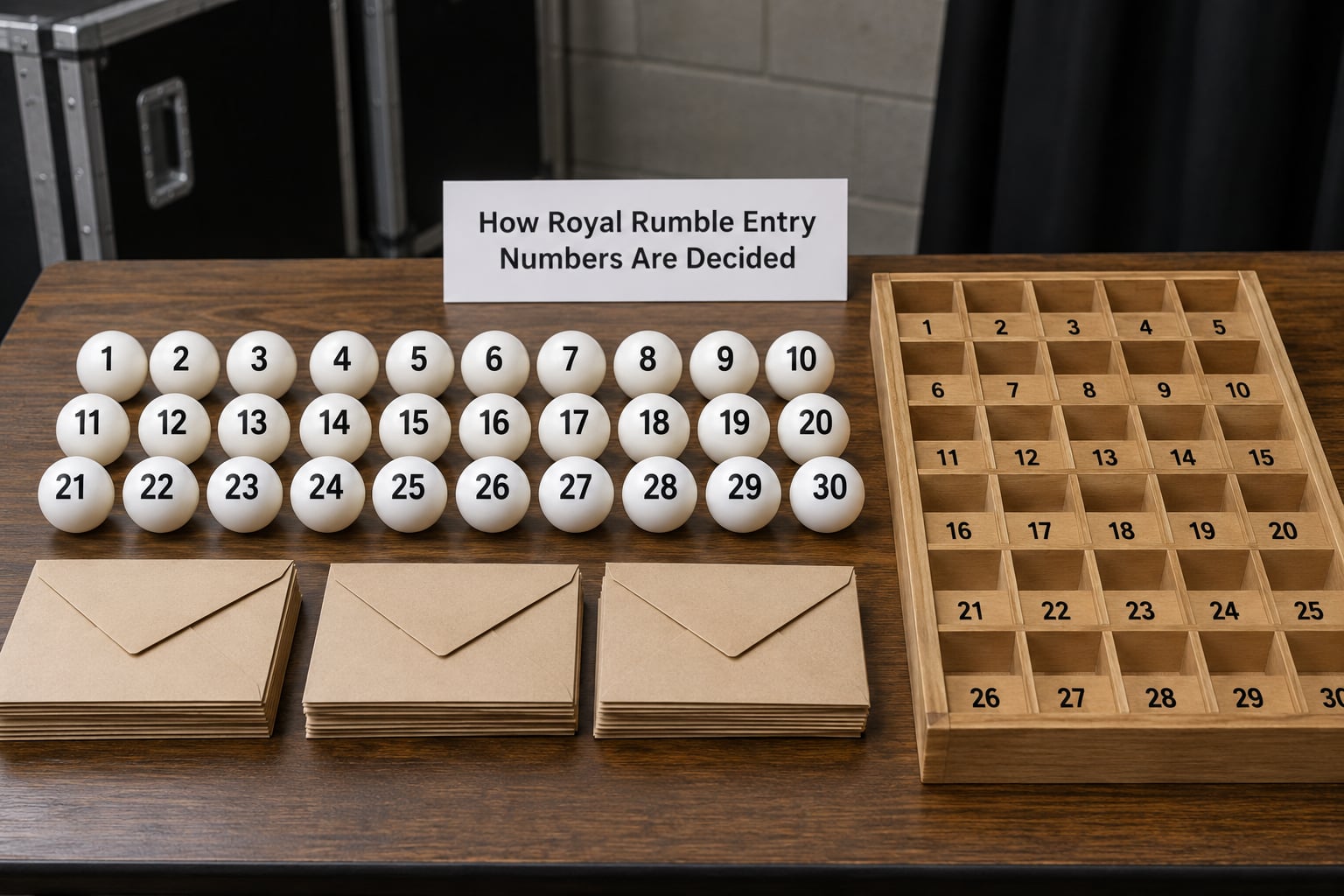
The direct answer: WWE puts a numbered slip for every eligible announced entrant into a hat or bag and the numbers are drawn shortly before the show goes on the air. Nobody picks their own Royal Rumble entry number, and the draw itself is presented as random even though the list of names placed in the hat was decided well in advance.
Wrestlers do not find out their number weeks ahead. Sheamus described the timing as roughly two or three hours before the show, which is late enough that a name can be added, removed or moved right up to the wire. That timing is deliberate. If everyone knew their slot in January, a planned elimination would be guessable months before the event.
Two things happen at roughly the same time in that window. The physical draw assigns numbers to the announced names, and the creative team finalises which slots are open, reserved, or being held for a surprise entrance.
Where the drawing actually happens
Usually in a backstage or production area close to the event start, not weeks in advance at a studio. Some of it gets filmed for social media, some of it happens live, and occasionally a draw gets skipped entirely because a segment needs a specific person in a specific place on the timeline.
Why the delay is so short
Hold the numbers back and every leak matters more. A tight window limits two things at once: the chance a wrestler spills his number during an interview, and the chance a reported sheet spoils the order before the show.
Who is actually in the room
Rumble draws typically involve a mix of the announced superstars, a producer or two running the segment, and occasionally an on-screen personality handling the presentation. Producers hold the remaining slips, which is where the reserved numbers live.
What you are seeing on television
The draw has become a broadcast beat. A wrestler posts his number on social media, an official channel clips the moment, and the crowd gets a reaction shot. The clip is genuine, the reaction is genuine, and neither one tells you who the creative team had winning at the end.
That gap between the reveal everyone sees and the plan nobody announces is the source of most Rumble frustration. Fans watch a draw, lock onto a number they like, and then watch creative ignore it. Nothing was rigged at the draw. The outcome was never part of the draw to begin with.
Why Royal Rumble Entry Numbers Matter
The entry number is the whole match in one number, because entry order is time in the ring. Every wrestler who enters late inherits a match that has already started, and every wrestler who enters early has to survive longer on less rest.
Number 1 starts the match alone with no partner and no backup. A number 5 entrant arrives to a ring that has already seen four eliminations. The number 30 entrant walks in during the final stretch with a fresh body and the whole audience still standing, which is why late numbers convert into wins so often.
There is a symbolic layer too. Drawing number 1 has become a badge of hardship, and the final available number carries the drama of a last-minute arrival. Neither is a status marker the way a main-event slot is, but both get treated that way by fans in 2026 more than they used to.
Entry order is the one thing a draw cannot soften
A storyline can be adjusted after a bad draw. An entry number cannot. That rigidity is why number reveals generate so much reaction footage: the wrestler reacting to a slip knows exactly how much time they have left to make an impression.
What the crowd is reacting to
Mostly the arithmetic. On a two-minute clock, a number 14 entrant walks in with the timer a little past 26 minutes. A number 4 entrant gets roughly 6 minutes of match before the next arrival, and the smart crowd reads that instantly.
Why the biggest names often draw late
Not because they asked for it, but because a late arrival keeps them out of the early chaos and lands them in the part of the match the crowd is still standing for. It also leaves them fresh for whatever comes after the Rumble on the card.
Where the number stops mattering
The final eight or so minutes. Once the field is thin, entry order matters less than who is left standing, and a number 12 wrestler still in the ring at that stage has already outperformed the number 28 who got thrown out at minute 25.
What Happens During WWE’s Number-Drawing Process
The standard process runs in a fixed order, and once you can name the steps the confusion about “rigged draws” mostly dissolves.
Step one: the eligible field is locked
WWE announces the participants weeks ahead. Those announced names form the eligible pool. Anyone not announced is not in the hat, which is why unannounced legends and returning favorites never receive a publicly drawn number.
Step two: the numbers are prepared
Slips or balls numbered 1 through 30 are placed into a container backstage. In recent years the draw has often been filmed and posted to WWE’s social channels, so the moment doubles as a promotional beat rather than something the audience sees live.
Step three: names are drawn
Each participating superstar draws a number, or a producer draws on their behalf if a wrestler is already elsewhere on the card or travelling. This is where camera angles matter. A wrestler sent to a live segment can react genuinely, because they just picked the slip a moment earlier.
Step four: reserved slots are added back
Numbers held for surprise or unannounced entrants are simply kept back. If number 17 never comes out of the hat, that is the signal that someone unnamed is walking in at minute 32.
Step five: order is locked and released
WWE confirms the running order, the timer graphics are set, and the match card positions around it. By the time the bell rings, the drawing is over and every number has a purpose.
Who Decides the Numbers and What They Cannot Control
The drawing establishes order. It does not establish who wins, who gets pinned, or who walks out with the title shot. That separation is the single most useful thing to understand about Royal Rumble numbers.
WWE writers and producers control the field, the storylines, the timing of each entrance, which names are eliminated early to protect bigger names, and the finish. A wrestler can genuinely draw number 2 and still be on the receiving end of an elimination two minutes later because the story called for it.
Draws can also shape what is possible. If the same two names are drawn back to back, that pairing is dealt with in the segment, either by re-drawing or by building the beat around them. Entry order sets the canvas, but the finish is written.
What creative decides before anyone draws
Typically the headlining storyline, the title scene, which returning names appear and when, and the pacing of the whole card. All of that exists before a single slip is printed.
What the number genuinely controls
Entrance timing, ring time, and the number of opponents a wrestler faces while fresh. A number 28 entrant arrives in the closing stretch with legs left. A number 3 entrant has two minutes of one-on-one before anyone joins them.
Why an early exit is not a bad draw
Protected names get thrown out early so they can appear later on the card, healthier and in a better segment. A number 4 draw followed by a quick elimination can mean less for the Rumble and more for the rest of the night.
How Random Are Royal Rumble Numbers?
Random within a pool that has been carefully built. That is the honest description, and it is the same description that applies to any draw-based format in wrestling or sport generally.
The genuinely random part is the mapping of names to numbers inside the eligible pool. The engineered part is everything that determines who is in that pool, and how the resulting order will be used. Talent booked for a main event run tends to have a range of numbers creative is comfortable with, because a draw can put anyone anywhere.
Late entry positions are sometimes settled earlier than the rest, especially in matches built around a specific reveal. If the plan calls for a returning wrestler to appear near the end, the number that gets them there is rarely left to chance once production knows what the segment requires.
Why the outcomes cluster in the late numbers
Not because the draw favours them, but because survival correlates with stamina. Late entrants arrive with legs left and face a field that has already thinned out. Early entrants spend the first minutes absorbing punishment from people who were resting.
What a fair draw would actually look like
If every announced name had an equal chance at every number and the draw were fully clean, winners would spread fairly evenly across 1 through 30. They do not, and they never have. That skew is the strongest evidence that the finish, not the draw, is the variable.
What a fan can verify
Clips of the draw exist for most Rumbles, which means the name-to-number mapping can be checked after the fact. Do that occasionally and a pattern shows up: certain stars draw early, get eliminated quickly, and reappear later on the card. The number was real. The purpose was not.
A short history of the draw itself
When Pat Patterson built the first Royal Rumble in 1988, numbers came out of a hat on the night with no announcement at all. The announced field, the filmed draw and the two-to-three-hour reveal window are refinements of a format that started as a genuine surprise for the crowd in the arena.
How Special Rules and Production Decisions Change the Order
The 30-man, two-minute format is the baseline, and every Royal Rumble variant bends the numbering rules in some way.
| Rumble variant | Entrants | Entry interval |
|---|---|---|
| Men’s Royal Rumble | 30 | Two minutes |
| Women’s Royal Rumble | 29 to 30 depending on the year | Two minutes |
| Ultimate Royal Rumble (40-man) | 40 | 90 seconds |
| 20-man Ultimate Royal Rumble | 20 | Two minutes |
| Pre-match elimination rounds | Opening count varies by year | Eliminations run as fast as possible, then the traditional timer takes over |
Pre-match elimination changes who survives to be numbered
Since 2020 the men’s Rumble has opened with a rapid elimination phase that clears a set number of wrestlers from the ring in a few minutes. Those names are still announced participants, but they are removed before the numbered timer begins, so their slots simply do not matter.
The Women’s Rumble runs on the same principle
The women’s match uses the same hat, the same two-minute clock and the same over-the-top-rope elimination rule. The pool is smaller, which means the variance in a thirty-name draw is less dramatic and the late slots carry proportionally more weight.
The Ultimate Rumble compresses everything
Forty names at ninety seconds each is the fastest main-event rhythm the format has ever run, and the surplus entrants beyond the announced field are usually the surprise slots that make it memorable.
Injuries, releases and replacements leave gaps
When someone is pulled from the card close to the show, their number is redistributed rather than reassigned by draw, and a replacement entrant can inherit a slot that was drawn weeks earlier by someone else. Fans notice numbers being skipped during the draw. It usually means a name is being held back for a surprise, not that the process broke.
Unannounced entrants are never drawn at all
This is the part that confuses newcomers most. A surprise entrant does not get a slip from the hat, because nobody knew they were participating. Their number is simply the gap left in the sequence, and it is decided by production rather than by chance.
Two Rumbles on one card
When the men’s and women’s matches both run at the same event, they are drawn separately with separate containers. Numbers do not carry over between them, and a wrestler cannot hold a number from one match while drawing in the other.
Why the announced list annoys people
Because the Rumble is built on surprise and the announcement gives away most of it. Fans reasonably point out that a fully announced field turns the draw into a formality. That complaint is fair, and it is also why the held-back slots matter so much to how the match is built.
What No. 1 and the Final Number Really Mean
Number 1 is decided by the draw, not by seniority or by who WWE wants to suffer. It is a survival test. One competitor, no help, no tag partner, and roughly an hour of match to survive, so the record for time in the ring almost belongs to whoever drew it.
That is why the slot carries a reputation, and why a number 1 draw is treated like a punishment in the locker room even though it is nothing more than the bottom of a bag. The record books show the last number winning most often, with number 30 at the top of the winners-by-entrance tally in compiled records, and numbers 24 and 27 appearing frequently among winners too.
Compiled tracking of Rumble winners puts the average winning entry number at around 20, which tells you something useful about stamina. The final entrant is the most likely winner because of fresh legs and late-match visibility, not because the draw favours them.
Number 1 as a survival record
The wrestler who draws number 1 has to go roughly an hour without rest or help, so the notable feats from that slot are almost all time-in-ring records. It is the worst number to win from and the easiest number to be impressive in, which is a strange combination but a real one.
Why later numbers get built around
Because a late entrance is the natural climax. The announce, the reaction, the crowd standing, all of it lines up with a wrestler who has not been worn down yet. Creative knows this, which is why the last few slots carry the most story weight regardless of who drew them.
The number nobody wants
Numbers one to five are treated as the difficult end of the draw because the ring is a mess by then and there is no time to build anything. Wrestlers with strong stamina have reportedly tried to avoid that range, which tells you how seriously the reputation is taken inside the building.
Winners by number, in broad strokes
Compiled lists of Rumble winners repeat a few names in the tally. The last number leads, numbers 24 and 27 sit close behind, and the low single digits almost never appear at the top. Anyone publishing an annual update of this table is doing useful work for the fan community.
| Entry number | What it usually means |
|---|---|
| 1 and 2 | Start the match, longest possible survival if you last |
| 3 to 10 | Early entrants, no rest, quick exits unless protected |
| 11 to 20 | Mid-card slots, enough time to build something |
| 21 to 29 | Late entries, arrive to a thinning field and real offense |
| 30 | Final entrant, most common winning number in compiled records |
Frequently Asked Questions
What entry number has won the most Royal Rumbles?
The last entrant, number 30, has won more often than any other spot in compiled Royal Rumble records. Numbers 24 and 27 also show up repeatedly among winners, and the average winning entry number sits at roughly 20. The pattern tracks stamina and airtime: a late entrant arrives with fresh legs to a match that has already been decided several times over.
Is the Royal Rumble entry number draw rigged?
The draw is random in the sense that nobody chooses their own slip, but the pool of eligible names is assembled weeks earlier and certain slots are held back for surprise entrants. So the mapping of names to numbers inside the announced field is a genuine draw, while the boundaries of that field are a creative decision.
How many entrances are in a Royal Rumble?
The standard men’s Royal Rumble has 30 entrants, numbered 1 through 30, starting with numbers 1 and 2 in the ring and adding a new entrant every two minutes. The Women’s Royal Rumble uses a similar pool of about 29 or 30. The Ultimate Royal Rumble expands to 40 entrants on a faster 90-second interval.
What are the rules of the Royal Rumble match?
Numbers 1 and 2 begin the match, one new entrant arrives every two minutes, and elimination happens only when a wrestler is thrown completely over the top rope and both feet touch the floor. The last wrestler standing wins. Nobody leaves the ring and the match does not pause, so the clock is the real opponent.
Do wrestlers choose their own Royal Rumble number?
No. Wrestlers draw a numbered slip from a container backstage, usually a few hours before the show goes on the air. Sheamus described the timing as roughly two or three hours before the bell, and said some draws land very close. That short window is what lets WWE add or move an entrant right up to airtime.
What to Watch During the Number Draw
Watch which numbers come out and, just as importantly, which numbers never do. A number skipped in the draw belongs to somebody who is not named on the card, and that gap is often the most interesting moment of the whole segment.
Then separate what you just saw from what was decided months earlier. The slip is a random result; the field it came from, the eliminations, and the winner were all settled before anyone reached for the container. Rumble dirt sheets posted weeks ahead tend to be wrong for exactly that reason, and the draw is the part you can actually trust.
Best first step for a new fan: learn the two-minute interval and the top-rope rule, then watch one Rumble with the draw in mind. Once you know that entry order is time in the ring, the rest of the format explains itself.