A wrestling promo is a piece of microphone work in which a wrestler or their manager talks straight to the camera and the crowd to advance a storyline. It can be read word for word from a page, or it can be built from a handful of bullet points and finished on the night. Almost everything in between exists too.
This guide walks through the whole process: how a creative team decides what a promo has to accomplish, who physically writes the words, what the wrestler receives before show day, how the rehearsal runs, and why a great script still gets thrown away mid-ring when the crowd reacts differently than anyone planned.
Two things are worth saying up front. First, no major promotion hands every talent the same amount of writing. Second, the rehearsal half of the job is the part fans almost never see, and it is where most of the work actually happens.
Table of Contents
- What a Wrestling Promo Is Actually Meant to Do
- How the Creative Team Develops the Promo
- How a Wrestling Promo Is Written and Rehearsed
- The Four Stages of a Professional Wrestling Promo
- 1. Concept: What the Promo Must Accomplish
- 2. Writing: From Bullet Points to a Loose Script
- 3. Rehearsal: Learning the Words Without Sounding Memorized
- 4. Performance: Adapting the Promo in the Ring
- What Writers Put in a Wrestling Promo
- How Much of a Wrestling Promo Is Rehearsed?
- Why Wrestlers Change the Script During the Match
- How to Rehearse a Wrestling Promo
- What Makes a Wrestling Promo Feel Believable?
- Frequently Asked Questions
- Are WWE promos fully scripted?
- What is a wrestling promo?
- Do wrestlers rehearse promos before the show?
- How do wrestlers memorize long promos?
- Who writes wrestling promos?
- How do you write a good wrestling promo?
- Conclusion: Start With the Message, Not the Words
What a Wrestling Promo Is Actually Meant to Do
A wrestling promo is a scripted-or-improvised segment in which a performer speaks directly to the audience to sell a match, establish a character, or provoke a reaction. It is microphone work, not wrestling moves. The in-ring action is a separate craft entirely.
The difference between a promo and a ring promo matters because ring promos have no script at all. When a wrestler stands on the apron and shouts at an opponent mid-match, nobody wrote those words and nobody approved them. That is the improvised end of the spectrum, and it is the rarest version.
A backstage interview segment is different again. The interviewer and the guest are working from an outline, but the actual exchange is conversation. Promos get confused with interviews constantly, especially on shows that run both back to back.
Every promo has a job, and it is one of three. It sells a match the audience has not seen yet. It builds sympathy for someone the audience is meant to cheer. Or it generates heat, meaning the audience is meant to boo. A promo that does none of the three is usually just a plug for merchandise.
How the Creative Team Develops the Promo
Every promo starts as an objective, not as dialogue. The team decides what has to change by the end of the segment, and only then does anyone open a document.
Say a challenger is being called out of the gate by a champion. The objective might be that the champion looks rattled in public for the first time. Once that is fixed, the writer picks a point of view: what does this character want, and what are they willing to say to get it?
Details come next, and this is where good writing separates itself from generic writing. A promo built on specifics lands harder than one built on adjectives. What did the opponent actually do last week? Which match, which date, what was said afterward?
The team also decides what the audience should carry out of the segment. One line they can repeat. One villain they can hate. One date they remember. Promos that try to communicate six things at once usually communicate none of them.
Who sits in the room varies. On a television show, that usually means a head writer such as Johnny Russo at NXT, a creative lead who signs off on story direction, a producer handling timing, and often the agent or manager attached to the character. Paul Heyman told ESPN that he is allowed to write his own scripts once he has been told the mission of the promo. The mission comes first. The words are his.
How a Wrestling Promo Is Written and Rehearsed
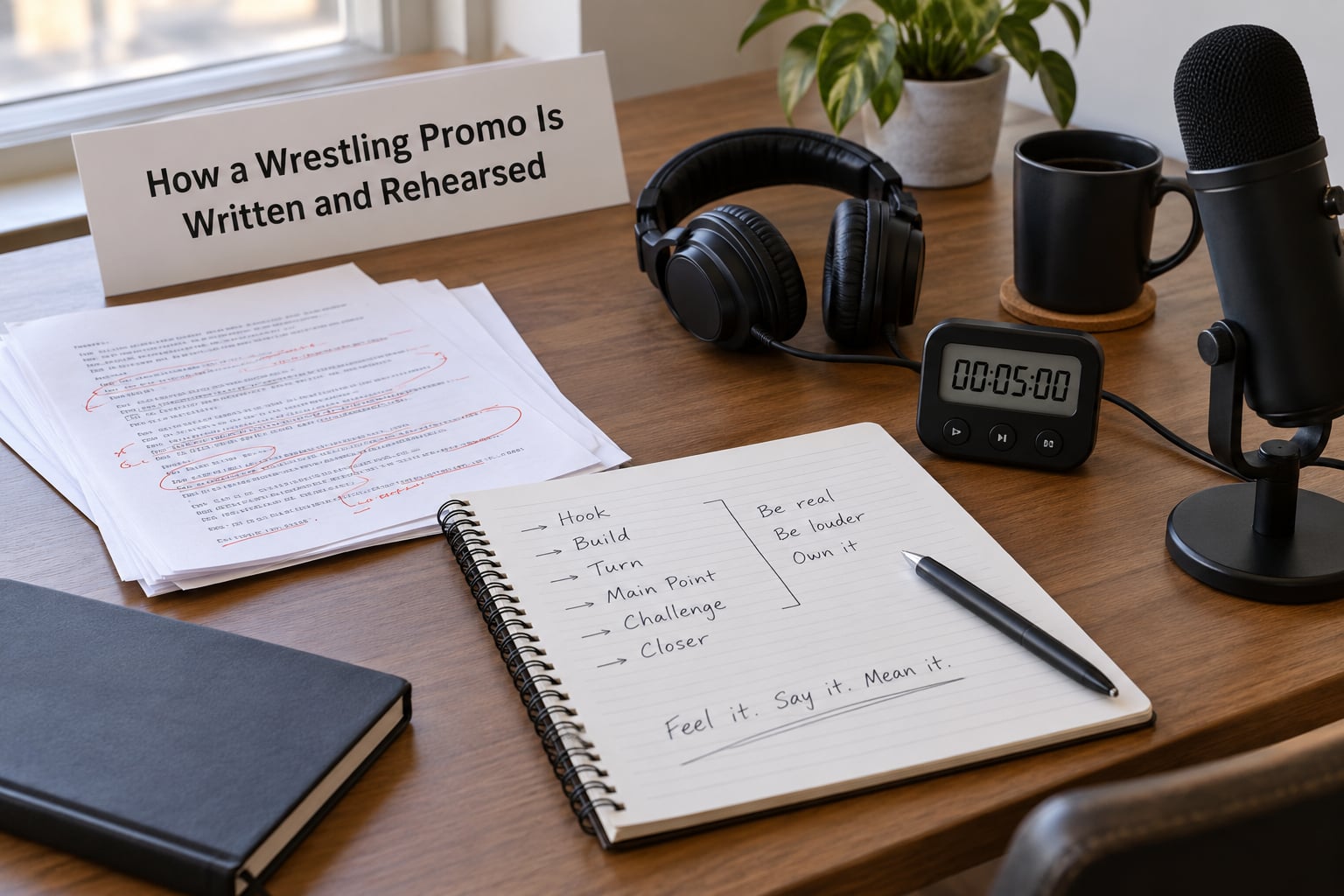
The workflow runs from a creative meeting through a beat sheet, talent notes, a producer pass for timing, and finally a rehearsal with the actual performer. Here is how a wrestling promo is written and rehearsed in practice, in the order it happens.
- The creative meeting sets the story goal and the character angle.
- The writer drafts a beat sheet, which is a short list of points in order, not sentences.
- The draft goes to the creative lead for story approval and gets rewritten if the beats land wrong.
- The agent or manager rewrites the beats into the character’s language.
- The wrestler gets the finished document, plus a note on how much of it is fixed.
- The wrestler rehearses alone, then runs it in the room with producers.
- The producer marks timing cues, including where the segment has to land before a commercial break.
- On show day the promo runs live or pre-taped, and only part of what was written actually gets said.
Step seven is the one fans notice without understanding it. Television runs on a clock, so a two-minute promo on a ninety-minute show has to be exactly two minutes, and often has to finish its strongest line just before the break.
That single constraint shapes how promos are written. Writers are told to build a “tell” line near the break, and rehearsed delivery is timed from the top rather than improvised to fill whatever space is left.
The Four Stages of a Professional Wrestling Promo
1. Concept: What the Promo Must Accomplish
Concept is the answer to one question: what should a viewer believe when this segment ends? Not what should happen in the ring, but what should be understood right now.
The character motivation follows. A character who wants a rematch needs a different promo than a character who needs sympathy after a bad loss, even when both are talking about the same opponent. Same topic, completely different angle, opposite crowd response.
2. Writing: From Bullet Points to a Loose Script
At the writing stage, the format ranges from a verbatim page to a list of beats. Here is the same promo idea, written both ways.
| Beat sheet version | Verbatim script version |
|---|---|
| Reference the opponent’s last win | “Two weeks ago you beat a man who had already been beaten twice that month.” |
| Say the win was luck | “That was not skill. That was the floor giving you a favour.” |
| Announce the date and location | “You will not get the same help on the night. Bring a coat.” |
| End on a promise of exposure | “Then I am going to show everybody exactly what I saw.” |
The left column can be delivered by a dozen different people and still sound like the same character. The right column can only be delivered by one person in one way, and it sounds like a script when it does not come out perfectly.
That is the whole argument between scripted and unscripted promos in miniature. Beats survive a bad crowd. Verbatim does not.
3. Rehearsal: Learning the Words Without Sounding Memorized
Rehearsal is about the beats, not the sentence. Wrestlers are told repeatedly in run-throughs to learn what each line is for, and then to say it however it comes out.
A table read is the common starting point. The producer reads the script aloud while the talent follows along, flagging anything that sounds wrong in the mouth or that will not land in the time allowed. Those flags go back to the writer.
The rehearsal focus is on transitions, pauses, and tone. A pause before the tell line reads as confidence. The same pause after an argument reads as a lost train of thought.
Eye contact and pacing matter as much as wording. Johnny Russo’s most repeated advice to newer talent is to slow down when the crowd gets loud, because the instinct is to speed up and race past the noise.
4. Performance: Adapting the Promo in the Ring
On show day the performer works to the clock. If a segment is running long, beats get dropped from the middle rather than the end, because the closing line is usually the one the crowd needs to hear before they go to commercial.
Reactions from the crowd also get read in real time. A pop that lands can buy ten extra seconds of flexing. Silence gets covered with volume and body movement rather than more words.
What Writers Put in a Wrestling Promo
Strip away the jokes and most promos contain the same handful of parts, in roughly this order.
- The hook, which is the first line that makes a fan who was not planning to listen keep listening.
- The character motivation, which explains why this person is talking at all.
- The conflict, which is the thing standing between them and what they want.
- The information reveal, which is the new fact the audience did not have before.
- The challenge or promise, which sets up the match being sold.
- The signature language, which is the catchphrase or verbal tic that identifies the character.
- The closing line, which is the last thing heard before a commercial or a bell.
If a promo is missing one of those parts, it usually feels thin even when the writing is clever. The joke is the delivery mechanism, not the structure.
How Much of a Wrestling Promo Is Rehearsed?
The amount of rehearsal depends entirely on the tier of scripting, which depends on the wrestler. Four tiers cover almost everything that happens on television.
| Tier | What the wrestler receives | How it is rehearsed | Where you see it |
|---|---|---|---|
| Verbatim script | A full page of dialogue, sometimes a page and a half | Word-for-word memorization, multiple run-throughs, timed to the show clock | New talent on television shows, cut as pre-taped segments |
| Beat sheet | Bullet points in order, no sentences | Learning the order of the points, not the wording | Most working segments on televised wrestling |
| Talking points and a time limit | An objective, three or four things to mention, and a duration | A short sound-out plus a timing check | Veterans and anyone with a proven mic game |
| Full improv | A storyline and an opponent, nothing written | General prep, no run-through | Main-event characters with fully trusted personal brands |
Sean Ross Sapp reported on the Fightful podcast that WWE still writes some promos verbatim for talent to recite, and that it varies by wrestler, noting that The Rock is not somebody who goes out with an exact script. That is the honest answer to the question fans argue about most.
The pattern by talent type holds fairly consistently across promotions.
| Talent type | Typical scripting | Reason |
|---|---|---|
| Newcomer | Verbatim script | Protecting someone who has never done television timing |
| Developing talent | Beat sheet with a hard time limit | Learning pacing while keeping the words safe |
| Veteran | Talking points | Trust that the character and the instincts are trained |
| Established personality | Nothing written, or rewrites it himself | His voice is the asset being protected |
Independent wrestling sits at the other end of this. Most indies have no writing team, so the wrestler writes their own promo from a rough outline and rehearses it in a car park. The bar for polish is lower and the character voice tends to be more distinctive, because nobody is smoothing it out.
What has changed over the years is not the amount of rehearsal but the tolerance for cutting loose. Sean Ross Sapp’s reporting covered CM Punk describing his WrestleMania promo as going out with the point of the promo and not the words, which is exactly what a talking-points brief looks like from the inside.
The most common rehearsal failure is not forgetting a line. It is recalling wording mid-sentence, which kills the rhythm and makes a crowd that was with you suddenly stop listening. That is why beats win over scripts for anyone who has not got memorized down to the syllable.
Why Wrestlers Change the Script During the Match
Promos get rewritten live, and most of the rewriting is an improvement rather than a mistake. A performer walking into the ring with an outline knows the plan but not the crowd.
Several things force a change. A crowd pops harder than expected, which usually buys more time and more flexing. A match has already gone somewhere different from what the segment assumed, so the response no longer fits the words. A cue gets missed backstage and the performer has to find their own route to the next beat.
Timing failures do the same thing. Run two minutes long backstage and the promo may need to lose its entire middle section live, which means the performer has to recognise the cut while standing in front of thousands of people.
Sharp lines also survive rehearsal and die on television. A writer will produce something clever in a room that does not survive contact with a live audience, and the performer will replace it with a blunter line that actually lands.
What performers avoid is changing the outcome of the segment. Going off-book on delivery is fine. Going off-book on the story is not.
How to Rehearse a Wrestling Promo
If you want to practise this yourself, the process is the same one used backstage, just smaller. Define the objective, outline the beats, write a loose version, read it out loud, record it, revise, then perform it under pressure.
Start with the objective in one sentence. If you cannot finish that sentence, the promo has no direction and neither will the crowd.
Then outline seven beats. Hook, why you are talking, the conflict, the new information, the ask, a line that is yours alone, and a closing line you could say from memory. Seven is enough structure to sound deliberate and few enough to remember under pressure.
Write a loose version in full, then read it out loud twice. Anything you stumble over out loud is usually a sentence that was written for a page rather than for a mouth.
Record it on your phone with a stopwatch. Most first attempts run long, and the fix is almost always cutting words rather than talking faster.
Revise once, then do the part that matters most: perform it standing up, at volume, with a friend interrupting you. Adrenaline will shorten your sentences and raise your pitch, and you want to find out what the version that survives adrenaline actually sounds like.
The nerves are the part nobody scripts around. Talking to a room is a skill that builds through repetition, and the reps matter more than any single take. Practise in front of people, badly and often, rather than perfecting it alone in a bedroom.
What Makes a Wrestling Promo Feel Believable?
A promo convinces when the performance matches the words, and it collapses the moment it does not. CageSide Seats, in a widely cited piece on the craft, broke performance into four fundamentals: body language, voice, dialogue, and crowd interaction.
Body language does the quiet work. Walking, standing still, holding a title belt at your side, or turning your back to someone all carry meaning that no line of dialogue can. Repetition of a physical routine makes a character recognisable before a word is spoken.
Voice is rhythm, pitch, pace and volume. Most new talent talks too fast, which flattens everything. Dropping volume at the end of a line instead of raising it makes the same words sound more serious.
Dialogue only works when the character would actually say it out loud. Wrestling language is loud and simple because it has to survive a bad speaker system, not because simplicity is elegant.
Crowd interaction is what separates a promo from a speech. A line aimed at the person in the front row gets a different noise than a line aimed at the camera, and performers who understand that can sell the same match twice.
The uncomfortable truth for anyone chasing a perfect script is that conviction counts for more than wording. Fans forgive an improvised promo and they rarely forgive a recited one.
Frequently Asked Questions
Are WWE promos fully scripted?
Some of them. WWE still writes certain promos out verbatim for talent to recite, and the level of scripting varies by wrestler. Sean Ross Sapp reported that The Rock is not somebody who goes out with an exact script. Newer talent usually receive full pages, while veterans tend to get bullet points or approved talking points with a time limit.
What is a wrestling promo?
A wrestling promo is a scripted or improvised piece of microphone work where a wrestler or their manager speaks directly to the camera and crowd to sell a match, build sympathy, or generate heat. It is different from an in-ring promo, which has no script at all, and from a backstage interview, which is a conversation working from a shared outline.
Do wrestlers rehearse promos before the show?
Yes, and televised shows rehearse most strictly because of the clock. A segment has to hit an exact run time and land its strongest line before the commercial break, so the rehearsal is timed from the top rather than improvised to fill the space. Pre-taped promos get the most rehearsal because mistakes cannot be edited out on the night.
How do wrestlers memorize long promos?
They rarely memorize every sentence, because trying to recall exact wording mid-sentence kills the rhythm. Instead they learn the order of the beats and what each line is for, then say it however it comes out. That is the main reason beat sheets are preferred over verbatim pages for anyone working live.
Who writes wrestling promos?
On a television show it is usually a writing room led by a head writer, such as Johnny Russo at NXT, with a creative lead approving story direction and a producer handling timing. Agents and managers often rewrite beats into the character’s language. Paul Heyman told ESPN he can write his own scripts once he has been told the mission of the promo.
How do you write a good wrestling promo?
Fix the objective before you write a word: one sentence on what the audience should think when the segment ends. Then outline seven beats, write a loose version, read it aloud, record it with a stopwatch, cut whatever runs long, and rehearse it standing up with interruptions. Conviction and clean beats beat perfect wording every time.
Conclusion: Start With the Message, Not the Words
The strongest promo begins with a clear storyline goal, not a good line. It becomes a flexible set of beats through rehearsal, and it is delivered in the performer’s own voice rather than recited off a page.
So if you are learning this yourself, do one thing first: write the single sentence describing what the crowd should feel when the segment ends. Everything after that, including whether the words are scripted, is easier.