A wrestling arena seating chart decides your view mainly through three things: where your section sits in relation to the ring, how far back the row is, and what production has built between you and the mat. Read those three and the chart tells you more about sightlines than the price tier ever will.
Charts cannot show you everything. A section label like 114 carries no note about the lighting tower that swings over section 112 on some nights, or the fact that the promotion adds a camera platform to your row on the day. What the chart can tell you is roughly what kind of view you are buying, and that is usually enough to make a good decision if you know what you are looking at.
This guide breaks a wrestling seating map into the four zones it actually contains, names the wrestling-specific structures that block sightlines, and gives you a step-by-step way to audit a chart before you commit. It is written for a first-timer who has opened three seat maps in an hour and cannot tell any of them apart.
Table of Contents
- How Arena Seating Charts Show the View
- How wrestling arena seating charts affect the view in one sentence
- Why Seating Position Changes the Ring View
- What Rake Height and Row Elevation Do
- Why Stadium and Structural Obstructions Matter
- How to Read Section Labels and Row Numbers
- Which Seats Usually Have the Best Wrestling View
- How to Choose Seats Before You Buy
- Frequently Asked Questions
- What are the best seats for watching professional wrestling?
- Do lower rows always have a better wrestling view?
- Are upper-level seats obstructed at wrestling arenas?
- Is sitting behind the hard camera better for wrestling?
- What should I do if an arena seating chart shows no view details?
- How do I avoid buying obstructed wrestling seats?
- Conclusion: Start With the Section, Then Check the Row
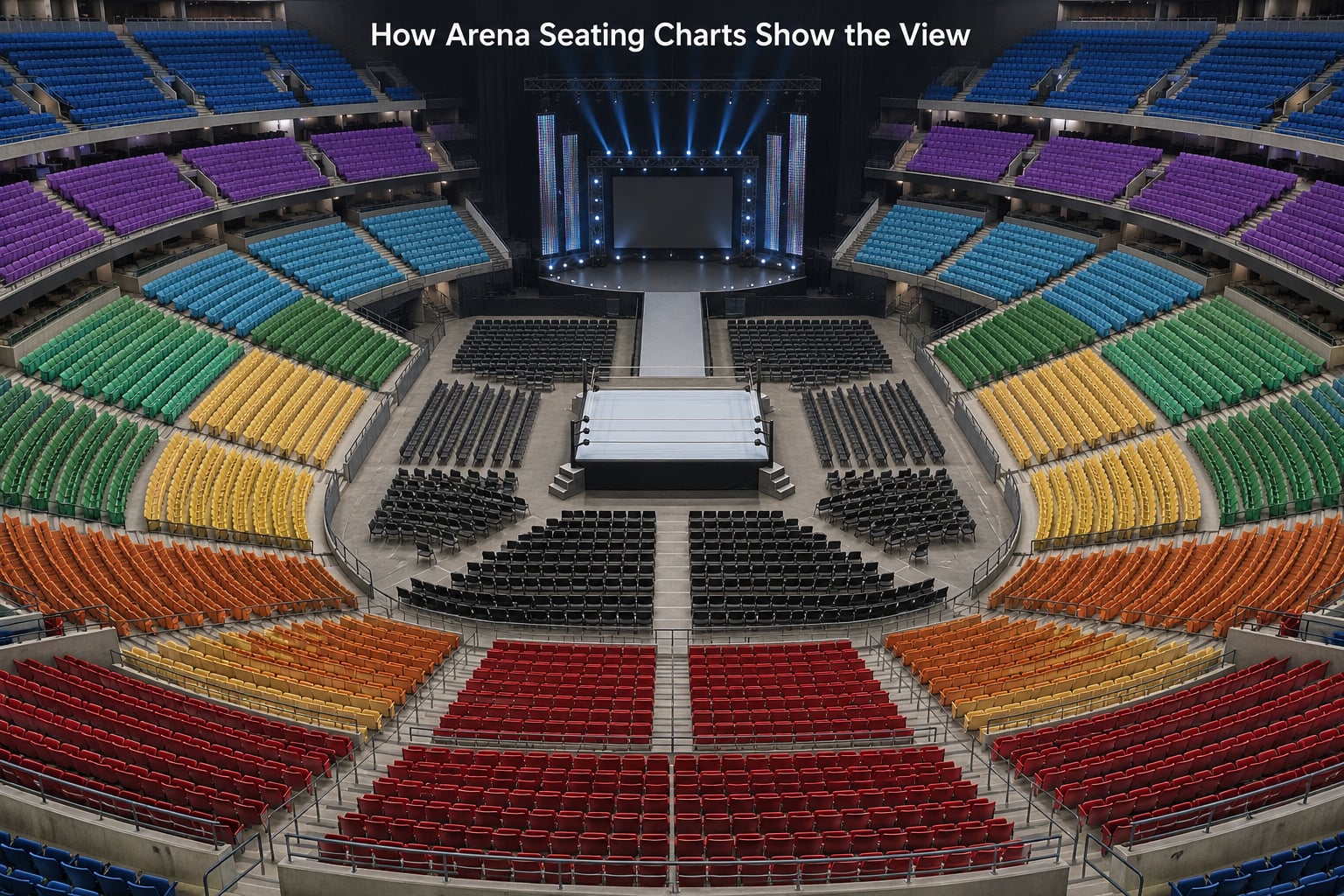
How Arena Seating Charts Show the View
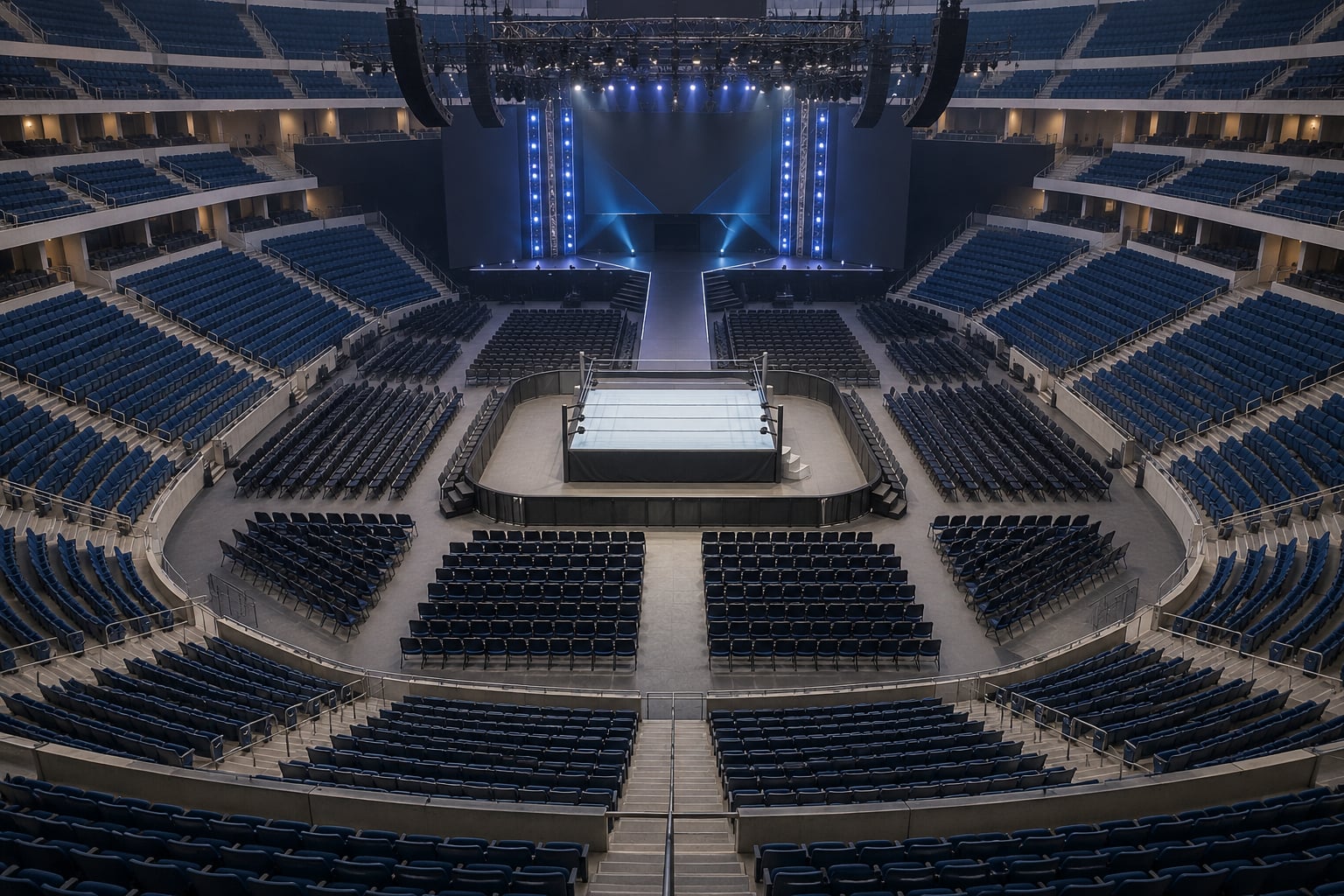
Every chart plots each seat as a position in a bowl that has been reshaped around a ring. That single fact explains most of the variation you will find between two sections carrying the same price.
A wrestling arena seating chart communicates five things, and only five. Where the section sits around the ring. How deep the row is. How steeply the floor rises at that point. How far the seat is from the mat. And whether the listing flags any obstruction, either as a partial-view tag or as a section that has been held back from sale entirely.
Charts do not communicate elevation the way a stadium diagram does, so you have to infer it. Sections numbered in the low hundreds sit closest to the floor in most modern arenas, and the higher the first two digits climb, the further back and higher up the bowl you are looking. That convention holds at the large venues most wrestling cards now run through, but it is a convention rather than a law, and older buildings break it.
What a chart genuinely hides is production. Wrestling is unusual in that the seating bowl is temporary in a way basketball is not. The entrance stage, the video screens, the lighting trusses and the camera positions are all installed per event, and they change which seats are usable. Wrestletix, in its analysis of how promoters build wrestling seat maps, puts the entrance stage at roughly 2,000 to 5,000 permanent seats removed from sale, with floor inventory typically landing somewhere between 800 and 2,500 depending on how much floor the stage and barricades consume.
So read the chart twice. First for geometry, which is reliable. Then for production, which you have to go and confirm separately.
How wrestling arena seating charts affect the view in one sentence
Your view is the product of three chart numbers and one thing you have to look up yourself: section position sets your angle, row depth sets your elevation, distance sets how much detail you resolve, and production equipment sets whether any of it is visible.
Why Seating Position Changes the Ring View
Wrestling is played on a roughly 20-foot square, with bodies constantly moving to all four sides and often outside the ropes. That geometry punishes bad angles far more than a bad distance, because the far side of the ring sits behind the near side from a low seat.
Lower bowl seats at or slightly below ring level give you a near-horizontal angle. You see faces, you hear the pads and the mat, and you see the crowd across the ring. What you lose is the far side of anything. In a tag match with all four competitors in the ring, the two working on the far apron disappear behind the two on the near apron, and the referee is often in the way as well. Wrestlers compensate by working toward the hard camera, which is why a lower-bowl seat on the wrong side can feel like a worse version of the same show.
Upper bowl seats flip the problem. The steeper angle gives you a clear line over the near ropes to the far side of the ring, and a tag match becomes readable for the first time. You give up detail: a wrestler standing on the far apron is a small figure, facial work is gone, and commentary gets harder to pick out. One A View From My Seat reviewer at The O2 in London described a seat there as a perfect view of the whole arena where they hardly had to look at the screen at all. The same site’s Wembley report from AEW All In described a good-value seat that still required looking up at the screen during ramp work, with no overhead screen on that side of the venue.
End-zone seats, behind and in front of the ring rather than to the side, compress the depth of the ring. A wrestler climbing a ladder looks stacked on top of the one below. Floor seats near the end are excellent for entrances and poor for in-ring geometry, which is why an AEW Double or Nothing attendee behind the stage at Louis Armstrong Stadium said the crowd only shows you the walkout, then rated the rest of the experience as amazing anyway.
Aisle seats trade the best angle for the most legroom and the easiest exit. Several regulars on r/SquaredCircle point to sitting behind the commentary team as the version of this that does not cost you the middle of the bowl, since you get an unobstructed arc of the ring and a clear path out at every break.
| Zone | Typical labels | What you see clearly | Best for | Main drawback |
|---|---|---|---|---|
| Floor and ringside | Floor, A, B, ringside | Facial detail, mat sound, crowd on the far side | Proximity and entrances | Heads and shoulders of the row in front; far apron hidden |
| Lower bowl | 100 level, 101 to 129 | Most of the ring, near-side detail, most of the in-ring action | General watching and being seen on camera | Hard camera side only; entrance side can be a wash |
| Upper bowl | 200 and 300 level | The whole ring and the whole floor at once | Tag matches, ladders, tables, steel cage | Small figures, thin commentary, more screen watching |
| Behind the stage | Often unlisted or held | The walkout, lighting, and little else | Nostalgia and pyro | The ring itself is frequently blocked or too far to read |
What Rake Height and Row Elevation Do
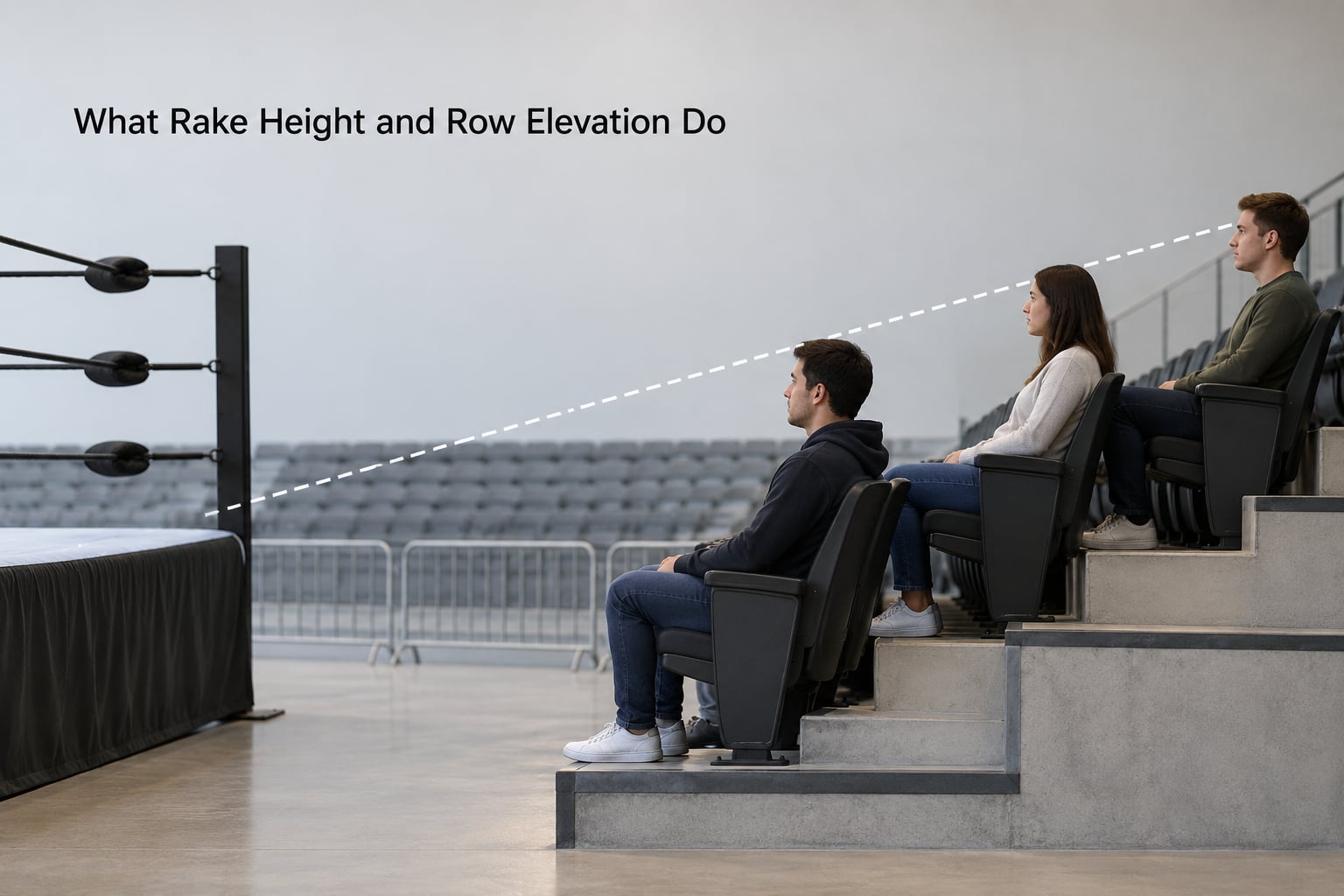
Rake is the slope of the seating bowl, and it is the reason a row ten seats back can be a better seat than one five seats in front of it.
Every row rises a few inches. When the slope is gentle, that few inches is not enough to clear the head of the person in front of you, so your sightline to the ring is really a sightline to the back of a stranger’s head. When the slope is steep, you gain enough vertical offset that the same row number reads as if you are sitting higher, and you see under the head in front and over the near ropes to the far apron.
This is why the first row is not automatically the best seat. Row one at floor level gets you close enough to feel the mat shake, and it puts you level with the apron, so a wrestler on the far side is chest-to-shoulder with someone in your eyeline. One WrestleMania attendee on r/WrestlemaniaPlans who had paid well over face value for a 100-level seat on the entrance side reported that they could not really tell what was going on, that the drama and the small mannerisms were gone, and that only the big moves landed. That person concluded you need the first few rows, and also noted rows past about five or eight get hard to see depending on your height. Both halves of that report are about geometry, not about seating tier.
Elevation also decides how you follow a ringside brawl. Two wrestlers fall to the floor on the near side and disappear behind the barricade and the ring apron from a low seat; from any real rise in the bowl you are looking down on them. The apron itself, about three feet tall, is the single most underrated obstruction in wrestling, and it only stops mattering once you are meaningfully above ring height.
If you can find the rake on the chart, use it. Charts rarely state it directly, but the visual gap between row lines on a steep section is noticeably wider than on a shallow one, and a steeper section also tends to have fewer rows between the railing and the floor.
Why Stadium and Structural Obstructions Matter
Some obstructions are part of the building and some are bolted in for the show. The building ones show up as a permanent quirk of a section; the production ones change from event to event.
The entrance stage is the big one. It sits at one end of the bowl, takes over a whole end zone, and stands tall enough to block the ring from several lower-bowl sections behind it. It is also the reason so many seats are simply absent from the map rather than marked obstructed. Behind the stage, fans commonly describe a workable view of the walkout and near-total blindness to the match. Seats there can be outstanding for atmosphere and still be the wrong buy for anyone who came to watch wrestling.
The video screens come with steel. The titantron and the screens flanking it need support towers, and those towers carry sightlines with them. The video board is also only as useful as its position: A View From My Seat reports from Wembley and other venues note upper-bowl sections where the balcony fascia physically cuts the screen off, so a seat can have a fine ring view and no screen at all.
Lighting and camera gear move. Truss towers carry the stage lighting and sit at the corners, and the camera jib or crane has a defined arc that production keeps clear. Fans regularly report intermittent blockages from a crane arm in an otherwise good seat. That is a production hold rather than a building fault, which is why it will not be marked anywhere.
At floor level the obstructions are human and stationary. Announce table, timekeeper area, the commentators’ monitors and the steel ring steps all sit inside your sightline. One M&S Bank Arena attendee noted their own seats gave a great view of both the ring and the screen, while the floor seats below them were restricted because of the people sitting in front.
And some obstructions depend on the match type. A steel cage introduces mesh across the near side. A tables or ladders match puts the finish in a corner, and corner-heavy matches punish anyone sitting at an end zone. Announce table commentary is inaudible from mid and upper sections, which is a sound problem rather than a sightline, but it changes the night in the same way.
How to Read Section Labels and Row Numbers
Section numbers in arenas follow a rough floor-first convention: low hundreds for the level nearest the ring, then club or premium level, then 200s and 300s as you climb.
Two details catch out newcomers. First, 101 is not automatically better than 114. Numbers usually climb clockwise around the bowl from a starting point that is not always near the hard camera, so 114 can sit behind the commentary team with a clean view while 101 sits at an end zone with a compressed angle. Second, the same number means nothing across buildings. Barclays Center, Kia Forum, State Farm Arena and Crypto.com Arena all number differently, and one arena’s 122 can be a worse seat than another’s 111.
Row numbers carry their own rules. The first row in a section can be against a rail, a wall or a tunnel, sometimes with the walkway behind you, sometimes with a support post clipping the corner seat. The last row of a lower-bowl section can be so deep and high that it behaves like an upper-bowl seat with a better distance to the ring, while the last row at the back of the arena is often the one where you look over a balcony lip. Corner seats in an end zone lose their view as soon as the action moves to that same corner.
Accessibility seating is worth locating on the chart deliberately rather than by luck. Accessible positions are usually at the back of a lower-bowl section or on a raised platform with a companion seat beside it, which means a decent ring angle and an easy exit, though often a longer distance than you would pick yourself.
Which Seats Usually Have the Best Wrestling View
For most people at most wrestling shows, the middle of the lower bowl on the hard camera side is the reliable choice, and a steep upper-bowl seat near the halfway line is the value choice.
The hard camera side exists because television is how the audience at home sees the show, so promoters aim the main camera at the section across from it and point wrestlers toward it. Sit on that side and the action happens in your eyeline. A regular on r/SquaredCircle puts it plainly: the middle of the 100 level is the best for seeing the most action and worth taking any day. A Barclays Center attendee noted that if you want to be seen clearly on the hard camera itself, the target is section F2 or the first two rows of section 8.
Where the two camps disagree is about distance rather than angle, and both are describing real geometry. Front rows resolve the most detail and lose the far side of the ring. Upper bowl rows resolve the whole ring and lose the detail. A steep upper-bowl centre section with a working overhead screen is a genuinely good wrestling seat, and several attendees who had one report never thinking about the screen at all.
Behind the ramp is worth a specific note. Ramp seats show the walkout in full and then look back at the ring from a difficult angle. Stage seats show the same walkout from further back and often cannot see the ring at all. Fans on r/SquaredCircle have pointed out that independent promotions often sell stage-adjacent seats for a fraction of the equivalent major-show experience, which tells you how promoters themselves price the stage view: as a premium, not as a necessity.
How to Choose Seats Before You Buy
Work through these in order. The earlier you catch a problem, the cheaper the mistake.
Find the ring on the map first, then orient yourself to it. Identify the end of the bowl where the stage sits, which is usually marked on the chart or obvious from the seating that is missing. Then identify the opposite end, which gives you a roughly symmetrical reference for every section number.
Work out where the hard camera is. It sits at floor level on one side of the ring, angled so that the announcers and the near ropes frame the shot. If the map does not tell you, assume it is on the side with the largest uninterrupted block of floor seating, since that is the side that was built for it.
Check the row, not just the section. Rule out anything in the first three rows and the last three rows of a section as a starting point, then look at how many rows the section holds. A short section near the front is closer and more obstructed; a long section gives you options if you want to move back.
Confirm the screen before you commit. Check that a video screen sits on your side of the building and that your section is not behind a fascia or under a balcony lip. This one check resolves most of the complaints fans post after the fact.
Then call the box office and ask two questions: which side is the hard camera on for this event, and is my section affected by production holds. Staff will usually tell you the camera side directly. Production holds are often known a few days out, occasionally the day of.
Look for seat photos from the specific section. Photo-review galleries exist for most major venues and let you see the real obstruction, the real screen placement and the real legroom from a named section, row and seat number. That is worth more than any description.
Understand the listing terms. Unobstructed means the promoter believes nothing structural is in the way. Limited or partial view usually names a cause, often a rail or a scoreboard. Obstructed view tickets are frequently discounted, and the discount is usually proportional to what you lose.
Re-check the chart on the day you buy and again on the day of the show. Promoters kill sections for the stage and open others as they sell, so the map you studied on Monday is not guaranteed to exist on Saturday.
Have a backup. Decide in advance what you would take instead of your first choice, and be honest about whether a cheaper upper-bowl centre seat beats a pricier lower-bowl seat behind the stage.
A note on arrival: security lines are the other thing that ruins a good seat. Being in the building early also gets you to the rail on floor sections before it becomes a scrum, which is the difference between watching a show and watching a fence.
Frequently Asked Questions
What are the best seats for watching professional wrestling?
For most shows, aim for the middle of the lower bowl, or 100 level, on the hard camera side. That angle is the one the wrestlers work toward, so you see the action as it is built rather than from behind it. If your budget points you to the upper bowl, choose a steep section near the halfway line with a clear view of an overhead screen. Floor and ringside seats are the best choice for proximity and detail, and the worst choice for seeing the far side of the ring.
Do lower rows always have a better wrestling view?
No. Lower rows resolve more detail but lose the far apron, the corner, and anything happening outside the ring on the opposite side. Row depth and the slope of the bowl matter more than the row number itself. A steeper section ten rows further back can beat a shallow section three rows closer, because you are looking over the person in front of you rather than at the back of their head. Judge the rake before you judge the row.
Are upper-level seats obstructed at wrestling arenas?
Sometimes, and the cause is usually specific rather than general. Upper-bowl sections can be blocked by a balcony fascia that cuts off the overhead screen, by lighting truss towers at the corners, or by the entrance stage pushing into the end zone. The ring itself is rarely hidden from an upper section because the angle is steep. Check that a screen sits on your side of the building and that your row is not behind a lip before buying.
Is sitting behind the hard camera better for wrestling?
Behind the hard camera means you are on the side the main television lens is pointed at, which is where wrestlers direct their work. You get an angled view of the ring rather than a flat one, and your seat is far more likely to be picked up on the broadcast. You also see the backs of heads more often, since the near-side bodies block the far apron. Behind-the-camera seats are also usually held for the broadcast rather than released at the same price.
What should I do if an arena seating chart shows no view details?
Work from geometry instead. Find the ring, find the end zone the stage occupies, work out which side the hard camera is likely on from the shape of the floor seating, and rule out the first and last few rows of any section. Then call the box office and ask which side the camera is on and whether your section is under a production hold. Finally, find seat photos from that exact section, row and seat number on a photo-review gallery. Between the three steps you will know more than the chart told you.
How do I avoid buying obstructed wrestling seats?
Avoid the sections behind the entrance stage, stay clear of the first three and last three rows of a section, and confirm an overhead screen exists on your side of the building. Read the listing language carefully, since partial-view tickets name their own obstruction. Most importantly, remember that understanding how wrestling arena seating charts affect the view starts with position, not row: the angle and the elevation decide almost everything, and the row only fine-tunes it.
Conclusion: Start With the Section, Then Check the Row
Pick the section before the row. A lower-bowl seat on the hard camera side beats a closer seat behind the stage, and a steep upper-bowl seat with a working screen beats a worse one without. Only after the section is right does the row matter, and then only to the extent that the bowl rises enough to clear the person in front of you.
Everything on a wrestling seating chart is geometry except the production equipment, and production is what you confirm by phone. Do both and you will watch the match instead of the monitor. Charts get rebuilt between events, so check the map again on the day you buy.