A wrestling referee counts with three things at once: a pair of eyes on both shoulder blades, a hand that strikes the mat, and a voice that calls one, two, three. If a shoulder comes off the mat before the third slap, the count stops and the match goes on. That is the whole pinfall rule, and everything else — how wrestlers communicate with the referee, which number ends the match, what happens when a spot goes wrong — is built on top of it.
Most of what you have heard about wrestling officiating is half-remembered from commentary. A count is not really seconds. A referee does not stand there waiting for three to elapse. And the famous hand signals are not a universal language; they shift from promotion to promotion, and they change meaning depending on who is standing in front of the official.
This guide covers the mechanics first, then the signals, then the parts that only make sense once you know the mechanics.
Table of Contents
- What Does a Wrestling Referee Count During a Match?
- How Do Referees Count Pinfalls?
- What actually has to be touching the mat
- The five beats of a three-count
- Why a pin breaks at two
- Rope breaks and illegal pin attempts
- What Referee Signals Tell Fans During a Match
- How Do Referees Count Submissions?
- What Happens When a Spot Is Disputed?
- The signals fans ask about most
- When the count goes wrong
- Frequently Asked Questions
- How many counts does a wrestling referee give for a pin?
- Why do referees signal a two count when a pin looks successful?
- What does the referee’s raised hand mean during a match?
- Can a wrestler win by submitting after the referee has counted one?
- When can a rope break stop a pin or submission?
- Why do wrestling promotions use different referee rules?
- Conclusion
What Does a Wrestling Referee Count During a Match?
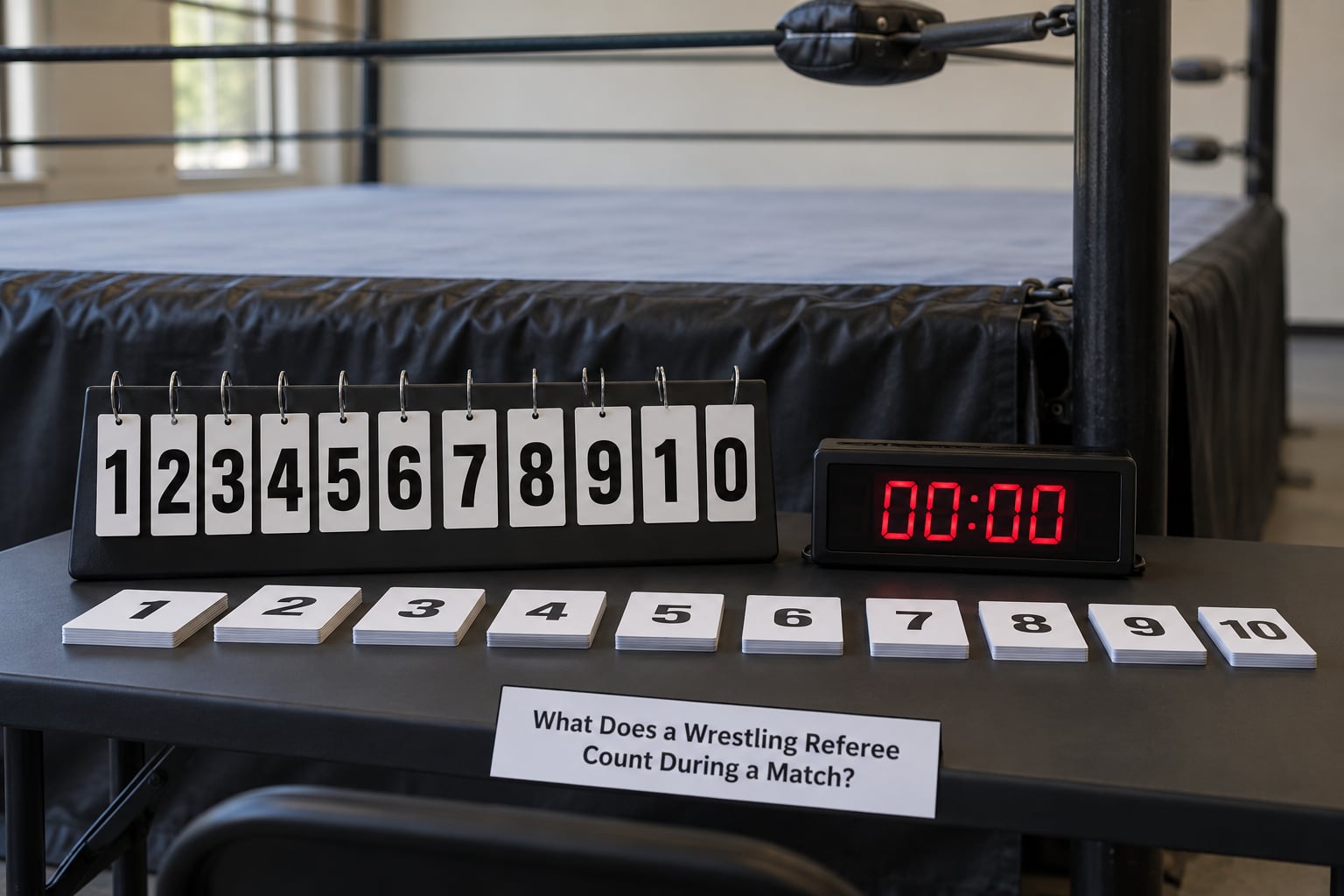
A referee tracks five things at once, and the count you think of first is only one of them.
- Pin attempts. Any time a wrestler goes for a cover, the referee drops low and watches for two shoulder blades flat on the canvas.
- Submissions. Once a hold is locked in, the referee shifts attention entirely to the trapped wrestler’s hands, face and voice.
- Rope breaks and illegal contact. The referee watches the ropes, the turnbuckles and the corners for anything that turns a legal cover into a legal win.
- Countouts on the floor. If a wrestler ends up outside the ring, the referee points and starts a ten count while the timekeeper handles the bell.
- Disqualification triggers. Weapons, intentional eye rakes outside a scripted spot, refusing to break a hold, refusing to leave the corner — the referee has to recognise all of it in a fraction of a second.
There is no single worldwide rulebook for professional wrestling, and that matters more than fans expect. The New York State Athletic Commission, the body that once regulated wrestling in the state, defined it as entertainment rather than sport, so there was never a governing rule set to enforce. What exists instead is a set of conventions that each promotion, each referee school and each era maintains loosely. Major US television, Japanese puroresu and lucha libre all count to three, but they differ on kick-out tolerance, rope breaks and how loudly a referee announces a decision.
Any answer that presents a rigid universal list is simplifying. Treat the specifics below as the working convention most matches are built on.
How Do Referees Count Pinfalls?
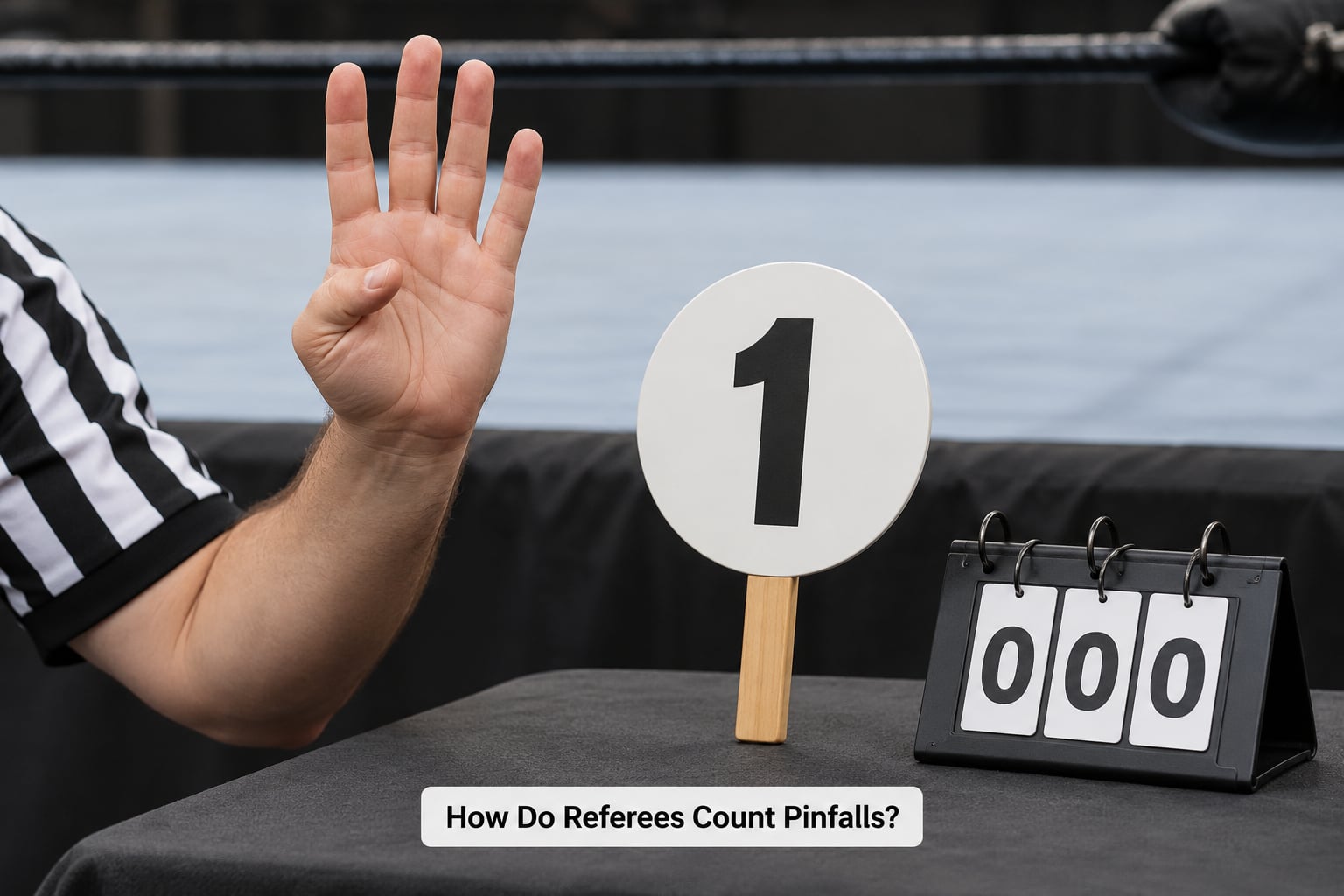
To count a pin in wrestling, the referee kneels beside the covering wrestler, confirms that both of the opponent’s shoulder blades are in contact with the canvas, then counts one, two, three out loud while slapping the mat with one hand and marking the numbers with the fingers of the other. The count ends the moment a shoulder lifts off the mat.
What actually has to be touching the mat
Both shoulders. Not the hips, not the back of the head, not one shoulder plus a shoulder blade grazing the canvas. Two points of contact, one on each side of the spine, held there long enough for the count to finish.
This is why a wrestler trying to bridge can lose a pin they were winning. A bridge lifts the hips and arches the back, and if the shoulders come up an inch with it, the count breaks. It is also why reverse presses and small-package positions look so much more secure than they are: the covering wrestler’s weight is distributed across the shoulders instead of being hinged at the waist, and a defensive wrestler has nowhere to push from.
The five beats of a three-count
- Drop and clear the view. The referee moves to the side of the cover with the best sightline, usually opposite the covering wrestler so their body is not blocking the shoulders. If they cannot see both blades, they will not count, and a smart defending wrestler will position themselves to block that view deliberately.
- Confirm contact. One hand goes to the mat beside the shoulders, or onto the covering wrestler’s back, to establish the surface the count is happening on.
- Slap and count one. The striking hand hits the canvas and the first number is called. The fingers of the other hand mark the count.
- Slap and count two. Same motion, faster. If a shoulder comes up here, the count dies and the referee waves a break.
- Slap and count three. The third slap is the one the crowd hears as the finish, and the timekeeper rings the bell on that slap. In practice the count is closer to a second and a half than to three full seconds, and the number is negotiated long before anyone hits the mat.
The mat slap is not decoration. A practitioner on a wrestling forum put it plainly: you count to two, then slap the mat, and the mat is usually slapped on three. The slap gives the crowd an audio cue that survives a wide arena shot where the fingers are invisible.
Why a pin breaks at two
Because nobody kicks out at three. The whole point of a near fall is that it looks finished and isn’t. Defending wrestlers learn to move just before the third slap — around one and three-quarter counts — so the two-count sells as a real escape rather than a slow-motion one.
Planned kick-outs are agreed before the match, down to the number. Fans reverse-engineer this constantly on r/SquaredCircle, where a good chunk of the conversation is spotting the agreed count on a botched spot or a suspiciously early kick-out. When a kick-out arrives instantly, the escape looks real. When it arrives at exactly the same fraction of a second every time, you are watching a number that was picked in advance.
Rope breaks and illegal pin attempts
Using the ropes for leverage is illegal in a cover: no lifting with the arms, no kicking the ropes to build height, no bracing a foot on the bottom rope. A referee who sees it will either break the cover or count it anyway, depending on how obvious it was and whether the point of the match depends on it. Ric Flair’s rope-assisted covers are the textbook example of the move being recognised, used on purpose and never officially punished.
Two other legality questions come up constantly. A wrestler pulled into a corner cannot be pinned against the turnbuckle in most promotions without the referee’s permission — that is the corner escape. And a suplex onto the top rope, or a chokeslam onto the top turnbuckle, gets a warning rather than an immediate disqualification, because both are legitimate spots that only become illegal because of where the rope or the buckle happens to be.
What Referee Signals Tell Fans During a Match
Referee hand signals are the fastest way for an official to communicate with the crowd, the ring crew and the timekeeper at once. Below is the working vocabulary most used, with the caveat that no two promotions use it identically.
| Signal | What it means | When you see it |
|---|---|---|
| Hand slapping the mat with fingers counting up | The count is in progress, one through three | Every pin attempt, right through the near falls |
| Open palm held up toward a wrestler | Break. Stop what you are doing | A rope break, a corner break, or a pin with a shoulder off the mat |
| Pointing at the mat or at the canvas beside a downed wrestler | Get down, or stay down — you cannot leave the count | When someone is on a top rope during a cover |
| Arm raised with one hand open at the finish | This is your winner | Once after every decided match |
| Free hand slapping the mat three times while a hold is locked in | Submission. The match ends here | When a wrestler taps, shouts, or gives up verbally |
| Arms crossed over the chest or waved in an X | Real injury. Stop everything | When a performer is actually hurt and cannot continue |
| Thumb toward the ropes, or a circling motion at the shoulder | Rope break, or break the hold | When a trapped wrestler reaches a rope or the hold has gone wrong |
| Counting fingers up while pointing at a wrestler on the floor | Ten count. This is a countout | When a wrestler is down outside the ring |
| Hand at the chest then pushed outward toward a wrestler | You are finished. Go home and lose properly | The quiet cue that tells a loser to sell the finish properly |
The crossed-arms signal is the one worth explaining. Wrestling has a worked injury vocabulary — someone grabs a knee and the announcer reacts — and an emergency vocabulary. When an official crosses their arms or waves them in an X, the show stops. Medical staff come out, the lights change, and the match is usually forfeited or simply abandoned. A referee who is unsure whether an injury is real will check the wrestler’s face and ask directly, which is why a scripted sell and a real injury look completely different from the outside.
The squeeze check is another one you will see less often than fans expect. The official takes the defending wrestler’s wrist and squeezes to ask, without speaking, whether they are genuinely hurt or working. It is a physical version of a spot call, and it happens most in independent wrestling where a small crew covers every role.
How Do Referees Count Submissions?
A submission is counted by watching the person in the hold, not the hold itself. The referee wants a clear, deliberate signal: three slaps of the free hand on the mat, or a verbal submission loud enough to be heard over the crowd, or an unmistakable body language that the person is done.
Three steps, in order:
- Verify the hold is on. The referee puts hands on both wrestlers to confirm the hold is genuinely locked, not a defended position with one arm hooked loosely.
- Watch the defender. Hands, face and voice. The referee positions themselves at the trapped wrestler’s side, because that is where the signal comes from.
- Count and stop. The free hand slaps the mat three times. The timekeeper rings the bell on the third slap, and the winning wrestler releases immediately.
What makes a submission finish interesting is the disputed release. A defending wrestler who refuses to tap and fights out of the hold buys a near fall of a different kind. In many promotions the referee will accept the loss before the defender has physically released, so the winning wrestler is already letting go and walking out of frame while the arm is still attached. That is a legitimate finish, and fans argue about it for years.
Voluntary releases matter more than they look. If the defending wrestler gets free on their own, the match continues — a submission attempt only ends the match if it is given up. And a referee who sees a hold applied to the throat, the eyes or the spine in an unscripted context will break it and warn the offending wrestler, sometimes in front of the crowd, sometimes quietly while the action moves on.
What Happens When a Spot Is Disputed?
When a spot is disputed, the honest answer is that it often is not resolved at all. A professional wrestling finish is an agreement between two wrestlers, one referee and a producer listening through an earpiece, and a disputed spot usually exposes which part of that agreement failed.
How wrestlers and referees communicate is the part almost nobody explains. Three channels run in parallel. Verbal calls happen in the exchange before a move, when the referee can hear both wrestlers over a live crowd. Hand signals happen mid-move, when the referee has eyes on one person and needs to reach the other. Touch happens constantly: a hand on a shoulder, a tap on the back, a push on the head to stop something starting. The referee’s positioning does the rest — standing on the correct side of the ring means they can see both wrestlers’ faces instead of one back and one face.
The signals fans ask about most
The most common question is why a referee keeps telling wrestlers to get down from the top rope during a cover. The answer is that a cover has to be legal, and a wrestler perched on the top rope turns an ordinary pin into an illegal spot. The referee is protecting the finish, not the wrestler.
The second is the go-home cue. A referee who needs the match to end now points toward the corner, or touches the wrestler’s shoulder twice, or simply says it into a wrestler’s earpiece mid-match. That last route is how match length is genuinely controlled: the producer knows the show has nine minutes left, so the referee tells the champion it is time to close, and the finish happens on schedule.
When the count goes wrong
There are a handful of recurring failures, and each has a different resolution.
Missed counts. The referee counts a shoulder that was never flat, or was already lifting. Nothing usually happens on television, but on a promotion with a rules body in the room it can be formally reviewed.
The referee bump. A planned spot where the referee takes a fall, usually to sell being knocked down or dragged out of the way. If the bump is missed and nobody sells it, the referee is suddenly an active participant in a match that was not booked to include them. The phantom bump is the same idea done without contact — the referee takes a fall nobody threw, purely for the camera.
The double pin. Both wrestlers cover each other, and for a moment it is genuinely unclear who has both shoulders down. The 2016 WWE title change that ended with both men’s shoulders appearing to be on the mat is the clean example: the official took a bump, never rendered a verdict, and the finish was treated as a draw. Nobody argued over the count because there was no count.
Counting after the bell. This happens more often than fans realise. A referee can slap one and two after the finish is decided, and a third slap that arrives after the bell rarely reverses anything, because the timekeeper and the producer have already moved on. Promotions with formal rules sometimes void the finish; mainstream television almost always lets it stand.
Interference. A manager, a second wrestler or anybody who enters the ring during a pin attempt stops the count immediately and usually loses their team the match by disqualification. It is the one finish the referee cannot argue with later, because it is the one the whole audience saw.
Frequently Asked Questions
How many counts does a wrestling referee give for a pin?
A referee counts to three for a pinfall. The count starts when both of the losing wrestler’s shoulder blades are flat on the canvas, and it ends the instant a shoulder comes off the mat. The bell rings on the third slap. In practice the whole count takes well under three real seconds, because the numbers are agreed in advance rather than timed by a stopwatch.
Why do referees signal a two count when a pin looks successful?
Because a pin that is never escaped does not build a match. A two-count sells the escape and makes the crowd react, which is the entire point of a near fall. Defending wrestlers are taught to move just before the third slap, so the escape looks hard-won. If a kick-out arrives instantly every time, that is a sign the moment was planned rather than fought for.
What does the referee’s raised hand mean during a match?
It depends on the moment. While a pin is being counted, a raised open palm means break, stop what you are doing. At the end of a decided match, the referee raises one arm and points at the winner. Arms crossed over the chest or waved in a cross signal a real injury and stop the match immediately. The signals are conventional rather than universal, so they differ a little between promotions.
Can a wrestler win by submitting after the referee has counted one?
Yes, and it is a normal finish. A referee who has counted one on a pin has not decided anything yet. If the cover breaks and one wrestler then locks in a submission, the referee drops that count entirely and starts watching the trapped wrestler instead. A submission ends the match the moment it is given up, which is why an arm bar can finish a match seconds after a pin attempt looked certain.
When can a rope break stop a pin or submission?
A rope break works only while a wrestler has not been fully in control of the opponent’s shoulders or has not been trapped in a hold. In a pin, the defending wrestler has to reach a rope without the cover being locked. In a submission, the hold has to be established first. Using the ropes for leverage inside a cover is illegal and gets broken or ignored depending on how obvious it was.
Why do wrestling promotions use different referee rules?
Because professional wrestling has no governing rulebook. It was regulated as entertainment rather than sport for most of its history, so each promotion developed its own conventions. North American television, Japanese puroresu and lucha libre all count to three but differ on kick-out tolerance, corner escapes, rope use and how loudly decisions are announced. Independent promotions vary even more, since one referee may cover several roles in a single show.
Conclusion
If you watch one thing in your next match, watch the referee’s hands during the pin. The count is the clearest signal in wrestling: a slap on the mat, fingers in the air, and a number that both wrestlers were already listening for. Everything else — the spot calls, the go-home cue, the decision to break a cover — is built around that single sequence.
Keep the five endings apart and you can follow any match. A pinfall needs both shoulders and a count of three. A submission needs a hold that is given up, signalled by the person in it. A countout needs ten counted on the floor outside the ring. A disqualification needs a rule broken badly enough to end the match on the spot. A knockout needs a referee who has checked that the person cannot continue.
Rope breaks, corner escapes and warning-then-break calls sit underneath all five. And if a finish looks wrong, that is usually because the agreement behind it broke somewhere, not because somebody miscounted.