How wrestling YouTube channels monetize matches is mostly a question about ownership, not advertising. A match video earns money when it runs ads for your channel, when a sponsor pays you to mention a product, or when fans tip you for extra material. If nobody has cleared the footage, none of those things happen, because claims, takedowns and monetization rules decide the outcome first.
That is the part most guides skip. They list revenue streams as if uploading a Saturday night main event is the same as uploading a documentary about the same wrestler. It is not. The full match gets claimed, blocked from ads or pulled entirely, and the hours spent uploading and captioning it earn nothing at all.
What follows is how the money actually moves: who owns the footage, which formats survive enforcement, what each method pays, and the order that works for a new channel. Figures quoted here are sourced estimates or illustrative math, not rates anyone can guarantee. Policies shift, and none of this is legal advice.
Table of Contents
- How Wrestling YouTube Channels Monetize Matches
- Who Owns the Rights to a Wrestling Match?
- What Revenue Can a Match Video Earn?
- Which Monetization Methods Do Wrestling Channels Use?
- How Wrestling YouTube Channels Monetize Matches With YouTube Ads
- Sponsorships and Brand Partnerships
- Memberships, Tips, and Direct Fan Support
- Affiliate Links, Licensing, and Paid Access
- How Much Does One Match Make?
- A Practical Match Upload Revenue Example
- What Should a New Wrestling Channel Do First?
- Frequently Asked Questions
- Can a YouTube channel make money by uploading full wrestling matches?
- Does fair use allow a channel to upload WWE or AEW matches?
- How much does a wrestling channel earn from one match video?
- Are highlights and commentary legal alternatives to full-match uploads?
- Should a wrestling channel rely only on YouTube ad revenue?
- How many subscribers does a wrestling channel need to monetize matches?
- Start With Rights Before Revenue
How Wrestling YouTube Channels Monetize Matches
Wrestling channels earn from a layered stack, and the layers only work in order. The core list runs: YouTube ad revenue, channel memberships, Super Chat and Super Thanks, sponsorships and brand deals, merchandise, affiliate commissions, digital products, podcast and newsletter income, and direct licensing or revenue-share deals with promotions. Licensing comes first in practice because everything downstream depends on it.
Most match uploads generate no revenue at all. Not because the channel is too small, but because the footage belongs to someone else and the rights holder decides what happens to it. A Content ID claim usually leaves the video visible while diverting or blocking the ad revenue. A takedown removes the video. Three valid strikes in ninety days and the channel is gone.
So the useful question is not “can I make money from wrestling footage” but “which wrestling footage am I allowed to publish, and in what form.” Get that right and the revenue streams below become available. Get it wrong and no monetization setting in YouTube Studio will save the upload.
Here is the honest split, in the order a channel usually encounters it:
- Ad revenue on cleared uploads, where ads run against your watch page.
- Sponsored integrations, where a brand pays for a segment, mention or dedicated video.
- Channel memberships with perks like early access and members-only breakdowns.
- Super Chat and Super Thanks on live streams and uploads.
- Merchandise, affiliate links and commissions on tickets, streaming plans and home video.
- Digital products such as full-show recaps, historical breakdowns or paid archives.
- Newsletter, podcast and live-stream income, including watch-alongs with tips.
- Direct licensing or revenue-share agreements with the rights holder.
Items one through eight all depend on the same gate: permission to publish, or a format that holds up when challenged.
Who Owns the Rights to a Wrestling Match?
The promotion that pays for the production usually owns the recorded match. That includes the picture, the commentary audio, entrance music, ring-side crowd, and the trademarks around wrestler names, logos and likenesses. Wrestlers contracted to that promotion generally sign reuse provisions, which is why their own channels often look more restricted than an independent promotion’s.
Ownership decides monetization more than any other variable, so it is worth being specific about what sits with whom.
| Footage or asset | Who typically controls it | What that means for a channel |
|---|---|---|
| WWE broadcast footage and full matches | WWE, part of TKO Group Holdings | Firmest enforcement position. Uploads are typically claimed or removed and cannot be monetized by the uploader. |
| WWE brand assets, likenesses and logos | WWE / TKO | Thumbnail and title use is a separate trademark question from the video itself, and a stricter one. |
| AEW matches | All Elite Wrestling and its broadcast partners | Uploads of entire matches have been taken down. Synced uploads may stay visible but usually cannot be monetized. |
| NJPW matches and on-demand content | NJPW and its distributors | Official YouTube uploads are ad-supported, but third-party re-uploads are claimed by the rights holders. |
| IMPACT / TNA and MLW matches | The promotion and its streaming partners | Consistently enforce Content ID. Direct licensing is the realistic route for anyone wanting the footage. |
| Independent and regional promotion matches | Varies by contract, often partly the promoter and partly the wrestlers | The most permissive corner of the internet. Many small promotions will license footage, grant permission, or send clips themselves. |
| Commentary and analysis by a third party | The analyst, subject to underlying footage rights | The uploader owns their own commentary, but a licence or fair-use argument is still needed for the footage they sit on top of. |
| Streamer-owned channels | The streamer, per contract with the promotion | Wrestlers who stream their own matches on their own channels can monetize the stream, but contracts usually cap what they may keep. WWE’s 2020 policy required talent-owned third-party channels to be handed over in exchange for a portion of proceeds. |
Two practical notes. Copyright, trademark and likeness are three separate problems, and clearing one does not clear the others. And fair use is a defense argued after the fact, not a permission you obtain in advance. A rights guide cannot tell you whether a specific clip is fair use; that assessment belongs to a lawyer, and anyone telling you otherwise is guessing with your channel.
What Revenue Can a Match Video Earn?
Match video income comes from several sources that behave differently at small and large channel sizes. Ad revenue dominates early because it needs no deal and no sponsor. Sponsorships and licensing need an audience and usually arrive later, but they pay far more per video than ads do.
| Revenue source | What drives the amount | Importance early | Importance at scale |
|---|---|---|---|
| YouTube ad revenue | Views, audience geography, watch time, ad fill, rights status | Primary | Meaningful but rarely the largest line |
| Sponsorships and brand deals | Average views, engagement, audience fit, format | Rare | Major |
| Channel memberships | Number of paying members and tier pricing | Small | Steady recurring line |
| Super Chat and Super Thanks | Live audience size and prompts | Minimal | Grows with watch-along streams |
| Merchandise | Fan identity, drop frequency, design quality | Testing only | High for personality-led channels |
| Affiliate commissions | Ticket, streaming and home-video clicks | Modest | Useful second tier |
| Digital products | Depth of archive and pricing | Untested | High margin, low volume |
| Licensing and revenue share | Negotiated agreement with the rights holder | Rare | Can become the core model |
One structural point matters more than the table. Everything above depends on rights, and the strongest signal you can send a promotion that you want to license their footage is a channel that already respects theirs. Nobody grants permission to a channel with a wall of removed videos.
Which Monetization Methods Do Wrestling Channels Use?
How Wrestling YouTube Channels Monetize Matches With YouTube Ads
Ad revenue pays for the attention ads buy from your watch page, and it works only when your channel is in the YouTube Partner Program and the specific video is not blocked from monetization. Program eligibility currently asks roughly 1,000 subscribers plus 4,000 valid public watch hours in twelve months, or 10 million Shorts views in ninety days, with the lower fan-funding tier set at 500 subscribers and either 3,000 watch hours or 3 million Shorts views. Confirm current thresholds in YouTube Studio, since they move.
Wrestling matches and most general entertainment sit at the low end of advertising demand, which is where the economics get uncomfortable. One partnered creator on r/PartneredYoutube reported match uploads earning around one pound per 1,000 views, describing that figure as shocking and considering adding wrestler documentaries to lift the channel average. Treat it as one self-reported data point from one creator in one geography, not a benchmark.
Shorts and clips earn from a separate pool with its own rates, and they are often the cheapest way to test whether a topic travels. The same matched footage can produce a full upload, a highlights package and a dozen vertical cuts, each reaching a different audience segment.
Sponsorships and Brand Partnerships
Sponsorships pay a fixed fee or a revenue share for a specific placement, and they are the fastest way for a wrestling channel to out-earn its own ad revenue. The formats are an intro read, a mid-roll integration, a dedicated video, a live sponsorship during a watch-along, or an affiliate code.
What you sell is the attention around wrestling, not wrestling itself. Supplement brands, energy drink brands, gaming hardware, video platforms and ticket resellers all buy sports-adjacent audiences; a promotion’s own competitor is a harder sell. Rate cards in this niche are extremely informal, so a first-deal quote from a mid-sized channel is often a flat fee rather than a percentage of anything.
Keep sponsorships away from match footage you do not own. A brand’s legal team will not want their product sitting inside a video that carries an open claim, and neither do you.
Memberships, Tips, and Direct Fan Support
Memberships, Super Chat and Super Thanks turn casual viewers into paying supporters, and they are independent of what advertisers pay per view. A channel with fifty members clearing a few dollars a month each is worth more than fifty times that in ad revenue at match-level rates. That is the core argument for building this layer early.
The exchange is usually access. Members-only breakdowns, early access to recaps, longer matches cut for members, vote access on which matches get covered, and a Discord channel where the talent answers questions all work. Tips work best on live watch-alongs, where a big match is happening and the audience is already in a generous mood.
Recurring income needs consistency. Members pay to be sure next week brings something worth returning for, which is why membership tiers pair badly with a channel that only uploads when news breaks.
Affiliate Links, Licensing, and Paid Access
Affiliate links work because the audience already intends to spend. Links to official streaming services, event tickets, home video releases, subscription packages and legitimate merchandise sit naturally in a description and under a watch-along broadcast.
Licensing is the cleanest path for anyone serious about showing full matches. Promotions and their distributors occasionally grant rights to creators, usually for a fee or a revenue share, and an indie promotion may be open to it after a direct conversation. Small promoters often say yes because they get distribution and archive value, not because they expect royalties.
Paid access, meaning a members-only back catalogue of cleared matches, is harder and needs the licence first. It also creates a real problem: moving footage to a members-only area reduces the public watch time that feeds ad revenue and channel discovery, so it suits rights-holders more than uploaders.
What does not work as a business model is unlicensed mass uploading. It produces claim revenue for someone else, occasional takedowns, a strike history, and eventually a terminated channel. The economics look fine on a spreadsheet right up until the channel is gone.
How Much Does One Match Make?
There is no fixed rate for a wrestling match, because the video either has rights and pays, or it does not and pays nothing. For cleared uploads, income comes down to views multiplied by your channel’s effective RPM, and RPM is CPM reduced by the share YouTube keeps and by slots that do not fill.
The table below shows monthly views needed to reach various income levels at three CPM assumptions. The low column uses roughly one pound per 1,000 views, matching the single creator report above. The middle and higher columns represent a channel mixing matches with better-paying original formats. All income targets are illustrative, and every figure depends on audience geography, watch time and ad fill on the day.
| Monthly income target | At low CPM, about 1.00 per 1,000 | At medium CPM, about 5.00 per 1,000 | At higher CPM, about 12.00 per 1,000 |
|---|---|---|---|
| A few hundred a month | About 250,000 views | About 50,000 views | About 22,000 views |
| Low thousands a month | About 2,000,000 views | About 400,000 views | About 170,000 views |
| Mid thousands a month | About 6,000,000 views | About 1,200,000 views | About 500,000 views |
| Low five figures a month | About 25,000,000 views | About 5,000,000 views | About 2,000,000 views |
Read the left column carefully. At roughly one pound per 1,000 views, monthly match-level ad income in the low thousands requires view counts most wrestling channels never reach. This is why creators who publish only full matches struggle, and why the same creator is adding documentaries to lift the blended rate.
That blending question comes up constantly. YouTube does not publish a single rate for a channel; the effective figure is a blend across everything you publish, and a channel can carry high-rate documentary uploads that subsidize low-rate match uploads. Splitting a channel into a match archive and an analysis channel keeps the ad-supported content away from the weakest rates, at the cost of dividing the audience.
A Practical Match Upload Revenue Example
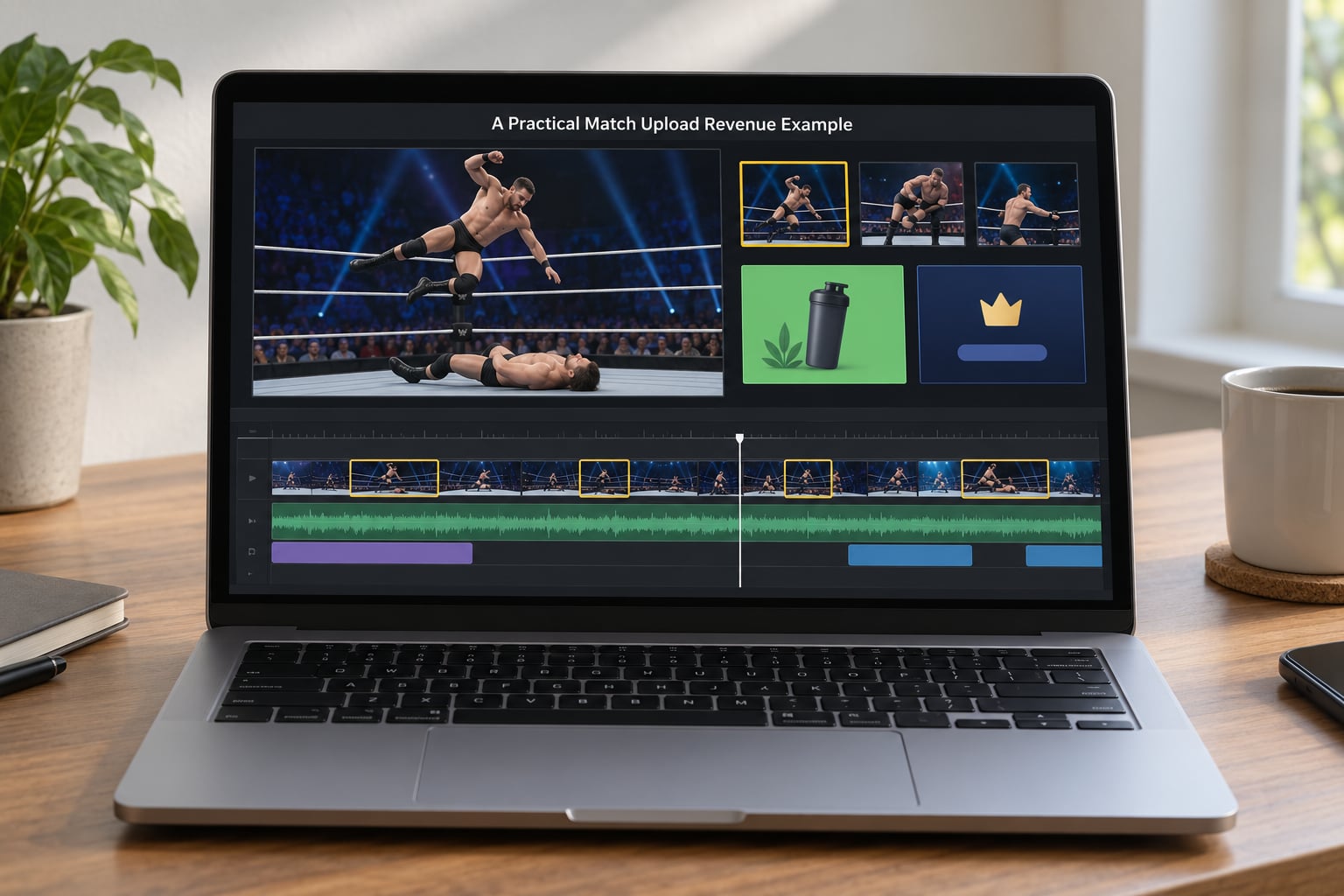
Here is an illustrative month for a channel with authorized footage, following one main event upload from upload to payout. Every number is a teaching example, not a promise.
An independent promotion grants a written licence for one show. The channel uploads the full match, a condensed 12-minute cut, and six Shorts from the same broadcast. Only the licensed versions are monetized, which matters because licensing usually specifies exactly what may be published and for how long.
Ad revenue is the biggest line. If the main event draws 40,000 views at roughly one pound CPM, the cleared portion earns about forty pounds, and the Shorts route through a separate pool with much smaller per-view economics. That single upload is not a business. A channel doing four licensed events a month in that range is looking at low hundreds before any other revenue layer.
The sponsor mention is where the month changes shape. A supplement brand pays a flat fee for a 45-second integration inside a recap video that also carries affiliate links, and the fee for that format is typically multiples of what the ad revenue on the same upload produced. Note the format: sponsorship attaches to the recap, which the channel owns, not to the licensed match.
Memberships add the recurring piece. Sixty members paying a few dollars each month produces a few hundred per month from the same audience that generated the views. Super Thanks during a watch-along adds a smaller variable amount that scales with how many people are watching live.
Total for the month lands in the low thousands from a combination of streams where match uploads supplied the reach. Take the match uploads away and the revenue collapses. That is the whole argument for making sure the footage is cleared first.
What Should a New Wrestling Channel Do First?
Settle the rights position before anything else, because every other decision downstream depends on it. Then pick an editorial format, work on retention, apply for the platform features you qualify for, diversify, and keep records. Six steps, in order.
- Secure rights in writing. Email the promotion or its distributor with the specific show, the specific format and the specific term you want. Keep the reply. For independent promotions this often takes one message and a small fee; for major promotions the answer is usually no.
- Choose one editorial format and say so on the channel. Recaps, documentary series, reviews and analysis are defensible; an archive of complete matches is not. A clear format makes sponsorship conversations easier too, because a brand can buy the audience you actually have.
- Build retention before chasing monetization. A wrestling audience watches for story and opinion, not just bumps. Longer watch time, stronger opening minutes and playlists that keep the session going are what lift RPM, and they matter more than upload frequency.
- Apply for every monetization feature you qualify for. Ad sharing, memberships, Super Chat and Super Thanks open at different thresholds, and shopping features open on their own timeline. Check Studio’s Earn tab rather than assuming one application covers everything.
- Diversify before ad revenue disappoints. Memberships, a newsletter, a podcast and merchandise do not care what advertisers bid per impression. Starting those at 1,000 subscribers is far easier than starting them at 100,000.
- Keep a rights record. A simple spreadsheet of every upload, its source, the permission received and the date. When a claim arrives six months later, that spreadsheet is the difference between a dispute and a surrender.
Two failure modes are worth naming. Reused and syndicated content is the other big reason wrestling uploads earn nothing. Full-match uploads that closely follow another upload of the same match, along with auto-synced third-party versions, are treated as reused content and are commonly kept out of ad sharing, regardless of ownership claims. If you can only produce an upload because someone else produced the video, the platform has already decided it is not worth paying for.
The second is advertiser suitability. Pro-wrestling channels were caught up in a documented wave of demonetization reported in 2017, when advertiser-friendly content policy changes hit channels across the niche. More recently, reports in 2026 described takedown notices reaching creators over reaction and clip videos. The lesson is not that wrestling content is unsellable. It is that a channel carrying open claims is a riskier place for any brand to advertise, and the damage lands on the sponsorship rate before it lands on the ad revenue.
Frequently Asked Questions
Can a YouTube channel make money by uploading full wrestling matches?
Sometimes, but only with permission. Full-match uploads from major promotions are typically claimed or removed, and claimed videos cannot be monetized by the uploader. Independent promotions are more open, and some will license footage or grant permission for a fee. Where a licence exists, income comes from ad revenue, and match-level rates sit low, so a full match rarely pays for the upload time on its own.
Does fair use allow a channel to upload WWE or AEW matches?
Fair use is a legal defense, not a permission. It is argued after a claim or takedown, on a case-by-case basis, and the factors courts weigh include purpose, amount used, market effect and transformation. Commentary and analysis sit on stronger ground than a complete match does. Nobody can tell you in advance that a clip is fair use, which is why creators should get permission rather than assume it.
How much does a wrestling channel earn from one match video?
For a cleared upload, multiply views by your effective RPM. A creator on r/PartneredYoutube reported around one pound per 1,000 views on match uploads, so 40,000 views would be about forty pounds before YouTube’s share. Highly variable and not a promise. Real income usually comes from mixing match uploads with higher-rate original formats, sponsorships and memberships.
Are highlights and commentary legal alternatives to full-match uploads?
They carry less risk, not zero risk. Short excerpts used for commentary or analysis are stronger fair-use candidates than complete matches, and many creators work that way. Fair use is still judged case by case, and reports in 2026 described takedown notices aimed at reaction and clip videos as well. Highlights also risk being classified as reused content, which blocks ad sharing independently of copyright.
Should a wrestling channel rely only on YouTube ad revenue?
No. Ad rates for match uploads sit at the bottom of the advertising market, so a channel built on them alone works much harder for the same result. Memberships, sponsorships, affiliate links to tickets and streaming, merchandise and newsletters do not depend on what advertisers bid for an impression. Treat ads as the reach layer and everything else as the income layer.
How many subscribers does a wrestling channel need to monetize matches?
Ad sharing currently needs roughly 1,000 subscribers plus 4,000 valid public watch hours in twelve months, or 10 million Shorts views in ninety days. The lower fan-funding tier asks 500 subscribers with either 3,000 watch hours or 3 million Shorts views. Clearing the threshold does not help if individual videos are blocked by a rights holder’s claim, so permission matters as much as the count.
Figures in this article come from creator reports and illustrative math rather than verified rate cards, and platform and promotion policies change regularly. Last reviewed in 2026. Nothing here is legal advice.
Start With Rights Before Revenue
Publish only footage you have permission to use, pick a format you can defend, and build everything else on top of that. Advertising, sponsorships, memberships, affiliate links and licensing all work far better on a channel with a clean record, and a single open claim can undo months of that work.
Ad revenue is the ceiling nobody can raise on its own in this niche. The way wrestling channels actually make money is by matching their reach to income that does not depend on the ad market: memberships, sponsorships that attach to their own recaps, affiliate links to real tickets and streams, and direct licensing deals where promotions need distribution and a creator has an audience to give.
For readers tracking the promotions themselves, our ongoing coverage of 2026 results and wrestler profiles makes a useful companion to a channel that follows the same companies week to week.