
A dusty finish is a match ending in which the face appears to win a big match, but the decision is immediately reversed by a technicality — a disqualification, a miscount, or outside interference — so the title never actually changes hands. It takes its name from Dusty Rhodes, who booked dozens of them in the NWA and later in WCW.
The word gets thrown around online as a synonym for any bad ending, and that is not what it means. A botched match, a cheat that decides the outcome, or a heel simply stealing a win are three separate things. None of them is a dusty finish. Knowing that separation is most of what there is to know about how wrestling dusty finishes work, because the device only functions when the reversal is a rule rather than an accident.
One clarification before we go further, because it comes up constantly: a finish is the end of a match. A finisher is a wrestler’s signature move. Dusty Rhodes’ finisher was the piledriver, which had nothing to do with where the term came from.
Table of Contents
- What Is a Dusty Finish in Wrestling?
- Why Do Wrestlers Use Dusty Finishes?
- What Happens During a Dusty Finish?
- How a Wrestling Dusty Finish Is Set Up
- How Timing and Selling Create Suspense
- Why Dusty Finishes Do Not Always Require a Three Count
- How Writers Book Repeated Dusty Finishes
- What Is the Purpose of the Near-Fall Callback?
- What Makes a Dusty Finish Feel Bad?
- Frequently Asked Questions
- What does dusty finish mean in professional wrestling?
- Why does a referee stop the count during a near fall?
- Is a two-count the same thing as a dusty finish?
- Who decides when a wrestler kicks out of a pinfall?
- Can a wrestling match end on a near fall?
- Why do wrestlers sometimes have multiple kickouts in one match?
- Conclusion
What Is a Dusty Finish in Wrestling?
A dusty finish is a finish in which the face appears to win a big match, but the decision is later reversed due to some sort of technicality — a disqualification, a fast count, or outside interference. Named after Dusty Rhodes, who booked many such finishes in the NWA and later in WCW.
There is a second meaning worth knowing about, because you will run into it. In looser usage, a dusty finish can describe an ambiguous ending where neither wrestler legitimately wins and nobody can quite say who got the decision. The pull-out match where both men leave the ring holding their heads is the classic example.
For this article, everything below uses the first meaning: the face wins, then loses it on a technicality.
Why Do Wrestlers Use Dusty Finishes?
Start with the rule that makes the whole device possible. In most federations, a championship cannot change hands on a disqualification. The winning wrestler is announced, the belt is handed over, and then the ruling gets reversed — and because no legal pin or submission occurred, the title stays exactly where it was.
That rule is why a dusty finish exists at all. Without it, a wrestler who gets the decision taken away would simply be handed the belt anyway and the drama would collapse into an argument.
The rest of the reasons are about the crowd rather than the rulebook.
- Suspense. Thirty seconds of genuine belief is worth more than a win that everyone saw coming. The pop on a reversed decision is the loudest sound a booking can produce.
- Crowd investment. Fans who think their favorite just lost something get louder and more engaged. Heat for a heel climbs because the crowd wants the rematch immediately.
- Callback material. Every failed pinfall is a tool that can be picked up again weeks or months later. See the section on callbacks below.
- Protecting a champion. A heel champion who wins cleanly every night stops being a threat. A dusty finish keeps the title picture open without making the champion look weak.
- Delivering a title change later. The face who loses the decision still gets to try again, and the win eventually handed over at a bigger show carries more weight.
Chris Jericho, talking about his match with MJF at AEW All Out in September 2021, put the intent plainly. He said the finish drove home that he could be done, and really helped from an emotional aspect. His line was that if you can get people to believe the story that you’re telling, then you’ve done a good thing.
That is the standard. The device is not the cheating. The thirty seconds of belief is the product.
What Happens During a Dusty Finish?
Here is the anatomy of one, step by step, using a championship match as the model.
1. The setup. Both wrestlers have been working for several minutes. The face has usually taken a beating that has been established on camera, which is why the kickout later reads as plausible.
2. The move. The face hits a finisher and goes for the cover. Often it is the same move they used earlier in the match, which quietly tells the audience this is the same shoulder or back that has been hurt all night.
3. The count. The referee counts. One. Two.
4. The kickout. The shoulder lifts at the last possible instant, sometimes with a hand on the mat, sometimes with a burst of speed to kick the referee away.
5. The reversal. Immediately after, the bell rings or the decision is announced, and then something undermines it. A manager grabs the referee. A second referee runs in and announces the disqualification. The timekeeper waves the count off as too slow.
6. The aftermath. The face sits or lies there having just been told they won. Then they watch it taken away, and the heel celebrates a win they never physically earned.
How a Wrestling Dusty Finish Is Set Up
A kickout only works if the audience had a reason to think it was coming. A wrestler with no visible damage kicking out at one is just a person refusing to lose.
Writers set that up in a few predictable ways. Injury is the most common: a shoulder worked over for ten minutes, a back repeatedly loaded with suplexes, a leg that stops working after a figure-four. Repetition helps too, since the same finisher landing three times in one match makes the fourth one feel like it has to be the last.
Stakes do the rest of the work. A dusty finish at a pay-per-view with a title on the line hits differently than the same finish on a television show, because there is something concrete to lose. So does the feud history. If two wrestlers have already failed to finish each other three times in previous meetings, the fourth near fall needs something different about it — a new hold, a new position, a slower build.
Two real examples show how varied the setup can be. At Night of Champions in 2015, Paige appeared to win the Divas Championship, and the decision was reversed afterward, so her fall had to carry the emotional weight of a moment she had waited years for. At the Elimination Chamber in 2015, Ambrose won inside the chamber only for a disqualification to be declared. Same device, completely different texture: one is a coronation taken away, the other is a survival story that turns into a grievance.
How Timing and Selling Create Suspense
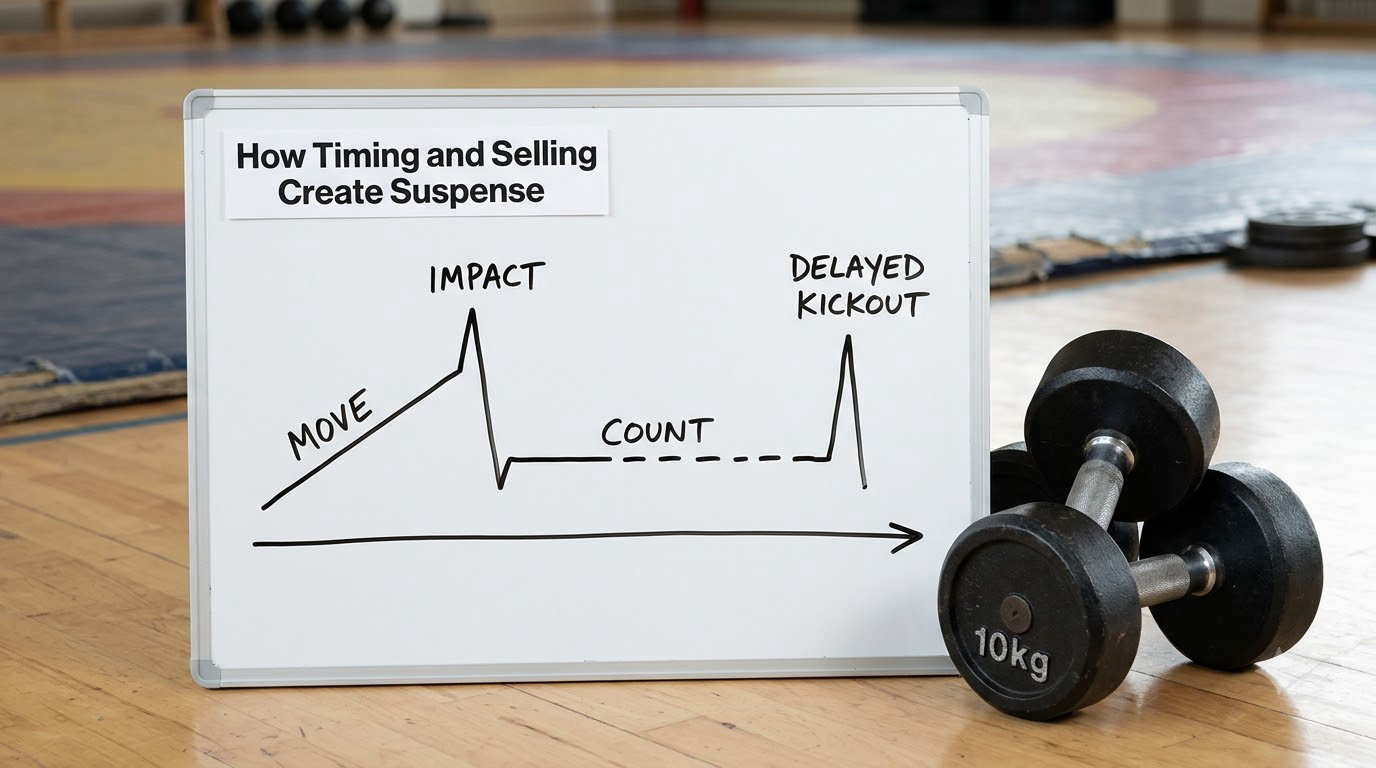
The mechanics of the kickout are small and they are the whole trick.
The impact. The move has to look like it hurt. Not performed-safely hurt, where both men are clearly fine, but landed-and-staying-down hurt. The person taking the move stays down for a beat before covering.
The count. The referee counts with a consistent rhythm. Slower than you expect is usually better, because it stretches the gap the crowd has to imagine the bell ringing.
The shoulder. The classic image is the hand lifting a fraction before three. Too early and it looks like stalling. Too late and nobody believes it. The delay is where the noise in the building comes from.
The after-effect. After the kickout, the person who kicked out should be visibly wrecked — holding whatever body part was worked, or simply flat on their back. That sells the cost of the moment and makes the reversal that follows feel cruel rather than arbitrary.
Here is the professional’s rule of thumb: the crowd should never be able to say exactly when the kickout happened. If they can, the timing was off.
Why Dusty Finishes Do Not Always Require a Three Count
The traditional sense of the term has nothing to do with kickouts. It is about a match that ends cleanly and then gets reopened by a ruling. The bell rang, the winner was announced, and then a disqualification, a slow count, or an illegal second referee reverses it.
That is why the term is not the same as a near fall. A near fall is any kickout before three. A dusty finish, in its strict sense, requires a completed win that is then voided.
Promotion rules have shifted over the years, which is worth knowing if you go back and watch old matches:
- Traditional territories and WCW era. Titles could not change hands on a disqualification. This is the environment Dusty Rhodes was booking in and the reason the device became so associated with him.
- WWE’s open era. Referee discretion expanded, and in many cases a disqualification could still result in a title being awarded to the winning wrestler. That reduced how often the classic dusty finish was available.
- Modern promotions. Rules vary by promotion, which is exactly why a rusty fan watching a different company’s match can end up confused about why a belt did not move.
Wrestlers also kick out for reasons that have nothing to do with a decision being overturned: they simply refuse to lose. Most kickouts in most matches are just that. When a kickout is later used as a callback to an earlier failed pin, it starts doing double duty as a dusty finish tool.
How Writers Book Repeated Dusty Finishes
Two near falls in one match can be a great structure. Three usually means something has gone wrong.
The purpose of the first failed pin is shock. The purpose of the second is a callback, or a bait-and-switch where the second kickout is faked and the finish is real. A third has nowhere left to go, because the audience has learned the pattern and now they are just waiting.
When a booker does stack them, four things need to change each time or the audience tunes out:
The move should be different, so the crowd cannot predict the finish from the cover alone. The timing should be different, with the second kickout happening at two instead of a fraction before three, or a shoulder rolling out of a pin entirely. The reaction should be different, since a wrestler who kicks out and then lies still tells a different story than one who kicks out and immediately attacks. And the outcome should eventually differ, because a match where every near fall fails the same way resolves nothing.
The 2015 Paige example is a good case study in the escalation problem. She lost a decision she had clearly won, on a championship she had chased for years. Whatever the reaction in the arena, the near fall landed because the whole match had been building toward a coronation and then removed it.
What Is the Purpose of the Near-Fall Callback?
A callback is when a later moment deliberately echoes an earlier one. Someone who was pinned and kicked out in January gets pinned in nearly the same position in September, and this time they do not get up.
Callbacks exist because wrestling is a serialized story with a returning audience. Rewarding the people who paid attention to a small detail six months ago is the cheapest way to make an arena feel like it is part of something, and it costs the booker nothing in terms of talent or budget.
There are three forms worth recognizing. The reversal callback is the common one: the same move, the same spot, the opposite result. The positional callback uses the same spot on the mat rather than the same move. And the outcome callback is the rarest — a match that references a specific failed pin from a named earlier match, in front of a crowd that was there for it.
Callbacks turn predictable when the show announces them. If a wrestler has spent three segments talking about the match they lost last year, the audience knows the payoff before it happens, and the tension leaks out of the whole thing.
What Makes a Dusty Finish Feel Bad?
Most of the bad reactions people have to dusty finishes are not really about the device. They are about the execution. These are the specific complaints that come up.
- The kickout was undeserved. Nothing was established, so the crowd reads it as the booker overruling them.
- The reversal makes no logical sense. The crowd saw a clean three-count and the belt still did not move, with no rule or official explained.
- It is the fourth one this year. Repetition is what drains impact, not the concept itself.
- Nothing followed. A reversed decision with no rematch, no explanation, and no consequence reads as a message rather than a story.
- The crowd reaction was faked. If the noise in the building is obviously cued rather than real, the whole illusion collapses at once.
- It was used to cover something else. A match that was genuinely misbooked can get retroactively explained as a deliberate dusty finish, and experienced fans tend to see through that immediately.
That last one is why the term has drifted into being an insult. On long-running fan forums the thread “What’s a Dusty Finish?” has been open for around two decades, and the answers drifted from explanation into argument. The device has been stretched to cover any ending a fan did not like, and that is why it now reads as shorthand for bad booking rather than for a specific booking tool.
The clean distinction worth holding onto: interference that decides a match is just cheating. A reversal that happens after a legitimate win, voiding it on a technicality while the title stays put, is a dusty finish.
Frequently Asked Questions
What does dusty finish mean in professional wrestling?
A dusty finish is a match ending where the face appears to win, but the decision is then reversed by a technicality such as a disqualification, a miscount, or outside interference. Because most federations do not allow a title to change hands on a disqualification, the champion usually stays champion. The term comes from Dusty Rhodes, who booked many of them in the NWA and WCW.
Why does a referee stop the count during a near fall?
A referee stops a count when the shoulders hit the mat in a way that does not satisfy the rules, when the person being pinned kicks out, or when the referee sees a rule violation such as a rope break or a closed fist. In a dusty finish, the count is sometimes stopped later by a second official announcing a disqualification, which waves off a decision that had already been counted.
Is a two-count the same thing as a dusty finish?
No. A two-count is simply any pinfall that ends before three, and it happens in almost every match. A dusty finish requires a win that was completed and then reversed on a technicality, which voids the result and often the title change. The two are frequently confused because the crowd reaction looks similar, but they are separate events.
Who decides when a wrestler kicks out of a pinfall?
In-story, the wrestler decides, and in practice the decision is booked by the writer with both performers before the match. Promoters often plan kickouts around audience emotion, tracking where the crowd is hottest in the arena. A wrestler can also improvise a kickout when the count is slow enough for them to judge the moment themselves.
Can a wrestling match end on a near fall?
A match cannot end in a pinfall sense on fewer than three, but a match can end on a decision that a near fall set up. A wrestler kicks out late in the bout, the referee declares a no contest or disqualification, or the time limit expires and the ruling goes to the champion. Those endings often feel like a near fall because the finish was decided by a moment that never resolved cleanly.
Why do wrestlers sometimes have multiple kickouts in one match?
Because a kickout is the simplest way to manufacture suspense, and one is not always enough to make a main event feel like one. Writers stack them when a match needs escalating stakes or when an earlier failed pin is being set up for a callback later. The risk is repetition: once the crowd knows a kickout is coming, the tension drops instead of rising.
Conclusion
A dusty finish works when four things line up: a move that visibly hurts, a count that stretches, a kickout the audience could not quite time, and a reversal that follows immediately enough to feel like one continuous moment rather than a re-run of the ending.
The takeaway worth keeping is the distinction. A kickout is suspense. A dusty finish is a completed win voided by a technicality, which is why the title usually stays exactly where it was. That is the whole of how wrestling dusty finishes work, and once you can tell those two apart, most of the arguments about whether a finish was cheap stop being about taste.