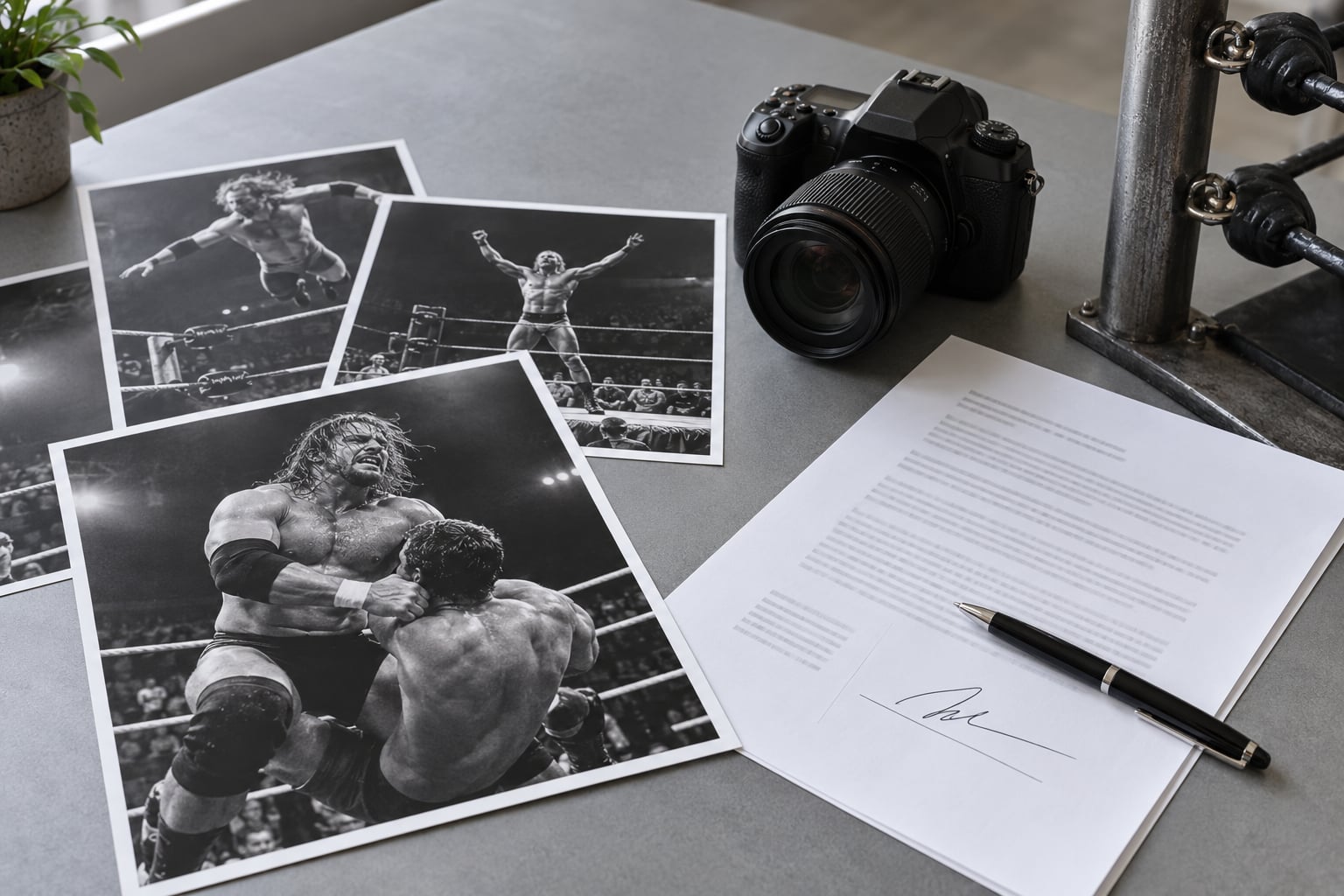
How wrestling photography rights work comes down to three separate layers that people constantly mix up: who owns the copyright in the photograph, who gave you permission to be in the room, and whether the wrestler’s image can be used the way you plan to use it. The photographer owns the copyright the moment the shutter fires unless a valid written agreement says otherwise, and buying a ticket or holding a media credential never transfers that ownership.
Below is a US-focused walkthrough of how those layers interact, what a promotion can and cannot demand, and what to check before a wrestling photo ends up on a poster, a stream thumbnail or a t-shirt.
Table of Contents
- What Are Wrestling Photography Rights?
- How Copyright Protects Wrestling Photographs
- When do you own copyright in a wrestling photograph?
- How does work-for-hire language change ownership?
- What does owning the copyright not give you?
- Who Owns a Photo Taken at a Wrestling Event?
- What decides ownership in a wrestling photo dispute?
- Who owns what: the rights matrix
- What Do Event Policies and Signed Releases Mean?
- Can You Sell or Publish Wrestling Photos Online?
- Which uses need which permissions?
- Do Wrestlers and Promotions Have Publicity or Likeness Rights?
- How to Check Rights Before Using a Wrestling Photo
- Frequently Asked Questions
- Can I take wrestling photos at a live event if I bought a ticket?
- Does a wrestling promotion own every photo taken at its event?
- Do I need a wrestler’s permission to publish an editorial photo?
- Can I license wrestling photos on stock sites or in AI datasets?
- What should I do if I find a wrestling photo used without permission?
- Conclusion: Start With the Contract and the Intended Use
What Are Wrestling Photography Rights?
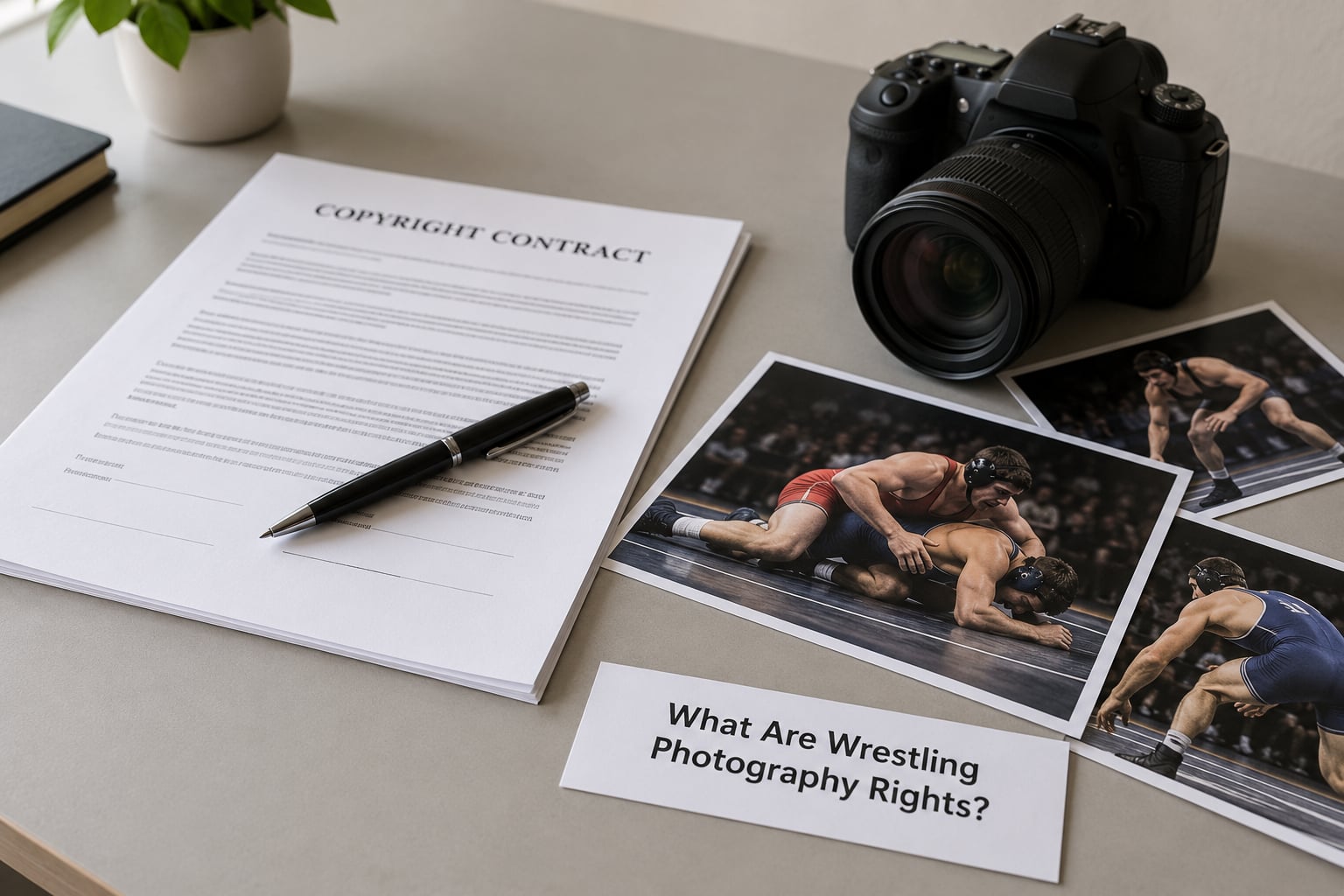
Wrestling photography rights are the rules that decide who owns a photograph taken at a wrestling event, who may publish it, and who may profit from it. They are not one rule. They are four, and each one answers a different question.
Copyright is the first layer, and it covers the photograph itself. Whoever created it usually owns it automatically, with no form to file and no registration required for ownership to exist.
Contract restrictions are the second. A promotion, venue or sponsor can limit where you may shoot, where the files may go, and how long a licence lasts, without ever touching your copyright.
Publicity and likeness rights are the third. A recognisable wrestler’s image carries commercial value, and both the wrestler and the promotion often have contractual say over how it appears in advertising or on merchandise.
The fourth layer is ordinary publication permission, which is the practical question most people actually have: can I run this photo, and do I need to ask anyone first?
These layers sit on top of each other, and US rules vary by contract wording and by state law. Treat anything here as a general explanation, not legal advice for your specific situation.
How Copyright Protects Wrestling Photographs
Copyright in a wrestling photograph starts with the person who made it. Registration with the US Copyright Office is not needed to own the work, though it does open the door to statutory damages and attorney fees in a lawsuit.
When do you own copyright in a wrestling photograph?
You own it the moment you take the shot, as long as you are the photographer and nobody signed you away from it. That is true whether the show was a 200-seat wrestling school card or a national televised broadcast.
The photograph is protected as an original work fixed in a tangible medium. Your shutter settings, camera body and level of experience do not matter for ownership. A blurry ringside frame of a handshake is still yours.
How does work-for-hire language change ownership?
Work for hire is the phrase that moves ownership, and it only works under narrow conditions. The US Copyright Act lists nine categories, such as a contribution to a collective work or a compilation, as work made for hire when a commissioned party does the commissioning. A standalone action shot from a live event usually falls outside that list.
Outside those nine categories, work-for-hire language only sticks when it sits in a written instrument signed by both parties. A promoter saying “these are our photos now” on the night of the show is not a written instrument.
Courts also test whether you were an employee rather than an independent contractor, using factors like who controls how the work is done, whether you are paid on an hourly basis, and whether you operate your own business. Freelance wrestling photographers usually fail the employee test.
The practical version is plain: no signed work-for-hire document, no transfer. Keep the contract and the invoice together in the same folder, because that is the evidence you will want first if the question ever comes up.
What does owning the copyright not give you?
Owning a photograph of a match does not give you ownership of the performance, the ring design, the wrestler’s moveset, the promotion’s logo or the music. Those belong to other people or companies.
Nor does copyright stop someone from photographing you. A wrestler who films your photo on their phone has not infringed anything.
Who Owns a Photo Taken at a Wrestling Event?
Ownership in a wrestling photo dispute comes down to employment status, what any written agreement says, and whether the promotion ever commissioned the work formally. Ticket stubs, credentials and handshakes carry no copyright weight.
What decides ownership in a wrestling photo dispute?
Start with whether you were an employee. An in-house photographer on salary creating work within the scope of a job is different from a freelancer invoicing per show.
Next, read any paper you signed. Media credential applications often contain an assignment clause buried near the end, and those get signed quickly at the door.
Then consider commissioning. If a promotion paid a flat fee for one specific shoot on a deliverable schedule, that points toward a commissioned work, though it still requires the written agreement to move copyright.
A familiar dispute pattern goes like this: a photographer shoots an event with no contract, gets paid, and months later the promoter claims ownership and asks for the memory card. Without a signed work-for-hire instrument, the photographer is usually in the stronger position.
Who owns what: the rights matrix
| Party | Usually owns | Grants you access by | Can restrict your use by |
|---|---|---|---|
| You, the photographer | Copyright in your frames, unless assigned | Nothing needed | Not applicable |
| The promotion | Its name, logo, event branding, footage | Ticket, credential, work-for-hire agreement | Credential terms, contract, house rules |
| The venue | Its building, signage and property | Ticket, escort rules | No-photo areas, backstage bans |
| The wrestler | Their likeness, name, persona, moveset | Not required for editorial use | Contract clauses and sponsorship deals |
| The sponsor | Its marks and campaign assets | Nothing needed | Signed agreements with the promotion |
Ownership and permission are not the same thing. A promotion can absolutely stop you from publishing a photo it commissioned without paying you, and it can absolutely keep its copyright even when it has no rights at all in your photograph.
What Do Event Policies and Signed Releases Mean?
Event policy limits behaviour in the room. It does not move copyright. A promotion can ban flash, ban photography during entrances, close the ringside camera line to the general crowd, or restrict floor access to credentialed outlets, and still have zero claim to your files.
Common restrictions worth reading closely before you shoot: no-photo signage in corridors and locker rooms, credential limits on camera bodies and lenses, an assignment clause buried in the credential agreement, and rules about when you may shoot rather than record.
Releases are the other document. A photo release or model release signed by a wrestler generally gives permission to use their likeness for commercial purposes. It does not hand over copyright, and copyright is not something a wrestler can transfer to you in the first place.
Extra care is warranted with minors and with backstage access. Talent involving wrestlers under 18 needs a guardian signature, and backstage or private access usually comes with an added confidentiality and non-commercial term that extends past the event.
Contract terms differ sharply by tier. A major national promotion runs formal credential applications and negotiated image agreements, while a local independent show often has no paperwork at all and relies on a personal relationship with whoever runs the room. Both situations are common, and neither one tells you who owns the photo.
Can You Sell or Publish Wrestling Photos Online?
Most wrestling photos can be published, but the permissions differ sharply by use. The core question is whether the use is editorial, promotional or commercial, and whether the promotion paid you for it.
Which uses need which permissions?
| Use | What you normally need | Main risk |
|---|---|---|
| Reporting, blog post, fan site | Your copyright, plus a licence if you were paid | Low if you credit the photographer |
| Promotion social media reposting | Permission built into your contract | Losing control of your own image |
| Streaming thumbnail or video overlay | Explicit still-photo licence | Unlimited terms in writing |
| Prints, posters, canvas sales | A licence that names prints and products | Royalty and duration clauses |
| T-shirts and merchandise | Written merchandise licence plus likeness clearance | Likeness claims from the wrestler |
| Stock licensing or image marketplaces | Model releases where faces are recognisable | Uncleared likeness rights |
| Paid advertising for a business | Commercial licence and usually a model release | Implied endorsement |
| AI training datasets | Written permission; many sites ban wrestler content | Unclear consent and platform bans |
Fair use is narrower than most people assume. News reporting is a favoured purpose, but fair use is a four-factor balancing test applied case by case, not a blanket exemption. Publishing a full gallery of an entire show is not automatically fair use, and neither is the fact that a fan would have liked to see it.
If you shot an event for free in exchange for portfolio credit, say that credit line clearly. The norm across independent wrestling photography is simple: say who took the picture.
Do Wrestlers and Promotions Have Publicity or Likeness Rights?
Yes, in practice. You can own the copyright in a perfectly good action shot and still not be allowed to sell that image on a shirt or use it in an advertisement.
State publicity statutes vary widely. A few states recognise a right of publicity in name or likeness for commercial advertising; most apply it more narrowly than people expect, and some have exceptions for news and commentary. Because the statutes differ, a photo that is fine in one state can be contested in another.
Contract rights are the bigger factor. A wrestler who has a deal with a supplement brand, a tattoo company or a local gym may have agreed that certain images are off limits, even for a legitimate use. The promotion frequently has parallel contractual rights, especially around official event imagery and pay-per-view artwork.
Trademark is the quieter trap. Putting a promotion’s logo in an ad for your own product can imply an official relationship, and promotions are protective of that. This is where an editorial photo of a championship celebration stops being an editorial photo and becomes a marketing asset.
The practical rule is simple. Reporting on a wrestler is one thing. Selling something with their face on it is another.
How to Check Rights Before Using a Wrestling Photo
Run through this list before you publish, print or license anything.
- Identify the creator. Find out who actually pressed the shutter, and whether you have a receipt, an invoice or an email trail showing it was them.
- Read the paperwork you signed. Credential agreements and freelance contracts. Look for assignment language, work-for-hire language and any exclusivity.
- Check the event rules. No-photo areas, restricted areas of the building, and anything the promoter said about social posting.
- Note recognisable subjects. If a face fills the frame, assume a model release question comes later.
- Separate editorial from commercial. Decide what the image is doing, not just where it is going.
- Keep records. Contracts, releases, RAW files with intact metadata, delivery confirmations and payment records.
- Ask in writing. A short email asking whether a specific use is permitted creates a record if the answer is disputed.
Protecting the asset also matters. Embed IPTC or EXIF ownership data, keep full-resolution files, register high-value or commercially significant images with the Copyright Office before licensing them, and use reverse image search to find unauthorised use. Watermarks work as a deterrent, not as protection.
If the money or the exposure is real, talk to an intellectual-property or media attorney. A short review of a one-page agreement is cheap next to a dispute over a national campaign.
Frequently Asked Questions
Can I take wrestling photos at a live event if I bought a ticket?
Usually yes, because buying a ticket grants access to the event rather than any rights in the images you make. Venue signs, house rules and the promoter’s terms can still restrict flash, recording or certain areas. Restrictions control where and how you shoot, not who owns the file. If the show is sold as a photography-restricted event, check your ticket terms before you attend.
Does a wrestling promotion own every photo taken at its event?
No. Copyright belongs to the photographer by default, and a ticket or media credential does not transfer it. A promotion would need a valid work-for-hire agreement, usually in writing and signed by both parties, or an assignment in a signed contract. Promotions do own their own logos, branding, footage and official event artwork, which is separate from your photographs.
Do I need a wrestler’s permission to publish an editorial photo?
Generally no. Reporting on a wrestling event using photographs you took is a normal editorial use, and most publicity statutes and contracts treat news and commentary differently from advertising. You do need permission for commercial use such as merchandise, advertising or an implied endorsement, and a recognisable wrestler may also have contractual restrictions through a sponsor deal.
Can I license wrestling photos on stock sites or in AI datasets?
You can offer a photo, but model releases are usually required for recognisable faces and many platforms restrict content from combat sports or sporting events. Some marketplaces ban wrestling imagery outright, and AI dataset licensing terms vary widely. Read the platform’s rules before uploading, keep your release documentation with the submission, and remember that a contract may already limit you from licensing the same frame elsewhere.
What should I do if I find a wrestling photo used without permission?
Save evidence first: a screenshot with the date, the URL, the page itself and any watermark visible. Send a short written notice naming the image, your ownership and the removal you want, and keep a copy. Licensing platforms often have a removal process for contributors. For commercial misuse, register the work with the Copyright Office and talk to an attorney about statutory damages and attorney fees.
Conclusion: Start With the Contract and the Intended Use
How wrestling photography rights work comes down to keeping three things apart: copyright, which belongs to the photographer unless a valid written agreement moves it; event permission, which controls where and how you shot but never ownership; and publicity or likeness rights, which decide whether the wrestler’s image can be sold or used to sell something else.
Document where every photo came from, read the credential and contract language before you sign, and confirm any commercial or endorsement use in writing before it goes live. If a single frame matters to a campaign, pay for an attorney’s review before the print run, not after the dispute.