Reader trust in wrestling coverage comes down to one editorial promise: never present a rumor as a fact, and show your work every time. Any fan can start a wrestling blog that readers trust — pick a narrow audience, write your sourcing rules down before you write your first post, and publish one carefully verified article at a time.
The mechanics are easy. The hard part is discipline, not software. Most new wrestling sites don’t fail because they’re ugly or slow. They fail because they recycle a rumor screenshot six hours after somebody else posted it and call it news.
Here’s what actually builds credibility for readers who spend all week arguing about booking on forums: sources you can click, a real byline, visible corrections, and match reviews that stay useful even when the writer hated the result.
Table of Contents
- What You Need: How to Start a Wrestling Blog That Readers Trust
- Step-by-Step
- Choose a Specific Wrestling Niche
- Create Editorial and Sourcing Standards
- Build Useful Coverage Pillars
- Verify the Story Before Publishing
- Set Up Clear Site and Article Standards
- Publish Reviews That Help Readers Decide
- Launch, Measure Trust, and Improve
- Common Mistakes
- Reposting other sites’ reporting as your own
- Writing rumors as facts
- Publishing before checking the basics
- Hiding corrections
- Letting the site read like filler
- Taking gifts and coverage without saying so
- Frequently Asked Questions
- Do I need special equipment to start a wrestling blog?
- How often should I post on a wrestling blog?
- Can I use anonymous sources in wrestling news coverage?
- How do I build credibility as a wrestling writer?
- Can a wrestling blog make money?
- How long does it take for a new wrestling blog to get traffic?
- Start With a Trustworthy Editorial Promise
What You Need: How to Start a Wrestling Blog That Readers Trust
Seven things need to be in place before you publish. Three of them are non-negotiable on day one; the rest can arrive in your first month without costing you credibility.
- A defined niche and an editorial promise. One sentence describing who reads your site and what you always cover for them.
- A primary-source list. Promotion accounts, official event pages, on-record reporters you follow, and the databases or archives you check before writing about history.
- Fact-checking and archiving tools. A screenshot tool that captures the source URL and timestamp, plus somewhere to save every link you cite.
- A written disclosure policy. What counts as a rumor, what counts as reporting, and how you handle tickets, gifts, and paid placements.
- A usable website. Loads fast on a phone, readable at night, with working category and author pages.
- A consistent editorial voice. The same structure and tone across recaps, news posts, and opinion pieces.
- A public correction process. A corrections page, and the willingness to change a headline when the story underneath it changes.
Launch-critical: the niche, the sourcing list, and the correction process. A reader who catches you correcting an error will usually trust you more than a reader who never saw an error. Domains, themes, and newsletter tools can all wait.
Step-by-Step
Choose a Specific Wrestling Niche
A specific promise beats broad coverage every time. “Independent wrestling results and promotion news from the UK and US mid-tier scene” is a promise. “Wrestling news” is not.
Good niches include independent promotion results, women’s wrestling, a specific era of wrestling history, weekly show reviews for one promotion, booking and kayfabe analysis, or workrate-focused match breakdowns. Each one has a different reader with a different appetite.
Run the sample-month test. Write down every story idea you’d want to publish for 30 days, then mark how many distinct audiences each one serves. If your list turns out to be three audiences — history, indies, and celebrity gossip — cut to one and take the other two off the board for the first quarter.
Create Editorial and Sourcing Standards
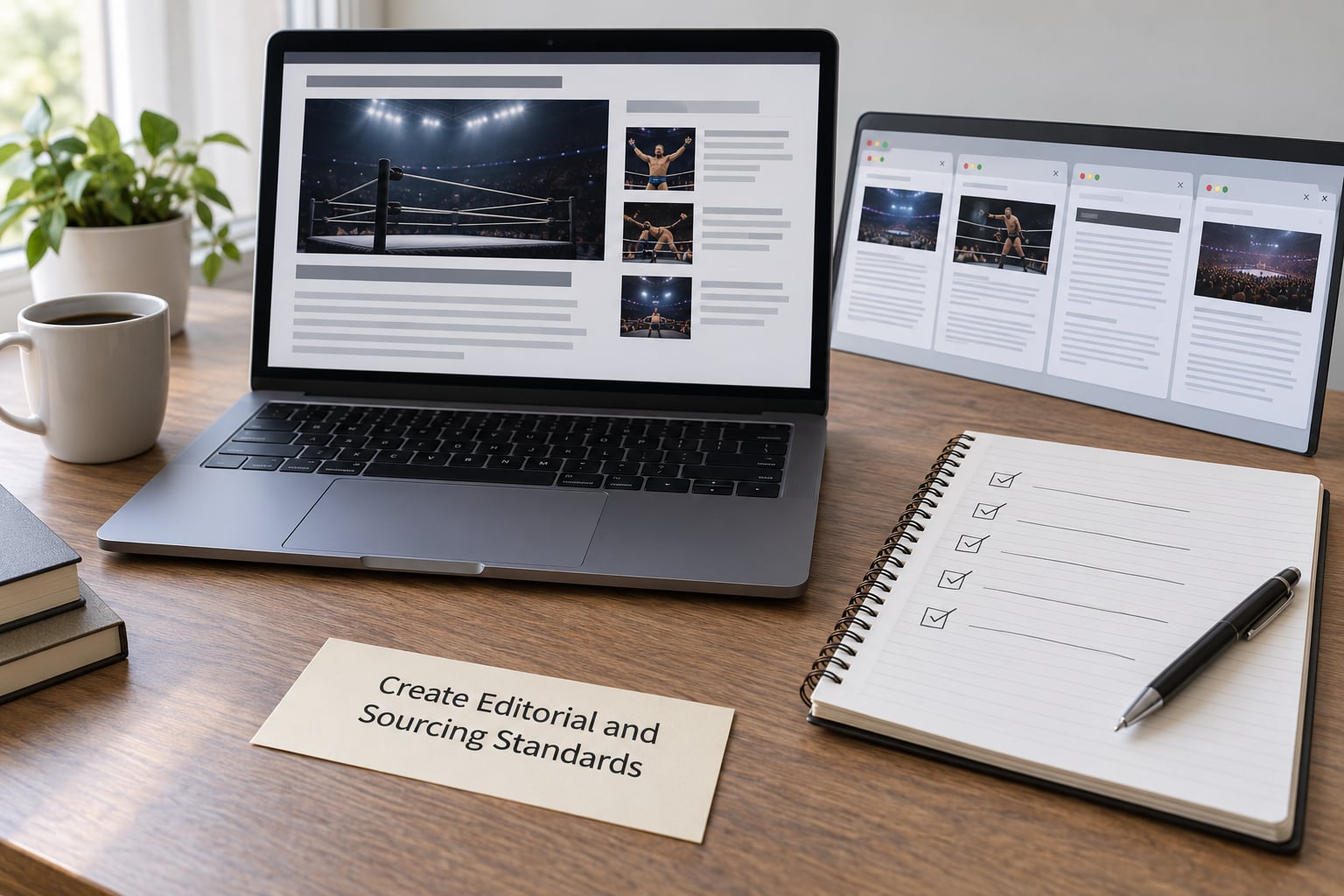
Write your labeling rules before you write anything else, because applying them after publication looks like damage control. Most wrestling sites use a simple ladder: confirmed, credible report, rumor, recycled story, opinion, sponsored.
Here’s a workable version. Confirmed means you can point at an official announcement, an on-record statement, or the event itself. Credible report means a named reporter with a track record has published it and you are linking to them. Rumor means it is unverified and you say so in the first paragraph, not in a footnote. Recycled means somebody else got there first and you are linking to the original.
Never write a quote you didn’t hear, never crop a screenshot so it implies more than the original post, and never present a worker’s contract status as fact when the only source is a message board. A one-page source policy, linked from every article footer, does more for trust than any theme you can install.
Build Useful Coverage Pillars
Recurring formats keep you publishing on slow weeks. Aim for six pillars: event results, news updates, rumor dispatches, wrestler profiles, interviews or opinion analysis, and historical retrospectives.
Each pillar answers a different reader need, and that is the point. Results answer “what happened.” News answers “what changed.” Rumor dispatches answer “what might be true, and how confident should I be.” Retrospectives answer “why does anyone still care about this era.” A blog that runs four or five of these on rotation stops depending entirely on breaking news, which is how most new sites burn out.
A useful test for balance is the 80/20 approach borrowed from blogging generally: roughly 80 percent of your output serves readers who arrive from search looking for something specific, and about 20 percent is pure personality. In wrestling that split usually looks like recaps and profiles on one side, opinions and rankings on the other.
Verify the Story Before Publishing
Use the same five checks on every story, no matter how fast it moves. Confirm the event and date first; a debut announced for a date that got moved is a very common embarrassment. Then find the original source rather than the account that reposted it.
Separate what is known from what is alleged. Note whether a wrestler is under contract, was seen at a tryout, or simply has not re-signed — those are three different stories and readers treat them as interchangeable. Check every name and spelling, especially for international independents, where transliterations differ between sources. And save the link so you can verify it again in three months.
When you get something wrong, correct it in public. Add a line to the article, note it on your corrections page, and leave the original text visible. Deleting the post and hoping nobody screenshots it is how credibility dies quietly.
Set Up Clear Site and Article Standards
Readers judge your operation before they judge your takes. Keep the homepage simple: latest posts, a short description of what you cover, and links to your sourcing and corrections policies. Predictable categories matter more than clever ones, because readers bookmark them.
Every article needs a visible byline, a publication date, and a last-updated date that changes only when you actually change something. Give yourself an author page with a real bio — name, where you have covered wrestling, what you do and do not cover. On a trust topic, provenance is doing half the work, and readers notice a missing byline faster than a slow theme.
Keep one article template: what happened, what was reported, what is confirmed, what remains open, and your take if you have one. Predictability reads as honesty.
Publish Reviews That Help Readers Decide
A match review earns trust when a reader can predict what you think before they finish reading it. That only works if your criteria are stated. Say whether you’re scoring the match itself, the segment around it, the crowd, or the booking decision — most arguments about a show are really arguments about which of those four things each person is judging.
Cover the strengths and the weaknesses in the same breath, with specifics. “The finish did nothing” is an opinion; “they had a clean nearfall and then went to a double count” is reporting. And keep the review useful when you hated the result, because that’s when readers decide whether you can be trusted.
Skip promotional summaries dressed as reviews. If you received a ticket or a gift, say so. Reviews that quietly read like ad copy are the fastest way to lose the readers you actually want.
Launch, Measure Trust, and Improve
Launch with a small set of finished articles — five to eight pieces that each meet your own standards — rather than a flood of thin posts. Then let people find them. Share into wrestling communities by answering questions and being useful first, and treat link-dropping as the fastest available way to be ignored.
Measure things that indicate trust rather than reach: how many readers come back for the next show, how many sign up for a newsletter, how many corrections you issue, and whether comments describe your reasoning instead of your intelligence. A small return audience beats a large one-off spike every time.
Take criticism in the comments the way you’d take an edit. The most repeated advice from writers who stuck with it is blunt: write because you care about wrestling, not because you’re chasing traffic. An audience of a few hundred real readers will sustain a hobby site; an algorithm will not.
Common Mistakes
Reposting other sites’ reporting as your own
Fix: link to the original reporter by name in the first line, and add something they didn’t have — context, a history thread, or your read on why it matters. Aggregation done openly is a service. Passing it off is the fastest route to a credibility problem you can’t undo.
Writing rumors as facts
Fix: use the ladder. Confirmed, credible report, rumor, recycled. Most wrestling sites fail on this one item alone, which is why readers have learned to dismiss the whole genre. One honest “this is unconfirmed, here’s the single source, here’s what would confirm it” paragraph does more for your reputation than ten accurate recaps.
Publishing before checking the basics
Fix: event, date, name spelling, and source link. Speed matters in this niche, but a wrong date in a results post gets screenshotted and shared for years. Slow down by five minutes; nobody notices, and screenshots do.
Hiding corrections
Fix: keep a corrections page, add a dated note to the article, and leave the original wording in place. Editors who correct openly are treated as careful. Editors who quietly rewrite history are treated as unreliable, and wrestling readers keep mental notes.
Letting the site read like filler
Fix: cut every sentence that could appear on any site about any topic. Vague match summaries and generic opinions are exactly what readers recognize as machine-written, and they leave. One specific detail — a promo line you loved, a spot that looked mistimed, a crowd that went quiet — beats a paragraph of generalities.
Taking gifts and coverage without saying so
Fix: disclose tickets, gifts, and paid placements in the article, not on a hidden page. If you buy a ticket like anyone else, say that too, because it tells the reader what your view actually is.
Two habits keep a schedule sustainable. Batch your admin — sourcing, archiving, corrections — into one fixed session a week so reporting stays separate from housekeeping. And commit to a pace you can hold on a bad week, because a three-post week repeated for a year beats a ten-post week that ends in March.
Frequently Asked Questions
Do I need special equipment to start a wrestling blog?
A laptop, a domain, a hosting plan, and a screenshot tool that saves the source URL and timestamp are enough for the first year. You do not need a camera or a fast connection to write recaps. Most new writers cover major shows from home and add live-event work later, once they have contacts and a corrections history worth showing a promoter.
How often should I post on a wrestling blog?
Three to five posts a week is a realistic pace for a hobby site, and consistency matters more than volume. Pick a rhythm you can survive on a bad week rather than the highest number you can imagine. Rope-a-days and slow weeks are when schedule discipline shows; filling every gap with thin posts is how new sites lose readers.
Can I use anonymous sources in wrestling news coverage?
You can, but label them honestly and expect readers to discount what they carry. Wrestling rumors usually arrive through anonymous or unverifiable channels, so the label is the credibility. Say where the claim came from, how many independent people repeat it, and what would confirm it. Never upgrade an unverified claim by rewriting it in confident language.
How do I build credibility as a wrestling writer?
Credibility comes from repeatable habits: a real byline, linked sources, a public corrections page, and reviews with stated criteria. Cover a show you disliked and explain why in specific terms, and readers will trust your praise too. Prove you went to the event, watched the tape, or read the announcement, and show the evidence rather than asking for belief.
Can a wrestling blog make money?
Some do, and most never will. Display ads, affiliate links, subscriptions, merchandise, and event coverage can all pay something, but the ceiling is low and the first months usually pay nothing. Writers who make wrestling publishing their income tend to be covering events and building a newsletter. If money is the goal, look at journalism work first and treat the blog as the portfolio.
How long does it take for a new wrestling blog to get traffic?
Plan for a long dry spell and keep writing through it. Search traffic on a new site can stay near zero for six months, and wrestling’s recency bias makes old posts compete with fresh coverage constantly. Regular readers arrive faster than search readers, usually through communities and social posting. That is why how to start a wrestling blog that readers trust starts with sourcing and standards, not promotion.
Start With a Trustworthy Editorial Promise
Pick one audience, write down how you label sourcing, publish a corrections page, and finish one article you would defend line by line before you publish a second. That single verified piece is worth more to your reputation than a month of fast recaps.
How to start a wrestling blog that readers trust is mostly a matter of doing the boring work in public: naming your sources, correcting yourself when you get something wrong, and writing opinions a reader could disagree with without the whole thing falling apart. Volume is cheap. Being worth coming back for is not.