
Title lineage records are tracked by logging every recognized change of a championship in date order, one entry per reign, with the champion, the event, the date and the number of days held. A promotion decides whether a change counts, and the entry is appended to the belt’s chain of custody so the history stays auditable.
That answer covers professional wrestling. If you landed here searching for how title lineage records are tracked and ended up looking at tournament software that logs a 10-year-old’s weight class wins, this is the wrong page — that system tracks amateur competition results, where every match is a real contest with an official ruling.
Pro wrestling lineages work the opposite way. A title change can happen on television, at a house show nobody filmed properly, on a dark show tape, or in a scripted angle that gets reversed weeks later, and the record-keeper has to decide whether any of that belongs in the official chain.
Table of Contents
- What Is a Title Lineage Record?
- How Title Lineage Records Are Tracked Step by Step
- How title lineage records are tracked for defunct promotions
- What Information Does Each Reign Record Include?
- Why Do Promotions and Record-Keepers Disagree?
- How Vacations, Tiers, and Renamed Championships Affect Lineage
- What unification does to a record
- How to Check a Lineage Claim for Yourself
- Frequently Asked Questions
- What is title lineage in pro wrestling?
- What makes a title reign recognized?
- Why do wrestling databases disagree about how long a reign was?
- What happens to title lineage when two championships are unified?
- Which wrestling title history database should I trust?
- Conclusion
What Is a Title Lineage Record?
A title lineage record is the ordered list of recognized champions for one championship, from its origin to the current holder, with each reign treated as a link in a chain rather than a standalone entry.
The distinction from a simple winners list matters. A winners list says who held the belt. A lineage says who held it, in which order, for how long, and — crucially — what each previous reign ended with. If a champion loses the title, gets it back at the next taping, then loses it again, that is three reign entries, not one.
A few terms get used loosely, so here are the working definitions:
- Reign — one continuous period during which a champion holds the title, ending when the belt changes hands or is vacated.
- Recognized reign — a reign the promotion or governing body officially counted at the time.
- Unrecognized reign — a win the promotion refused to honor, so it is logged but kept out of the main chain.
- Lineal championship — a belt whose chain of recognized reigns has never been interrupted by a vacancy or a disputed handover.
- Vacated — the title is emptied by the promotion, usually for injury, contract issues or a failed defense, and the chain pauses.
- Unified — two lineages merged into one championship, with one history feeding into the other.
- Brand extension — the same lineage presented as a separate title on a different show or roster, which either continues the history or starts a new one depending on the promotion’s decision.
Records like longest combined reign, most reigns and most successful titleholder only exist because of the lineage. You cannot sum a number across a chain nobody agrees on.
How Title Lineage Records Are Tracked Step by Step
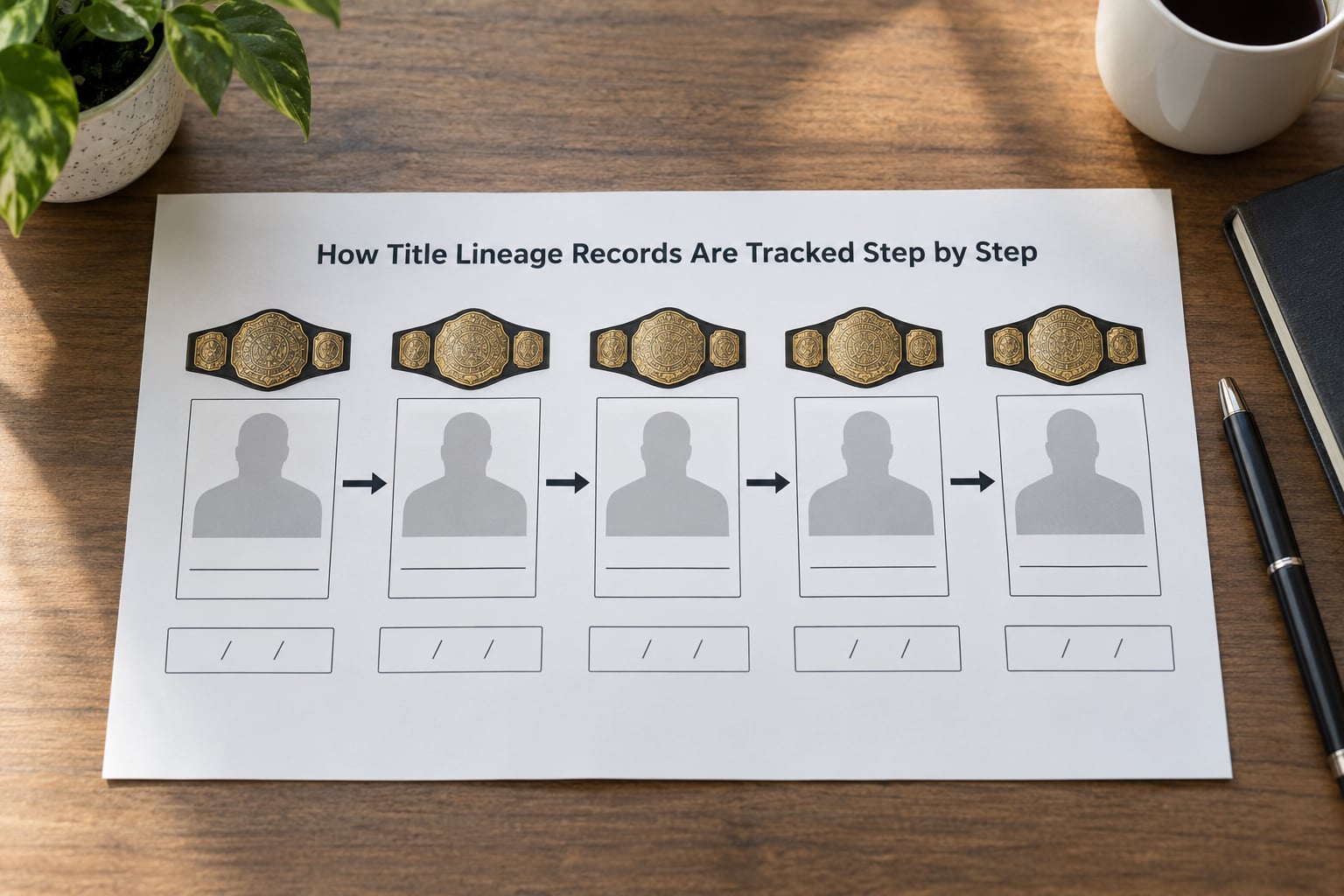
Every lineage, whether it is maintained by the promotion itself or compiled by an outside database, is built the same way. The work is less about collecting results and more about deciding what counts as one.
- Identify the championship being tracked. The name, the promotion, the weight division and the era all matter. A title that gets renamed mid-history can keep one lineage or split into two, and that choice has to be made before any reigns are added.
- Establish the origin point. Find the first recognized champion and the date it was first presented. For a unified belt, the origin is the older of the two lineages being merged, not the date of the unification match.
- Log each recognized title change in order. Champion in, champion out, one entry per change. The entry records who won, where, on what date, and the mechanism: a match, a tournament final, a stripped championship, a vacated title, or an angle handover.
- Date the change, not just the taping. Most promotions tape shows ahead and air them later, so a database may date a reign by the event date, the air date, or both. This is the single most common reason two databases show different reign lengths.
- Count the days. Reign length is measured from the win to the loss. Database editors often track two numbers — actual days held and days recognized by the promotion — because those diverge whenever a change is retroactively accepted, ignored, or overturned.
- Verify intervening reigns against primary sources. Official results pages, contemporary newspaper listings, published books, and post-event footage. An unsourced assertion from a forum post does not close a gap.
- Record the reason the reign ended. Injury, contract dispute, a scripted storyline loss, a tournament, a cash-in briefcase win, or a title stripped by the promotion. This note is what makes a lineage auditable months later.
How title lineage records are tracked for defunct promotions
When a promotion closes, the promotion is no longer around to confirm anything, and the chain becomes an archive problem. Editors fall back to tape, published books, newspaper reports and fan documentation, and they mark confidence levels where sources conflict. For territory wrestling especially, coverage is uneven by design: some regions have thorough archive work, others have long gaps that no amount of source-hunting closes.
The honest result is a lineage with visible gaps rather than a complete-looking table with invented middle rows.
What Information Does Each Reign Record Include?
Reign records are structured data, and the field list is remarkably consistent across databases. Knowing the fields is what lets you audit a claim: if a record is missing an event name or a location, the reign has not been properly verified.
| Field | What it captures | Why it matters |
|---|---|---|
| Champion | The recognized holder | Defines whose reign this is |
| Championship name | The title’s designation at that point in history | Shows renames and brand designations in order |
| Promotion | The organization controlling the belt | Explains a promotion changing its mind about a win |
| Win date | Date the change was won or awarded | Starts the day count |
| Recognition date | Date the promotion formally honored the change | Can be weeks or years after the win |
| Event and type | Show name and how the change happened | Separates a match win from a stripped title or an angle |
| Location | City, country or venue | Catches duplicated or misdated entries |
| Days held | Actual length of the reign | Feeds record leaderboards |
| Days recognized | Length the promotion officially counted | Explains why two sources disagree |
| Reign number | Ordinal position in the lineage | Prevents miscounting repeat winners |
| Notes | Reason the reign ended | Turns a data row into an explainable record |
Notice what is not in that table: the physical belt. A championship belt is a manufactured object that can be retired, replaced, or redesigned, sometimes years apart from the last title change. The lineage belongs to the title’s name and its chain of recognized holders, not to a piece of hardware.
Why Do Promotions and Record-Keepers Disagree?
Most disagreements come down to one question: who has the authority to say a title change happened? The answer is not always the promotion, and it has not always been the promotion.
Historically, state athletic commissions sanctioned championship matches and their decisions carried weight. Once commissions stopped sanctioning pro wrestling, that authority shifted entirely to the promotions themselves, which means a promotion can now accept or reject a change years after the fact.
| Scenario | How it is recorded | Why sources differ |
|---|---|---|
| Recognized change | Entered into the main lineage; previous reign closed | Only disagreement left is the date used |
| Disputed or unrecognized change | Logged as an unrecognized reign and excluded from the chain | The winning side may treat it as legitimate |
| Stripped championship | Reign ends without a match; chain pauses until a new champion is crowned | Some sources count the vacated reign, some do not |
| Renamed title | Usually one lineage with a new name from a given date | Some promotions start a fresh chain instead |
| Unified title | Both histories merged into one sequence, oldest first | Some editors keep two parallel tracks |
| Tournament champion | A single reign beginning at the final, not at the tournament announcement | Databases occasionally backdate to the bracket start |
The tape delay deserves its own note because it causes so much noise. A show taped on a Tuesday might air on the following Monday, and some promotions record results on the night of the taping while others record them after the segment airs. For a title change shown as a main-event angle, both dates are defensible, and they can differ by several weeks for anything taped far in advance.
Then there is the hard case: a wrestler who wins a championship match that is never acknowledged on television. Long-running arguments on wrestling forums and wiki talk pages circle exactly this scenario. The rule that most editors settle on is that the promotion’s decision governs, but the losing side rarely accepts it.
How Vacations, Tiers, and Renamed Championships Affect Lineage
A vacancy interrupts a lineage without ending it, and most records distinguish between the two. If a champion is stripped on a Monday and the title sits empty for three weeks, the day count usually stops at the stripping and resumes when a new champion is crowned.
Titles also sit at different tiers, and each tier can carry its own lineage. When a promotion splits a world title into two brand-specific championships, the promotion decides whether each new title inherits the combined history or starts clean. That single editorial decision changes every record number attached to the belt, which is why it’s worth looking for before you cite a reign total.
What unification does to a record
When two championships are unified, a title-versus-title match produces one champion holding two belts. Most record-keepers merge the histories rather than discard one: the older lineage is carried forward, the younger lineage is appended to it in date order, and the unification date becomes an ordinary entry in the combined sequence. Some fans read that as preserving history, others as diluting it, and both readings are legitimate opinions about an editorial convention.
| Lineage state | How the record is stored | What a reader sees |
|---|---|---|
| Before unification | Two separate chains, each with its own champions | Two independent reign lists and two record holders |
| Unification match | Both champions named in one entry | A single entry closing one chain and opening the other |
| After unification | One chain, oldest lineage first, both histories in date order | One combined reign list with shared record holders |
Renames usually work differently. When a promotion changes a title’s name without merging anything, editors most often keep one lineage and record the name change with a date range, so the history reads continuously across the rename. The name history itself is often stored as its own small table listing every designation and the dates it was in use.
How to Check a Lineage Claim for Yourself
You do not need access to anyone’s internal database to audit a claim. You need a source order and five checks. Most arguments about wrestling records die the moment someone checks the date column against a dated report.
- Confirm the title’s identity first. Same name, same promotion, same era? Two titles with identical names across different promotions or weight classes will give you completely different numbers, and plenty of bad arguments come from mixing them.
- Check the dates against a dated source. Look for a contemporary report with a publication date and find the event listing. If the air date and the event date differ, you now know why the reign lengths differ.
- Find out who recognized the change. Look for an official result, an announcement, or an on-air acknowledgment. A win with no acknowledgment is an unrecognized change, and it belongs outside the main chain under any sensible sourcing rule.
- Recount the days yourself. Count from the win date to the loss date, then compare with the published total. Discrepancies of a few days are almost always the date convention; discrepancies of months are usually a missing or misdated entry.
- Read the notes column. If a reign ended because of injury, a contract dispute, or a unification, that context explains most irregularities. A record with no notes is a record nobody has checked properly.
For source priority, a sensible order runs from the promotion’s own official results, to governing body or commission rulings where those exist, to contemporary newspaper and magazine coverage, to published books from reputable historians, and finally to fan databases and forum archives. Wikipedia sits in the middle as a well-cited secondary source that aggregates the first three categories; it is a reasonable starting point, but its own editors argue about recognition rules, so check the footnotes before you cite it.
No single database covers everything, and each has a different strength. Use them accordingly rather than picking a winner.
| Source | Best for | Watch out for |
|---|---|---|
| Wrestling-Titles.com | International and territorial histories, defunct promotions, date-stamped update logs | Coverage depth varies sharply by region |
| Cagematch.net | Large major-roster lineages with precise name-change date ranges | Independent promotions appear inconsistently |
| WrestlingData.com | Breadth of coverage and statistical breakdowns across many promotions | Reign lengths and recognition conventions vary by editor |
| Wrestling Profiles | Cross-referencing wrestler profiles, promotions, events and results | Lineage detail sits behind broader biography pages |
| Promotion websites | Whatever the promotion officially recognizes, including retroactive decisions | Promotional records can be revised or simply silent |
| Wrestling encyclopedias and books | Older eras where no online archive exists | Publication cutoff means recent reigns are missing |
The most common audit failure is not a wrong number. It is comparing a record from one database against a total from another without checking whether the two even count the same thing.
Frequently Asked Questions
What is title lineage in pro wrestling?
Title lineage is the ordered record of recognized champions for one championship, from its origin to the current holder, with each reign stored as one dated entry. It differs from a simple winners list because it records how each reign ended, whether the promotion recognized the change, and how many days it lasted. Records such as longest combined reign depend entirely on that chain being agreed on.
What makes a title reign recognized?
A reign is recognized when the promotion officially honors the champion who won the title, usually through an on-air acknowledgment, an announcement, or an official results listing. A win that was never acknowledged is logged as an unrecognized change and kept out of the main chain, even though the wrestler physically held the belt. Historically, athletic commissions made these rulings before promotions assumed full control.
Why do wrestling databases disagree about how long a reign was?
The usual cause is dating. Most shows are taped ahead and aired later, so one source may date a reign by the event while another dates it by the air date, and the gap can be several weeks. Other differences come from vacancy handling, retroactive recognition, and whether an unrecognized change is counted at all. Checking which convention a database uses resolves most disagreements.
What happens to title lineage when two championships are unified?
Most record-keepers merge the two histories into one sequence, carrying the older lineage forward and appending the younger lineage in date order, with the unification treated as an ordinary entry. Some editors instead keep two parallel tracks that share a branch point. Fans argue about which approach is right, since one preserves a shared history and the other keeps the two records distinct.
Which wrestling title history database should I trust?
No single source is best for everything. Wrestling-Titles.com is strongest on international and defunct promotions, Cagematch on major-roster lineages with precise name-change dates, and WrestlingData on breadth and statistics. Promotion websites tell you what the promotion officially recognizes, which can differ from any fan database. Check the date conventions a source uses before comparing two numbers.
Conclusion
Title lineage records are tracked one entry at a time: identify the championship, fix the origin, log every recognized change in date order, count the days, verify against primary sources, and write down why each reign ended. When a promotion disputes a change, a title is vacated, or two belts are merged, the same method decides whether the chain continues, pauses, or branches.
Before you quote a lineage record anywhere, check three things in order: the exact identity of the title, which body recognized the change, and the date convention the source used. Those three answers explain most arguments about wrestling records, and they take about two minutes to verify.