
A wrestling weight class is a published body weight limit that decides who a wrestler is eligible to face, while a division is the roster category a promotion files them under. In most American pro wrestling promotions there is no hard number on the scale at all — the label is usually a booking decision, not a measurement.
That distinction trips up new fans constantly. Someone gets billed as a heavyweight, gets worked over by a cruiserweight, and the comments section loses its mind. The short answer is that pro wrestling weight classes are mostly names with a loose expectation attached, while the strict, measured classes people picture belong to scholastic, collegiate and Olympic wrestling.
This guide covers how the modern pro wrestling system works, how divisions differ from weight classes, why promotions create them, and where WWE, AEW and TNA actually differ.
Table of Contents
- How Wrestling Weight Classes and Divisions Work
- Key terms you will hear on any wrestling show
- What Is a Weight Class in Pro Wrestling?
- How Divisions Differ From Weight Classes
- Common Wrestling Weight Classes and Division Examples
- Why Promotions Create Weight Classes
- How Weight Eligibility Is Usually Determined
- How Weight Classes Affect Match Making and Championships
- Wrestling Divisions Across Major Promotions
- Frequently Asked Questions
- What is a weight class in wrestling?
- Are wrestling weight classes the same in every promotion?
- What is the difference between cruiserweight and heavyweight?
- Can a wrestler move between divisions during their career?
- Do women’s wrestling divisions use the same classes as men’s?
- How do open weight championships work?
- Conclusion: Start With the Promotion’s Own Rules
How Wrestling Weight Classes and Divisions Work
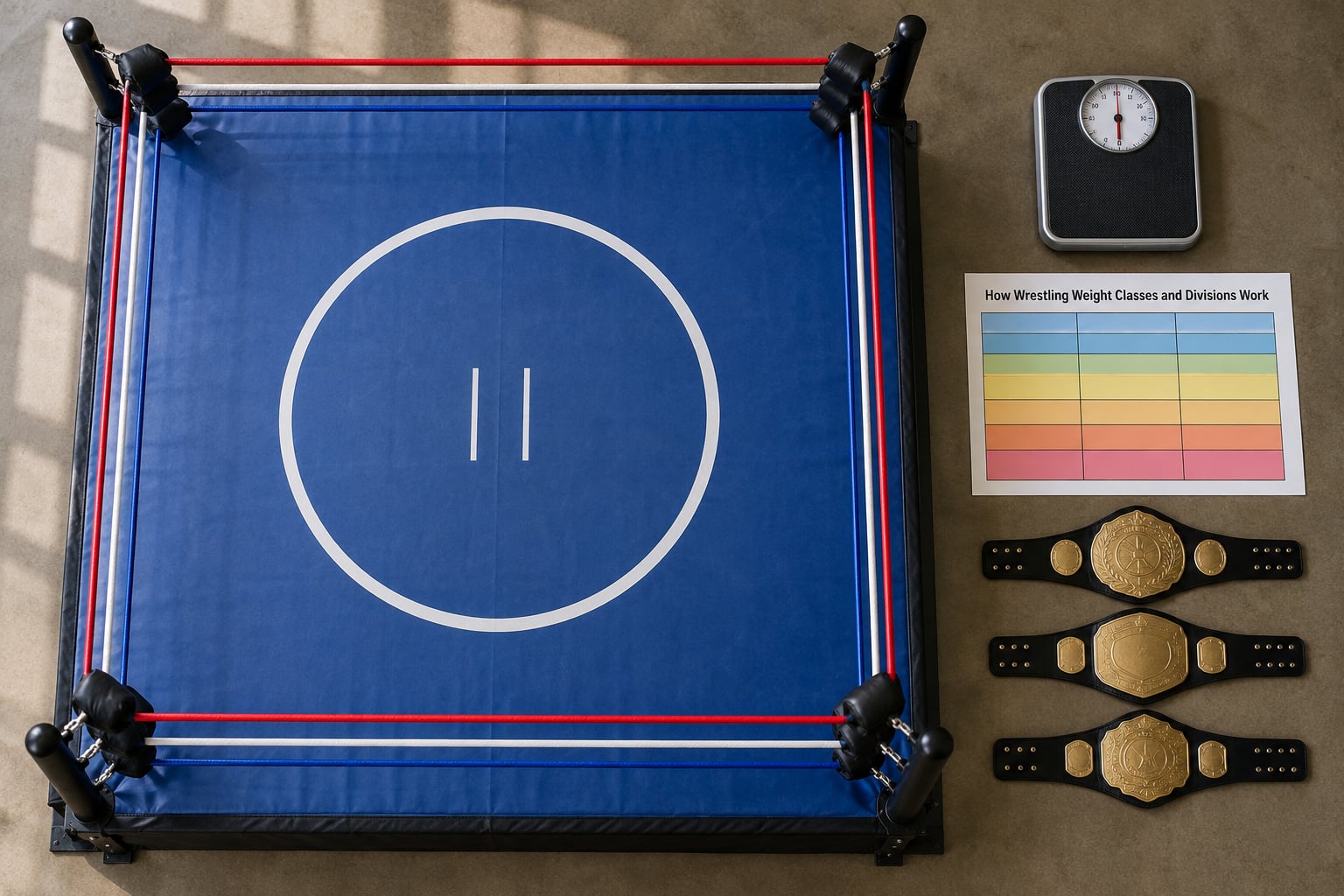
The system works in three layers: the promotion decides how many divisions it runs, each division gets titles and a spot on the card, and each wrestler is assigned to one of those divisions by the booker. Eligibility is almost never tested on a certified scale.
Think of it as an organizational chart rather than a measuring rule. A promotion announces its divisions, usually once a year or when the roster changes, and from that point every wrestler sits somewhere in the structure. Those labels then drive everything downstream: who gets a title shot, who appears on the poster, which names get paired together, and which championship a company decides to push.
Key terms you will hear on any wrestling show
- Division — the category a promotion puts a wrestler in, such as men’s, women’s, tag team or a size tier.
- Weight class — a named tier with an implied size, like cruiserweight or heavyweight.
- Open weight — a championship with no size tier attached to it, where anyone can be booked as a challenger.
- Title reign — a run with a championship, which is tracked separately from a wrestler’s division.
- Main event — the position a division’s top names occupy on a card.
None of those terms guarantees anything measurable. A promotion can call someone a heavyweight while the person genuinely weighs less than a wrestler labelled a cruiserweight, and the crowd will rarely question it.
What Is a Weight Class in Pro Wrestling?
A weight class in pro wrestling is a named eligibility range a promotion uses to sort its roster, and the limits attached to those names vary by organization. Some companies publish loose ceilings in writing. Most do not, and simply assign the label.
Being listed in a class tells you very little about a wrestler’s actual body weight. It tells you who the promotion wants you to be booked against, what division title you might contend for, and roughly where you sit on the card. The number people imagine — the wrestler stepping on a scale in front of an official — belongs to a different sport.
WrestleZone forum threads make the point constantly when fans debate whether a promotion could run strict divisions. The suggestion usually involves cutoffs like heavyweight starting around 206 pounds and cruiserweight sitting between roughly 186 and 205, which is a plausible ladder but not one any major American promotion enforces today.
How Divisions Differ From Weight Classes
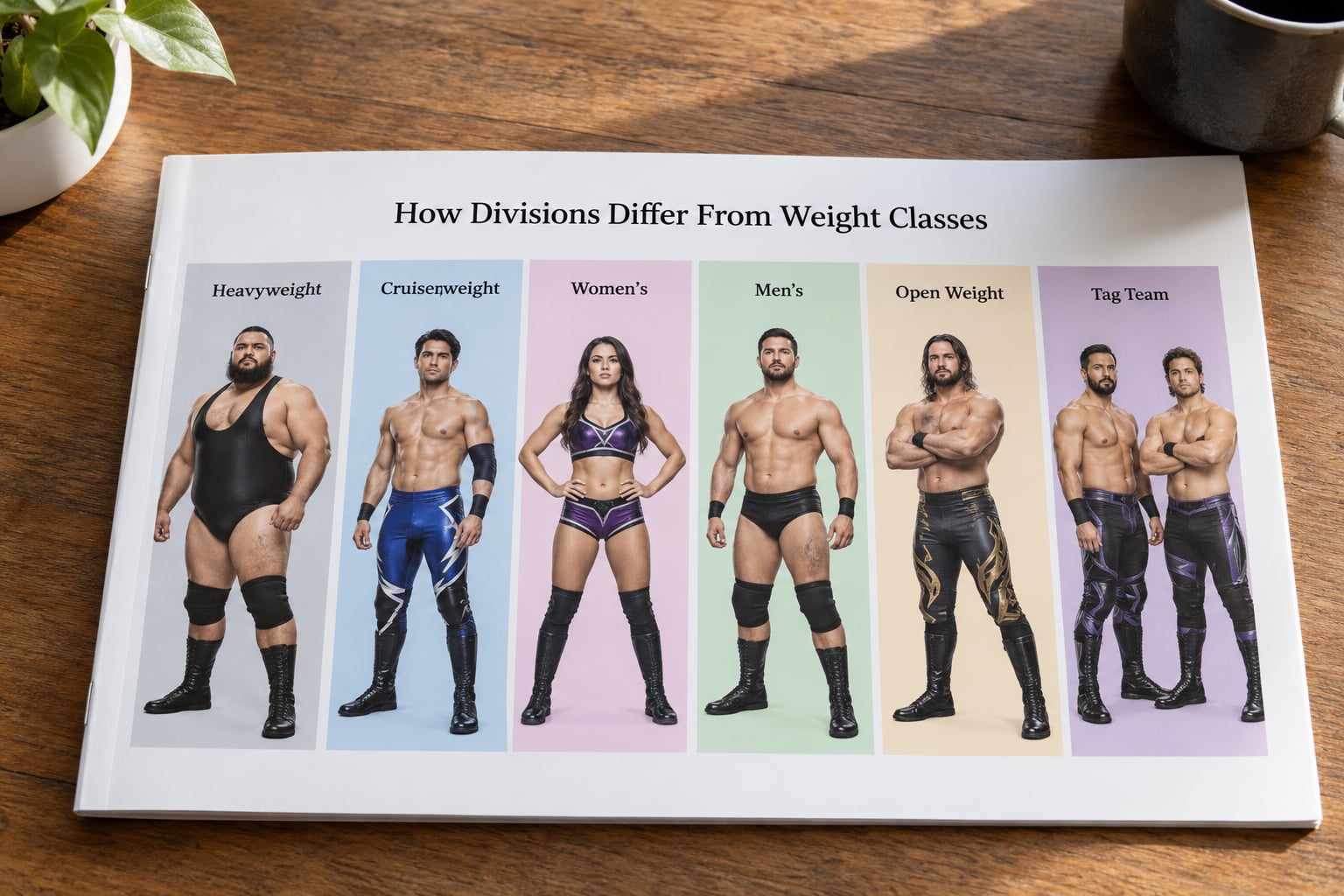
Divisions are categories the promotion assigns by contract or booking decision, while weight classes are supposed to be size ranges. In practice, the division decides the match, and the weight class is just the marketing label attached to it.
| Factor | Division | Weight class |
|---|---|---|
| What it is | Roster category | Named size tier |
| Who sets it | The promotion, by booking decision | The promotion, with no published limit at most companies |
| Basis | Gender, role, contract | Implied size |
| Title link | Each division gets its own championship | Some size tiers have a championship, some do not |
| Measured? | No | Rarely, and not on a public scale |
| Changes with | Roster shake-ups and brand strategy | Booking, injuries, and how a wrestler is presented |
Gender divisions are the clearest example of a category that has nothing to do with weight. A women’s division exists because of how the promotion builds its roster and audience, not because of any measurement. The same is true of tag team, which is a format rather than a size.
Common Wrestling Weight Classes and Division Examples
Heavyweight sits at the top of most rosters as the default main-event tier, cruiserweight is the standard working class, and light heavyweight is the middle band that changed a lot of programming over the last few years. Names and boundaries shift constantly, so treat them as promotion-specific rather than universal.
- Heavyweight — the top size tier and the usual home of the company’s headline championship.
- Cruiserweight — a middle working class, often the division where the fastest styles get showcased.
- Light heavyweight — historically a stretch, now in some promotions a booking label used for bigger names moving down a card.
- Men’s division — the gender category that carries most of the major single-wrestler titles.
- Women’s division — a separate gender category with its own championships and its own card placement.
- Open weight — a championship with no tier attached, so a division-crossing matchup can be booked for it.
- Tag team — a format division where size is rarely discussed at all.
The men’s and women’s labels are the only two most fans treat as genuinely fixed, and even those get blurred in open-weight stipulation matches or cross-promotional bookings.
Why Promotions Create Weight Classes
Promotions create weight classes to keep opponents physically comparable, protect talent from avoidable injury, and make a title feel like the top prize in its own bracket. Booking a 250-pound wrestler against a 165-pound wrestler every month is a bad idea for everyone involved.
There is a storytelling reason too. When a title exists inside a division, a loss means something specific — somebody failed to beat the champion of that class rather than the champion in general. It gives cards a clean structure: one or two matches per division, each with a clear stakes attached.
Size tiers also help develop wrestlers. A smaller wrestler moving into a lighter class gets longer matches and more main-event chances, which is how you build someone up over a few years. The trade-off is that the label is set by the promotion’s needs more than by the athlete’s body.
How Weight Eligibility Is Usually Determined
Eligibility is usually determined by published maximums where they exist, official weigh-ins, contract terms, medical or roster decisions, or plain informal classification. Which method applies depends entirely on the organization and the sport you are watching.
Take the difference between the two ecosystems. In scholastic wrestling under NFHS rules, an athlete steps on a certified scale at the weigh-in, gets a two-pound allowance for underwear, and weighs back in afterward to confirm they did not climb back over the limit. The full class ladder runs from 103 pounds to 285. In pro wrestling, none of that machinery exists — a company will occasionally reference a number in a contract, but the label comes from the booker.
Read forums and you will find wrestlers describing strict weigh-ins and frantic last-minute cuts on the independent scene, where a trainer’s show may run actual weight rules to make a division meaningful. Those situations are promotion-specific and rarely carry over to a televised company.
Whichever method applies, the rulebook is the only place that settles a dispute. Check the governing body’s current rules rather than trusting a wiki page that was last edited three years ago.
How Weight Classes Affect Match Making and Championships
Weight classes shape match making by limiting who can be booked against each other inside a division, which in turn decides title tournaments, contender rankings and card order. A new hire usually starts at the bottom of one division and works upward.
Nobody is permanently locked to a class. Promotions move wrestlers up when they grow, when a division needs a new lead, or when a bigger star joins and reshapes the order. The move is common, and the reaction from fans is rarely positive — losing a size edge is the most common complaint wrestlers hear after a promotion changes their division.
Championships follow the same logic. When a company introduces an open-weight championship, it is explicitly telling you that division lines no longer apply to that particular belt. That single change reshapes contender rankings across the entire card.
Wrestling Divisions Across Major Promotions
The three biggest American promotions all run men’s, women’s and tag team divisions, and none of them enforce a measured body weight limit. The differences show up in how they label the middle of their rosters and which championships stay attached to a size tier.
| Promotion | Men’s divisions | Women’s divisions | Tag team | Open weight title? |
|---|---|---|---|---|
| WWE | Uses brand-to-brand groupings more than size tiers; cruiserweight and light heavyweight have shifted meaning repeatedly | Three separate championships by brand rather than by size | Championships on both brands | Yes, brand-specific and physically unrestricted |
| AEW | More explicit size labels early on, with divisions that have shifted as the roster grew | One primary division plus a secondary women’s title | One championship | Yes, including a tournament structure |
| TNA | Runs size-based labels more consistently, anchored around a top division and a cruiserweight-style group | One women’s championship | One championship | Varies by era; treat any claim as date-specific |
Indie promotions run the whole spectrum. Some work with strict size contracts and actual weigh-ins, especially in promotions that lean toward shoot-style or Japanese-influenced booking. Others publish no structure at all and simply book whoever is available that month.
Frequently Asked Questions
What is a weight class in wrestling?
A wrestling weight class is a named body weight limit that determines which opponents a wrestler is eligible to face, so matches are decided by technique and conditioning rather than size. In scholastic and Olympic wrestling the limit is measured on a certified scale. In most American pro wrestling promotions the label is assigned by the booker instead of measured.
Are wrestling weight classes the same in every promotion?
No. Each organization sets its own structure, and the boundaries shift with the roster. A title that exists as one promotion’s cruiserweight championship may sit inside a differently named division elsewhere, and some promotions publish no limits at all. Check the current listing from the promotion before relying on any class name.
What is the difference between cruiserweight and heavyweight?
It is a difference of expectation rather than measurement. Heavyweight is normally the top tier where a company’s main event and top championship sit, while cruiserweight is the working class above the lightest divisions. The boundary between them has moved repeatedly, and neither label guarantees a specific body weight on any major American promotion.
Can a wrestler move between divisions during their career?
Yes, and it happens often. Promotions shift wrestlers when the roster changes, when a division needs a new top name, or when a bigger star arrives. Most moves happen early in a career. The most common complaint after a move is losing a size edge, which changes how a wrestler has to build matches.
Do women’s wrestling divisions use the same classes as men’s?
The divisions are separate by gender rather than by size, and each one has its own championships. Most promotions run one or more women’s titles instead of splitting them into size tiers, which means a women’s champion is not restricted by a measured limit the way a scholastic or Olympic weight class would be.
How do open weight championships work?
An open weight championship carries no size tier attached to it, so a challenger from any division can be booked against the champion. That is what makes cross-division matches for the belt possible. As of 2026, check the promotion’s own listings before assuming a title’s status, since division names and structures get restructured often.
Conclusion: Start With the Promotion’s Own Rules
Before you argue about whether somebody is too big for their division, name the promotion and the division first. Then check that promotion’s current rules and roster listings, because that is the only source that settles it.
Once you know which system you are looking at, the rest is easy. A weight class is a limit, a division is a category, and in pro wrestling the category usually wins. That one habit will stop you from walking into an argument you cannot win.