An Iron Man match is a multiple-fall match with a set time limit, usually 30 or 60 minutes. The winner is the wrestler who scores the most falls before the clock runs out, with each fall earned by pinfall, submission, disqualification, countout or knockout.
That is the whole rulebook on paper. The interesting part is how much the clock changes the way a match is actually built, and why fans who love the format and fans who call it the worst stipulation in wrestling are often describing the same hour.
Table of Contents
- How Iron Man Matches Are Structured at a Glance
- How many wrestlers and falls are used in an Iron Man match?
- Are all WWE Iron Man matches structured the same way?
- How does round-robin scoring decide an Iron Man match?
- How do pinfalls and submissions count?
- Can a wrestler be eliminated during an Iron Man match?
- What happens when an Iron Man match reaches the time limit?
- How do disqualifications and count-outs affect the result?
- What strategy do wrestlers use to win an Iron Man match?
- Frequently Asked Questions
- Do all WWE Iron Man matches have three wrestlers?
- Can an Iron Man match end on a draw?
- Does a disqualification automatically lose an Iron Man match?
- Why do wrestlers target the same competitor during overtime?
- How long is a standard WWE Iron Man match?
- Conclusion
How Iron Man Matches Are Structured at a Glance
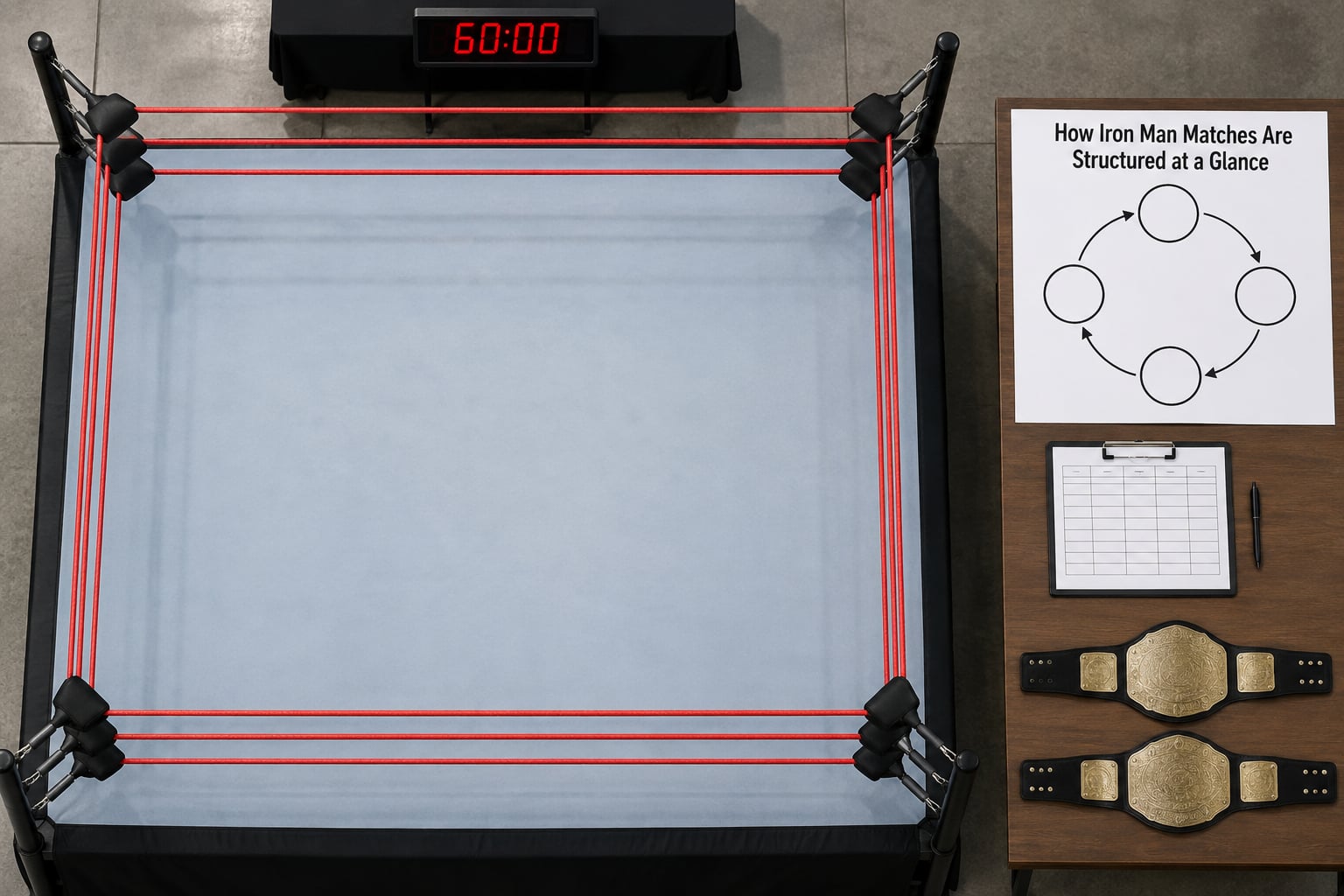
Every Iron Man match shares the same skeleton: a scoreboard, a clock, and a number of falls one wrestler needs to win. Here is the standard setup before any booking quirks get involved.
| Element | Standard setup |
|---|---|
| Competitors | Two, or three in a round-robin version |
| Fall target | First to two falls in two-man matches, first to three in three-man matches |
| Ways to score a fall | Pinfall, submission, disqualification, countout or knockout |
| Time limit | 30 or 60 minutes, announced when the match is set up |
| Elimination | Possible in three-man matches once a wrestler is two falls behind the combined opposition |
| At the bell | Highest score wins; a tie sends the match to sudden death overtime |
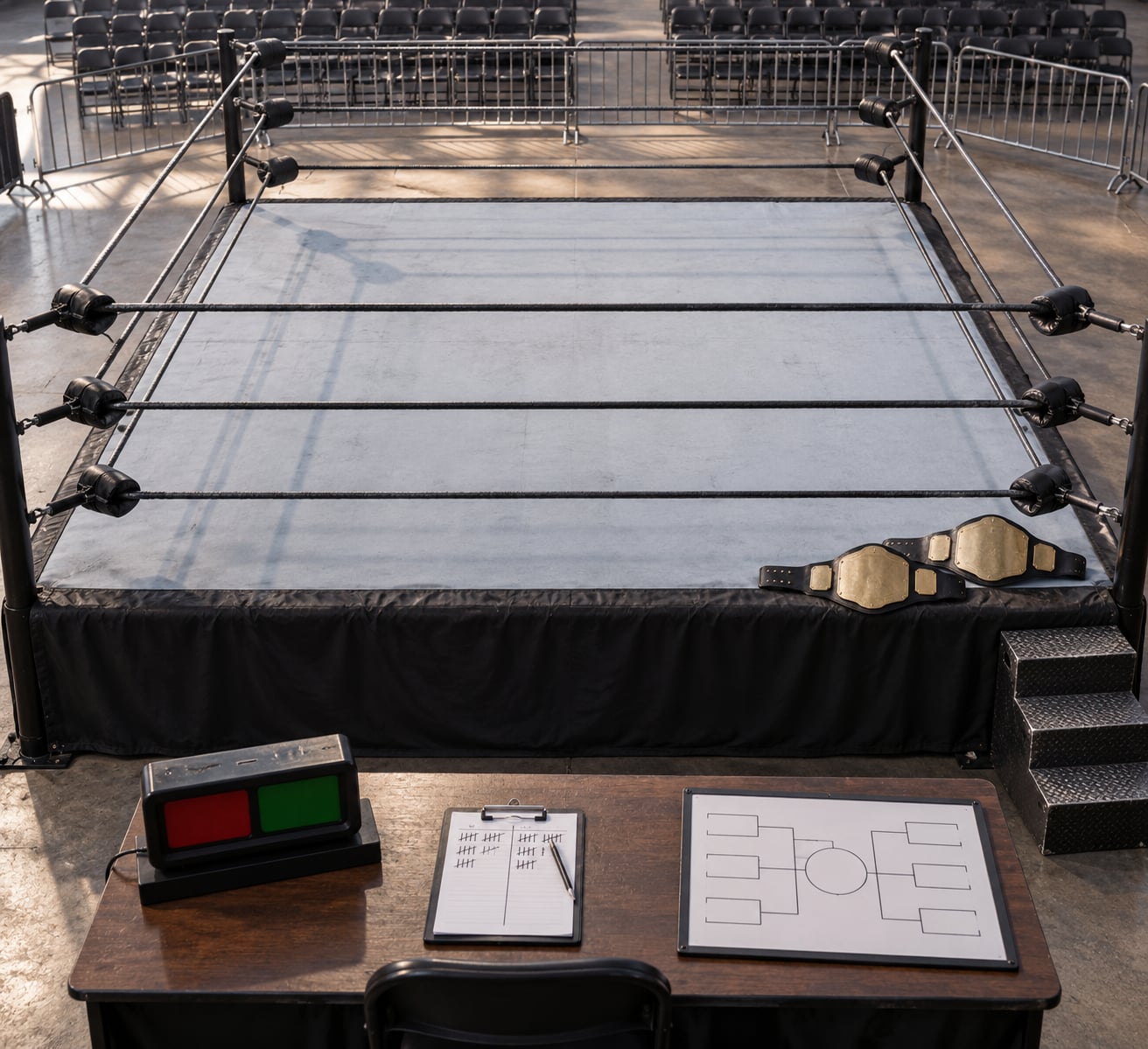
A timekeeper sits at ringside with the board for the whole match, and every fall gets marked on it in front of the crowd. That board is the reason the match exists. Without a visible score, an Iron Man match would just be a very long match.
How many wrestlers and falls are used in an Iron Man match?
Two wrestlers face each other under first-to-two falls with a time limit, and three wrestlers use a first-to-three format with a scheduled round robin.
The two-man version is the older and simpler one. Each fall is scored directly against the opponent, the score is simply a running tally of pinfalls and submissions, and the match can end before the time limit is reached if one man reaches two first.
The three-man version works as a round robin. Wrestler A faces Wrestler B, then B faces C, then C faces A, and each of those scheduled bouts can hand out a fall. The fall still goes on the scoreboard, but it is credited as a point in the tournament rather than a permanent gap in someone’s record.
Are all WWE Iron Man matches structured the same way?
No. Every Iron Man match is set up with its own parameters announced beforehand, and those parameters are the rules.
The number of competitors, the time limit, the number of falls needed, whether disqualification loses the match, and what happens at the bell are all fixed in advance. A 30-minute match with no-disqualification rules can be announced on one show and a 60-minute fall-count match on the next, and both are legitimate Iron Man matches.
Short-form variants exist too. Independent and regional shows frequently run five-fall or thirty-minute versions, and outside WWE in 2026 the format lives mostly in that compressed form, where the clock is tight enough that nobody has time to hide.
How does round-robin scoring decide an Iron Man match?
In a three-man match, each wrestler faces every opponent once, and each scheduled bout produces one point for the winner.
The mechanics matter more than they sound. A wrestler who loses their opening bout can still win the match by taking both of their remaining ones, which is why a trailing competitor often goes all-out early instead of pacing themselves. A wrestler who wins the first two bouts has banked the points they need and can coast through the rest of the card.
Because points come from opponents as well as from direct wins, the standings can shift without anyone being pinned twice. A wrestler sitting on one point who loses their next scheduled bout can drop behind the pair tied above them, even though neither of those two wrestlers has done anything to them.
How do pinfalls and submissions count?
A wrestler earns a fall, or a point, by making the opponent submit, count them out, be knocked out, or pin them.
Count-outs and disqualifications complicate the math in three-man matches, since one wrestler cheating on a third changes the standings for two people at once. Booking usually handles that by having the cheating fall count against the cheater’s opponent, who now has a point they did not earn on their own.
There is also no such thing as a near fall here. A two-count is not a partial fall, so the one-count kickouts that carry an ordinary match lose some of their charge. That is the single most common structural complaint about the format, and it comes up every time.
Can a wrestler be eliminated during an Iron Man match?
Yes, in three-man matches, and elimination and losing a bout are two different things.
Losing a scheduled bout in a round robin costs you a point. It does not remove you from the match, and it does not end your night. Elimination is a separate mechanism, used when a wrestler has fallen too far behind to win on points and the remaining competitors agree, or when the match is booked to reward a clear standout.
The usual threshold is two falls. In a first-to-three match, a wrestler on zero who gets taken down twice, or who falls two points behind the field after their bouts, can be out of the contest entirely, which effectively converts the round robin into a one-on-one match.
WrestleMania XII is the example everyone remembers for the time limit rather than elimination. Bret Hart and Shawn Michaels were tied at nothing when the hour expired, went to sudden death overtime, and Michaels finally pinned Hart for the fall.
What happens when an Iron Man match reaches the time limit?
If the scores are level when the bell rings, the match goes to sudden death overtime and the next fall wins it.
Some bookings announce extra periods of five minutes a pop instead, with the bell coming back and the fall needing to happen within them. The two approaches exist side by side. Sudden death is cleaner on the board, while timed extra periods give the match a visible countdown and usually produce a more frantic finish.
The 60-minute bell is not a mercy bell either. When it rings with one wrestler ahead, the match is over on the scoreboard, and the wrestler with fewer falls simply loses. That is the part that unsettles people who expect a wrestling match to end with a bell and a pin.
Most wrestlers do not force overtime. A draw at the bell means no title changes hands, so the incentive is to win before the time expires rather than gamble on a period nobody has trained for.
How do disqualifications and count-outs affect the result?
Under standard Iron Man rules a disqualification is a fall for the other wrestler, not an automatic loss.
No-disqualification variants flip that. Announce no disqualification before the match and the usual list of fouls is gone, so weapons, outside interference and eye rakes become legal tactics rather than fall-winning crimes. The same wrestling suddenly looks very different, because cheating stops being a strategy and becomes the strategy.
Count-outs follow standard count-out rules, but they carry extra weight here. A wrestler who cannot reach the ring has to beat the count before it reaches ten, and in a long match the ability to even get back to the ropes is the first thing exhaustion takes away. In a three-man match a count-out can hand a point to someone who was not even part of the finish.
The announcement always wins. If a promotion sells a match as no-disqualification Iron Man, no amount of refereeing convention overrides it.
What strategy do wrestlers use to win an Iron Man match?
The dominant strategy is fall math: work out how many falls you need, when the clock runs out, and how much you can afford to lose before the scoreboard turns.
In a 60-minute match the answer is usually three falls for each man, and the arithmetic is tight. Two falls in the first twenty minutes puts a wrestler in a commanding position but burns the material he needs later. Falling behind early forces a total change of approach, because there is no way to catch up with a safe match.
Body-part targeting is the pacing device that keeps an hour alive. Attack one limb for ten minutes, then switch, and you get something to look at while both men pretend to be fresh. MJF versus Bryan Danielson at AEW Revolution 2026 is the modern version of this: MJF worked the shoulder, Danielson went after the knee, and the escalation was what filled the hour rather than the fall count.
Protecting finishers is the other half. A finisher used in minute ten means very little, so the good Iron Man matches ration the payoff spots to the closing stretch, and a wrestler who blows through a near-fall sequence in the first act has already spent the drama.
The turnaround usually comes late. A three-man match where one wrestler loses the first two scheduled bouts leaves him no safe path, so the last bout goes to a length nobody could have predicted. Bad strategy turns into the best wrestling a format can produce, which is the whole argument in favour of putting a clock on it.
Critics make the opposite argument. JBL called the format horrible on a podcast and said the ideal hour-long match would have three or five decisions at most, which is a complaint about dead zones rather than about the rule itself. Plenty of fans agree, and Triple H versus The Rock at Judgment Day 2000 is still treated as the template every later Iron Man match is measured against.
The honest summary is that the format weakens near falls and drains finisher mystique, and it does that on purpose. For a match built around a scoreboard, that trade is worth it. Outside of the very best performers, it often is not.
Frequently Asked Questions
Do all WWE Iron Man matches have three wrestlers?
No. Most WWE Iron Man matches are two-man affairs decided by first to two falls within a set time limit. Three-man versions use a round-robin format, usually first to three points, where each wrestler faces both opponents once. Three-man matches are the exception rather than the default, so do not assume a scheduled bout structure when you see the stipulation announced.
Can an Iron Man match end on a draw?
Not officially. If the scores are level when the time limit expires, the match goes to sudden death overtime or announced extra periods instead, and the next fall decides the winner. Bret Hart versus Shawn Michaels at WrestleMania XII ended level at 0-0 after an hour and had to be finished in overtime. An undecided result is avoided so that titles always change hands.
Does a disqualification automatically lose an Iron Man match?
It depends on the announcement. Under standard Iron Man rules, a disqualification counts as one fall for the other wrestler. If the match is advertised as no-disqualification, the usual list of fouls is removed and cheating becomes legal. That single line in the match announcement is the difference between a rules match and a cheating match, and it changes how the whole hour is worked.
Why do wrestlers target the same competitor during overtime?
Because in a round-robin format, one opponent can decide the result on their own. After a tie, the remaining fall has to come from a specific scheduled bout, so the wrestler who needs it and the wrestler defending it both know exactly who is being hunted. That makes overtime the most focused and most vicious part of an otherwise sprawling match, and the fastest way to a finish.
How long is a standard WWE Iron Man match?
Usually 60 minutes for a main-event showcase, or 30 minutes for a television or Grudge Classic specialty match. The limit is announced when the match is set up and can vary by promotion and card position. WWE has not built its yearly championship picture around full-hour Iron Man matches in recent years, though the format still turns up on independent shows, often in shorter five-fall versions.
Conclusion
An Iron Man match is a multiple-fall match with a set time limit where the most falls wins, and every element of it, from the scoreboard to overtime, exists to serve that one idea.
When you watch one, check four things first: how many wrestlers are in it, how many falls are needed, whether it uses round-robin scoring or straight fall counting, and what happens when the bell rings. Once you know those, the pacing stops looking like padding and starts looking like a plan.