Calling a match on the fly means two wrestlers agreeing on each move seconds before it happens, in the ring, using short verbal cues, body language, rest holds and the referee. They are not running a memorised script. They are working from rehearsed building blocks and filling in the middle live, in front of a crowd, with one take and no second chances.
Wrestling fans ask this question constantly, usually right after a match ends and nobody can explain what just happened. The short answer is that nothing is improvised from scratch, and nothing is fully locked in either. Most of the match was agreed, and the connective tissue was decided in the seconds before it happened.
The rest of this guide breaks down how that works: the six channels a wrestler uses to communicate, how the story is tracked in real time, what makes a called spot look believable on television, and what happens when the plan falls apart mid-ring. If you are new to the craft, there is a practice section as well, because this is a trainable skill rather than raw talent.

Table of Contents
- What Does Calling a Match on the Fly Mean?
- The six channels wrestlers use to call a match
- How Wrestlers Track the Story in Real Time
- How a Wrestler Calls a Match on the Fly in Real Time
- How Communication and Chemistry Make It Work
- What Makes a Called Spot Look Believable?
- How Do Wrestlers Adapt When Something Goes Wrong?
- Five mistakes wrestlers make when calling on the fly
- How beginners can practise calling matches
- Frequently Asked Questions
- What does it mean when a wrestler calls a match on the fly?
- Are professional wrestling matches completely spontaneous?
- How do wrestlers communicate during a match?
- What should a wrestler do if a planned spot fails?
- How can a beginner practise calling matches?
- What is wrestling psychology, and how does calling connect to it?
- Conclusion
What Does Calling a Match on the Fly Mean?
Two different things get called “calling” in wrestling, and most fan arguments come from mixing them up. Calling a spot is a single decision, one move announced in a three-second window. Calling a match is the whole thing: pacing, psychology, the shape of the story, and deciding in real time which spot serves it next.
The industry phrase for the live version is “calling it in the ring.” A wrestler builds an outline before the match, usually the opening exchange, the comeback, the big near-fall, and the finish. The middle is deliberately left loose, because a fixed script cannot respond to a crowd that is louder than expected or to an opponent who sells differently than planned.
This was not always the norm. Older territory wrestling called far more on the fly, and a wrestler who could not work that way would not have lasted long. Modern mainstream wrestling is more heavily rehearsed and more tightly produced, so there are more pre-agreed beats, but the live layer has not disappeared. Anyone who watches a main event knows exactly when the finish is being cued.
The six channels wrestlers use to call a match
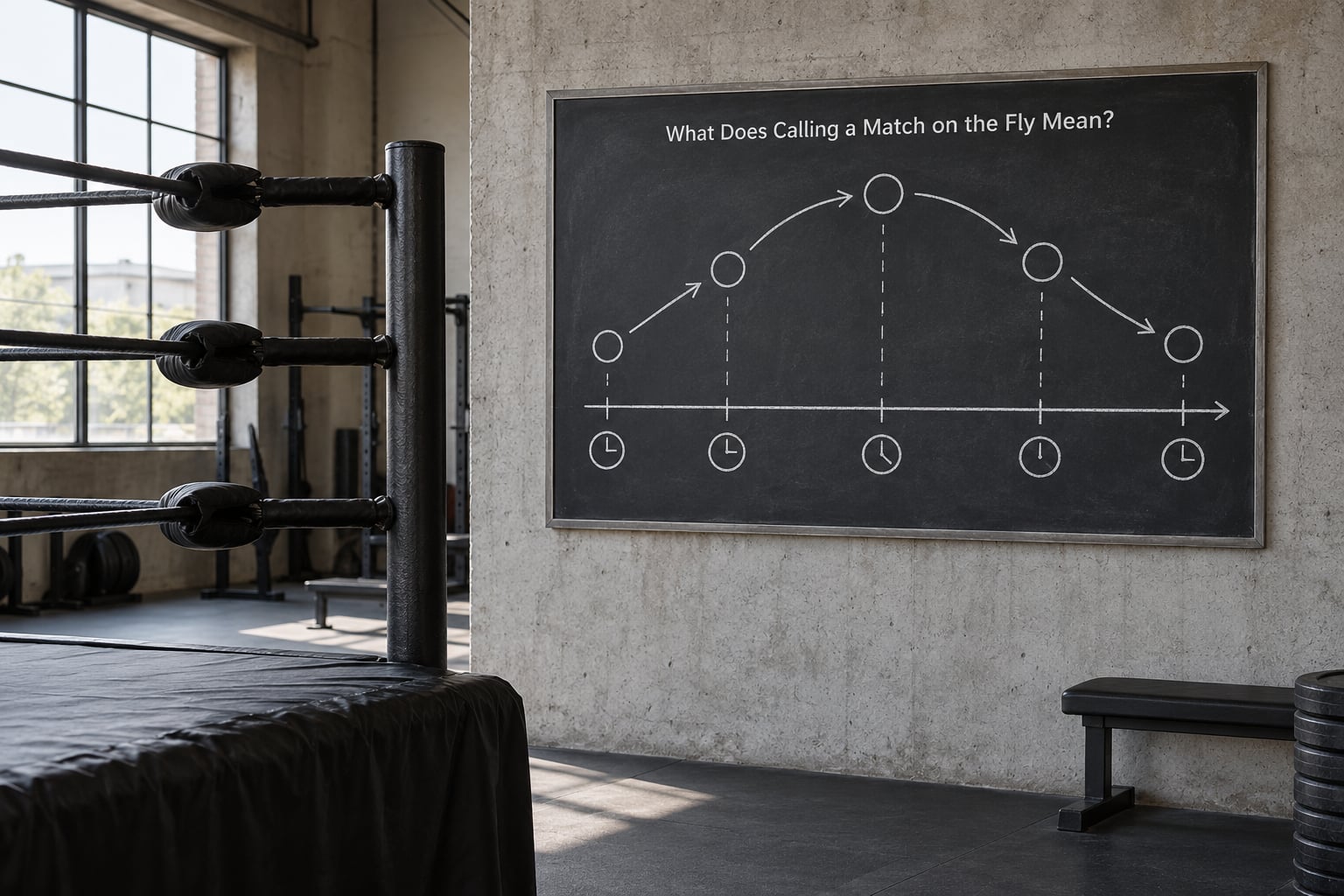
Every cue travels through one of six channels. Most real communication uses two or three at once, which is why a live exchange can look like two people having a quiet conversation in the middle of a fight.
- Verbal shorthand. Short imperatives said into the opponent’s ear or near the mat. “Hold on.” “Kick me.” “Sit up.” “Neckbreaker.” “You okay?” Two words is a full sentence.
- Body language and eye contact. A held head position that means stay, a shoulder that says go, a look at the corner that means the turn is coming. This is the primary channel when the two wrestlers do not share a language.
- Touch cues. Hand placement does most of the work. Where a wrestler puts a palm tells the other what the next transition is, and a squeeze on an arm before a whip signals the direction.
- The rest hold. A side headlock or armbar held with no apparent purpose. It buys time, it lets both wrestlers breathe, and it is the closest thing wrestling has to a meeting room.
- The referee. Refs pass along time warnings, outside interference, and count pressure, and they relay instructions from ringside without the wrestlers having to break character.
- The producer. On bigger shows the producer can speak into the referee’s headset and from there into the ring. It is how a match gets extended, or cut short, without a visible timekeeper signal.
Fan forums get this right more often than the mainstream write-ups do. On r/SquaredCircle threads about in-ring communication, the recurring answer is that most talk happens inside rest holds and face locks, and that the sequences themselves are usually already agreed. The talk is not inventing the match. It is sequencing what both people already know.
How Wrestlers Track the Story in Real Time
A wrestler calling a match is running five inputs at once, and the reason it looks effortless on television is that only one of them gets attention.
The first is the story beat. Before the bell, the assigned story has turning points, and a called spot is either serving the current beat or cutting straight to the next one. When a heel has just taken the beating they were supposed to take, the comeback spot can be brought forward and something else dropped.
The second is the crowd. A rising pop is an argument for staying in the current sequence, because the audience has already decided what they want. A sudden silence or a visible restlessness says the match needs a change of pace, usually something bigger or faster.
The third is the opponent’s condition. Rookie partners sell differently from veterans, and a wrestler who notices a partner protecting a shoulder mid-exchange will change the next spot rather than push through it. Fourth is the clock. Television time limits have tightened over the years, so fewer spots fit into the same segment, which forces more improvisation, not less.
The fifth is the next moment that has to land. Every match has one or two spots that the finish is built on. If those are still ahead, the calling shifts toward setting them up. If they have already happened, the wrestler is now inventing an ending.
How a Wrestler Calls a Match on the Fly in Real Time
The decision itself follows a short loop, and it runs several times per minute in a busy match.
Observe. Read the position, the partner’s body, the crowd volume and the referee’s signals.
Interpret. Decide what it all means. Is the partner slow because of injury, nerves, or because the crowd just went quiet?
Choose. Pick the spot that fits the story beat and is safe from where everyone is standing right now. There is no point calling a beautiful spot from a position that cannot support it.
Communicate. Say the cue, show the cue, or buy a rest hold if the cue did not land. Repeat it louder or from a different angle the second time.
Assess. Watch how it was received. If the crowd popped, hold that pace. If nothing happened, cut the sequence short and move on rather than trying to fix it.
That last step is the one people skip. A wrestler who keeps pushing a sequence that has already died looks like they have run out of ideas, while one who moves on keeps the match moving and nobody notices the seam.
How Communication and Chemistry Make It Work
Calling well is mostly chemistry, and chemistry comes from repetition. Two wrestlers who work together weekly share timing that outsiders cannot see, which is why some partnerships can run a chaotic match and it still reads as clean.
The rest hold is where most of that conversation happens. A side headlock held for eight seconds looks like nothing to a casual viewer, and it is often the moment where the next two or three spots get agreed. Both wrestlers get a breather, the pace resets, and the sequence is laid out. It is a legitimate rest hold as a protection of the neck, not just a stalling tactic, and both reasons are usually true at once.
Verbal cues stay short because breath is short. Wrestlers have said things like “you gotta hit me with the tombstone,” “Cena first and the RVD,” “elbow,” and “stay down” on camera, all of them in the context of a fixed spot rather than a whole match. The vocabulary is small on purpose and rehearsed until it stops requiring thought.
Veteran and rookie etiquette matters here. A good veteran gives a newcomer something to do and lets them succeed, which usually means calling the same basic spot repeatedly rather than escalating into something the rookie cannot handle yet. Fans notice the opposite behaviour immediately and rarely forgive it, and the rookie pays for it in the ring rather than in the review.
Cross-language cards push all of this further. On promotions working in Japan, Mexico, or on multi-country cards in the United States, the verbal channel shrinks to almost nothing, and touch cues, eye contact and the referee carry the match. r/SquaredCircle threads about non-verbal communication keep circling the same problem: how do you pass information when your partner’s vocabulary is not your vocabulary? The answer is that the pair agrees on a small personal dictionary beforehand, and the referee becomes the fallback.
One more channel sits outside the ring. Backstage and at ringside, partners feed notes between matches, and a wrestler who notices something in week one changes it in month two. Calling a match on the fly is the visible half of a process that mostly happens in rooms nobody sees.
What Makes a Called Spot Look Believable?
Any wrestler can call a move. The difference between a good match and a bad one is whether the called spot makes sense to someone watching for the first time.
Setup comes first. A spot pays off because of what happened before it, and the previous sequence has to plant it. Escalation means the next spot is bigger than the last one, or at least different in kind, so the match keeps climbing. A match that repeats the same exchange four times reads as a loop, no matter how good the moves are.
Selling is the part most newcomers underestimate. After a called spot lands, both wrestlers react, and the reaction is what the camera and the crowd actually buy. A wrestler who hits a spot and then immediately gets back to their feet has told the audience the spot did not matter, and the crowd will agree with them.
The crowd is an input, not just an audience. When a sequence gets a real pop, a wrestler will usually stay inside it for another beat, and when it does not, the smart move is to move on quickly. That is not artistic failure. It is a live read.
When the planned move cannot be done, a believable substitute does the same job. A rope-assisted spot that will not hit correctly in this building gets replaced with a cleaner, safer version that tells the same story, rather than being attempted anyway. On television the audience never learns what the original was.
Documented on-camera moments show how natural this looks when it works. Batista telling The Undertaker he needed the Tombstone at Bragging Rights, John Cena cueing an elbow with Sheamus in a steel cage at Money in the Bank, Chris Jericho calling a neckbreaker and asking RVD to slow down at Survivor Series 2001, Shawn Michaels telling Ric Flair to stay down at WrestleMania 24. Fans have compiled these for years. What they reveal is not chaos, it is two people confirming a spot they had both already agreed on.
How Do Wrestlers Adapt When Something Goes Wrong?
Something goes wrong in most matches. The question is only whether the wrestlers have a next move ready.
A missed reaction is the most common problem. The partner was supposed to fall and does not fully sell it, and the sequence now has a beat that landed flat. Usually the fix is speed: the calling wrestler compresses the next two spots into one, so the crowd remembers a fast exchange instead of a pause.
A botch is harder. If a spot lands wrong, the wrestler who called it usually takes the reaction himself, turns it into an injury or a shock, and buys the other person time to reset. Covering for each other is the entire reason trust makes calling work at all.
When someone is hurt, safety outranks story. The match slows, the moves get simpler, and the finish happens early. A wrestler who needs a tag in a singles match, or who is clearly favouring an arm, will have the sequence cut rather than push through, and the other wrestler will sell a legitimate victory rather than make it look cheap.
Crowd shifts and time limits are the easier problems. A match that is getting too long gets a bigger spot and a faster finish, and one that is dying gets a change of pace. Production decides how much time is left, and the wrestlers get that information through the referee.
Five mistakes wrestlers make when calling on the fly
- Calling too loudly near the hard camera. The single most recognisable mistake. If you can hear the cue on the broadcast, the audience hears it too, and the moment gets clipped and discussed for years.
- Breaking character to talk. A wrestler who suddenly uses flat, everyday phrasing in the middle of a dramatic exchange gives the kayfabe away in a single sentence.
- Skipping the sell after the called spot. The spot is not the payoff, the reaction to the spot is.
- Repeating a sequence that already failed. Trying the same exchange a second time in the hope it lands harder rarely works.
- Refusing to follow a called spot. If a veteran calls something, refusing it in front of a crowd exposes both wrestlers, and the veteran looks the worse of the two.
How beginners can practise calling matches
Nobody learns this by watching. It comes out of training school sessions and short indie runs where the reps come fast.
Start with rest holds. Hold a headlock for a full minute and talk through a sequence with your training partner, then repeat the same sequence ten times until the words disappear and only the positions remain. That repetition is what makes it survive a live crowd.
Then go non-verbal. Run a five-minute match with no talking allowed and only touch cues and eye contact. It is awkward for the first two sessions and then it becomes faster than talking, because the hand signal does not need to be deciphered over noise.
Build a personal spot vocabulary with one partner rather than a dozen. Ten agreed transitions that both of you know cold are worth more than fifty you have never worked. Once that is solid, call the match structure rather than the moves, and work on taking a planned spot and adding one unplanned beat in the middle.
Finally, take live matches where nothing is agreed beyond the opening and the finish. Those are the ones that teach you to read a crowd, and they are also where most indie wrestlers learn that calling on the fly is a skill with a real ceiling.
Frequently Asked Questions
What does it mean when a wrestler calls a match on the fly?
It means the wrestlers are deciding the next sequence live in the ring rather than reading a memorised script. They use short verbal cues, body language, rest holds and the referee to agree each spot seconds ahead of doing it, working from rehearsed building blocks while the crowd and the opponent’s condition stay open to interpretation.
Are professional wrestling matches completely spontaneous?
No. Almost nothing in pro wrestling is fully spontaneous, and a truly spontaneous match rarely holds up. What happens is a planned outline with a loose middle, where the opening, the major beats and the finish are agreed and the connective spots get called live. Wrestlers who only improvise usually produce a match that feels random rather than exciting.
How do wrestlers communicate during a match?
Mostly in short verbal imperatives like hold on, kick me or sit up, delivered into the opponent’s ear or near the mat. Underneath that sit hand placement, eye contact and body position. The referee passes along time warnings and outside instructions, and on bigger shows the producer can speak to the referee through a headset.
What should a wrestler do if a planned spot fails?
Cover it, do not push through it. The wrestler who called the spot usually takes the reaction themselves and turns it into an injury or a shock, which buys the other person time to reset. If the problem is a missed reaction rather than a botch, the fix is usually to compress the next two spots into a faster exchange so the crowd remembers pace, not the pause.
How can a beginner practise calling matches?
Work rest holds first, talking through sequences from a headlock until the words disappear and only positions remain. Then run matches with no talking allowed and communicate through touch cues and eye contact alone. Build a shared vocabulary of about ten transitions with one partner, call the structure rather than individual moves, and take live matches where only the opening and finish are agreed.
What is wrestling psychology, and how does calling connect to it?
Wrestling psychology is the idea that the match tells a story with clear beats, each move doing a job: establishing a character, earning a comeback, or setting up a payoff. Calling on the fly is how that story adapts in real time, since the wrestler decides which spot serves the current beat and whether to hold or skip ahead based on the crowd and the clock.
Last updated: October 2026
Conclusion
Develop awareness before technique. A wrestler who knows where the story is, what the partner can safely do right now, how loud the room has just gotten, and which spot comes next can call a match almost by accident. The one thing to decide before the bell is the fallback move for when the expected spot cannot happen.